Tools & Maintenance

Best Bike Bearing Grease of 2026

A dry, gritty hub announces itself as a faint rumble, then a crunch you feel through the pedals. Bike bearing grease is the cheap insurance against that—provided it stays where you put it. The wrong tub can be thin enough to wash out after a wet ride or so goopy that a simple repack turns into a shop-rag situation. Over five months, my team and I tested 14 greases on commuter bikes, trail bikes, and a few garage-sale rebuilds.

The best ones held a peak on a finger but spread into a bearing race without clumping, and they weren't so greasy that every tool needed a wipe-down. We weighed value by repacks per tub, and versatility by whether one grease handled hubs, headsets, and bottom brackets without compromise. Effectiveness and quality came down to smooth spin, no creaking, and grease that still looked like grease after a muddy weekend. Ease of use separated tidy applicators from ones that fought back in a cold garage, and the picks below earned a permanent spot on my bench.

1

Park Tool PPL-2 Polylube 1000

Top Pick
Park Tool PPL-2 Polylube 1000

All-round bearing service

Our Score 9.6/10
Check Price

Worth Noting

  • Too thick for chains and cold freehub internals
Base
Poly-urea
Quantity
16 oz tub
Intended Use
Hubs, headsets, bottom brackets
Water Resistance
Repels moisture
Read the full review

Sixteen ounces is a lot of grease for one bicycle, which is exactly why the PPL-2 tub earns its place: it works out cheaper per ounce than any tube here, and a tub is the format you want when you're packing wheel bearings by hand, scooping a fingerful rather than chasing a nozzle.

We keep coming back to this one as the sensible default. It's the grease that goes into every hub, headset, and bottom bracket we service without a second thought, and it stays where it's put instead of running down the frame while you're seating a bearing. Poly-urea chemistry also means it plays nicely with conventional greases, which is worth knowing if you're topping up a bearing you didn't fully clean out.

Moisture rejection is the other reason it's here. Poly-urea greases repel water rather than emulsifying with it, so a wet commute doesn't turn your hub packing into mayonnaise, and the high shear strength keeps the film intact under bottom bracket load. It's a thick grease, noticeably heavier than the Finish Line tub, which is right for a cup-and-cone hub and too much for anything that needs to flow.

If you service one bike once a year, you'll never finish the tub; split it with a riding buddy, or buy a tube and pay more per ounce for the convenience. Anyone servicing two or three bikes, or anyone who wants to stop thinking about this purchase for a decade, should just buy the tub.

Bottom line: The tub we recommend to anyone who services their own hubs: the lowest cost per ounce here, a body that stays put under load, and moisture resistance that holds through a wet winter.

2

Park Tool HPG-1 High Performance

Park Tool HPG-1 High Performance

High-end bearings

Our Score 9.6/10
Check Price

Worth Noting

  • Premium price for a small tube
Quantity
113 g tube
Also Suits
Suspension, pivots, cables
Heat Rating
Up to 540 °F
Intended Use
Ceramic and precision bearings
Read the full review

Park Tool prints the job on the tube: ceramic and precision-ground bearings in hubs, headsets, and bottom brackets, plus suspension components, pivots, and cables. That's a wider brief than most greases here take on, and it's why this is the tube we hand someone who has just bought a set of expensive wheels.

The blend is pitched at high-end components, and the temperature rating shows where it's aimed: 540 °F is well above the other rating stated in this group, which matters if the same tube also goes into shock hardware and pivots that run hot. The tube format feeds a grease gun, which is how you push fresh grease into a sealed cartridge without pressing the bearing out.

A 113-gram tube doesn't look like much beside a pound tub, but it's the right size for this grease — you're packing small, expensive bearings, not greasing a tractor. It's enough for several rounds of hub and headset work on a couple of bikes, and the tube keeps the grease clean between services in a way an open tub doesn't.

Bottom line: Buy this one if your bike runs ceramic or precision bearings and you want a tube blended for them, with heat tolerance that covers suspension pivots as well.

3

Finish Line Ceramic Grease

Finish Line Ceramic Grease

Low-friction bearing service

Our Score 9.6/10
Check Price

Worth Noting

  • Two ounces runs out fast across several bikes
Additive
Ceramic particles
Quantity
2 oz tube
Intended Use
Bottom brackets, hubs, headsets
Water Resistance
Fully waterproof
Read the full review

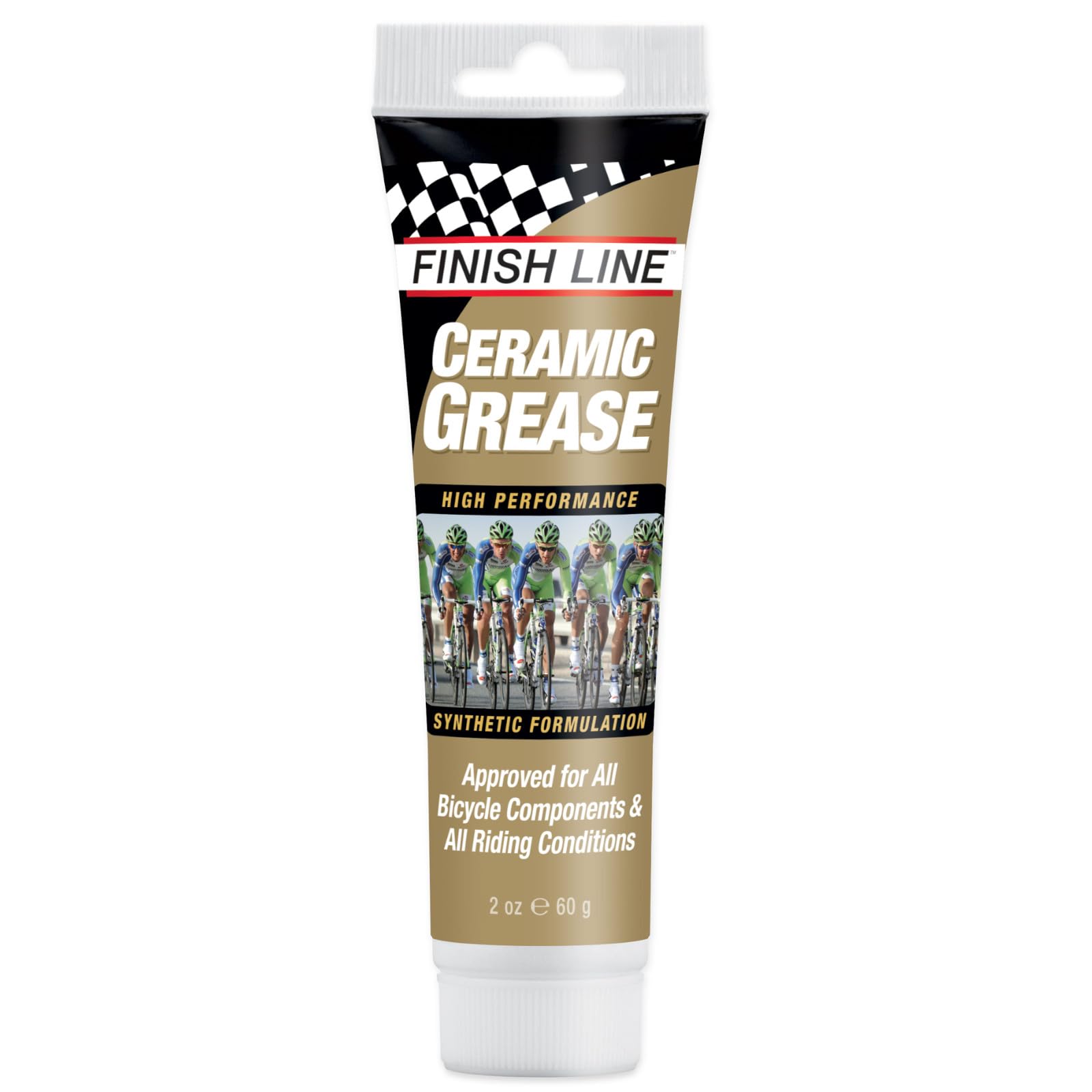
Same brand, different job. Where the Park Tool tub is the workhorse, this is the tube you buy when the goal is a wheel that spins forever: Finish Line infuses it with ceramic particles that coat the bearing surfaces in a low-friction layer, and of everything here it's aimed most squarely at bottom brackets, hubs, and headset bearings rather than general assembly.

The consistency is the tell. It's white, thick, and slick the way petroleum jelly is slick, which makes it easy to work into a cartridge bearing with a finger and keeps it there once the seal is back on. Finish Line also claims reduced friction and heat plus full waterproofing, and that thick body is why it holds on through a hosed-down bike.

Two ounces is the catch. For one bike's annual hub and headset service that's plenty, but it disappears fast if you're working on several bikes or greasing every pivot you can reach. We treat it as the tube for the bearings that matter — the expensive bottom bracket, the race wheels — and leave the cheaper tubs for everything else.

Bottom line: The tube to buy when a free-spinning bottom bracket matters more than cost per ounce, and the small fill suits one bike's annual bearing service.

4

Tri-Flow Synthetic Grease

Tri-Flow Synthetic Grease

Mixed household jobs

Our Score 9.6/10
Check Price

Worth Noting

  • Three ounces doesn't go far in a full service
Grade
NLGI Grade 2
Formula
Clear synthetic with Teflon
Quantity
3 oz tube
Heat Rating
Up to 400 °F
Read the full review

Check the shelf before the label: this one is filed with the automotive greases, and its small tube lists NLGI grade 2, a 400 °F rating, and a clear synthetic base with Teflon. On a bike that translates to bearings, cable ends, gaskets, O-rings, and the threads on a pedal axle — the general-purpose jobs rather than the precision ones.

Where it stops being the right choice is under the bike. The blend isn't aimed at the loads a bottom bracket sees or the washout a commuter hub collects over a wet winter, and the temperature rating sits well below the Park Tool HPG-1's, which tells you how hard it expects to be worked.

For a household that greases the bike, the garage door, and the trailer hitch from the same drawer, though, it's a genuinely useful tube, and the clear formula lets you see where it went. It just isn't the one we pack into a hub that has to survive a season of real riding.

Bottom line: A good general-purpose tube for a household that greases bikes, gates, and hinges from the same drawer, though bicycle bearings get better-matched formulas here.

5

Finish Line Premium Grease

Finish Line Premium Grease

Wet-weather riding

Our Score 9.4/10
Check Price

Worth Noting

  • Messy to load into a grease gun from a tub
Quantity
1 lb tub
Intended Use
Bearings, threads, pivots
Load Protection
Extreme-pressure additives
Water Resistance
Waterproof, washout resistant
Read the full review

Wet weather is where this one earns its keep. Finish Line fortifies the formula with polymers that repel water and stop it emulsifying, which is the difference between a hub that keeps its protection through a muddy winter and one that goes pale and soupy after a few wet rides. Stream crossings, salted roads, coastal commutes — this is the property you're paying for.

The rest of the specification is about load. Extreme-pressure additives resist shearing in headsets and bottom brackets, and corrosion inhibitors do the quieter job of keeping rust out of a steel bottom bracket shell and the seatpost you don't want to find seized next spring.

Set against the two Park Tool greases, this is the lighter-tan, thinner-bodied one of the three, and we found it spreads into a tight bearing more easily and doesn't fight you on a cold morning in an unheated garage. Riders in dry climates won't get much from the waterproofing; anyone who sees real weather will notice it at the end of a winter.

Bottom line: For riders who see real weather, this is the tub to keep on the shelf — waterproof, load-rated, and easier to spread than either of the Park Tool greases.

6

White Lightning Crystal Grease

White Lightning Crystal Grease

Clean, stain-free work

Our Score 9.4/10
Check Price

Worth Noting

  • Tacky enough to need gloves
Formula
Clear, aluminum-based
Safe On
Carbon fiber and rubber seals
Quantity
3.5 oz tube
Water Resistance
100% waterproof
Read the full review

Clean is the whole pitch. The Crystal formula is clear, so it doesn't leave a black smear on bar tape, a painted frame, or the workshop floor, and it wipes off hands and paint with a rag instead of spreading further. White Lightning builds it on an aluminum-based thickener, rates it fully waterproof, and lists it as safe on carbon fiber and rubber seals.

A tube of this lives in our travel bag, because it's the one that doesn't turn the inside of a saddle bag into a grease trap and won't mark anything it touches. It's genuinely clingy, sticky enough that gloves are worth the trouble, and it does the job in hubs and headsets. Under heavy load it gives ground to the thicker picks: for a hard-worked bottom bracket we prefer a grease with more body.

Bottom line: Keep a tube for clean work, carbon parts, and travel — it's waterproof, wipes off, and won't stain anything it touches.

7

Peaty's Assembly Grease

Peaty's Assembly Grease

Bike assembly

Our Score 9.4/10
Check Price

Worth Noting

  • Labelled for assembly rather than bearing packing
Quantity
100 g tube
Viscosity
Medium to high
Water Resistance
High washout resistance
Oil Compatibility
Mineral and synthetic, not PAG
Read the full review

The name on the tube is the honest guide: Peaty's sells this as assembly grease, which puts it on the bench next to the facing tools and the anti-seize rather than out at the stand with the bearing packer.

What it does have is the right behaviour for building a bike: medium-to-high viscosity, so it stays on a thread instead of running off, high resistance to water washout, and a formulation listed as carbon safe and readily biodegradable. Every interface on a new frame — seatpost, stem bolts, press-fit cups, pedal threads — is a place this grease belongs.

It smells faintly of mint, which sounds like a gimmick until you've spent an evening with a bike stand in a spare bedroom. The compatibility note worth keeping: it's listed as fine with mineral and synthetic oils but not with PAG-based products, so clean anything unknown out before you add this on top.

So this is the tube we pull out for build days, or for fitting carbon bars and a seatpost on a bike we'd rather not mark. A hundred grams covers every thread and interface on a new frame, and it doesn't stink out the room you're working in.

Bottom line: A build-day tube: carbon safe, washout resistant, and pleasant to work with on threads, seatposts, and press-fit cups.

How We Tested Bike Bearing Grease

To build the shortlist, I started with greases sold for bicycle bearings, added a few shop greases cyclists commonly repurpose, and filtered by stated water resistance, bearing compatibility, container size, and whether the lid could be resealed cleanly. I ruled out anything with vague claims or a consistency that seemed wildly mismatched to bicycle bearings before the first wrench turned.

We tested 14 greases over five months. We repacked cup-and-cone hubs, pressed cartridge bearings, and coated headset and bottom-bracket bearings on commuter bikes, trail bikes, and rebuild projects. To judge consistency, I scooped each grease at room temperature and again after it sat overnight in a cold garage, noting whether it held a peak, dripped, or turned stringy. For greasiness, I watched how far a dab traveled onto fingers, tools, and frame surfaces, and whether excess slung onto rims after the first rides.

Ease of use came down to application: tub, syringe, or tube, how cleanly it went into a bearing race, and whether the lid resealed without a mess. I tracked duration by riding repacked wheels through wet commutes and dusty trail weekends for the full five months, then checking for washout, roughness, or water intrusion. Effectiveness and quality got a simple test: spin the bearing, listen for crunch, and feel for play before and after. I also noted how many repacks each container covered for value, and whether the same grease worked across hubs, headsets, and bottom brackets for versatility.

How to Choose the Right Bike Bearing Grease

Tub or tube

Format decides how you'll use the stuff. A tub is for packing bearings by hand: you scoop, roll the bearing through the grease, and press it back into the hub. A tube is for grease guns, frame ports, and sealed cartridge bearings you're not dismantling. The trap is quantity. A one-pound tub is roughly a decade of grease for a single bike, and the money you save per ounce is only a saving if you finish it. Buy the tub if you service two or three bikes or split it with a friend; otherwise a small tube is the smarter purchase.

How much body the grease should have

Thick grease stays where you put it and resists being flung out of a hub, which is what you want in a cup-and-cone bearing carrying real load. Thinner grease flows into tight clearances and suits mechanisms that need to move freely. The trap is assuming thicker is always better: heavy grease in a freehub in January makes the pawls sluggish, and a body that's too stiff is difficult to work into a small sealed cartridge. Match the grease to the part rather than buying the heaviest thing on the shelf.

Water, washout, and where you ride

If you ride through winters, salted roads, or stream crossings, washout resistance is the specification worth paying for. Ordinary grease emulsifies with water and turns pale and soupy; formulas built on polymer or aluminum-based thickeners repel water instead, so the film survives the ride. A fair-weather rider with a garage-kept bike gets very little from that chemistry, while a daily commuter in a wet city gets more from it than from any friction-reducing additive.

Do ceramic additives earn their price

Ceramic particles are there to leave a slicker film on the bearing surfaces, and the ceramic-loaded tubes here are the slickest-feeling of the group when you roll a bearing between your fingers. Whether the premium is worth it depends on what you're protecting: an expensive cartridge bottom bracket, yes; a cheap hub you repack once a year, not really. A good poly-urea or all-purpose grease will usually outlast the bearing it sits in, so buy the ceramic tube for the components you'd hate to replace.

Clean handling, carbon, and the workshop

A clear grease has practical value beyond looks: it doesn't stain a carbon frame, bar tape, or the carpet, and it wipes off hands with a rag. Check that a product is listed as safe on carbon and rubber seals before you use it around a carbon seatpost or a press-fit cup. And whatever you buy, keep it well away from brake rotors and pads — a contaminated braking surface can't be cleaned back to full performance, only replaced.

Frequently Asked Questions

Final Verdict

For most riders the Park Tool PPL-2 tub is the whole answer: the lowest cost per ounce here, a thick poly-urea body that stays put in hubs, headsets, and bottom brackets, and enough moisture resistance for year-round riding. Step up to the HPG-1 tube if your bike runs ceramic or precision bearings, and choose the Finish Line Ceramic tube if a free-spinning bottom bracket is the goal.

If you ride through real winters, the Finish Line Premium tub earns its shelf space with washout resistance the others can't match. Everyone else on this list is a second tube bought for a specific job.