Bags & Storage

Best Bike Floor Stands of 2026

A bike parked by the front door is convenient until it lists sideways and puts a handlebar into the drywall. Without a garage wall to spare, a floor stand should hold the bike upright, keep the tires off the paint, and take up as much floor space as a pair of shoes. I've lived with bikes in hallways, and the difference between a stand you trust and one you don't shows up fast. The right stand turns a leaning bike into stable, freestanding parking — no drilling, no wall hooks, no daily balancing act.

Over six months, our team assembled and lived with 12 bike floor stands, from basic cradles to adjustable racks. We loaded them with commuters, hybrids, and a heavier e-bike, noting whether each stayed put and felt sturdy when the bike rolled in and out. We timed assembly solo and judged design and value — footprint, finish, hardware quality for the price. The best faded into the routine; the rest made every ride a chore — the picks below are the keepers.

1

BikeHand YC-97 Floor Stand

Top Pick
BikeHand YC-97 Floor Stand

Value pick

Our Score 9.4/10
Check Price

Worth Noting

  • 2.4-inch tire ceiling rules out plus and fat tires
Contact
Tire only
Wheel Sizes
24 to 29 in
Stand Weight
1.96 kg = 4.35 lbs
Maximum Tire Width
2.4 in
Read the full review

Two adjustable pulleys on a vertical post are the whole idea behind the BikeHand: you set them to your wheel's diameter, slide the front or rear tire between them, and the bike stands up on its own. Set the pulleys once and the stand disappears into the routine.

At 4.35 pounds it is the stand we move around the garage without thinking — out to the driveway for a wash, back against the wall afterward. Stability is where this one earns its keep. With a 29er in it we never had the front wheel try to climb out, and the low base keeps it from feeling like something to trip over in the dark. Fit runs 24 to 29 inches, which covers adult road, gravel, hybrid and mountain bikes.

The ceiling is tire width at 2.4 inches, so a plus tire at 2.8 or a fat bike at 4 inches simply will not seat, and that is the number to check before ordering. Placement is the other detail: leave a few inches behind the stand, because the back of the tire needs somewhere to sit and a wall pressed against the rear edge makes the roll-in awkward.

Bottom line: A light, genuinely stable cradle for a normal road or trail bike — the one we name when the top pick costs more than you want to spend.

2

Brutus Professional Floor Stand

Brutus Professional Floor Stand

Heavy e-bikes

Our Score 9.4/10
Check Price

Worth Noting

  • Most expensive single stand in this set
  • 26-inch minimum wheel size leaves out kids' bikes
Wheel Sizes
26 to 29 in
Stand Weight
8 lbs (3.6kg)
Load Capacity
66.1 lb
Maximum Tire Width
2.8 in
Read the full review

Eight pounds of steel is the argument. Roll a rear wheel into the slot and a tire-lock clamps it without touching rim, spokes or frame, and because that weight sits low in the base, a 60-pound e-MTB stays planted when you brush past it in a narrow garage. There is no lifting involved at any point.

The limits are 26- to 29-inch wheels, tires up to 2.8 inches, and 30 kg of bike, which covers e-MTBs, gravel bikes and anything with a bit of heft. It also makes a decent work station: the textured powder coat shrugs off hose spray, the non-slip rubber feet leave a hardwood or tile floor alone, and there is room to walk around a parked bike for a chain wipe-down.

Where it gives ground is price and reach. It is the most expensive single stand here, and it will not take a fat bike or a kid's 20-inch — 26 inches is the floor. If you run enduro-width rubber, measure at the knobs before you order, because 2.8 inches is a hard stop and the riders who get caught are the ones with a wide rear casing.

Bottom line: If your bike weighs as much as a small motorcycle, this is the stand we trust with it — buy it for the base, not the badge.

3

Feedback Sports Rakk 2.0

Feedback Sports Rakk 2.0

Most bikes

Our Score 9.2/10
Check Price

Worth Noting

  • Wide base needs clearance behind the bike
Setup
No assembly required
Contact
Tire only
Footprint
17.75 x 17.25 x 21.75 in
Maximum Bike Weight
75 lb
Read the full review

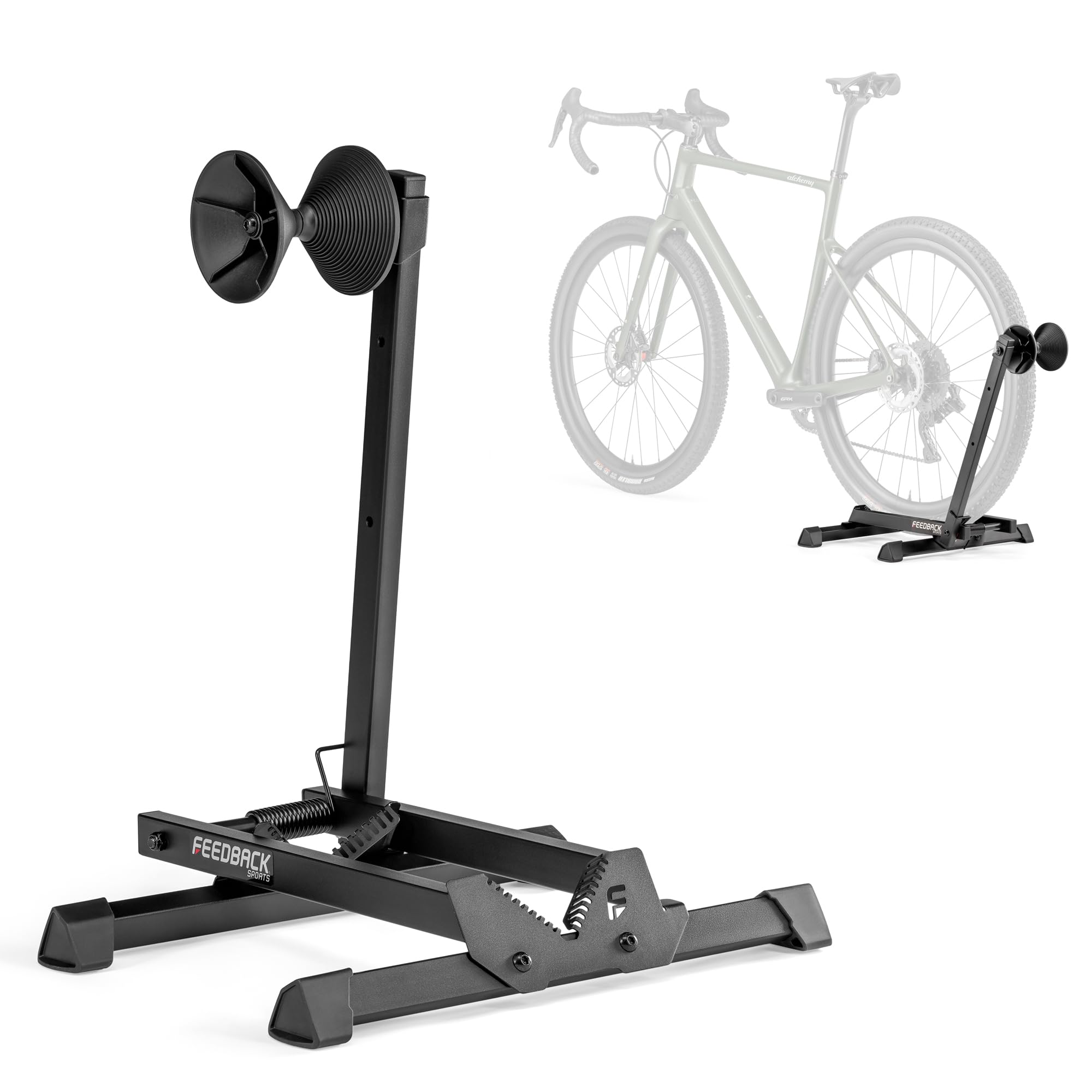
The Rakk 2.0 comes out of the wrapper ready to use, and that was the first thing we noticed — no bolt bag, no diagram, no ten minutes on the garage floor with an Allen key. You set it down, roll a wheel into the deep cradle, and the bike leans back against a long spring arm. It holds the tire and nothing else: no frame contact, no rotor contact, no clamp on the seatpost.

Range is what the extra money buys. The body is wide, the cradle is deep and the support arm is long, so one stand takes a 700c road bike, a 29er trail bike and a kid's bike without swapping parts. The rating is 75 pounds, which covers a loaded commuter and most e-bikes. We rolled bikes in front wheel first and rear wheel first; both settled at the same angle and neither needed a second shove to stay put.

Floor is what you give up. The base measures 17.75 by 17.25 inches and the arm wants a few inches behind the wheel, so it sits better along a wall than in the tight corner where a bare cradle would squeeze. Rubber feet hold on sealed concrete; on a glossy painted floor, set the stand where you want it before loading the bike rather than sliding a loaded one sideways.

Nothing here folds away, which suits a bike that lives in the garage year-round and less well a hallway where the stand has to disappear between rides. If portability matters more than that wide cradle, the BikeHand below is a good deal lighter.

Bottom line: The one we point most people to: it shows up built, swallows a 75-pound e-bike, and grips the tire only, so nothing touches your frame.

4

CyclingDeal 5-Bike Floor Rack

CyclingDeal 5-Bike Floor Rack

Family garages

Our Score 9.0/10
Check Price

Worth Noting

  • Flat bars need alternating slots
  • Frame shifts when bikes are pulled out
Footprint
14.37 x 70.87 x 13.98 in
Wheel Sizes
12 to 29 in
Bike Capacity
5
Maximum Tire Width
2.5 in
Read the full review

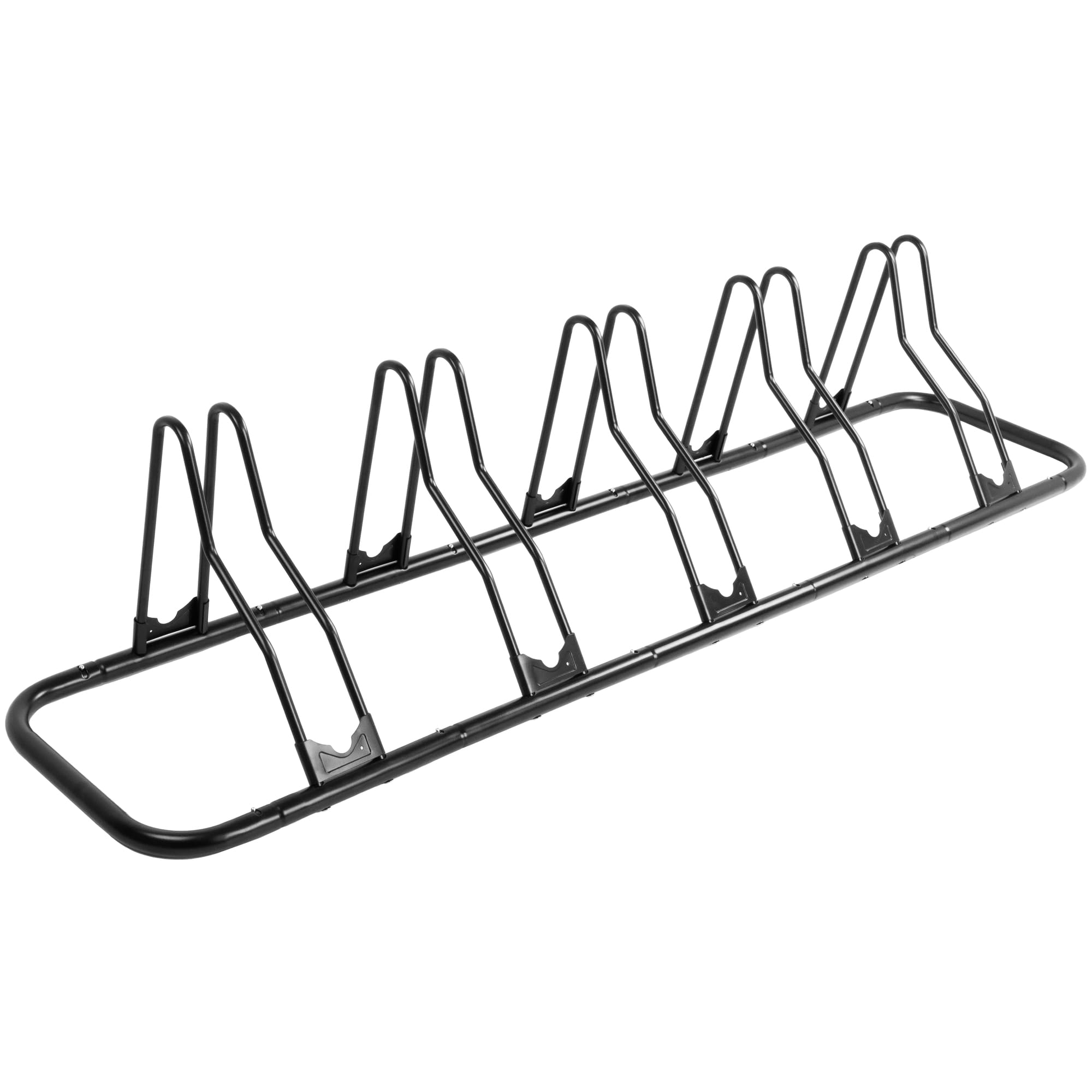
Five bikes in about six feet of wall. The CyclingDeal rack is one linked unit — five pairs of angled plates, each with a tire groove — that you build once and then park the whole family in. The plates sit at an angle rather than dead upright, which is what lets a bike lean back and hold itself steady.

The base sections click together and the vertical plates screw down with a Phillips screwdriver, so a solo build is realistic. The connected frame is the point: one long rack is far less likely to wander than five separate stands, and it breaks back down into sections without tools if you move house or want it out of the way for a project. Steel with a powder coat, rated for indoor use.

Where it gets fussy is width. With flat-bar mountain bikes you need to alternate nose-in and nose-out, because the grips and pedals otherwise fight for the same air, and three adult mountain bikes plus a couple of kids' bikes is a more realistic load than a clean five. The rack also shifts a little when a bike is dragged out rather than lifted clear — a small thing, but one you feel every time. We would still take it over five singles in any garage with a long empty wall.

Bottom line: For a household with more bikes than wall, this linked five-slot rack is what we recommend over a row of separate stands.

5

CyclingDeal Upright Bike Stand

CyclingDeal Upright Bike Stand

Tight corners

Our Score 9.0/10
Check Price

Worth Noting

  • 44-pound limit rules out e-bikes
Wheel Sizes
24 to 29 in
Stand Weight
7.78 lb
Load Capacity
44 lbs/20kg
Parking Positions
Vertical or horizontal
Read the full review

Most stands make you choose: bike horizontal, taking up its own length, or vertical against a wall. This CyclingDeal does both. The same rollers and hook hold the bike flat for a drivetrain check or stood on its rear wheel in a corner, and switching between the two is a matter of resetting the hook.

Three rollers and a hook, all adjustable, is more fiddling than dropping a wheel into a fixed cradle, but it means the stand follows the bike rather than the other way round: 24- to 29-inch wheels and 700c road bikes all sit in it. The base is compact enough to tuck beside a shelf, and the rubberised feet keep it off a wood floor without marking it.

The limit is weight at 20 kg, about 44 pounds. That is a fine road, gravel or hybrid bike and not an e-bike, and it is the reason we rank this below the heavier single stands here. If your bike lives indoors and comes out at weekends, the small footprint is worth more than the extra capacity.

Bottom line: A neat two-way stand for a light road or gravel bike that has to fit in a corner — just do not ask it to hold an e-bike.

6

CHEPARK Bike Floor Stand

CHEPARK Bike Floor Stand

First stand

Our Score 9.0/10
Check Price

Worth Noting

  • Not enough stand for a heavy e-bike
Contact
Three-point wheel grip
Mounting
Freestanding, no drilling
Wheel Sizes
20 to 29 in
Read the full review

A slider that drops down onto the tire and a wide base that grips at three points is a sensible design, and the CHEPARK does it for less than anything else here. Nothing about it feels thrown together: the metal is finished well and the slider moves freely along its track.

Fit is the reason it is worth a look beyond price. Twenty to 29 inches covers a kid's bike through an adult 29er, and because the slider comes down to meet the tire rather than relying on a fixed groove, the wheel sits clear of the rotor instead of crowding it — the detail that decides whether a disc-brake bike goes in without a fight.

Setup is a handful of bolts and a slider to set, and then you are parking a bike. The base is broad enough that the stand does not skate when you roll a wheel in at an angle, which is more than you can assume at this end of the market.

What we keep coming back to is how little fuss it makes of the job. Roll the wheel in, set the slider to the tire, and the bike stands square with the bars turned slightly — no strap, no hook, no seatpost clamp. Just the tire, held at three points.

Bottom line: A cheap first stand that fits almost anything with two wheels and clears the rotor — just keep it away from a heavy e-bike.

7

Sttoraboks Vertical Bike Stand

Sttoraboks Vertical Bike Stand

Small spaces

Our Score 8.8/10
Check Price

Worth Noting

  • Holds the bike by the seatpost, not the tire alone
Wheels
Four lockable casters
Wheel Sizes
24 to 29 in
Load Capacity
55.1 lb
Maximum Tire Width
4 in
Read the full review

Four lockable casters under a vertical stand is a small idea that changes how a garage gets used. Park the bike nose-up, catch the seatpost in the V-brackets, strap it, unlock the wheels, and the whole assembly — bike and all — rolls into the corner you are not using.

We like it most in a space that has to do two jobs: the bike goes vertical against the wall while the floor stays clear, and comes back out when you want to work on it. The frame is rated to 25 kg, the brackets adjust to the tire, and the listed fit runs 24 to 29 inches with tires up to 4 inches wide, which is more range than most single stands here offer.

Two things to accept. It holds the bike by the seatpost rather than the tire alone, so a carbon post or a loaded frame bag deserves a look at how the strap sits before you commit. And a loaded stand on an uneven floor can feel tippy when you wheel it, so keep the casters locked and roll it slowly over the lip of a garage slab.

Bottom line: The space-saver we reach for when the floor doubles as a workshop: park the bike vertically, then roll the whole thing out of the way.

8

Delta Single Bike Stand, 2-Pack

Delta Single Bike Stand, 2-Pack

Two bikes

Our Score 8.8/10
Check Price

Worth Noting

  • Uprights flex under a loaded bike
Footprint
16.93 x 15 x 16.93 in
Pack Size
2 stands
Adjustment
Tool-free thumb screws
Bike Types
Road, MTB, fat, BMX, kids
Read the full review

Four thumb screws and no tools: the Delta stand adjusts to your tire width by hand, which matters if the household runs a 25c road bike and a fat bike off the same corner of the garage. Twist, slide, twist again, and the uprights have moved out to meet the casing.

You get two of them, and that is the point. A pair of separate stands can split to opposite corners or sit side by side as a two-bike bay, and each has a smaller footprint than a dual cradle that carries both bikes on one base. The steel wears a hammered powder coat that hides scuffs, and rubberized feet keep it from skating across a smooth floor.

Setup is genuinely four thumb screws, and adjusting for a new tire is twisting them again — no hex key hunt, no stripped bolt on a Sunday.

What keeps this out of the top tier is the uprights. They flex under a loaded bike, and a knock can leave a heavier machine leaning rather than standing square. That is a fair trade for two hand-adjustable stands instead of one premium single, but if you want something that feels planted every time you walk past it, the Brutus or the Rakk is the better floor.

Bottom line: Two independent stands with hand adjustment, which is what we suggest when a household runs a skinny road bike next to a fat-tire e-bike.

How We Tested 12 Bike Floor Stands Over Six Months

We started with a shortlist of more than 30 floor stands sold by established bike and home brands, then narrowed it to 12 based on stated tire-width range, footprint dimensions, assembly requirements, and whether replacement parts were listed. Price mattered, but only as a tiebreaker; a cheap stand that flexed under a loaded bike was not a good value.

Testing ran for six months in garages, apartment hallways, and a living-room corner where a bike does not belong but often ends up. I assembled each stand alone with the included tools and a stopwatch, noting where instructions were vague or a second pair of hands was needed. Then I parked and removed a 30-pound commuter and a 50-pound e-bike 20 times each, watching whether the cradle held the wheel straight, whether the stand skated across concrete, and whether the bike tipped when I nudged the saddle.

Sturdiness showed up later: after daily use, I checked bolts for loosening, welds for rust, and contact points for scuffed paint. I also measured the floor footprint of each stand and looked at how the finish held up in a visible hallway — design counts when the stand lives where guests walk. Value came down to whether the hardware still felt tight after six months and whether the stand did its one job without flex, wobble, or a frustrating lift-and-shove routine.

How to Choose Bike Floor Stands

Measure the Tire Before Anything Else

A stand has two separate limits — wheel diameter and tire width — and the width is where buyers get caught. The cradles in this group top out between 2.4 and 2.8 inches, which covers most road, gravel, hybrid and trail rubber but not a plus tire, an enduro casing or anything fat. A fat bike needs a body wide enough for a 4-inch tire. Kids' bikes are the other trap: several stands start at 24 inches, so a 20-inch bike has no home in them.

Measure across the knobs with the tire at riding pressure rather than trusting the sidewall number, and check the wheel diameter at the same time.

Decide What the Stand Is Allowed to Touch

A cradle holds the bike by the tire and nothing else, which is why the Rakk and the BikeHand suit carbon frames, disc rotors and derailleurs. Vertical stands usually work differently: the Sttoraboks takes the seatpost in reinforced V-brackets and a strap, so a carbon post, a delicate dropper collar or a frame bag is worth a look before you commit. If your bike is expensive or wears mudguards, pay for tire-only contact and accept the wider footprint it usually brings.

One Bike or Five, and the Floor It Costs

A single stand wants roughly two feet of width plus a little clearance behind the wheel, so it cannot sit flush against a wall. A multi-bike rack trades that for a long run of wall: the CyclingDeal five-bike unit is about 71 inches across, and flat handlebars need alternating nose-in, nose-out spacing or the grips and pedals clash. Vertical parking is the third option — the bike swaps floor for height, and you need clear wall above it.

Weight, Floor Surface and Movement

Rated capacity runs from about 44 pounds on the lightest upright stands to 75 pounds on the Rakk, and base weight matters as much as the number on the box: an e-bike on a light stand tips however good the cradle is. Casters help in a garage that has to do two jobs, though they roll best on smooth concrete and can feel tippy with a bike loaded on. Rubber feet protect wood and tile, and a stand that simply sits there is the safer choice on a sloped floor.

Frequently Asked Questions

Final Verdict

Buy the Feedback Sports Rakk 2.0. It arrives assembled, holds a road bike and a 75-pound e-bike in the same cradle, and never touches the frame — that combination is why it is the one we send most people to. The Brutus is the answer when the bike is genuinely heavy and you want more steel underneath it, and the CyclingDeal five-bike rack is the right buy when the problem is a household rather than a bike.

Working in a corner or a hallway? The Sttoraboks rolls the bike out of the way and stands it on its rear wheel, which is the closest thing here to storage that costs you no floor at all.