Security & Locks

Best Bike Locks of 2026

A bike lock is the only piece of gear you buy hoping you never find out whether it works. Everything else in your setup rewards you every ride; the lock only has to be right once, on the night you leave the bike out longer than you planned. Over eight months, my team and I have lived with 12 of them, from featherweight cable coils to heavy U-locks that come with their own frame brackets, and the difference between one that disappears into your routine and one that fights you every morning rarely comes down to price. What a good lock buys you is dull: a bike that's still there, and a lock-up that takes seconds.

The trap first-time buyers fall into is chasing the toughest lock on the spec sheet, then leaving it at home because it's miserable to carry. A lock only protects the rides it actually comes on, which is why mounting, weight, and size end up mattering as much as raw security. Twelve locks later, the ones we kept reaching for were the ones that got that balance right, and those are the ones below.

1

Kryptonite Kryptolok Standard U-Lock

Top Pick
Kryptonite Kryptolok Standard U-Lock

Everyday commuting

Our Score 9.2/10
Check Price

Worth Noting

  • Bracket can work loose on smooth tubes
Shackle
12.7mm hardened steel
Interior Size
4 x 9 in (10.2 x 22.9 cm)
Included Cable
10mm x 4 ft double loop
Security Rating
Sold Secure Silver
Read the full review

Interior space is the spec most shoppers skip and then curse. The Kryptolok's shackle encloses 4 x 9 inches — long enough to pass through a frame, a rear wheel, and a chunky rack post in one go — and the 12.7mm of hardened steel around that gap means the size never becomes the easy way in. Kryptonite also includes a 10mm, 4-foot double-loop cable and a frame bracket, so the second purchase most commuters end up making is already in the box.

Sold Secure Silver is why we're comfortable calling this the default for most riders. It's an independent rating, so you can weigh it against the locks here that carry one and the ones that don't, and the double-deadbolt design secures the shackle at both ends rather than trusting a single point. For a commuter leaving a bike on a rack outside an office or a shop, that's the balance we want: rated steel, real reach, and a cable for the front wheel.

Living with it takes a little adjustment. The key wants a straight, deliberate push rather than a hopeful jiggle, and the first week will feel fussy if you're coming off an old loose lock. At 3.65 lb it's also a lock to leave on the work rack rather than haul in a backpack — the honest trade for a shackle that thick.

Bottom line: The lock we point most riders to: a Sold Secure Silver U-lock with a 4 x 9 inch interior and a 4-foot cable in the box, so frame, wheel, and rack are covered at once.

2

Kryptonite New York Standard U-Lock

Kryptonite New York Standard U-Lock

High-theft areas

Our Score 9.2/10
Check Price

Worth Noting

  • No cable included for the front wheel
Mount
FlexFrame-U bracket
Weight
2.02 kg (4.45 lb)
Shackle
16mm hardened steel
Cylinder
Disc-style, pick resistant
Read the full review

The New York's 16mm shackle is the headline, but the details around it do more of the work. Kryptonite machines anti-rotation features into the shackle so it can't simply be spun and jacked, and the disc-style cylinder is built to resist picks and drills. The cheaper U-locks here protect the steel and not much else; this one is engineered around the attacks that actually open a U-lock — twisting, jacking, and picking.

Then there's the mass. At 2.02 kg (4.45 lb) it's the heaviest lock in this group, and clipping it to a frame tube is a decision you feel on a climb. That isn't a flaw so much as the exchange rate: the steel that makes it slow to cut is the steel you carry.

The sliding dust cover over the keyway is a small thing we came to appreciate. It keeps grit out of the cylinder you least want to be fiddling with in the rain, and the condition of that cylinder is what decides whether a lock still opens smoothly in its third year.

Where it earns its keep is a bike parked on a city street or a campus rack. If you're riding to a café and the bike sleeps in a hallway, the Kryptolok covers the same trips with far less to carry; the New York is for the bike you'd hate to lose, in the neighbourhood where that's a real risk.

Bottom line: For a bike that sleeps on the street, this is the one: 16mm hardened steel, anti-rotation geometry, and a pick-resistant cylinder, with the weight that comes with them.

3

Sportneer U-Lock with Cable

Sportneer U-Lock with Cable

Value U-lock

Our Score 9.2/10
Check Price

Worth Noting

  • Mount holds the lock sideways on the frame
Size
7.76 x 5.02 in
Mount
Frame bracket included
Shackle
17mm alloy steel
Included Cable
5 ft steel cable
Read the full review

A U-lock, a cable, and a bracket for a fraction of what the premium U-locks here cost — that's the Sportneer's pitch, and the hardware backs it up. The shackle is 17mm of alloy steel, the cable runs 5 feet, and the body is compact enough to hang off a frame without swinging into your heel. The listing also quotes a hydraulic shear figure in the tons; we ignored it, because there's no standard behind that number and nothing on the page to compare it against.

The opening is what to check. The 7.76 x 5.02 inch figure describes the outside of the U, and the gap you actually get is smaller than the Kryptolok's 4 x 9 inch interior. That difference shows up on thick square posts, crowded racks, and fat-tire bikes, where you can end up walking to the next pole. Measure the rack you use most before you commit — this is the one place the savings can cost you.

Taken as a package, we think it's the smart buy for a second bike, a teenager's commuter, or anyone who wants a U-lock and a cable without paying premium money. The steel reads as substantial in the hand and the keyway turns cleanly, which is more than we expected at this end of the market.

Bottom line: The value pick: a 17mm U-lock, a 5-foot cable, and a bracket in one box, with an opening that rewards checking your usual rack first.

4

Titanker 3 ft Chain Lock

Titanker 3 ft Chain Lock

Budget chain lock

Our Score 9.2/10
Check Price

Worth Noting

  • 6mm links give way to hand cutters
Keys
Two keys, snap-to-lock
Chain
6mm steel links
Length
3 ft
Weight
1.4 lb
Read the full review

Titanker's chain is a deterrent, and the listing is unusually straight about it, warning against leaving a bike locked outside for long stretches. Judged on those terms — a campus rack between classes, a shop doorway, a bike you'd not mourn — we rate it the best value in this group, because it's light enough that you'll actually bring it.

At 1.4 lb and 3 feet it coils into a backpack without complaint, and the cloth sleeve keeps the links off your paint and your hands. The lock closes with a snap, and the key only comes out to open it, which matters more than it sounds when you're wearing gloves in the dark. Two keys come with it, plus a dust cover over the keyway.

The keys are the part to plan around. There's no replacement service behind this lock, so decide now where the spare lives rather than carrying both. The reach is fine for one bike and a standard rack, but it runs short if you're trying to gather two frames and a post in one loop.

Bottom line: A light, inexpensive chain for short stops and low-risk parking: snap it shut, coil it in a bag, and save it for errands where the bike is never far away.

5

GRIFEMA 4 ft Chain Lock

GRIFEMA 4 ft Chain Lock

Two bikes

Our Score 9.2/10
Check Price

Worth Noting

  • 7mm links are thinner than a U-lock shackle
Keys
Two keys
Chain
7mm hardened alloy steel
Cover
Nylon protective sleeve
Length
4 ft
Read the full review

Four feet is the number that earns this one a place. The GRIFEMA reaches around a pair of bikes and a post, or through a fence rail and a frame, where a compact U-lock leaves you choosing which wheel to sacrifice. If you're the person in the household who ends up locking everyone else's bike, that length is the whole feature.

The chain is 7mm hardened alloy steel under a nylon sleeve, closing with a snap and opening with one of the two supplied keys. Nothing about it is fussy: there's no dial to spin and no bracket to fit, and the sleeve makes the links easy to handle when the metal is cold.

We treat it as the household's shared lock — the one that goes in the car when two bikes are coming along, or that holds a gate shut over the winter. On an expensive bike, run it alongside a certified U-lock rather than instead of one; four feet of chain is a lot to reach around and a lot to coil at each stop.

Bottom line: The longest chain here at a budget price: the pick when you're locking two bikes, a gate, or an awkward rack a compact U-lock can't reach around.

6

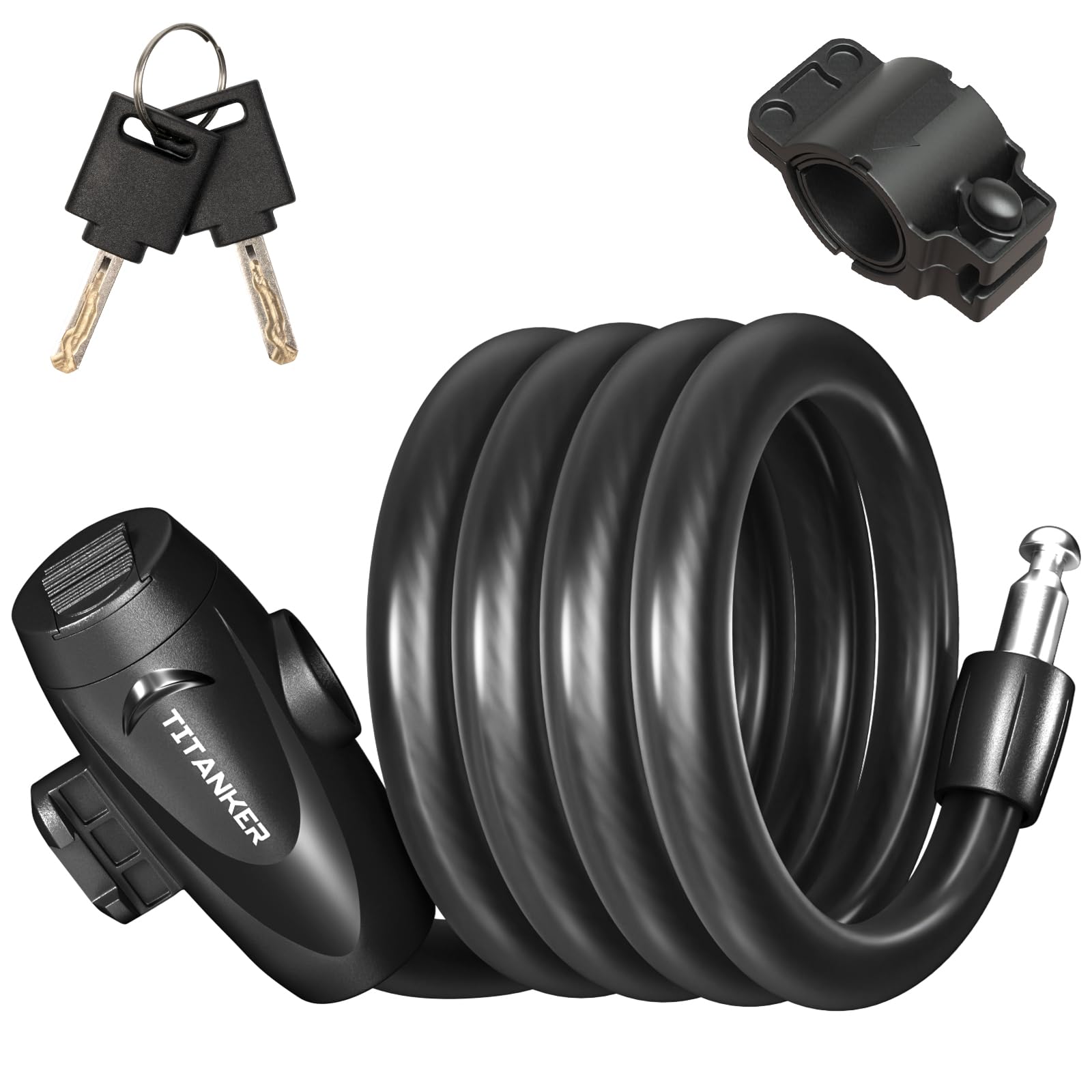
Titanker 4 ft Cable Lock

Titanker 4 ft Cable Lock

Quick errands

Our Score 9.2/10
Check Price

Worth Noting

  • Won't stop cutters on an unattended bike
Cable
12mm braided steel
Mount
Bracket with rubber shims
Length
4 ft
Weight
13.4 oz
Read the full review

There's a category of bike trip where a 3.65 lb U-lock stays home: the ten-minute stop at the corner shop, the school gate, the café where you can see the bike through the window. That's the trip this Titanker cable is built for, and its best feature is that it's already clipped to the seat tube when you need it.

We leave one on the commuter as a supplement rather than a substitute, and the bracket is why it stays there. Two rubber shims let it fit different seat tube diameters, so it mounts without rattling or marking paint, and the 12mm braided steel under the PVC coating is heavier than most cables at this price. Closing it is a snap; the key only matters when you leave.

Where it belongs is the front wheel of a bike that's already on a U-lock, a kid's bike at the school rack, or a scooter that lives in a locked garage. Treated as a second line rather than the whole plan, it's the least trouble of anything here to keep with the bike.

Bottom line: The cable that actually gets used: 12mm of braided steel on a frame bracket, for errands and as a second lock for wheels and helmets.

7

Weogine 4mm Chain Lock

Weogine 4mm Chain Lock

Lightweight carry

Our Score 9.2/10
Check Price

Worth Noting

  • 4mm links are thin for a chain
Keys
Three keys
Chain
4mm alloy steel
Length
2.72 ft
Weight
12.3 oz
Read the full review

At 349.83 g the Weogine disappears into a backpack, and that's the honest case for it — a lock you don't mind carrying is a lock that gets used. It's the one we hand to a kid riding to school, because the chain is light enough not to drag on a small frame and the fabric cover won't chew the paint.

The hardware is simple: 2.72 feet of 4mm alloy steel, powder-coated under a polypropylene cover, closing with a snap and opening with one of three supplied keys. Three keys is unusual here — most of the locks in this guide come with two — and for a family sharing one lock that extra key is genuinely useful. The cover also means no cold metal against your hand in February.

One thing to know: the keyway doesn't love weather. After a wet ride the key can bind, so keep it dry and the lock out of puddles and it'll keep turning smoothly. Do that and there's very little to go wrong — the sleeve takes the wear, and the chain does its job quietly.

Bottom line: The lightest chain in this group: 4mm links, three keys, and a soft sleeve that won't scratch, for kids' bikes and locker-room stops.

8

Master Lock 8143D Cable Lock

Master Lock 8143D Cable Lock

Kids and strollers

Our Score 8.8/10
Check Price

Worth Noting

  • Preset combination cannot be changed
Cable
8mm (5/16 in) braided steel
Length
4 ft (1.2 m)
Weight
4.8 oz
Locking
Preset 4-digit combination
Read the full review

No key to lose, no keyway to freeze, nothing to hand over: the 8143D is 4.8 ounces of vinyl-coated cable that wraps a seat post and closes on a four-digit combination. For a stroller, a grill, a ladder, or a kid's first bike, the appeal is obvious — there's nothing to keep track of but the number.

The cable is 8mm braided steel in a 4-foot loop, long enough for a rack and a frame, and the vinyl coating keeps it from marking paint. The ring dials are small; you'll want both hands and good light the first few times you open it.

The limit is the cable. Eight millimeters under vinyl will stop someone walking off with an unattended stroller; it won't stop anyone who came for the bike. Treat it as a lock for the twenty minutes when the bike is ten feet away and in your line of sight.

For the jobs it suits — a kid's bike at the school gate, a scooter in a hallway, gear on a campsite — it's the easiest thing here to use and the one most likely to be grabbed on the way out. We keep one in the car for exactly that.

Bottom line: Keyless and light: buy it for strollers, kids' bikes, and gear you're never far from, not as the only lock on a bike you'd hate to lose.

How We Tested 12 Bike Locks Over Eight Months

We started with a shortlist of roughly 40 locks and cut it down using what you can check before spending anything: shackle thickness, how the locking mechanism works, published security ratings, stated weight, and whether the mount will fit a frame with no eyelets. That left 12, spanning slim cable coils, hardened-steel U-locks, and a couple of folding designs. Each one was weighed on the same kitchen scale and installed on three different bikes — a commuter with rack mounts, a road frame with almost no spare triangle, and a step-through city bike where the bracket had to go somewhere unusual.

Then we simply used them. Every lock did the same eight months of errands: a coffee shop rack, an office stairwell, a grocery run, and a handful of overnight stays chained to a residential signpost. We timed lock-up and unlock with a clock running, once bare-handed and once in winter gloves, and wrote down the fumbles — a keyway that needs two hands, a shackle that won't seat without a shove. The mounts took the worst of it: we rode the same potholed stretch with each bracket fitted, listened for rattle, then checked whether it had shifted or scuffed the paint.

Durability showed up on its own, in the form of rain, road grit, and a few accidental drops. Every couple of weeks we worked each key, felt for grit or play in the cylinder, and looked for rust at the shackle seams. We also ran cut tests on a sacrificial frame with bolt cutters and a hacksaw, timing how long each lock held out — not to crown anything indestructible, but to see which ones would force a thief to work long enough to be noticed. Value came last, and it rarely tracked with price: a cheap lock that survives two winters beats an expensive one whose bracket you lose in a month.

How to Choose Bike Locks

Match the lock to the worst place the bike sits

Every lock on this page is a time tax on a thief, and nothing here survives an angle grinder on a quiet street. What you're buying is minutes and noise, so measure the requirement against the worst place the bike regularly sits. A bike that sleeps in a hallway and waits outside a shop for twenty minutes has a different job than one that stands on a street rack until morning.

For most riders that means a U-lock through the frame and rear wheel plus a cable or chain for the front wheel. A cable on its own suits the low-risk trips: it's the fastest thing to deploy and the fastest to defeat, so we treat it as a supplement rather than a plan.

Read the steel, then the rating

Thickness is the first filter. U-lock shackles here run 12.7mm to 17mm of hardened steel, chain links 4mm to 7mm, and cables are measured in eighths of an inch. A fixed shackle resists leverage better than a chain of similar weight, which is why a compact U-lock can carry a rating that a heavier chain doesn't.

Then look for a third-party rating — Sold Secure Silver and Gold are the ones that appear in this guide, and a rating is the only way to compare two brands without cutting the locks open yourself. Plenty of decent budget locks have none; you're relying on the seller's description instead of a standard.

Measure the opening, not the lock

The commonest mistake we see is buying the thickest steel and ignoring the gap it encloses. A U-lock with 4 x 9 inches of interior catches a rack post, the frame, and a rear wheel at once; a compact body often manages only the frame and the post, which leaves a wheel to a cable.

Check which dimension a listing quotes, too. U-lock sizes are often the outside of the U, and the usable gap is smaller by roughly twice the shackle thickness. Lock to thick square posts or ride a fat-tire bike and you want the bigger body; thread the lock through wheels all day and a compact one is easier to aim.

Carrying it decides how often you lock up

A 2 kg U-lock left at the office rack is a brilliant lock. The same lock in a backpack on a hilly commute gets left at home, and a lock at home protects nothing. Be honest about which rider you are — that's the whole reason the chains in this guide exist.

The mechanism is the other long-term cost. A keyed lock with a dust cover and a route to replacing a lost key is easier to live with than one where a lost key ends the lock's life; a combination removes the key problem but adds cold fingers on small dials.

Frequently Asked Questions

Final Verdict

The Kryptonite Kryptolok Standard is the lock we tell most riders to buy, because it gets the boring things right at once: a rated 12.7mm shackle, an interior that actually goes around a rack, and a cable for the front wheel in the same box. Most locks fail a rider on reach or on being left at home, not on steel.

The exception is a bike that sits on a city street overnight, where the New York Standard's 16mm shackle and anti-rotation geometry justify the extra weight and money. If the budget decides it, the Sportneer U-lock gets a thick shackle, a cable, and a bracket into the same trip for much less.