Bags & Storage

Best Bike Panniers of 2026

There's a real satisfaction in riding home from the store with groceries strapped to the bike instead of swinging off your wrist. Then the bag slips, the strap catches the wheel, and you remember why you drove last time. A proper pannier fixes that: it clips to the rack, stays put over potholes and curb hops, and hauls far more than a dangling tote ever will. The trick is finding one that holds its shape when loaded, mounts without a wrestling match, and doesn't rattle loose on rough pavement.

I've commuted by bike through slush and August heat and hauled everything from a laptop to a 20-pound bag of dog food, so I have opinions about what a full bag should do. Over the past eight months, my team and I rode with 10 panniers on school runs, grocery trips, and a couple of overnighters, and the spread in usable capacity, hardware quality, and how they sat on the rack genuinely surprised me. No single bag suits every rider, but the ones below earned a permanent spot on our racks rather than a shelf in the garage.

1

ORTLIEB Back-Roller City

Top Pick
ORTLIEB Back-Roller City

Rain and touring

Our Score 9.2/10
Check Price

Worth Noting

  • Roll-top closure is slow to open and close
Capacity
40 liters
Mounting
Rack mount, 8 and 11 mm inserts
Water Resistance
Waterproof
Read the full review

Strip away the pockets, the dividers and the straps and you are left with what actually matters in a pannier: a bag that keeps water out and stays on the rack. The Back-Roller City is that bag. It is a pair that totals 40 liters, with one compartment per side, a fully waterproof shell and a mounting system that adjusts to racks of different tube sizes. We have filled them with groceries, a laptop and a week of clothes, and the thing we noticed is how little there is to go wrong.

The mount is the quiet hero. Ortlieb supplies 8 mm and 11 mm inserts so the hooks sit tight on thinner and thicker rails, and the bag sits against the rack instead of cantilevering off it. Forty liters across the pair takes a full grocery run with room left for a jacket, and because the top rolls down, a half-full bag compresses instead of rattling. Off the bike, the adjustable carrying straps turn either bag into something you can sling over a shoulder for the walk into the office.

What the City does not give you is organization. One compartment means keys, cables and a snack bar all end up in the same place, and you will want a small stuff sack or two to keep order — we did. That is the trade for a shell with fewer seams and openings to leak. If you want a laptop sleeve and dividers built in, they exist elsewhere; if you want the bag that survives the commute, start here.

Bottom line: Our default for commuting and touring in any weather is this pair: two sealed 40-liter bags that fit nearly any rack and shrug off daily use.

2

Ibera PakRak Clip-On Panniers

Ibera PakRak Clip-On Panniers

Daily commuting

Our Score 9.2/10
Check Price

Worth Noting

  • Modest 19.8-pound load rating
Capacity
30 liters
Mounting
Clip-on with 3-point interlock
Compartments
Top pocket, two inner pockets, drawstring pouch
Water Resistance
Water resistant, rain covers included
Read the full review

A rigid plastic plate does the work here rather than hooks and straps. The bag drops onto the rack, the top clips grab the rails, and a lower arm locks it against the frame so the whole thing stops swinging when you stand on the pedals. Thirty liters across the pair holds a laptop, a change of clothes and a bag of shopping, with a zippered top pocket, two inner pockets and a drawstring pouch for the loose stuff.

We found the clip system quicker than every hook-and-bungee setup in this guide for daily use. There is no strap to thread and no bungee to re-hook after every stop — you drop the bag on, feel it seat, and ride. Each side also ships with its own rain cover, which is the difference between a bag that tolerates drizzle and one you trust in a downpour, and the whole thing looks tidy on the bike rather than flapping.

The one thing to check before ordering is your rack. The clip geometry is built around Ibera's own PakRak carrier, and on some other racks the clips sit proud of the rails or miss the spacing, so the bag never feels fully seated. Buy the PakRak rack at the same time and that question disappears entirely; if you already own a rack, measure the gap between your top rails first.

Bottom line: If you clip bags on and off several times a day, this is the pair we point to: rigid clips, three-point anchoring, and a rain cover in each bag.

3

Bushwhacker Omaha Grocery Panniers

Bushwhacker Omaha Grocery Panniers

Grocery runs

Our Score 9.0/10
Check Price

Worth Noting

  • Open tops let rain and spray in
Mounting
Metal hooks and bungee
Dimensions
14 x 9 x 11.5 inches
When Empty
Folds flat
Load Rating
30 lb
Read the full review

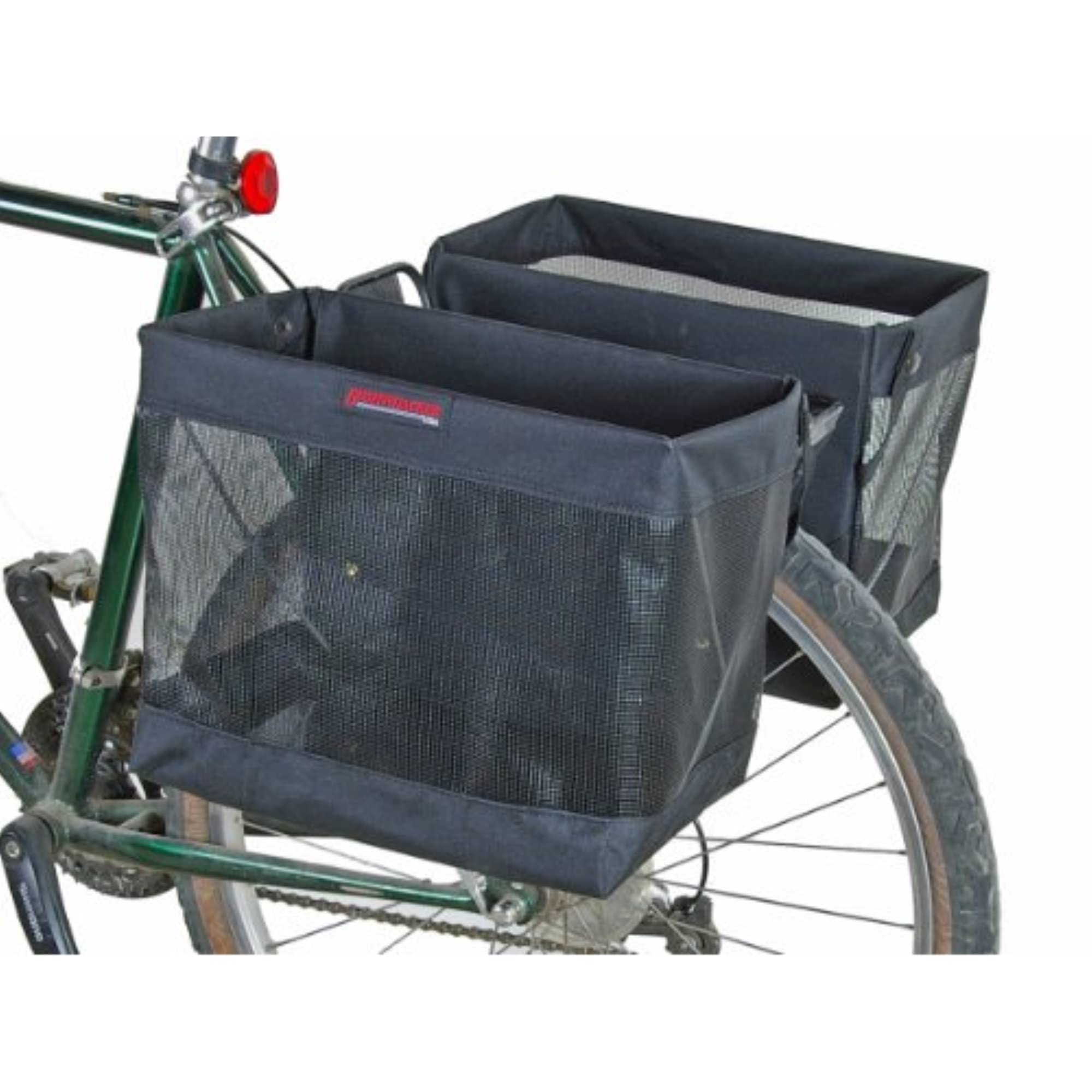
A grocery run has a shape: two heavy bags, a short ride, and no interest in untying bungees in a parking lot. The Omaha panniers are built for exactly that. Each one is a square basket sized around a single full grocery bag, so you pack at the checkout, drop the bag in, and ride home without repacking anything.

The frame is metal with mesh and 600-denier polyester sides, which means the basket keeps its shape while you wrestle a jug of milk into it. Mounting is old-school: metal hooks over the top rails and a bungee down to the rack legs or frame, with each pannier rated to 15 pounds for a 30-pound pair. When you are not carrying anything, both baskets fold flat against the bike and stay out of the way.

We think these are the most useful panniers here for errands and the least clever for everything else. The hooks sit on the rails rather than locking to them, so on washboard surfaces hook the bungee before you set off and check it again at the far end. For the weekly shop, that is a small ritual next to unloading a pair of roll-tops in the rain.

Bottom line: For shopping trips, this is the pair we reach for: two fold-flat baskets that swallow a full grocery bag each and vanish against the bike when empty.

4

KEMIMOTO 34L Panniers

KEMIMOTO 34L Panniers

First pannier set

Our Score 8.8/10
Check Price

Worth Noting

  • Waterproofing depends on the included rain cover
  • Straps and hooks are slower than a clip mount
Capacity
17 liters per bag
Mounting
Six straps plus two side hooks
Compartments
4
Water Resistance
Water resistant, rain cover included
Read the full review

Two bags, 34 liters between them, and the lowest price of anything in this guide. The KEMIMOTO pair covers the basics of hauling groceries or a change of clothes, and it does it without asking you to spend like a tourer. We think it is the right first set for someone who is not yet sure panniers will become part of the routine, and a sensible second set for a bike that lives outside.

The design detail that earns its keep is the sloped front panel. A square bag can catch your heel on every stroke when the rack sits far forward; this one angles away, and on a short-wheelbase commuter that is the difference between a clean pedal stroke and a scuff. Inside there are four compartments to spread a load, and six straps plus two side hooks hold the bag down.

Two things to know. The fabric is soft, so tension the lower hooks properly or the bag can drift toward the wheel on a narrow rack — check the gap with the bike loaded before your first ride. And the panels do not hold a crisp shape when the bag is half full, which shows up as a slight sag at the bottom corners. Neither is a dealbreaker at this price, and both are the kind of thing you stop noticing within a week.

Bottom line: We think it is the right first set for someone unsure about panniers: 34 liters, a rain cover, and the lowest price here.

5

Büchel 26L Pannier

Büchel 26L Pannier

One-bag commuting

Our Score 8.8/10
Check Price

Worth Noting

  • One zippered pocket, no dividers
Carry
Shoulder strap and rubber handle
Capacity
25.4 liters
Mounting
Three rack-diameter adapters
Water Resistance
Waterproof
Read the full review

Not everyone needs a pair. If your commute is a laptop, a change of clothes and lunch, a single bag keeps the bike narrow, cuts the fiddling at the rack in half, and leaves one side free for a lock or a bottle. The Büchel is the single bag we recommend for that job, and at 25.4 liters it swallows a full shop without turning the bike into a truck.

The mounting is the part we appreciate most. Three adapters cover different carrier tube diameters, so the bag sits level on racks where other panniers rattle around, and the adjustable hooks let you slide it forward or back for heel clearance. The shell is a waterproof TP material with a rubberized handle and an included shoulder strap, and there are reflectors on the bag — small things that matter on a winter commute.

The trade is asymmetry. A single loaded bag pulls slightly to one side, and the effect grows with the weight, so keep the heaviest items low and close to the rack and the pull stays mild. For a one-bag commute, that is a small price for a bike that still handles like a bike when you are carrying something.

Bottom line: The single bag we recommend: 25.4 waterproof liters that fit almost any rack and carry over your shoulder when you park.

6

Rhinowalk 7L Pannier

Rhinowalk 7L Pannier

Light daily loads

Our Score 8.8/10
Check Price

Worth Noting

  • Fits only racks with tubes under 18 mm
Capacity
7 liters, expands to 10
Mounting
Hook and 360° rotary buckle
Water Resistance
Welded PVC tarpaulin, waterproof
Read the full review

Seven liters sounds like a great deal less than 40, and it is. It is also enough for a U-lock, a rain shell, a water bottle and a sandwich, which is what most rides actually carry. The Rhinowalk is built for that ride: a single bag that expands to 10 liters when you need the extra room and rolls back down when you do not.

The roll-top suits a bag this size because it compresses as you load it, so a half-full bag does not flap. The welded PVC tarpaulin means rain runs off instead of soaking through, which is rare at this end of the range. Mounting is a tool-free hook plus a 360-degree rotary buckle — quick to seat, quick to release — and at 580 grams it is light enough that you notice the contents rather than the bag.

We came away thinking of this as the errand bag rather than the touring bag. It is the one to put on a city bike that does short trips to the shop, the pool or a friend's place, and the one that comes off and goes inside with you without a second thought. If your week includes a real grocery run, buy a pair instead; this one is honest about being small.

Bottom line: We keep this one for short rides: a welded 7-liter bag that carries a lock, a jacket and lunch, and adds almost nothing to the bike.

How We Tested the Best Bike Panniers

We started by comparing listed volume, mounting hardware, and price across a couple of dozen models, then cut anything with plastic hooks that looked brittle or a mount that couldn't be adjusted to fit different rack tube diameters. That left 10 bags, which we rode for eight months.

Each one lived on a rear rack for a full week and got used the way a pannier actually gets used: a laptop and change of clothes to the office, a full grocery run, and a 24-hour overnight with a sleeping bag and stove. We mounted and removed each bag several times a day, often standing in rain or holding a helmet, and noted whether the clips released one-handed, whether a second tug was needed to seat them, and whether the bag shifted at all after clipping in. With 15 pounds inside, we rolled off curbs, crossed washboard gravel, and hit a few unavoidable potholes, watching for sway, rattle, and any heel strike on the pedals. Packing to the seams told us how much of the listed volume was actually usable once the roll-top or lid closed.

By the end of a wet spring, we'd checked seams, zippers, and metal hardware for rust, fraying, or sloppy stitching, and looked at how the corners had scuffed. We also weighed each bag against its price: hooks that seat cleanly and fabric that keeps its shape matter more than a logo, and a mid-priced bag with solid clips beat a costly one that needed fiddling every time.

How to Choose Bike Panniers

Fit the Rack Before You Fall for the Bag

Panniers hang from the top rails and anchor at the bottom, so tube diameter and rail spacing matter more than the liter count. The Ortlieb ships with 8 mm and 11 mm inserts for thinner and thicker rails, the Rhinowalk takes tubes under 18 mm, and the Ibera clip system is built around its own PakRak carrier.

Measure your rack's tube diameter and the gap between the rails before ordering, and check that there is a lower mounting point for the bag to hook onto — a bare seatpost rack usually leaves a pannier with nothing to hold it down. That single check prevents most of the flapping and re-seating that makes people give up on panniers.

Waterproof Fabric or a Rain Cover

A roll-top bag made from waterproof fabric keeps rain out with few openings to fail, which is why the Ortlieb copes with a downpour without anything extra. The Rhinowalk goes further with welded PVC tarpaulin, where the seams are fused rather than stitched.

A zippered bag with a separate cover works too, but only while the cover is on and secured: covers flap at speed, pool water in the folds, and get left at home. The KEMIMOTO ships with one and needs it in steady rain. If you ride through winter, pay for the sealed bag.

Match Liters to the Load

Capacity figures only mean something once you picture the load. Seven liters holds a lock, a jacket and lunch. Twenty-five liters, which is the Büchel, swallows a full shop for one person. Thirty to 34 liters across a pair covers groceries plus a change of clothes, and 40 liters is touring territory.

Shape matters as much as volume. A square basket like the Bushwhacker takes a full grocery bag standing up, while a flat profile suits a laptop. If you shop weekly, buy for the grocery run rather than the trip you take twice a year.

Stiffness Keeps the Bag Out of Your Wheel

A pannier with a soft back panel can fold inward under load, and on a narrow rack that means a corner drifting toward the spokes. A rigid frame, a stiffened back, or a lower hook under tension holds the bag where you put it. Heel clearance is the same conversation from the other side: the further forward your rack sits and the longer your cranks, the more the bag needs a sloped or tapered front.

Load the bags, sit on the bike and pedal backwards before your first real ride. It takes twenty seconds and it is the only reliable way to know whether your heel, the bag and the wheel can all coexist.

Hardware Fails Before Fabric Does

Zippers, hooks, rivets and clips are what break, and they break at the worst moment — a jammed zip at the supermarket, a hook that pops off on a bump. Roll-top closures have very little hardware at all, which is part of why they last.

Where there is hardware, look for metal hooks rather than plastic, a lower attachment that stays hooked under load, and a clip you can work with cold hands. Bounce the loaded bike over a curb and watch what moves.

Frequently Asked Questions

Final Verdict

Start with the Ortlieb Back-Roller City if you ride in the rain and want bags you stop thinking about: 40 liters, a fully waterproof shell, and a mount that fits nearly any rack. The Ibera pair is the better call if you clip on and off several times a day, since its rigid clips are quicker than anything else here and the rain covers come with it.

And if your whole load is one bag of shopping or a laptop, buy a single Büchel and keep the bike narrow.