Tools & Maintenance

Best Bike Repair Stands of 2026

There's a particular frustration to fixing a bike that won't hold still. I once indexed a derailleur with the frame flipped upside down on a garage floor and finished the job with a scratched shifter and a bruised knee. A repair stand fixes exactly that: it lifts the frame to chest height and holds it there, so both hands are free to spin the crank and turn a wrench. The wrong one adds its own miseries — a base that skates across the concrete when you lean into a stubborn bottom bracket, a clamp that makes you nervous about a carbon seatpost.

We've spent the past eight months with 12 stands, from folding tripods to heavy shop-floor models, and the gap between good and aggravating shows up within the first five minutes. Value matters, but cheap and costly both wobble when the legs are wrong. Your workspace counts as much as your bike does, and a stand that collapses into a tidy bundle earns its keep in a small apartment. The picks below are the ones we kept reaching for.

1

Feedback Sports Sprint

Top Pick
Feedback Sports Sprint

Carbon frames

Our Score 9.6/10
Check Price

Worth Noting

  • Front wheel must come off before every job
  • 50 lb bike limit excludes e-bikes
Mount
Fork or dropout
Stand Weight
12.6 lb
Load Capacity
85 lb
Bike Weight Limit
50 lb
Read the full review

The Sprint starts by asking you to take the front wheel off. In exchange, it holds the bike by its fork dropouts instead of clamping a frame tube, and that single design decision is why we point carbon owners here first.

The adapters cover quick-release 9 x 100, 130 and 135 mm and thru-axles in 12 x 100, 142 and 148 mm Boost rear and 15 x 100 and 110 mm Boost front, so most modern road, gravel and mountain bikes bolt straight in. From there the platform rotates a full 360 degrees, which means you can spin the bike to reach a derailleur or a brake caliper without moving your feet.

The numbers to respect are 50 pounds for the bike and 85 pounds total load, and we think that is the honest way to state capacity — it covers a loaded mountain bike easily and rules out most e-bikes. The build is lovely: anodized 6061 T6 aluminum, 12.6 pounds, folding small enough to slide under a bench.

The trade is time. Every job begins with the wheel out and the bike lifted into the dropout, which is nothing on a drivetrain swap and mildly annoying when you only want to nudge a derailleur. For bottom brackets and brake bleeds on a bike you would rather not squeeze, nothing else in this guide comes close.

Bottom line: The stand for a bike you would rather not clamp: drop the front wheel out, lock the fork in, and work on a carbon frame without a jaw touching the paint.
2

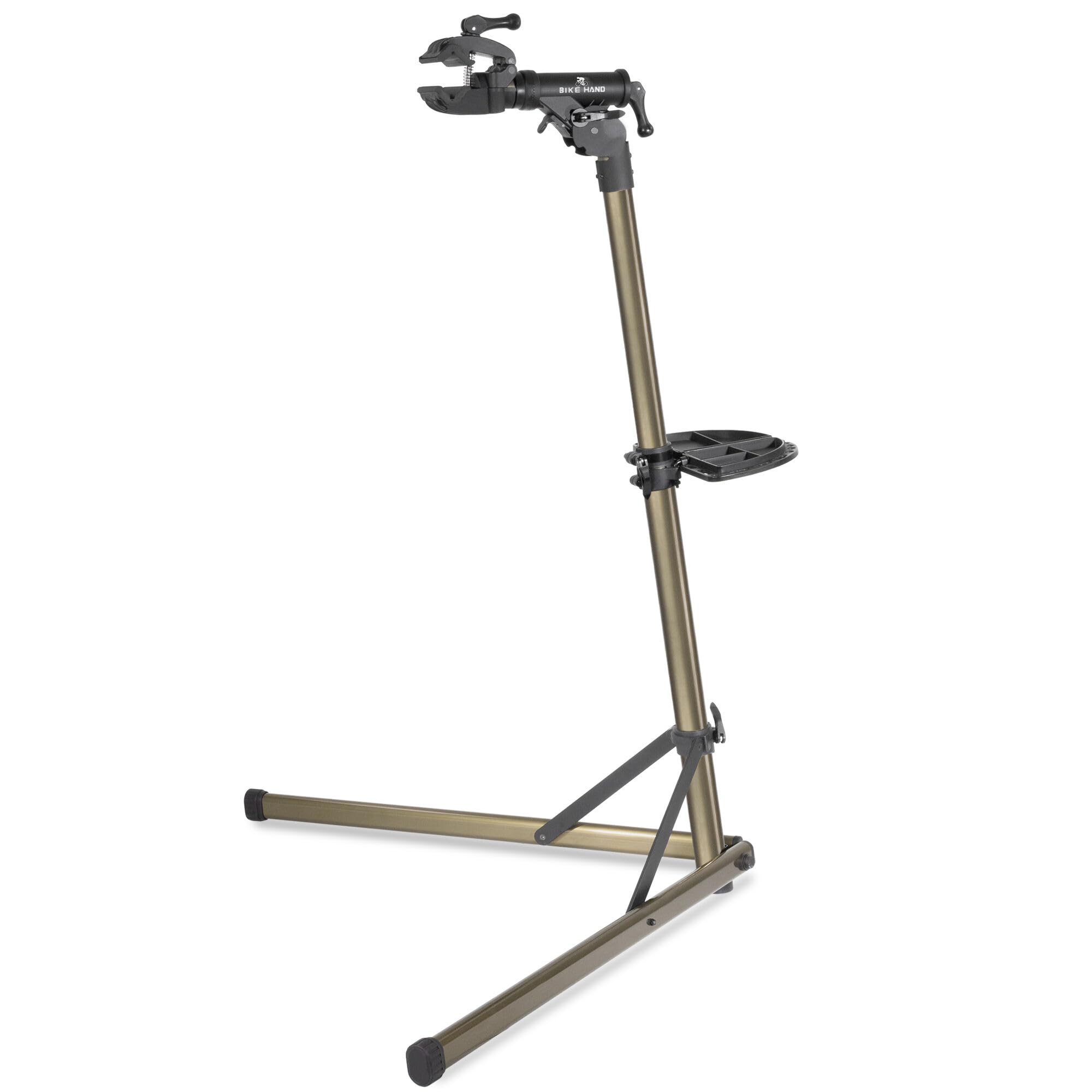
BikeHand YC-100BH Repair Stand

BikeHand YC-100BH Repair Stand

Most home repairs

Our Score 9.4/10
Check Price

Worth Noting

  • Plastic clamp head and jaws are the wear point
  • 55 lb limit is below most e-bikes
Clamp
360° rotating head
Tool Tray
Foldable magnetic plate
Height Range
39 to 59 in.
Load Capacity
55 lb
Read the full review

Unboxing this one is a two-minute affair: no bolts, no Allen key, no instructions to decode. The legs fold out, the upright telescopes up, and the clamp is ready for a seatpost. We have spent longer than that hunting for the hardware that came with other stands, and the difference is not trivial — a stand you can set up without a project gets used for the five-minute jobs, not just the annual overhaul. That head start is the first reason it is our top pick.

The clamp head turns a full 360 degrees on a quick-release knob, and the height runs from 39 to 59 inches. We raised and lowered it constantly rather than picking one setting and living with it, because a bottom bracket at the right height is the difference between standing up straight to index gears and hunching over the top tube. The 55-pound rating covers road, gravel and mountain bikes comfortably; it does not cover a 60-pound e-bike, and no amount of careful clamping changes that.

The clamp head and jaws are plastic on an aluminum frame, and that is the part we keep an eye on, because it is the part under load and the part that decides how the stand ages. Our read: if your bike is under 40 pounds and you work on it in the garage, the plastic will not be what ends this stand's life. If you are clamping a heavy bike twice a week, it might.

What we appreciate most is how completely it disappears between jobs. Folded, it stands in a corner like a camera tripod, and the magnetic tool plate holds bolts and washers at working height instead of in a cup on the floor where you will inevitably kick them.

Bottom line: For most home mechanics this is the stand to buy: it goes from box to holding a bike in minutes, adjusts to save your back, and folds away to almost nothing.

3

Park Tool PRS-25

Park Tool PRS-25

Shop-grade portability

Our Score 9.4/10
Check Price

Worth Noting

  • The most expensive stand in this guide
Material
Aluminum
Stand Weight
13 lb
Folded Length
47 in.
Load Capacity
100 lb
Read the full review

Thirteen pounds of aluminum holding a hundred-pound bike. That ratio is the whole argument for the PRS-25: light enough to carry to a race in one hand, stiff enough that a downhill bike hangs off it without a shiver.

The hex-shaped tubing is the reason. Round tubes want to rotate under load; the hex profile resists it, so the bike stays where you put it when you lean on a crank. The micro-adjust clamp is the same idea applied to the jaws, the clamping height reaches 60 inches, and the whole stand folds to 47 inches with the legs strapped together so it goes in a trunk.

We have used it as a garage stand and as a stand that leaves the house, and it is the only one here that does both without a compromise you notice. Setup takes seconds, the leg straps keep everything together in transit, and there are no loose pieces to lose in the grass at a race.

The catch is the price, and it is the highest in this guide. If your bikes never travel, the PCS-10.3 does the same work with 80 pounds of capacity for a lot less, and the BikeHand does it for less again. The PRS-25 earns its keep when the stand goes with you — races, trips, a friend's bike across town.

Bottom line: For the mechanic who travels, this is the one: shop-grade rigidity at 13 pounds, folded into a package that fits in a trunk.

4

Yaheetech YT-424 Repair Stand

Yaheetech YT-424 Repair Stand

Budget builds

Our Score 9.2/10
Check Price

Worth Noting

  • Plastic clamp and collars are the wear point
  • Hand-tightened collars, no quick release
Clamp
360° swivel clip
Height Range
42.5 to 74.8 in.
Stand Weight
14.1 lb
Load Capacity
66 lb
Read the full review

At 42.5 to 74.8 inches of adjustment, the Yaheetech goes taller than anything else in this guide, which matters if you are tall or simply like the bike up at chest height while you work. It is steel, it weighs 14.1 pounds, and the wide three-legged base plants itself on a concrete floor. You feel that weight when you carry it and you appreciate it when you lean on a bottom bracket.

As a budget stand, it gets the important parts right. The clamp is rated for 66 pounds — more than our top pick — so it will hold a heavier bike than most riders own, and assembly is a minute of pieces popping into place. Folding it flat afterward takes about as long, which is why it ends up back in the corner of the garage rather than staying out as furniture.

Where the savings show up is the fittings. The clamp and collars are plastic on a steel frame, and plastic is what gives out first when a stand is asked to hold a heavy bike year after year. Treated as a tune-up and cleaning stand rather than a daily shop tool, ours has been trouble-free, and it is the one we hand to someone who wants a stand this month without spending much.

Bottom line: The best budget stand here: 66 pounds of capacity, the tallest height range in this guide, and a steel frame that sits still while you work.

5

ROCKBROS Wall/Bench Mount Stand

ROCKBROS Wall/Bench Mount Stand

Small spaces

Our Score 9.2/10
Check Price

Worth Noting

  • Bike can rotate in the clamp under load
  • 44 lb limit excludes e-bikes
Mount
Bench or wall
Clamp Range
30 to 75 mm
Stand Weight
3 lb
Load Capacity
44 lb
Read the full review

If your garage has room for a car or a workstand but not both, this is the one to look at. Four long screws fix the ROCKBROS to a bench or a wall, the arm swings out to hold the bike, and when the job is done it flips back flat against the surface. Nothing stands on the floor, which is the entire point.

The clamp closes on tubes from 30 to 75 mm, which covers seatposts and most frame tubes, and the soft silicone jaws are kind to paint. At three pounds the unit itself is easy to handle, and installation is a one-person job if you have a drill and something solid behind the surface.

We like it for the specific job it does: a small garage, a bench that already exists, a bike that needs a chain and a brake adjustment once a month. What it will not do is hold a heavy bike out at arm's length without complaint — the arm is a lever, so a bike can rotate in the clamp if it is not cinched firmly, and the 44-pound rating rules out e-bikes. Fix it to framing or a substantial bench rather than drywall, because those screws are only as good as what is behind them.

Bottom line: If floor space is the problem, this is the answer: bolt it to a bench or wall, clamp the bike, and flip the arm out of the way when you are done.

6

Feedback Sports Sport-Mechanic

Feedback Sports Sport-Mechanic

All-round home use

Our Score 9.2/10
Check Price

Worth Noting

  • A bike can swing if it is not centered
Height Range
42 to 65 in.
Stand Weight
12.6 lb
Clamp Opening
Up to 1.9 in.
Load Capacity
65 lb
Read the full review

At 12.6 pounds, this is a stand you carry out to the driveway in one hand. That sounds like a small thing until you have wrestled a heavier stand through a doorway to work outside on a nice day. Folded, it is roughly 44 inches long and 6 inches across, so it stands in a corner or slides under a bench. That portability, plus a clamp that behaves like a shop stand's, is why this is the step-up pick.

The clamp is the part that earns its keep. A spinner knob closes the jaws for uniform pressure, the rubber coating protects paint, and the opening takes tubes up to 1.9 inches, wide enough for fat seatposts and most frame tubes. The head rotates 360 degrees and the clamp height runs from 42 to 65 inches, so you can work standing or on a stool without fighting the stand.

Where it asks for your attention is clamp tension. It closes by hand, so a bike that is not centered can swing nose-down while you work, and a 60-pound e-bike finds that out faster than a 20-pound road bike. Center the bike, tighten firmly, and the 65-pound rating covers everything short of a heavy cargo e-bike.

It also grips a dropper post without marking it, which is more than we can say for the hard plastic jaws on cheaper stands — a small thing that matters a lot the first time you clamp a bike you actually care about.

Bottom line: The stand we reach for when we want a shop feel without the shop outlay: light enough to carry one-handed, stiff enough that a bike stays where you put it.

7

Park Tool PCS-10.3

Park Tool PCS-10.3

E-bikes

Our Score 9.2/10
Check Price

Worth Noting

  • Heavy at 9 kg to reposition
Material
Steel
Bike Types
Fat bikes and most e-bikes
Stand Weight
19.8 lb
Load Capacity
80 lb
Read the full review

Eighty pounds is the number that matters here. That rating covers the heavy e-bikes and fat bikes that sit outside the 44- and 55-pound limits of the cheaper stands in this guide, and it is the reason to spend Park Tool money instead of budget money if your garage holds an electric cargo bike.

The rest of the stand is built to match: steel tubing, a powder-coated finish, and a folding frame that goes flat for storage. At 9 kg it is not a stand you move around one-handed, and that mass is exactly what keeps an 80-pound bike from walking across the floor while you torque a crank. We will take a heavy stand over a nervous one every time.

It folds, too, which matters more than it sounds. Plenty of heavy-duty stands are permanent furniture; this one collapses when the car needs the garage back. If your bike weighs 30 pounds, though, you are paying for capacity you will never use — the BikeHand or the Feedback Sports stand does the same work with less weight and less outlay.

Bottom line: Buy this one for a heavy e-bike or a fat bike: 80 pounds of rated capacity in a steel stand that still folds away when the garage needs to be a garage again.

8

Handlebar Jack V3

Handlebar Jack V3

Trailside fixes

Our Score 8.8/10
Check Price

Worth Noting

  • Hook-and-loop straps are the wear point
  • Jacks can tip if the bike is knocked
Weight
1.5 oz each
Includes
Two jacks
Material
Nylon
Ground Offset
3.7 in.
Read the full review

A rear flat on a gravel shoulder, a loaded bike, and nothing to lean it against — that is the situation these were invented for. You strap one under each side of the handlebar, spread the three legs, and the front end is off the ground with the controls and the display clear of the gravel.

Each jack weighs 1.5 ounces and closes to 6.6 by 2 by 2 inches, and they snap together magnetically so they live in a tool bag without rattling. The ground offset is 3.7 inches, the hook-and-loop strap is 0.8 inches wide, and the legs have detents so they click open and stay open.

What they are not is a workstand. There is no clamp, nothing holds the bike by the frame, and you are not going to adjust a derailleur or bleed a brake with the bike propped this way. They hold the front end steady for a tube change or a chain lube, and that is the whole brief.

For the money that is a narrow job, and we would not carry them on a road bike with nothing mounted on the bars. But if you ride an e-bike with a display and switches sitting proud of the handlebar, or a mountain bike with a dropper remote and a computer mount, laying it down on the trail is exactly the thing you want to avoid. Ours live in the bag now.

Bottom line: Not a workstand and not pretending to be, but for a flat on the trail, or an e-bike you would rather not lay on its controls, these two little jacks earn their place in the bag.

How We Tested Bike Repair Stands

We started by sorting through clamp designs — seatpost jaws, fork mounts, and wheel cradles — alongside base styles like folding tripods, two-leg A-frames, and wall-mounted units, plus published weight limits and how small each stand gets when folded. Anything that couldn't hold a loaded commuter, or that folded into an awkward bundle, got cut before it ever saw a bike. That left 12 stands, which we used for eight months in a garage, on a driveway, and on one genuinely cramped apartment balcony.

Every stand handled the same jobs: chain cleaning after wet rides, derailleur indexing, a bottom bracket swap, and a set of brake bleeds. We clamped a 28-pound trail bike and a 45-pound cargo bike, first at the seatpost and then at the frame, and leaned on a pedal with a cheater bar to see whether the base walked across the floor or the arm flexed under load.

Setup and teardown got timed solo, and each stand was folded one-handed and carried up a flight of stairs to judge real portability. We torqued clamps onto a carbon seatpost to check for crush marks and slip, and left bikes hanging for 48 hours to catch any creep in the arm. For durability, two stands lived on a covered porch for the entire test, with their leg joints checked monthly for play. At the end we tallied what each stand's price actually bought — for some, stability; for others, mostly convenience.

How to Choose Bike Repair Stands

Clamp or Dropout Mount

A clamp stand grabs the seatpost or a frame tube and lifts the bike whole. That is the fastest option for most jobs, and the reach matters: the ROCKBROS bench clamp closes on 30 to 75 mm tubes, while the Feedback Sports Sport-Mechanic opens to 1.9 inches. A dropout mount works the other way around — the front wheel comes off and the fork locks into the stand, as on the Feedback Sports Sprint.

That second design is the choice for a carbon frame or an aero seatpost you would rather not squeeze, at the cost of a slower setup for jobs that take five minutes.

Match the Load Rating to Your Heaviest Bike

Ratings in this guide run from 44 pounds to 100, and the number to compare is your heaviest bike, not your lightest. A 30-pound trail bike is comfortable on almost anything; a 60-pound e-bike eliminates the budget tripods entirely.

Watch how capacity is stated, too. The Sprint separates a 50-pound bike limit from an 85-pound total load, which tells you more than a single figure would. If an e-bike is in your future, buy for it now rather than replacing the stand in two years.

Height, Rotation, and Your Back

Height range decides whether you enjoy the job. The BikeHand tops out at 59 inches and the Yaheetech reaches 74.8, so a tall rider or anyone with a temperamental back should look at the upper end of that spread. A 360-degree clamp head lets you spin the bike to reach a derailleur instead of walking around it.

Set the clamp so the bottom bracket lands somewhere between waist and chest height and the stand stops being something you fight.

Floor Space and Where It Lives

A tripod stand folds like a camera tripod and lives in a corner. A bench or wall mount frees the floor entirely but needs a surface you can drill and solid material behind it.

The trap is the word compact: in listings it usually describes folded length, not weight or the footprint when open. Check the folded dimensions and the weight as separate numbers, and measure the open leg spread against the space you actually have before you order.

The Clamp Is What Wears Out

Frames and legs rarely fail; clamp heads, collars and plastic jaws do. That is where the money goes on a better stand, and it is why a hand-tightened plastic clamp is fine for occasional tune-ups and irritating if you are in the garage every week.

If you plan to keep one stand for a decade, spend on the clamp and the quick releases. It is the difference between a stand that ages quietly and one that starts fighting you in year three.

Frequently Asked Questions

Final Verdict

Most riders should buy the BikeHand. It goes from box to holding a bike in minutes, the 360-degree head and 39-to-59-inch height range spare your back, and it folds into a corner when the job is done — all of which makes it the stand we point friends toward first.

If your bike weighs more than 55 pounds, or you want a steel stand built for heavier loads, the Park Tool PCS-10.3 is the upgrade that makes sense. If your frame is carbon and you would rather not clamp it at all, the Feedback Sports Sprint is the answer.