Bags & Storage

Best Bike Sheds of 2026

My bike spent two winters under a tarp in the side yard, and every spring I paid for it — a rusted chain, a mildewed saddle, and brake cables that had quietly seized. A bike shed is the fix, but only the right one. The wrong shed is a fabric tent that flaps itself apart in the first gale and soaks everything inside, or a metal box so awkward to open that you start leaning the bike against the house again. What you're actually buying is dry, ventilated storage that fits your bikes and the patch of ground you've got, and that you'll still be bothered to use on a wet Tuesday.

We've spent the past eight months assembling, anchoring, and living with 12 of them, from lightweight covers to rigid units that took an afternoon and two people. One thing I'd tell any first-time buyer: a shed sealed up tight is worse than one with a bit of airflow, because condensation rusts a bike faster than rain ever will. The picks below are the ones that stayed dry, stayed upright, and didn't make me dread getting the bike out.

1

UNP Bike Storage Shed Tent

Top Pick
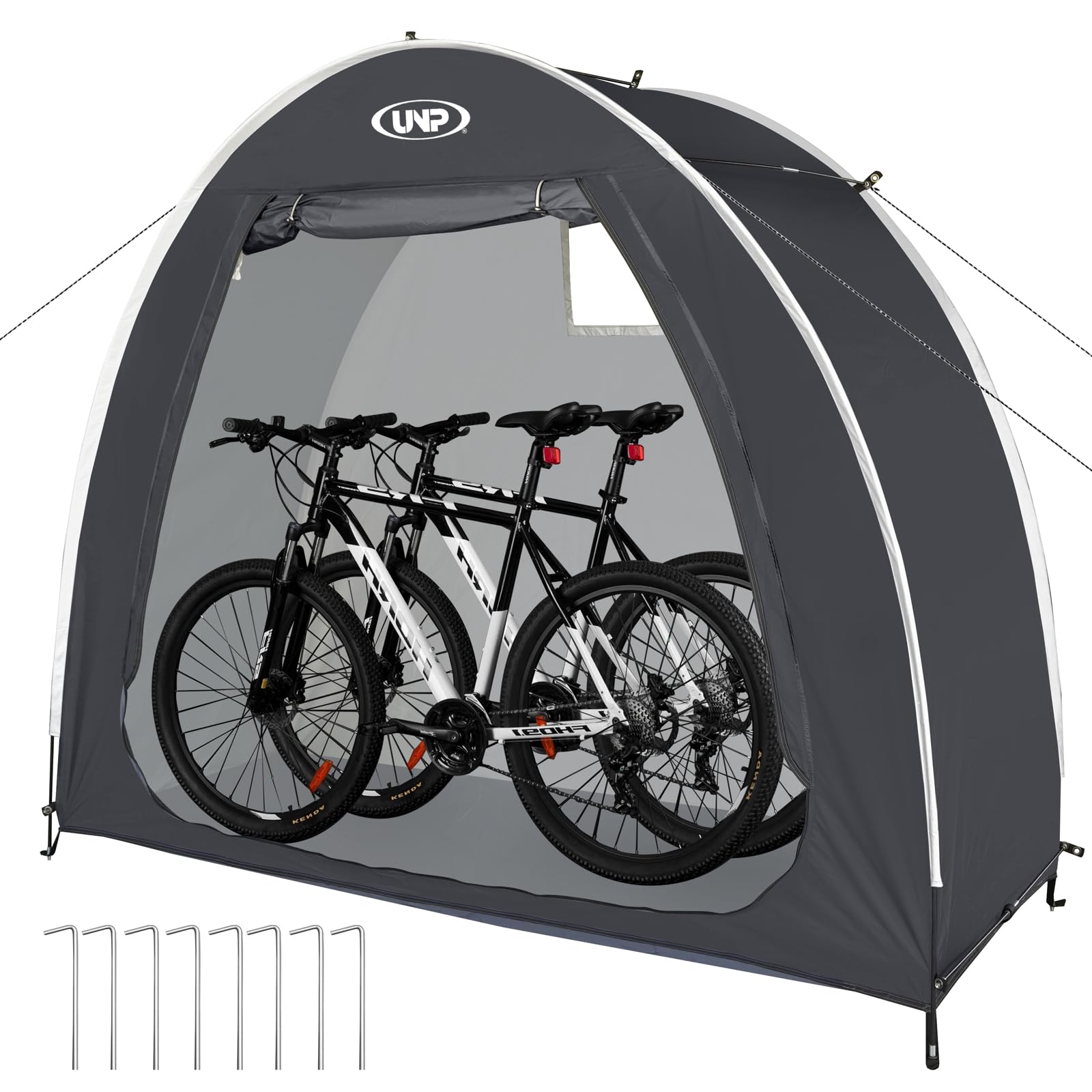
UNP Bike Storage Shed Tent

Camping and travel

Our Score 8.6/10
Check Price

Worth Noting

  • Capacity claims run from one bike to three
Weight
8 lb
Footprint
78.7 x 31.5 x 65 in
Packed Size
17 x 5.5 x 5.5 in
Stated Capacity
2 bikes
Read the full review

This is the one that leaves the yard. Folded, it is a 17-inch bundle weighing about 8 pounds, and it goes back into its bag without a fight — which is the whole reason we keep reaching for it when a trip involves bikes. As a shed it is a 78.7 by 31.5 by 65-inch arch that holds two bikes with enough room left for a helmet and a tool roll.

Two is the number to plan around. The listing cannot quite decide: one bullet says one to two bikes, the color name says two to three. The 65-inch peak is also among the lowest here, level with the PROLEE, so measure your handlebar height before you commit if there is an e-bike with a swept-back bar in the household.

Protection is where it surprised us. The 210D shell with a PU4000 coating and a silver liner kept bikes dry through a soaking rain, which is not something we can say for every tent here. One thing to know before the box arrives: there are no printed instructions. Setup points you at a video, which is fine in a driveway with signal and useless at a trailhead without it. Watch it once at home and the pole order stops being a puzzle.

Ours lives in the back of the car between trips, which is the highest compliment we can pay a tent this size.

Bottom line: We take this one camping — it folds to 17 inches, sets up solo, and has kept bikes dry in steady rain.

2

HAPPY TRAVEL Cabin Bike Tent

HAPPY TRAVEL Cabin Bike Tent

Two-bike households

Our Score 8.4/10
Check Price

Worth Noting

  • Two bikes only
  • Door zip is the part to watch
Fabric
210D Oxford, PU4000 coating
Weight
8 lb
Footprint
86.5 x 31.5 x 73 in
Stated Capacity
2 bikes
Read the full review

Seventy-three inches at the peak is what won us over. Most of the tents in this group stop between 65 and 68 inches, which is fine right up until you are rolling an e-bike in and the bars drag the roof fabric on the way past. The extra height, plus 86.5 inches of length, turns parking a bike into one motion instead of two. That, more than any single feature, is why this is the one we recommend first.

The frame earns its place too. The poles clip together and the shell drops over the top, so nobody is feeding a bent fiberglass rod through a seven-foot sleeve while the wind takes the fabric. It is a one-person job after the first attempt, and it comes with a bag that lets the whole thing live in the garage over winter.

Two bikes is the honest capacity. Put a mountain bike and an e-bike inside and there is still room for helmets, a pump, and a lock; three adult bikes is optimistic unless they are road bikes with narrow bars. At 8 pounds it is light enough to shift on your own when you want to sweep under it, and the 210D Oxford with its PU4000 coating is the same class of cloth as everything else here.

What you are buying is a few seasons of dry bikes. The top panel takes the sun and the wind where it flexes over the frame, and that is the part that goes first. Better to buy it knowing that than to expect it to behave like a shed with a roof that stays put for fifteen years. If the bikes are worth more than the tent, the arithmetic still works in your favor.

Bottom line: Our pick for most riders: the tallest tent here, a clip-together frame that stands up fast, and a shell that keeps a wet week out.

3

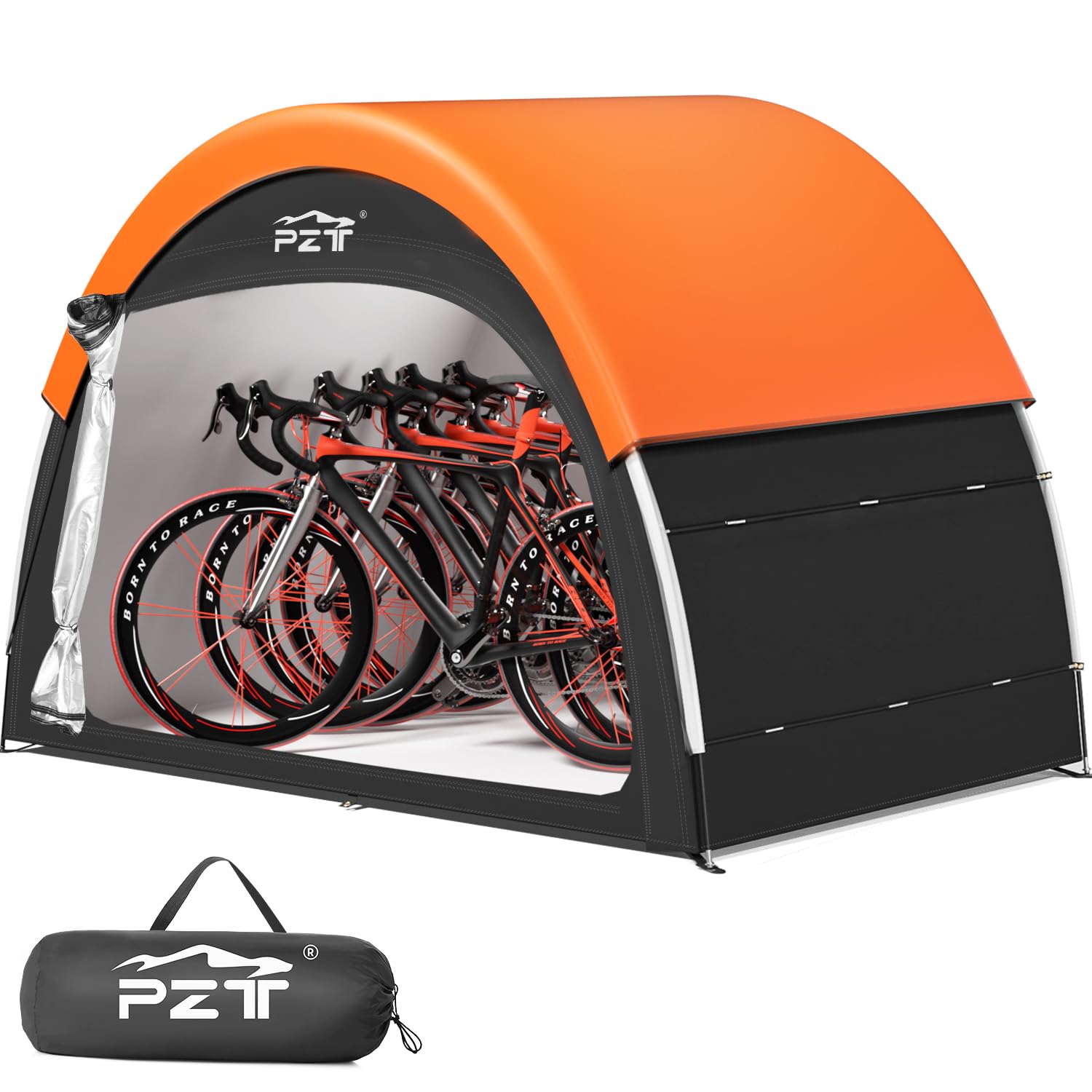
PZT Upgraded Bike Tent

PZT Upgraded Bike Tent

Family bike fleets

Our Score 8.4/10
Check Price

Worth Noting

  • 67-inch peak is tight for tall handlebars
Footprint
79 x 59 x 67 in
Stated Capacity
4–5 bikes
Weather Protection
Rain cover with heat-sealed seams
Read the full review

Fifty-nine inches of width is the number to look at. Every other two-bike tent here is about 31.5 inches across; the PZT is nearly double, and that extra depth is what turns four bikes from a marketing claim into something you can actually stand up inside. Four adult bikes side by side in a fabric shell is a different proposition from squeezing three into a two-bike footprint.

So this is the one for the household with three or four bikes and no garage — the family whose bikes currently lean against a fence under a tarp. We prefer it to buying two smaller tents: one door to open beats two, and there is room left for a mower or a stack of garden chairs beside the bikes. The trade is ground. At 79 by 59 inches it needs a real slab of flat patio or lawn, and it needs to be flat.

Two details do the weather work. A rain cover sits over the roof, aimed at the part of these tents that goes first — fabric flexing and thinning in the sun — and the stitching inside is heat-sealed. The cover wants tensioning on the guy lines before it stops shifting in a breeze; ours settled once the lines were snug. Six stakes and four guy lines come in the box, which is more anchoring hardware than most of this group gives you.

Bottom line: We point four-bike households here: 59 inches of width does more for you than any other spec on this page.

4

PROLEE Bike Storage Tent

PROLEE Bike Storage Tent

Tight budgets

Our Score 8.4/10
Check Price

Worth Noting

  • Water can work through in long, driven rain
Footprint
79 x 31.5 x 65 in
Door Width
31.5 in
Stated Capacity
2–3 bikes
Read the full review

There is not a cheaper way into this category than the PROLEE, and it does the basic job: 79 by 31.5 by 65 inches, a single 31.5-inch door, an arch frame, and room for two adult bikes. A third goes in only if it is a road bike with narrow bars, whatever the listing's two-to-three figure suggests. The door is wide enough to wheel a bike through without turning the bars sideways, which sounds small until you do it in the rain.

For a first tent — a rental, a first e-bike, a bike that has been living in the hallway — this is the one we point people to. It goes up on your own without drama, and the layout is simple enough that nobody ends up reading a manual by flashlight. The fabric is the usual 210D Oxford, so nothing about the shell feels cheaper than the tents on either side of it.

Where it gives ground is wind. The poles are the part that surrenders first in a gale, and a tent this light leans before it breaks. Siting does most of the work: against a wall or under an eave, out of the prevailing wind, ours stood through weather that flattened it in the open. Stake it properly and check the guy lines after the first big blow.

Bottom line: We send first-time buyers here: it is the least expensive way into a two-bike tent that goes up without a fight.

5

Dikutar Bike Storage Tent

Dikutar Bike Storage Tent

Vented storage

Our Score 8.2/10
Check Price

Worth Noting

  • Back panel can leak in heavy rain
Footprint
78.7 x 31.5 x 67 in
Ventilation
Rear mesh window
Waterproofing
PU5000 coating, taped seams
Stated Capacity
2 bikes
Read the full review

What ruins a stored bike usually is not rain — it is the damp air that cannot get out. A sealed fabric box that bakes in the sun and cools overnight is a condensation engine, and every wet ride parked inside adds to it. The Dikutar is the only tent here with a mesh window across the back, and that vent is the reason it made this list.

The rest of the spec is solid: 78.7 by 31.5 by 67 inches, a PU5000 coating that is the heaviest number in this group, taped seams over the stitching, and a two-way zip under a storm flap. At 5.8 pounds one person can move it, and the tool-free frame goes together without more than the usual pole-ordering fuss.

Our reservation is the frame. The poles on the tent we had ran long enough to fight the sleeves at the corners, and the door frame wants a second pass before it sits square. That is a ten-minute annoyance at setup, not a reason to walk away. What we kept coming back to is how deliberately the weather protection is put together — taped seams, a flap over the zip, a vent that actually moves air.

Bottom line: We like the rear vent more than the coating number; buy it for airflow, not for the door hardware.

6

HAPPY TRAVEL XL Cabin Shed

HAPPY TRAVEL XL Cabin Shed

Mowers and motorcycles

Our Score 8.0/10
Check Price

Worth Noting

  • Door zip jams and tears
Frame
5 horizontal poles, 2 uprights
Fabric
210D Oxford, PU4000 coating
Footprint
86.5 x 59 x 73 in
Stated Capacity
5 bikes or 2 motorcycles
Read the full review

The biggest tent here is the one we recommend least often, and that is not a knock on how it is built. At 86.5 by 59 by 73 inches it is designed for a mower and two motorcycles, or a whole corner's worth of garden gear. Most people with two bicycles simply do not need that much floor.

If you do need it, little else here will do. Five horizontal poles and two uprights go up the same way as any of these tents, and 73 inches of headroom with 59 inches of width means a ride-on mower goes in without the handle folded down. The full-width double zip opens the entire front, which matters more the bigger the thing you are pushing through it.

The part that gives us pause is the price. This sits at the top of the group and does not buy a sturdier shell than the PZT — same 210D Oxford, same PU4000, eight pounds. What it buys is volume. If the thing you store is wide rather than numerous, that is a trade worth making. If it is four bikes, the PZT does the same job with better weather hardware and a footprint that fits a patio.

Bottom line: We recommend it only for wide cargo — a mower or two motorcycles — where its 59-inch width earns the price.

How We Chose and Tested the Best Bike Sheds

We started with roughly 40 sheds sold by the big home and outdoor retailers, then cut anything with vague footprint dimensions, no anchoring hardware in the box, or a door opening that looked too narrow for a set of handlebars. That left 12, spanning fabric tents, resin panels, and metal units, which we assembled ourselves — solo, with only the tools included, on a Saturday morning — timing each build and noting exactly where the instructions stalled or a second pair of hands became unavoidable.

Each shed then sat in a real yard through late-summer sun, a wet fall, and a run of winter storms. We hosed every one down for ten minutes and checked the frame tubes, seams, and floor with dry paper towels to see where water actually got in. On the fabric models, we ran the zipper open and closed 20 times in a row, then again wearing gloves, watching for teeth that separated or a pull that snagged at the corner. On windy days we shook each one by a roof corner and recorded which rocked, then re-checked the anchoring into grass, gravel, and a concrete pad.

Fit and daily use got the most attention, because a shed you fight is a shed you abandon. We wheeled in a 29er mountain bike, a kid's 20-inch, and a bulky e-bike, and noted whether handlebars cleared the opening, whether two bikes could go in without tangling, and whether the door stayed put while you steered one through. After eight months we went back over every unit for rust at the base, faded panels, cracked joints, and bent tubes, then weighed all of that against what each one cost. A cheap shed that leaks isn't value — it's a second purchase waiting to happen.

How to Choose Bike Sheds

Start With the Bikes, Not the Bike Count

Listed capacities assume road bikes with narrow bars. Handlebars are the widest part of almost any bike and they set the real spacing, so a 31.5-inch-deep tent holds two bikes staggered and not much more, whatever the listing promises. The models that go to 59 inches wide are the ones that genuinely swallow three or four.

Height matters as much as floor area. A 65-inch peak is fine for a mountain bike and tight for an e-bike with a swept bar, which is why the taller models are worth the extra money when there is an e-bike in the household. Measure your longest bike and its bar height, then check both against the door width before ordering.

Fabric, Coating, and the Seasons You Get

Nearly everything here is 210D Oxford cloth with a polyurethane coating quoted as PU4000 or PU5000. That number describes how much water pressure the cloth holds back, not how long it survives the sun — and the sun is what kills these tents, because the roof panel flexes over the frame in every gust and thins where it does.

Taped or heat-sealed seams help more than a bigger coating number. If the shed will sit in full sun and wind, a model with a separate rain cover gives you a replaceable layer over the part that fails. Treat any of them as a shelter you will replace rather than a building, and you will be pleased rather than disappointed.

Clips, Sleeves, and Setup You'll Repeat

Two frame styles split this group. Some clip together with the shell dropping over the top; others make you feed long fiberglass poles through sewn sleeves, which is fine on a still day and miserable in a breeze. If the tent goes up once and stays up, either works.

If you take it down for winter or pack it for trips, the clip-and-cover designs are worth paying a little more for. Whichever you choose, put it up in the yard once before the day you need it, and keep the carry bag — it is what keeps poles and stakes together between seasons.

The Zipper Is What Actually Breaks

Door zips outlast almost nothing else on these tents. The failure pattern repeats: fabric creeps into the teeth, the slider gets forced, and the coil splits. A two-way zip under a storm flap lasts longer than a bare one, and a door that hangs straight closes without a fight.

Do not overstuff the shed. A shell bowing outward puts the zip under tension every time you close it, and tension is what kills the slider. Clear grit out of the teeth instead of yanking, and judge a tent by its door hardware as much as by its coating number.

Anchoring, Wind, and Where You Put It

Every tent here ships with stakes and guy lines, and every one of them needs using. Stakes only work in soil; on a patio, run cord through the corner tabs and weight them down. Site the shed out of the prevailing wind, ideally against a wall or fence, because a fabric box becomes a sail once wind gets under the skirt.

Guy lines should be snug rather than guitar-string tight, and worth re-checking after the first real blow. None of this turns the tent into a permanent structure, and none of it changes what these shelters are for: keeping bikes out of the weather, not out of reach.

Frequently Asked Questions

Final Verdict

For a two-bike household, our money goes to the HAPPY TRAVEL Cabin: 73 inches of headroom, a frame that clips together instead of fighting sleeves, and a shell that has handled a wet week without drama. It is the tent we point people toward when they want to stop worrying about the bikes.

Storing three or four bikes changes the answer, and the PZT's 59-inch width matters more than anything else on this page. If the shed needs to travel with you, the UNP folds to 17 inches and still keeps the rain out.