Tools & Maintenance

Best Bike Torque Wrench of 2026

There's a particular crunch a carbon seatpost makes when a bolt is one turn too tight, and I've heard it once — enough to make a torque wrench non-negotiable in my garage. A bike torque wrench takes the guesswork out of small fasteners: stem bolts, seat clamps, cockpit hardware, and the alloy and carbon parts where 'tight enough' is a genuinely bad measurement. What separates a good one isn't the biggest number on the dial. Most bike bolts live between 4 and 6 newton meters, so low-end accuracy and a click you can actually feel matter far more than a 20 Nm ceiling.

Over eight months, we put 10 bike torque wrenches through garage tune-ups and component swaps. Some felt like precision tools, with clean adjustment and a click you could hear through a glove; others developed play or let bits rattle loose in the case. Value came down to whether a wrench stayed accurate and pleasant to use, not the lowest price. The picks below are the ones I'd trust on my own bikes, from saddle tweaks to full cockpit changes.

1

Park Tool TW-6.2

Top Pick
Park Tool TW-6.2

Bottom brackets, cassettes

Our Score 9.6/10
Check Price

Worth Noting

  • 10 Nm floor rules out cockpit bolts
Drive
3/8 inch
Length
17 inches
Adjustment
Dial-adjust click
Torque Range
10-60 Nm
Read the full review

A cassette lockring wants about 40 Nm and a threaded bottom bracket wants 35 to 50, which is the point where every 1/4-inch wrench in this guide runs out. The TW-6.2 is a 3/8-inch ratcheting click wrench covering 10-60 Nm, and it is the tool that finishes the job the small wrench starts.

The dial presets a value and holds it, and the 17-inch body gives you the leverage to reach 50 Nm without bracing the frame against a wall. Bottom bracket cups and crank spindles are where that length earns its keep — the jobs that turn a short wrench into a wrestling match.

It arrives as a bare wrench. None of your 1/4-inch hex bits fit a 3/8-inch drive directly, so sockets and an adapter are part of the budget — factor that in if you are coming from a 1/4-inch kit and expecting your existing bits to carry over.

Our take: this is the second wrench, not the first. Buy it once you have decided to do your own drivetrain and bearing work, and keep a small click wrench above it for everything else. It is the priciest tool here, and the SUERCUP covers the same band for far less if the dial and the ratchet feel don't matter to you.

Bottom line: The one we reach for above 30 Nm — 60 Nm of headroom, a dial that holds its setting, and a handle long enough to get there.

2

Park Tool ATD-1.2

Park Tool ATD-1.2

Carbon cockpit bolts

Our Score 9.4/10
Check Price

Worth Noting

  • Bit storage cap works loose in a bag
Type
Adjustable preset driver
Length
7 inches
Construction
All-metal internal
Torque Settings
4, 4.5, 5, 5.5, 6 Nm
Read the full review

Five settings, no scale, and no way to loosen a bolt: the ATD-1.2 sounds like the least flexible torque tool in this guide, and it is the one we reach for first on anything carbon. The dial gives you 4, 4.5, 5, 5.5 or 6 Nm, which is precisely where bar clamps, stem faceplates and seatpost heads live, and there is nothing to misread on the way to the click. For a rider whose cockpit costs more than the frameset did, that is the whole argument.

It is a driver, not a wrench — the clutch clicks and stops, and it will not undo a fastener, so keep a hex key beside it. All-metal internals and a T-handle give it the solid feel of a shop tool at 7 inches long, and it takes standard bits, so the ones already in your drawer fit. What you give up is range: 6 Nm is the ceiling, which puts thru-axles, pedals and everything on the drivetrain out of reach.

If you already own a click wrench that reads accurately at 5 Nm, you don't need this. If you don't — or if you have crushed a carbon bar clamp once and would rather not repeat it — the ATD-1.2 removes the reading step entirely, and that is worth more than the extra range a full kit brings.

Bottom line: Our pick for carbon cockpit work: five presets between 4 and 6 Nm make a misread impossible, and the clutch stops rather than trusting your wrist.

3

PRO BIKE TOOL Torque Wrench Set

PRO BIKE TOOL Torque Wrench Set

Cockpit bolts

Our Score 9.2/10
Check Price

Worth Noting

  • Some units have failed within a few months
  • Scale leads with inch-pounds, not newton meters
Drive
1/4 inch
In The Box
8 hex bits, 3 Torx bits, extension bar, case
Torque Range
2.2-16.9 Nm (20-150 in-lb)
Stated Accuracy
±4% clockwise
Read the full review

Four to nine newton meters is where the expensive mistakes happen on a modern bike — stem bolts, bar clamps, seatpost heads, saddle rails, brake calipers, rotor bolts. The PRO BIKE TOOL set is built around exactly that band, with a 2.2-16.9 Nm range on a 1/4-inch drive and a scale in both newton meters and inch-pounds. The 16.9 Nm ceiling still reaches a thru-axle or a set of cleat bolts, which is about as far as a wrench this size should be asked to go.

What puts it first here is the box rather than the number. Eight hex bits from H2 to H10, Torx T10, T25 and T30, and a 100 mm extension bar mean a full cockpit rebuild happens out of one case — and the extension is the piece most kits skip, the one that lets you sit squarely on a caliper bolt tucked behind a rotor. We also like that each wrench ships with an individual calibration certificate to ISO 6789 instead of a generic accuracy claim. For a first torque wrench, that combination is hard to argue with.

Two habits make it easier to live with. The scale leads with inch-pounds, so if your component specs are in newton meters you will be converting for the first week or two. And the click is firm and obvious through the middle of the range but much softer down near 3 Nm, so on cleat bolts and small clamp screws you feel for it rather than listen. Back the collar off to the lowest setting before the case closes; that single habit is what keeps a click wrench honest.

Bottom line: We recommend it as the default because one case covers every cockpit, saddle and rotor bolt most riders will ever torque, with a certificate behind the accuracy.

4

YIYEIE 1/4-Inch Torque Wrench

YIYEIE 1/4-Inch Torque Wrench

Tight budgets

Our Score 9.2/10
Check Price

Worth Noting

  • Ships as a bare wrench; bits and sockets are extra
Length
10.5 inches
Ratchet
72-tooth, dual-direction
Torque Range
1.1-26 Nm (10-230 in-lb)
Stated Accuracy
±3%
Read the full review

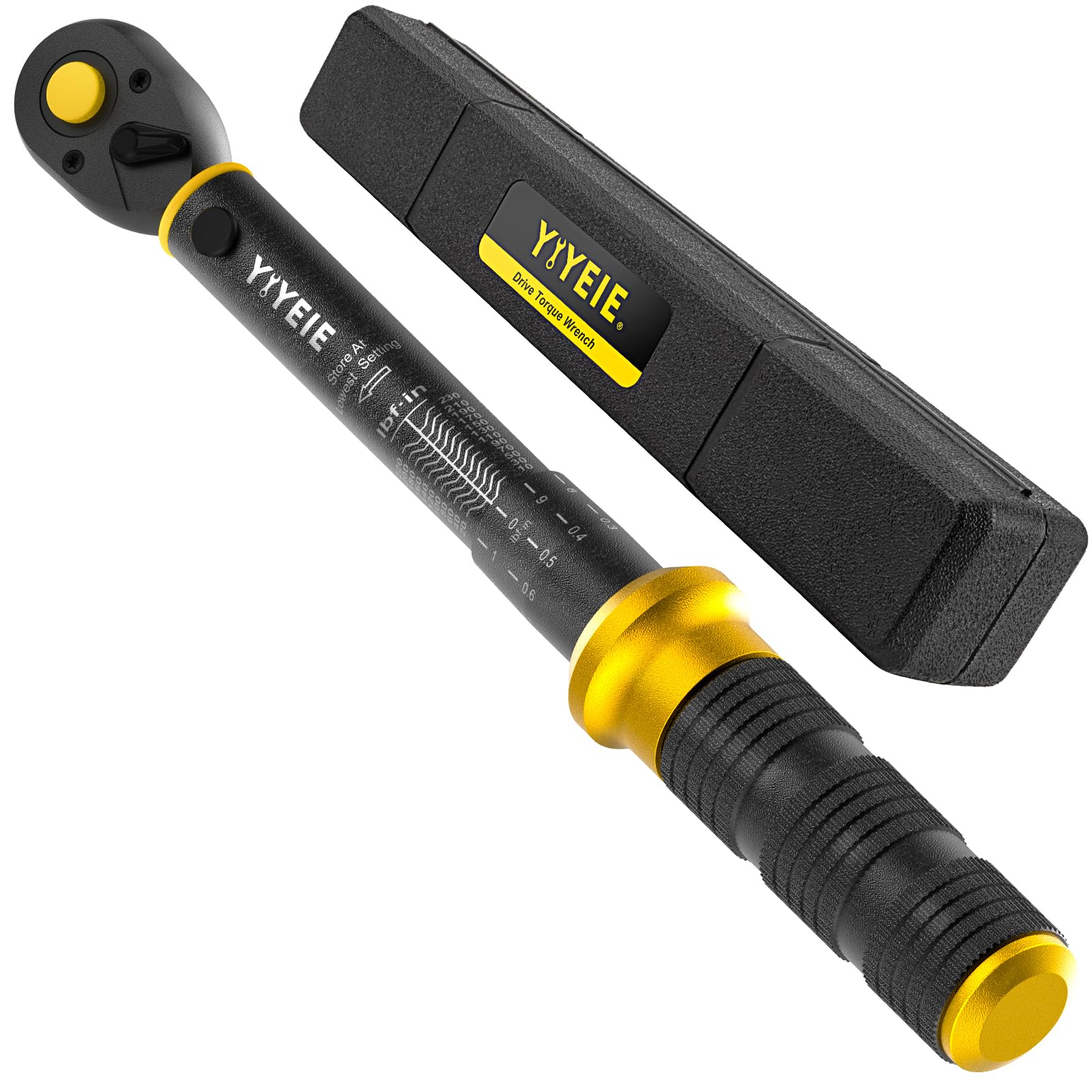
The cheapest way into a calibrated click wrench here is a bare one. YIYEIE's 1/4-inch drive runs 1.1-26 Nm with 1 in-lb micro-adjustment and a stated ±3%, and it arrives with nothing else in the box. If you already own hex keys and a socket set, that is the right trade — you are buying the mechanism, not a case full of duplicates. The collar takes a moment to learn: push up to unlock, turn the knob, pull down to lock. It is quicker than the hold-and-turn rings on older designs.

Two things to plan for. Your hex bits need a 1/4-inch hex shank to fit the drive directly, and there is no extension bar, so a caliper bolt behind a rotor stays awkward until you add one. The other is trust: the certificate is a starting point, and the bottom of the range is where we want to check a reading against a second wrench before pointing it at a carbon seatpost.

Bottom line: We send readers here when they already own hex keys: the cheapest calibrated click mechanism in this guide, with nothing else in the box.

5

Venzo Torque Wrench Set

Venzo Torque Wrench Set

Long warranty coverage

Our Score 9.2/10
Check Price

Worth Noting

  • Accuracy is least certain at the smallest scale
Warranty
10 years
Torque Range
2-24 Nm
Included Keys
3-10 mm hex, T20-T30 Torx
Stated Accuracy
±4%
Read the full review

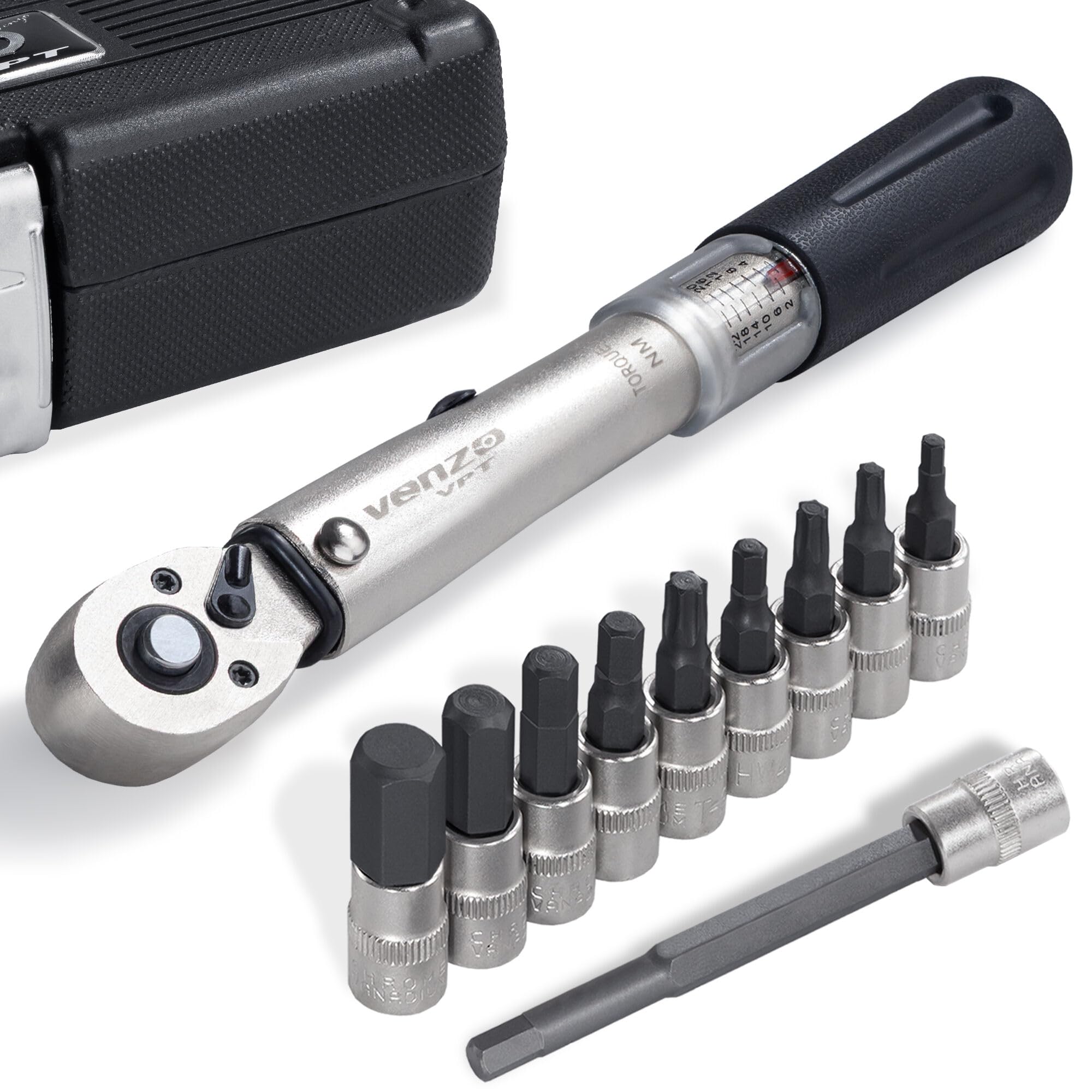
Ten years is a long warranty for a tool with a spring inside it, and it is the first thing that separates Venzo's set from the other mid-priced kits here. The numbers are familiar — 2-24 Nm, ±4%, 1/4-inch drive, hex keys from 3 to 10 mm and Torx T20 through T30 in a hard case — but the coverage behind them is not.

The detail we didn't expect to care about is the long 5 mm hex key. Brake caliper bolts sit close to the rotor, and a standard key puts your knuckles against the disc; the extended one clears it. That is the sort of thing a set either includes or doesn't, and it tells you someone at Venzo has worked on a bike. Second to that, 24 Nm puts it within two newton meters of the widest 1/4-inch kit here.

The adjustment is where it slips: there is no lock ring, so the collar turns freely and a setting can drift if the wrench gets knocked around in a bag. Check the torque before each bolt rather than once per session and it stops being a problem. Treat that as a habit rather than a fault and the set does what the others do, with better backup behind it.

Bottom line: Worth it for the backup: a 2-24 Nm kit with the longest warranty here and an extended 5 mm key that clears the rotor.

6

SUERCUP 3/8-Inch Torque Wrench

SUERCUP 3/8-Inch Torque Wrench

High-torque fasteners

Our Score 9.2/10
Check Price

Worth Noting

  • 6.8 Nm floor rules out cockpit and saddle bolts
Drive
3/8 inch
Ratchet
72-tooth, dual-direction
Torque Range
5-45 ft-lb (6.8-61 Nm)
Stated Accuracy
±3%
Read the full review

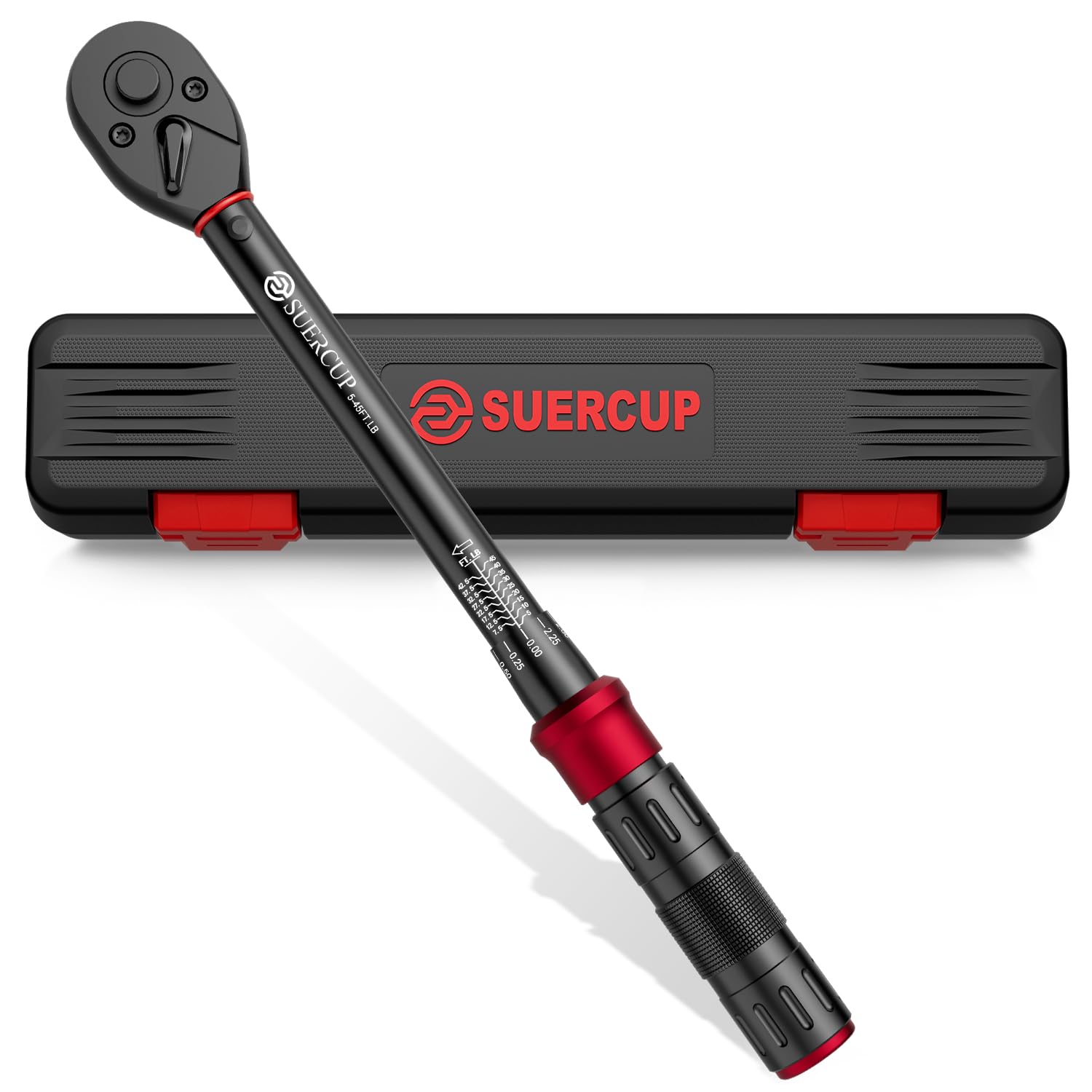
The scale starts with foot-pounds, which tells you most of what you need to know: this is a 3/8-inch click wrench built for spark plugs and drain bolts that happens to be useful on a bike. The range is 5-45 ft-lb, or 6.8-61 Nm, with a stated ±3% and a 72-tooth reversible head in an 11.8-inch body.

The floor is the catch for bike work. At 6.8 Nm it cannot be set for a stem faceplate, a bar clamp or most seatpost heads, all of which sit below that. What it can do is everything above: cassette lockrings, crank bolts, pedals, thru-axles and bottom brackets, where 40 to 50 Nm is normal and a 1/4-inch tool is out of its depth.

It is one of the cheapest routes to a calibrated high-torque click wrench here, and a fair trade against the Park Tool's better dial and longer handle if cassette swaps are your main job. Test the click on a scrap bolt first — this head is positive at 40 Nm and less so as you drop toward its floor. Buy it as your second wrench and keep something smaller for the cockpit.

Bottom line: Worth it as your second wrench: 61 Nm of range for lockrings and cranks, provided nothing on your bike needs 5 Nm.

7

LEXIVON LX-191 Kit

LEXIVON LX-191 Kit

Full bike kit

Our Score 9.0/10
Check Price

Worth Noting

  • Some units have failed early in ownership
Ratchet
72-tooth, quick-release
Kit Contents
15 pieces
Torque Range
2-26 Nm (17.7-230.1 in-lb)
Stated Accuracy
±4% clockwise, ±6% counterclockwise
Read the full review

Seventeen newton meters is plenty for a stem and nowhere near enough for a cassette, and for riders who want one case rather than two, the LX-191 stretches the useful band to 26 Nm. It is a 1/4-inch click wrench with 0.2 Nm micro-adjustment and 15 pieces in the case — bit sockets, adapters and the sizes most bikes actually use. That extra headroom will not reach a lockring, but it does cover suspension pivots, cleat hardware and the larger frame bolts a 17 Nm tool runs out on.

Two details stand out. The 72-tooth ratchet needs a much shorter swing than a coarse head, which matters when you are working between a top tube and a bar clamp. And the wrench measures torque in both directions — ±4% clockwise, ±6% counterclockwise — so left-hand-threaded parts get a real number instead of a guess. The yellow-on-black scale stays legible in a dim garage.

Nine newton meters is the whole difference between this and our top pick, and it is worth having if your bike has pivots. For a hardtail, a road frame or a gravel bike, the top pick's extra bits and longer body win; for anything with a rear shock, or a crank that comes off twice a season, this is the kit we take.

Bottom line: Choose it if your work runs past the cockpit: 26 Nm, a fast 72-tooth head and torque measured in both directions for cranks and left-hand threads.

8

YIYEIE 50-Piece Master Kit

YIYEIE 50-Piece Master Kit

Biggest bit selection

Our Score 8.8/10
Check Price

Worth Noting

  • The full case is heavy and bulky to carry
Drive
1/4 inch
Kit Contents
50 pieces
Torque Range
1-26 Nm (10-230 in-lb)
Stated Accuracy
±3%
Read the full review

Fifty pieces is not a marketing round number here. The list runs from 2 mm hex to 10 mm, Torx T8 to T40, six-point sockets from 4 mm to 15 mm, plus Pozi, Phillips and slotted bits and a 3/8-inch adapter. If your tool drawer is currently two tired hex keys and a folding multi-tool, this is the shortest route to a working bench.

The wrench underneath is the same 1/4-inch click design the company sells on its own: 1-26 Nm, 0.1 Nm micro-adjustment, a stated ±3% with a serialized certificate, a 72-tooth quick-release ratchet and a dual newton-meter and inch-pound scale. The bits are color-coded and individually labeled on the holder, which sounds like a small thing until you are hunting a T25 one-handed while holding a brake lever out of the way.

Our honest read: from a standing start, the arithmetic is hard to beat — a full socket and bit library plus a calibrated wrench in one case. If you already own decent hex and Torx keys, most of those fifty pieces duplicate what is in the drawer and you are paying for volume. Buy it as a first kit, or as a gift for someone setting up a home workshop, not as an upgrade.

Bottom line: Buy it as a first kit rather than an upgrade: one case equips a bare bench with a wrench, sockets and every bit a bike takes.

How We Tested Bike Torque Wrenches

We started by pulling every bike-specific torque wrench we could find in the 2–20 Nm range, then narrowed the field by drive size, included bits, adjustment style, case quality, and value — what came in the kit versus what it cost. That left 10 models, which we used for eight months in a home workshop and on bikes before weekend rides.

On accuracy, we cross-checked each wrench against a reference beam wrench at 4, 5, and 6 Nm on a test fixture, then repeated the low setting three times to see whether it drifted. We ran each adjustment collar from minimum to maximum and back, noting backlash, sticky spots, and whether the scale was easy to read at a glance. For click feel, we tested bare-handed and with winter gloves, listening for a distinct, repeatable break rather than a mushy give.

Build quality got checked at the ratchet head, the lock ring, and the case hinge; after eight months we looked for play, worn markings, and bits that had escaped their holders. Bit storage mattered more than expected — we shook each case, carried it in a toolbox, and noted whether bits stayed put or spilled into the bottom. We also used each wrench in tight spots: under a saddle, around a stem faceplate, and beside a water bottle cage, judging whether the head could reach the bolt without stripping it.

How to Choose the Right Bike Torque Wrench

Start at the bottom of the range, not the top

Ranges are quoted as a span, and shoppers read the ceiling. The floor is what decides whether a wrench can do your bike at all. Stem faceplates, bar clamps and seatpost heads sit around 4 to 7 Nm; cassette lockrings and threaded bottom brackets want 35 to 50. A 1/4-inch tool covering roughly 2 to 17 Nm or 2 to 26 Nm handles the first group, and a 3/8-inch tool in the 10 to 60 Nm band handles the second.

The trap is the automotive-style 3/8-inch wrench whose scale begins around 6.8 Nm. It cannot be set for a 5 Nm stem bolt at all, however good the rest of it is. Read the bottom number first.

The click is the whole tool

A click wrench works by releasing when you reach the setting, and everything depends on whether you notice. At 40 Nm the signal is a solid jolt; at 3 to 5 Nm it can be a soft tick that vanishes in a noisy garage. That is why we try any new wrench on a bolt we don't care about before it goes near carbon — you are learning the feel, not the sound.

Micro-adjustment matters down there too. A wrench that moves in 0.1 or 0.2 Nm steps lets you land on 4.5 Nm, where a coarse 1 Nm collar leaves you choosing between 4 and 5.

What's in the box decides when you can use it

A bare wrench assumes you already own the bits, and 1/4-inch hex bits fit a 1/4-inch drive directly. Move up to a 3/8-inch wrench and nothing in your hex set fits without an adapter, which is the hidden cost of upsizing. The other piece worth checking is an extension bar: caliper bolts sit behind the rotor, and a short bit cannot reach them squarely.

If your drawer already holds good hex and Torx keys, buy the wrench alone. If it doesn't, a kit usually costs less than assembling the pieces one at a time.

When a preset driver beats an adjustable wrench

Adjustable click wrenches are the default because they cover everything, but they ask you to read a scale and set a collar every time, and that is where mistakes come from. A preset driver removes the step: the Park Tool ATD-1.2 offers 4, 4.5, 5, 5.5 and 6 Nm and nothing else, which is exactly the band a carbon bar, stem and seatpost occupy.

We treat the two as complements rather than rivals — a preset driver for the cockpit, an adjustable wrench for the drivetrain and anything that needs 20 Nm and up.

Frequently Asked Questions

Final Verdict

The PRO BIKE TOOL set is what we hand most riders: a 2.2-16.9 Nm click wrench with every hex and Torx bit a cockpit needs, an extension bar for caliper bolts, and an individual calibration certificate in the case.

Add the Park Tool ATD-1.2 if carbon bars and a stem are regularly on your bench, because its 4-6 Nm presets remove the reading mistake entirely. And if you pull your own cassettes and bottom brackets, budget for a second, 3/8-inch wrench like the Park Tool TW-6.2 rather than pushing 45 Nm through a 1/4-inch tool.