Bags & Storage

Best Bikepacking Bags of 2026

Loading a bike for an overnighter is half the fun — until the first washboard descent and your saddle bag starts swinging like a pendulum. Bikepacking bags are what get your gear off your back and onto the frame, but the wrong one rattles loose, rubs a bald patch into your paint, and turns a two-hour fire-road cruise into a running inventory of what's about to fall off.

I've learned that the hard way more than once, so over the past eight months my team and I logged miles with 13 different bags — saddle packs, handlebar rolls, frame bags, and a couple of fork-mounted options — each loaded with the same real kit: a quilt, a pad, a stove, two days of food, and a water filter that never quite fit anywhere. The best ones disappeared under me; the rest are why I now check zipper coils and strap hardware before I care about anything else. One thing worth knowing before you shop: listed liters measure volume, not shape, so a bag that claims the same capacity as another may not swallow your actual load.

1

Moosetreks Stem Bag

Top Pick
Moosetreks Stem Bag

Food and water

Our Score 9.4/10
Check Price

Worth Noting

  • Base strap runs short on some frames
Closure
Drawstring
Material
Ripstop nylon
Mounting
Three-point hook-and-loop
Bottle Fit
Up to 32 oz
Read the full review

A drawstring top and a body wide enough for a 32-ounce Nalgene is an odd way to describe a bag until you are four hours into a gravel day and can reach a bottle, a bar, or a wrapper without unclipping. That is the case for the Moosetreks: it mounts between bar and stem, where your hand already falls, and the drawstring opens and closes with one hand. Of everything here, it is the bag we touch while moving.

The three-point attachment is what makes it trustworthy. One loop goes round the bar, a second round the stem, and a third ties the base down, so the result does not swing or load the steering the way a bar bag can. We like that the loops fit either side of the stem, which means you can run one bag on each side and still reach both. Inside is ripstop nylon, insulation, and a drainage hole at the base — the detail that matters when a bottle sweats or a cap leaks.

Capacity is bottle-first: a 32-ounce bottle, a large bike bottle, or a couple of bars and a phone in the mesh side pockets. It will not take a sleep kit and it does not pretend to. On a bike already carrying two cages and a frame bag, this is how you get a third bottle aboard without strapping anything to the bars. The third strap is the one thing to check when it arrives: it runs short, and on some frames it lands on the head tube rather than the fork.

Bottom line: If you buy one bag for a bikepacking trip, we think it should be this one: bottle-sized, one-handed, and steady on rough ground, on every bike you own.

2

ROCKBROS Top Tube Bag

ROCKBROS Top Tube Bag

Phone and snacks

Our Score 9.2/10
Check Price

Worth Noting

  • Zip feels like the budget component
Weight
3.17 oz
Pockets
External mesh
Capacity
1 L
Mounting
Three-point elastic cord
Read the full review

Most top-tube bags are a rectangle of velcro, and they creep forward on washboard. This one uses a three-point elastic cord instead: hook it round the top tube and the head tube, then take up the slack until the bag is tensioned against the frame rather than merely strapped to it. On a long descent with a phone and a multi-tool inside, ours stayed exactly where we set it.

The shape is the other half of the argument. It is narrow enough that our knees cleared it going in and out of the saddle, and the external mesh pockets hold a wrapper or a gel where you can see it rather than at the bottom of the main compartment. Inside there is room for a phone, keys, wallet, gloves, and a small tool, and at 90 grams it disappears once it is mounted. Light, out of the wind, out of your knees — that combination is why it stays on the bike between trips.

It is a cockpit bag, not a cargo bag. A shell, a spare tube, or a day of food will not fit, and if that is your load you want a frame bag rather than a bigger top-tube bag. What we appreciate is that it does not try to be both: the low profile is the point, and the mesh pockets mean the thing you need at a junction is already on the outside.

Bottom line: Our pick for the bag you open at every junction: tensioned to the frame, light enough to forget, and roomy enough for a phone, snacks, and a tool.

3

Rhinowalk Handlebar Bag

Rhinowalk Handlebar Bag

Small frames

Our Score 9.2/10
Check Price

Worth Noting

  • Zip can stick and is the weak part
Extras
Removable shoulder strap
Weight
5.64 oz
Capacity
2.4 L
Mounting
Three hook-and-loop straps
Read the full review

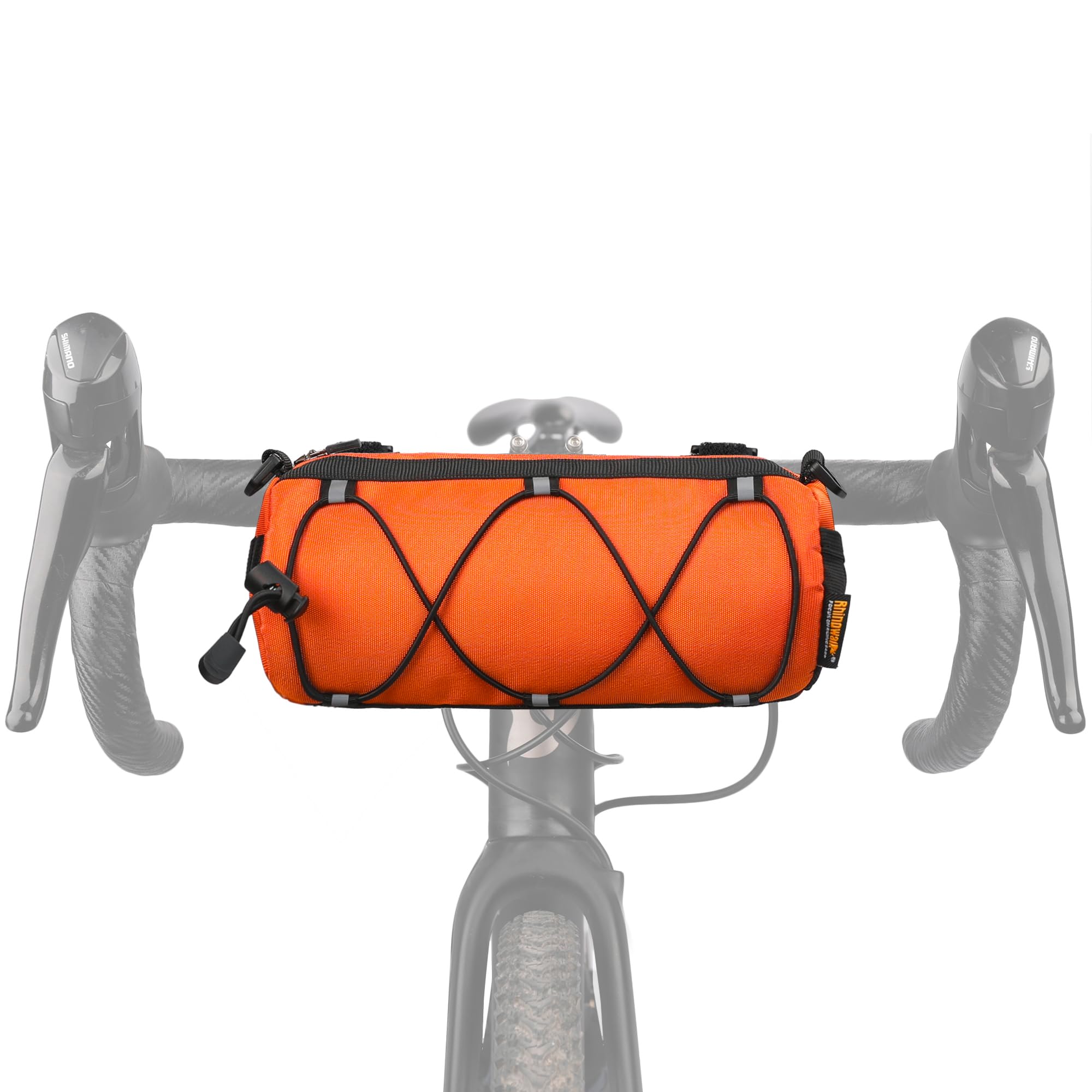
The shoulder strap is what sold us. A small bar bag usually lives on the bike, which means your phone, keys, and wallet are only as safe as the bike is; this one unclips and comes into the shop or the tent with you, and at 160 grams it is no burden to carry. On the bike it is a 2.4-liter barrel held by three hook-and-loop straps, sitting clear of a light or a computer.

It is the bag we point at when there is no frame room. Small frames, full-suspension linkages, and triangles already full of bottle cages all leave you short of space, and the bar is the obvious place to reclaim some. The zip runs along the top of the barrel so you can open it one-handed at a junction, and six reflective strips run round the body — a small thing that shows up when headlights hit it.

Capacity is honest for a bar bag: phone, wallet, keys, gloves, a small tool roll, and a couple of bars, with the barrel holding its shape when it is half empty instead of sagging onto the front wheel. Load it heavy and you do feel it in the steering, which is the trade for keeping everything in reach. On a bike with nowhere else to put a bag, that is a trade worth making.

Bottom line: For bikes with no frame space, we recommend this one: a 160-gram bar bag that unclips and comes into the shop with you.

4

WOTOW Frame Bag

WOTOW Frame Bag

Night riding

Our Score 9.2/10
Check Price

Worth Noting

  • Water-resistant coating, not a waterproof shell
Closure
Zipper on both sides
Material
600D Oxford
Mounting
Three hook-and-loop straps
Visibility
Reflective panels, both sides
Read the full review

Two large reflective panels, one on each side, are the reason to look at this bag instead of the plainer triangle next to it on this page. On an unlit road or a bike path at dusk they throw light back at a driver from angles where a small rear light does not reach, and they cost nothing in weight or bulk.

The rest is a competent triangle bag: 600D Oxford with a PU coating, three hook-and-loop straps with loops sewn all round the shell so you can reposition them, and a zip on each side — a slim one for cards and cash, a wide one for the main compartment. The main zip opens far enough to get a hand in without unpacking, which is what we want for a tool or a bar, and it is about as cheap as a frame bag gets here. What we do not love is how far it comes down the seat tube on a small frame.

Fit is the catch, and it is the one thing to sort before ordering. It is the biggest triangle bag here, and it crowded the top tube on the smaller frame we tried it against, which is also why it is happiest on a large one. Measure the triangle — top tube to down tube, along the seat tube — and expect the bag to sit closer to the head tube than the product photos suggest.

Bottom line: Our pick if you ride at night: reflective panels on both sides and two zips, on a bag that needs a large frame triangle to fit.

5

NDakter Frame Bag

NDakter Frame Bag

Tools and pumps

Our Score 9.0/10
Check Price

Worth Noting

  • Water-resistant, not waterproof
Padding
5 mm foam
Capacity
1.5 L
Mounting
Three hook-and-loop straps
Water Resistance
Water resistant
Read the full review

Three velcro straps and a triangle of padded fabric is not complicated, and that is the appeal: it goes on in under a minute and comes off just as fast when you swap bikes. What decides whether it works is your frame. Ours sat neatly in the triangle of a gravel bike; on a small frame the same bag crowds the top tube, and on the wrong bike it becomes the thing your knee finds on every pedal stroke.

The 5 mm foam layer is why we reach for this one over a bare nylon triangle: it holds shape when the bag is half full, and a mini pump or a multi-tool does not rattle against the frame. The main zip opens wide enough to see what you are doing, and a slim zipped slot on the other face takes cards, cash, and a key — the things you do not want to dig for at a resupply stop.

Two things to do before you ride it. Clean the frame and put clear film under the strap lines, because a strap-on frame bag rubs paint and this one is no exception; then re-check tension after the first hour, once the straps have settled. Capacity is more modest than the 2-liter billing suggests once a pump is inside. For the money, though, it is the best value in a frame bag here, provided your triangle is big enough for it.

Bottom line: The frame bag we recommend on a budget: three straps, foam padding, and a wide opening — as long as your triangle is big enough.

6

Rhinowalk 13L Saddle Bag

Rhinowalk 13L Saddle Bag

Multi-day loads

Our Score 8.8/10
Check Price

Worth Noting

  • Plastic cam buckles feel like the weak point
  • One compartment, no internal dividers
Extras
Elastic cord, tail-light hook
Capacity
13 L
Mounting
Four-point straps with cam buckles
Water Resistance
Waterproof inner, 3000 mm
Read the full review

Thirteen liters is a different category from everything else on this page. The frame and top-tube bags here hold tools, snacks, and a phone; this one is sized for a tent, a sleeping bag, and a change of clothes, with an elastic cross-cord on top for a wet jacket or a helmet. For an overnighter, it is the bag that turns a day bike into a trip bike.

We were skeptical of a strap-on saddle bag at this size, because a loaded bag hanging off the seat post is where sway starts. The four-point mounting holds better than we expected: a strap to the post, a strap under the saddle rails, and cam buckles you press closed after tensioning. Loaded to the top and ridden out of the saddle it can still move, and how far forward your saddle sits makes a difference — a saddle pushed forward leaves less post to strap against. Pack the dense stuff at the saddle end and it settles.

Waterproofing is where it earns its keep: PVC polyester outside and a separate inner bag rated to 3000 mm, so a downpour does not require a liner. A bag this size is much easier to mount off the bike, with the buckles open and the bag half full, then tightened once it hangs where you want it. The reflective strap and the tail-light hook are the sort of detail that only matters on a trip that runs late, which is exactly when it matters.

Bottom line: Our pick when the trip involves a sleeping bag: 13 liters of genuinely waterproof space over the rear wheel, carried on four straps.

How We Tested Bikepacking Bags

We started with the spec sheets — claimed volume, mounting hardware, roll-top versus zippered closures, and how each bag attached to the bike. Anything with brittle-feeling buckles or a mount that needed a tool for every adjustment got cut, and we ended up buying 13 bags. Each one went onto three different frames, including a small gravel bike with a cramped front triangle, to see what genuinely fit where and what crowded the tire or the bottle cages.

For eight months we rode them loaded. Every bag carried the same kit, so we could compare real capacity against the number on the label, and we weighed each one empty and packed. We taped seatposts and fork legs before rides and checked for scuffing after every washboard descent and rocky stretch, because a bag that shifts even a couple of millimeters will sand your paint over a season. Zippers took the worst of it: we overstuffed bags past their stated volume, yanked sliders with gloved hands, and noted which ones skipped, separated, or let grit into the teeth.

Waterproofing got tested the unglamorous way — a wet spring of commuting and two overnighters in steady rain, then a hose run over each bag with dry paper towels stuffed inside. At the end, we compared what each bag cost against how its hardware, seams, and closures had held up, since value here is mostly a question of what still works in month eight.

How to Choose Bikepacking Bags

Build the Load From the Frame Out

Start with what your frame can hold, because that is the one space you cannot change. A frame bag puts weight between the wheels where it barely touches the handling; the top tube and cockpit then carry what you want in reach, and the saddle bag takes the bulky, light stuff — a sleep kit, a jacket. On a small frame, or a full-suspension bike with a shock in the triangle, that order flips: a stem bag and a bar bag do the work a frame bag cannot.

Our top pick is a stem bag for exactly that reason. It is useful on every bike, whatever else you end up carrying, and it is the bag you use on a day ride as readily as on a trip.

Match Capacity to a Job, Not a Number

Listed liters are optimistic. A two-liter frame bag with a mini pump, a tube, and a multi-tool inside is full, and a 13-liter saddle bag stops being 13 liters the moment a tent with poles goes in. Decide the job first — tools and snacks, a day of food and water, or a full sleep kit — then size the bag to it. Roughly 1 to 3 liters covers tools and food; you need something in the 10-to-15-liter class before a sleeping bag is realistic.

Pack at home, not at the trailhead. A bag that closes easily on the kitchen floor is the one that closes in the rain.

Mounting Is Where Bags Succeed or Fail

Three systems show up here: hook-and-loop straps, an elastic cord tensioned against the frame, and bolted mounts on frames that have the bosses. Straps are the most universal and the easiest to move between bikes; a tensioned cord holds a top-tube bag still without crushing a soft frame bag; bolts are the most secure where you have them. Whatever the system, the checks are the same — does the bag clear your cables, does it stay put when you stand and rock the bike, and does anything touch paint?

Clear film under the strap lines is cheap insurance, and a strap that is snug in the driveway will often loosen in the first hour of a loaded ride.

Closures and Weather

The closure is the part that ends a bag's life. Zips take grit, flex where the bag bends over the frame, and give out before the fabric does; a drawstring or a magnetic flap sidesteps the problem but lets water in more easily. If you ride in real rain, look for welded or coated fabric and a separate inner bag, and read water resistant as shower proof rather than dry.

For a sleep kit, a thin dry bag inside is worth more than any coating on the outside. We check a zip loaded and half-closed before a trip, because that is where it binds.

Access and Clearance

Food and water are no use in a bag you have to stop to open. A stem bag with a drawstring top, or a top-tube bag whose zip runs along its length, lets you get a hand in without unclipping — and with gloves on, which is the test that actually matters.

Clearance is the other half. A bag that is narrow at the top stays out of your knees, and anything mounted on the bars adds its weight to the steering. Load the bag, then ride out of the saddle once before you commit to the position.

Frequently Asked Questions

Final Verdict

If you buy one bag from this list, make it the Moosetreks stem bag. It is the bag you use on every ride rather than twice a year — bottle-sized, one-handed, and steady on rough ground — and it is the first thing we mount before a trip. Everything else you add is about volume and reach.

Going overnight? Add the Rhinowalk 13-liter saddle bag, which is the only bag here sized for a sleep kit, and check the cam buckles before you load it. On a tight budget, the NDakter frame bag covers tools and a pump for the least money here, provided your frame triangle is big enough to take it.