Tires & Tubes

Best CO2 Inflators for Bikes of 2026

A flat tire is a ten-minute inconvenience right up until you realize your only inflation option is a mini pump and 400 strokes on a gravel shoulder. CO2 inflators erase that moment: one cartridge, one twist, and the tire is back to riding pressure. The catch is that you get one shot per cartridge, so the tool has to work the first time, with cold hands and no do-over.

I've carried one in my saddlebag for years and have watched riding partners waste a full cartridge on a head that wouldn't seal. Over four months, my team and I tested 14 inflators, from palm-sized road models to chunkier workshop-friendly designs. The lessons held: threaded cartridges seal more reliably than unthreaded ones, a head that screws onto the valve beats one you have to press and hold, and the lightest option isn't always what you want when your fingers are numb. Below, the picks are grouped by how you'll actually use them.

1

BriskMore CO2 Inflator Kit

Top Pick
BriskMore CO2 Inflator Kit

Most riders

Our Score 9.2/10
Check Price

Worth Noting

  • Sleeve fits 16g cartridges only
  • Kit weight suits a saddle bag, not a pocket
Flow Control
Control valve
Max Pressure
100 psi
Cartridges Included
5 × 16g threaded
Valve Compatibility
Presta and Schrader
Read the full review

Five 16g cartridges, the head, a foam sleeve, and three spare sealing washers arrive in one box, which is the whole argument for buying a kit rather than a bare head. It's the second flat that decides whether a kit was worth buying, and it's the one you can't fix if the refills never got ordered. The head takes any threaded UNF 3/8 cartridge from 12g to 25g, so nothing ties you to one brand of gas.

At the valve end the head threads onto Presta or Schrader stems with no adapter to lose, and a control valve sits between cartridge and chuck. That valve is the part we care about. A quarter turn gives you enough gas to settle a tube inside the tire; open it further when you want the last stretch in a hurry. It's the difference between a controlled fill and a bang that leaves you holding a half-inflated tire and an empty cartridge.

Weight is what the kit asks back. The set is listed at 12.7 ounces, most of it the five steel cartridges, so carry two on the bike and leave the rest at home and it becomes something you stop noticing. A 16g cartridge is a one-tire fill on a mountain bike, which makes the box roughly a season of bad luck.

The seal is what decides whether the kit still earns its place next spring. A washer that has spent a season in a saddle bag can harden and let gas escape at the cartridge joint, which is exactly what the three spares are for; swapping one takes a minute. Close the control valve before you thread a cartridge on and you won't be the rider who empties one into the air.

Bottom line: For most riders this is the one: five cartridges, a control valve, and a sleeve in one box, for less than the premium heads here cost on their own.
2

Lezyne Control Drive CO2

Lezyne Control Drive CO2

Precise flow control

Our Score 9.2/10
Check Price

Worth Noting

  • Only one 16g cartridge in the box
  • The most expensive of the picks here
Flow Control
Twist-control valve
Max Pressure
120 psi
Cartridge Included
1 × 16g
Valve Compatibility
Presta and Schrader
Read the full review

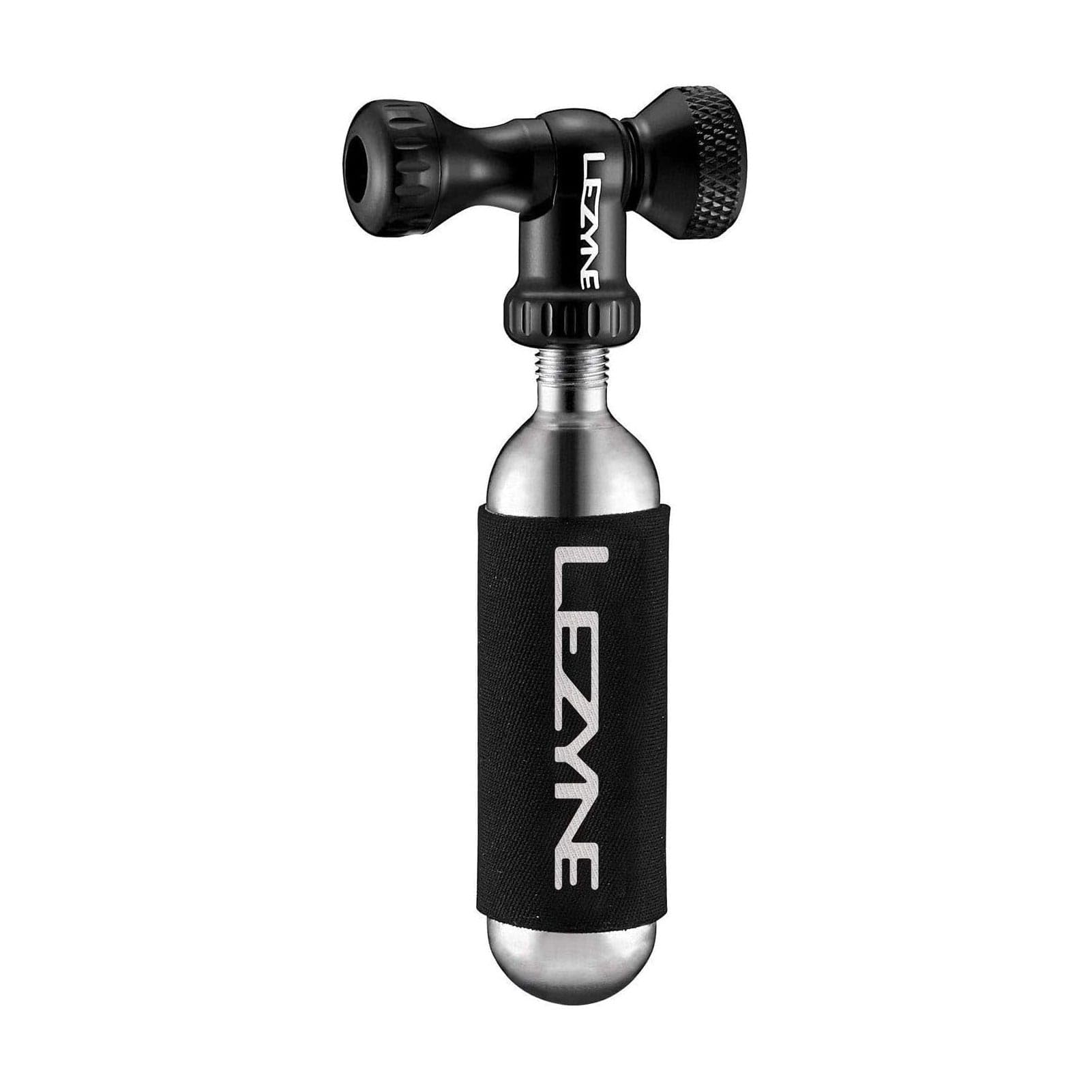
The Control Drive's valve is a twist collar rather than a push button, and that single choice is why we reach for it when a wheel has to be right the first time. Crack it open and you get a trickle; keep turning and the flow opens up. Nothing dumps.

On a road bike, that collar is the difference between a tire at roughly the pressure you run and one that's merely full. The body is CNC-machined aluminum with stainless hardware inside, the Twin Slip Chuck pushes onto Presta or Schrader without swapping parts, and a neoprene sleeve covers the cartridge while it frosts over.

The listed ceiling is 120 psi, the highest in this group alongside the Shiny Object, and the collar shut off cleanly with no hiss at the joint — the small sign we look for that a seal is doing its job. The chuck pushes on and pulls off without turning anything, so there's no risk of backing a removable valve core out with the inflator.

Bottom line: Buy this if precise, adjustable flow matters more to you than a box of cartridges — the twist collar and alloy body are the best-made combination here.

3

PDW Shiny Object CO2

PDW Shiny Object CO2

Minimal saddle bags

Our Score 9.2/10
Check Price

Worth Noting

  • Cartridge sold separately
  • Early failures on some units
Weight
40 g without cartridge
Flow Control
Precision control knob
Max Pressure
120 psi
Valve Compatibility
Presta and Schrader
Read the full review

Forty grams and 44mm tall, the Shiny Object disappears into a saddle bag and stays there until the day it matters. It's the pick here we forget we're carrying, which is the highest compliment a flat kit can get. The control knob sits at the top, where a cold thumb finds it.

Thread a cartridge into the base, push the chuck onto the valve, and turn the knob for anything from a whisper to a full dump. That range is the most precise of the head-only inflators here, and the 120 psi ceiling matches the Lezyne. The body is machined metal rather than plastic, which is why it feels like a tool rather than a cartridge holder.

The knob is the whole argument. A push button gives you fast or nothing; this lets you hold a low trickle while the tube settles into the casing and then open up. That's why this is the head we hand to someone running high-pressure road tires, where a cartridge dumped in one go is a wasted cartridge.

Bottom line: The smallest, most controllable head here — buy it if your bag has room for a cartridge but your patience doesn't stretch to a full-blast inflator.

4

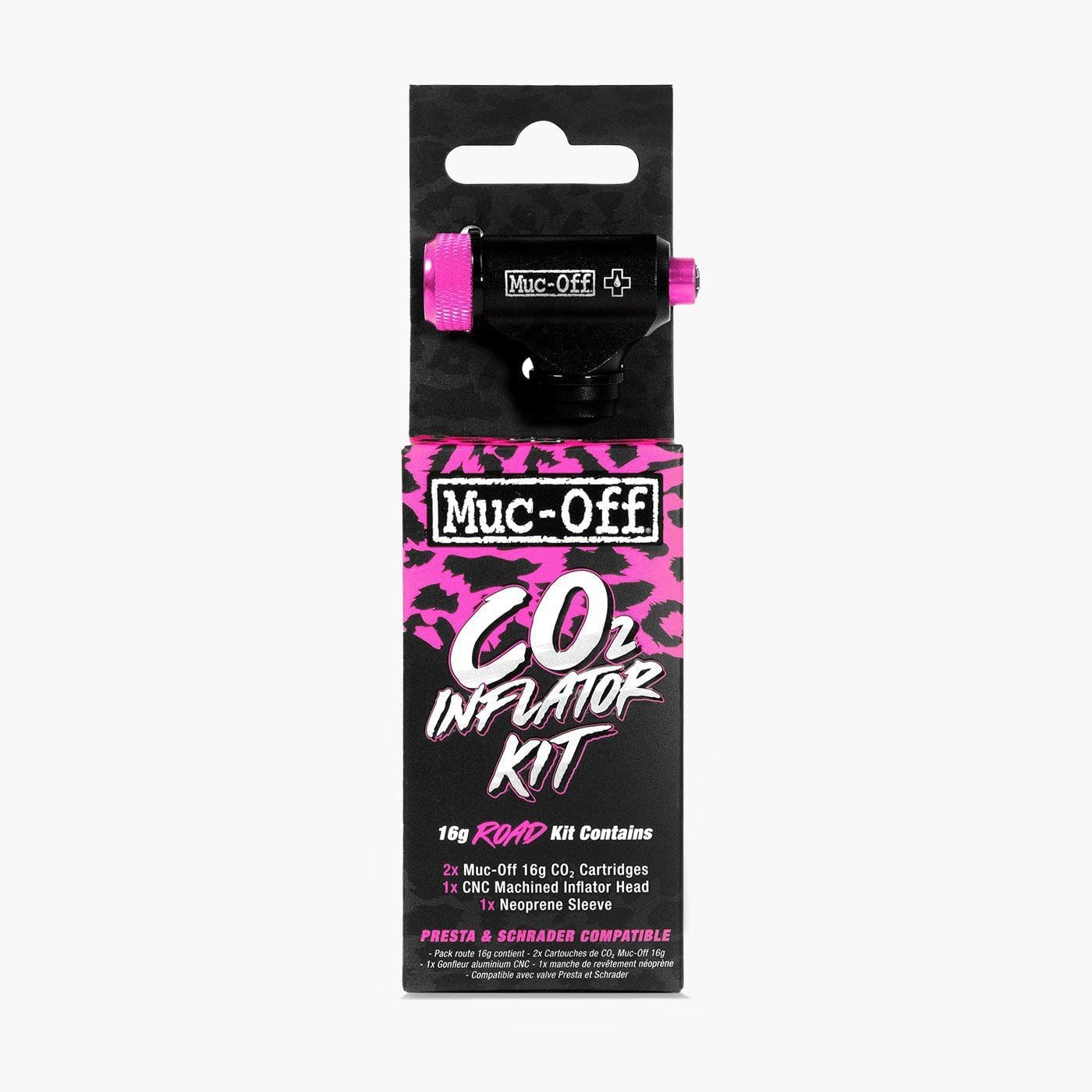
Muc-Off Road CO2 Kit

Muc-Off Road CO2 Kit

Road tires

Our Score 9.2/10
Check Price

Worth Noting

  • 100 psi ceiling, below the 120 psi heads here
  • Two cartridges in the kit
Flow Control
Press-down button
Max Pressure
100 psi
Cartridges Included
2 × 16g
Valve Compatibility
Presta and Schrader
Read the full review

Freeze burn is the part of CO2 that nobody mentions until a fingertip is stuck to a cartridge, so the combination of a neoprene sleeve and a soft-touch press-down button is more thoughtful than it first looks. A gloved thumb can work that button without hunting for a collar.

In the box there's a CNC-machined aluminum head, two 16g cartridges, and the sleeve. Muc-Off builds a separate mountain bike version with larger cartridges, which tells you what this one is for — high pressure, low volume. The listed ceiling is 100 psi, and Muc-Off puts a full 16g charge at 100 psi from flat in a road tire.

The button is quicker to find than a twist collar and coarser to modulate, so a stubborn tubeless bead takes more care here than it does with the Lezyne's dial. What the premium buys is a branded kit that arrives ready to go, sleeve already sized for the two cartridges in the box, with no parts to match up.

Bottom line: A tidy, road-focused kit for riders who want the sleeve and cartridges sorted in one purchase, with a button that rewards a light thumb.

5

Kadacha CO2 Inflator Kit

Kadacha CO2 Inflator Kit

First flat kit

Our Score 8.8/10
Check Price

Worth Noting

  • No valve core removal tool
Kit Extras
Tire levers, patches, rasp
Max Pressure
100 psi
Cartridges Included
5 × 16g threaded
Valve Compatibility
Presta and Schrader
Read the full review

Tire levers, glueless patches, a rasp, five 16g cartridges, and the head: this is the only pick here that also fixes the hole. That's the difference between a kit you can hand to a new rider and one you have to explain first.

For someone building a first saddle bag, the completeness is the recommendation. Buying an inflator and then discovering at the roadside that there's nothing to lever a tire off with is a common way to lose an afternoon. The head covers Presta and Schrader, and the box's own figures put one 16g cartridge at 100 psi in a road tire or about 40 psi in a mountain bike tire — enough to ride out, not to ride hard.

The head is where the risk sits. Behaviour splits between kits that did exactly what they were asked and kits whose head gave up the first time, so thread a cartridge and crack the valve somewhere you can afford for it to go wrong before you trust it on a long ride. Do that at home and the case for it is straightforward: a full repair kit and five cartridges for the price of a premium head.

Bottom line: The one kit here that patches the tube as well as inflating it — best for a new rider assembling a saddle bag from scratch.

6

CXWXC CO2 Inflator Kit

CXWXC CO2 Inflator Kit

Second kit

Our Score 8.6/10
Check Price

Worth Noting

  • Head can fail after the first use
  • Gas can leak at the cartridge joint
Max Pressure
100 psi
Cartridge Fit
All threaded sizes
Cartridges Included
4 × 16g
Valve Compatibility
Presta and Schrader
Read the full review

Four 16g cartridges, a head, and an insulated sleeve for less money than any other kit here — that's the pitch, and it's a good one. Nothing else in this group puts that much gas in a bag for the outlay.

The head takes any threaded cartridge, so the refills you buy later don't have to match the brand, and the listed ceiling is 100 psi. The body is alloy steel, the sleeve covers a 16g cartridge, and the warranty runs two years — longer than most of the heads here offer.

Where that leaves us is a kit to buy in pairs rather than one to build a ride around. A commuter, a car, a second saddle bag that only opens twice a season: those are the places this earns its keep, because a premium head is wasted in a bag you check in spring. Keep the order confirmation for the warranty and it's a low-stakes way to have CO2 in more than one place.

Bottom line: The value pick: a head and four cartridges for less than the premium heads cost alone, and a sensible way to put CO2 in two bags.

How We Tested the Best CO2 Inflators

We started with the inflators that shop mechanics and our own saddlebags keep pointing to, then filtered for what actually decides whether one earns permanent space: heads that fit Presta and Schrader valves, bodies that accept 12g, 16g, and 20g cartridges in threaded and unthreaded versions, and a weight and footprint that wouldn't be a penalty to carry on every ride. Price factored in too, since an expensive inflator that fights you is worse value than a plain one that seals every time. Fourteen made the cut, and we used them for four months.

In the garage, we weighed each one on a kitchen scale, empty and loaded with a cartridge, and timed a full inflation from valve cap off to 80 psi. After every fill we sprayed soapy water around the head and valve and watched for bubbles, which is where leakage shows up first. On the road, we ran them on training rides and a daily commute, in jersey pockets and saddlebags, noting which ones rattled, which needed two hands, which let us feather the flow, and which dumped gas so fast the tire overshot pressure. On a 38-degree morning we inflated bare-handed and gloved, watching for numb fingers and heads that froze onto the valve.

Because most people keep one of these for years and use it a handful of times, we cycled each inflator repeatedly rather than once, reseating cartridges, partially discharging and re-tightening, and checking O-rings and threads for wear and cross-threading. Two heads developed slow leaks at the valve seal by month three, and one couldn't be trusted to hold a cartridge in a packed bag without piercing it. The ones that survived did it on build quality and consistency, not on being the smallest or the lightest.

How to Choose CO2 Inflators for Bikes

Push-On or Screw-On: The Chuck Matters Most

The chuck is the part you actually fight with at the roadside. A screw-on head grips the valve threads and holds a good seal, which is why so many kits use one. But if your tube or tubeless valve has a removable core, that grip can back the core out as you unscrew the inflator, and you're left holding a valve stem with nothing to attach to.

Push-on chucks such as the Twin Slip Chuck on the Lezyne and the Shiny Object slip over Presta and Schrader without turning anything. Whichever you choose, a valve core tool on the keyring costs almost nothing and turns a stuck valve into a ten-second fix.

The Control Is the Feature You're Paying For

A full-blast inflator releases a 16g cartridge in seconds. If the tube is twisted inside the tire or the bead hasn't seated, you've spent the cartridge and you're walking. The picks here spread across three mechanisms: a twist collar for the finest control (the Lezyne, the Shiny Object), a control valve as a good middle ground (the BriskMore kit), and a press button for speed (the Muc-Off).

For high-pressure road tires a collar pays for itself the first time you avoid dumping a cartridge. For mountain bike volumes and tubeless seating, a button is quick enough and easier to find with a gloved thumb.

Cartridge Size, Thread, and What One 16g Charge Buys

Almost everything on the shelf is a 16g cartridge on the UNF 3/8 thread, and that's the sensible default: roughly one road tire to 100 psi or a mountain bike tire to about 40 psi, for very little weight. Step up to 20g or 25g for fat bike and high-volume tires, or down to 12g if you count grams and only need a road tire.

Then decide between a kit and a bare head. The cartridges are the recurring cost, and the kits here work out cheaper per flat than buying gas separately. Check that the head takes the cartridge sizes you'll actually refill with, since a 12g-only sleeve and a 25g cartridge are a bad pairing.

Where the Kit Lives Between Flats

A 40g head with one cartridge beside it takes up far less room than a 12.7 oz kit of five, so match the bag to the riding: one cartridge for a road ride, two or three for a mountain bike day. Buy a sleeve sized to your cartridges — several are cut for 16g only, and a 25g cartridge with no sleeve is bare metal well below freezing.

Storage is the decision people get wrong. A pressurized cylinder left in a hot car through the summer is the one thing here that genuinely matters, so keep the cartridges in the bag you take indoors.

Frequently Asked Questions

Final Verdict

Most riders should buy the BriskMore kit and stop looking. The control valve does the job that actually matters, the five cartridges mean you aren't ordering refills after your second flat, and the spare washers keep the seal alive into a second season.

Spend more only for a reason. If fine flow control is what you're missing, the Lezyne Control Drive's twist collar is the best version of it here. If your saddle bag is already full, the Shiny Object's 40g body is the one you'll forget you're carrying.