Tires & Tubes

Best 24-Inch Bike Tubes of 2026

A flat on a 24-inch bike is a small disaster with a long tail: the ride stops, the repair is fiddly, and the size is just uncommon enough that not every shop keeps it on the shelf. A good tube fixes the immediate problem, but it also decides whether you’ll be back on the bike in ten minutes or fighting the tire again next weekend. I’ve patched plenty of tubes on driveway afternoons, and my team and I have now spent four months testing 16 of them, from thin race-style tubes to thicker puncture-resistant options.

What surprised me wasn’t the price—it was how much the installation feel and air retention varied. A tube that looks right on the box can fight the rim, sit crooked, or bleed pressure overnight. Check the size range against your tire sidewall, match the valve, and don’t assume thicker is always better: a beefy tube can resist thorns but make a roadside swap miserable. The picks below are the ones that seated cleanly, held air, and earned a place in my saddlebag.

1

Schwalbe AV10 24" 2-Pack

Top Pick
Schwalbe AV10 24" 2-Pack

Unusual tire widths

Our Score 9.4/10
Check Price

Worth Noting

  • Most expensive per tube here
Pack
2 tubes
Valve
Schrader, 40 mm
Wheel Size
24 inches
Tire Width Range
40 to 62 mm
Read the full review

Schwalbe sizes the AV10 by bead-seat number rather than inch fraction, and that's why its range runs from 40-507 to 62-507 — roughly 1.5 to 2.5 inches, the widest spread here. A narrow 24 x 1.5 slick on a juvenile road bike and a 24 x 2.4 cruiser balloon both fall inside it.

The valve is 40 mm, among the longest here, and the box holds two tubes. We think the range is the reason to buy it rather than any trick of construction: this is the tube that's actually specified for the odd sizes the others skip.

If your tire is a 1.75 or a 2.125, every pick on this page will fit, and this one simply costs more for coverage you don't need. If it isn't — a skinny road tire, a wide balloon, anything the standard tubes leave out — the AV10 is the only one here specified for the job, and the premium stops looking like one.

Bottom line: The one we point to when a 24-inch tire sits outside the usual 1.75-to-2.125 band, since the AV10 is specified from 40 to 62 mm and nothing else here goes that wide.

2

Bell Standard 24" Tube

Bell Standard 24" Tube

Everyday replacements

Our Score 9.2/10
Check Price

Worth Noting

  • Standard-weight rubber, not a thorn barrier
Valve
Schrader, 35 mm
Wheel Size
24 inches
Tube Weight
6.7 oz
Tire Width Range
1.75 to 2.25 inches
Read the full review

A 24-inch wheel is not one size. The 1.75-inch knobby on a kid's mountain bike and the 2.125 balloon on a cruiser both take the same tube, and Bell's 1.75-to-2.25-inch range swallows the pair of them without stretching the rubber thin at either end. That range is why this is our default for a straightforward replacement: one part number, most of the 24-inch bikes in the garage, no squinting at a sidewall in the shop aisle.

The rest of the spec holds up. It's a 190-gram tube with a 35 mm Schrader valve — long enough to clear a standard rim and still leave room for a pump head — and the rubber is mold cured so the sidewall stays even rather than thinning at a seam. We put ours in with just enough air to round it out, and it seated under the bead without the usual wrestling match. Air retention is where cheap tubes give themselves away, and this one has stayed up between rides instead of sagging overnight.

It ships as a single tube, so count your wheels before you order: two 24-inch bikes in the house means two boxes, with one kept boxed as the spare. That spare is the whole point of a tube like this. It goes on with a couple of levers and a floor pump, it holds, and you stop thinking about it until the next piece of glass.

Bottom line: Our default for any 24-inch wheel: a plain 190-gram tube that covers 1.75- to 2.25-inch tires, fits without a fight, and is the least expensive single here.

3

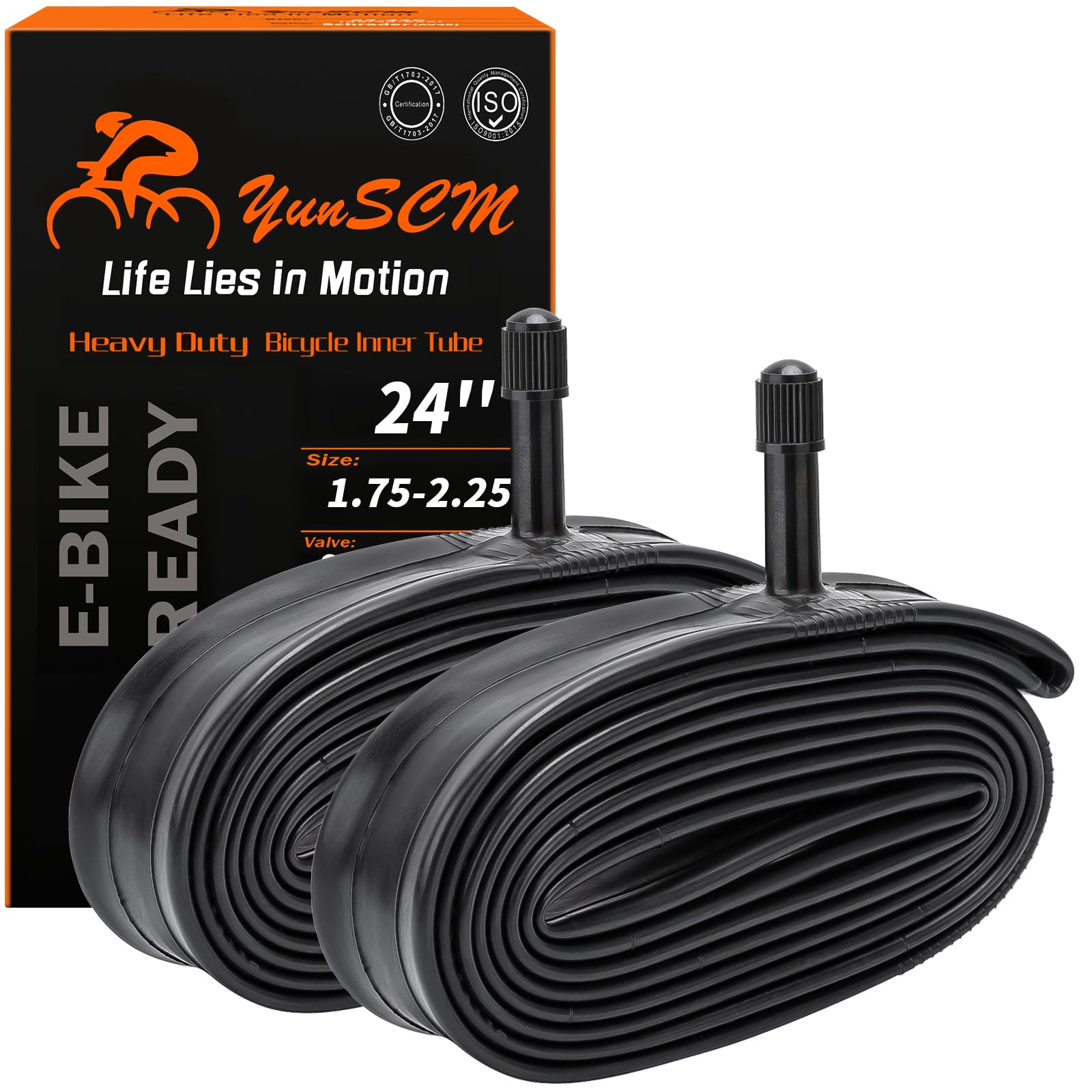
YunSCM Heavy Duty 24" 2-Pack

YunSCM Heavy Duty 24" 2-Pack

Rough ground

Our Score 9.2/10
Check Price

Worth Noting

  • 32 mm valve is short for deeper rims
  • Heavier, slightly deader ride
Pack
2 tubes
Valve
Schrader, 32 mm
Wheel Size
24 inches
Tire Width Range
1.75 to 2.25 inches
Read the full review

"Heavy duty" is the most worn phrase in the tube aisle, and YunSCM at least puts a number behind it: a claimed 40% increase in wall thickness, from a butyl and EPDM blend, in a two-pack sized 1.75 to 2.25 inches.

Thicker rubber buys something real. There's more material between a thorn and the air inside, and more resistance to the chafe where a tube rubs against the inside of the casing on a soft tire. It costs something too: the pair is heavier in the hand, the ride is a touch deader under a light rider, and a kid doing laps of the driveway gets little from either benefit.

The 32 mm valve is the first thing we check. It's short by the standards of this group, and on a rim with any depth the pump head ends up jammed against the rim instead of seated on the valve. On a flat-rimmed kids' bike or a cruiser it's a non-issue, and what you get is a spare in the box and a tube that should take more abuse than the standard-weight picks.

Bottom line: We recommend this thicker butyl pair to riders who keep flatting on rough ground, as long as the rim isn't deep enough to swallow a 32 mm valve.

4

Ultraverse 24" Tube 2-Pack

Ultraverse 24" Tube 2-Pack

First tube swaps

Our Score 9.2/10
Check Price

Worth Noting

  • Levers are light-duty plastic
  • Range stops short of 2.25-inch tires
Valve
Schrader, 37 mm
Included
2 tire levers
Wheel Size
24 inches
Tire Width Range
1.75 to 2.13 inches
Read the full review

Two plastic tire levers and a folded instruction sheet come in the box, and that's the detail that makes this the pair we hand to a first-timer. Levers are the tool people forget, and a swap without them usually ends with a pinched tube and a walk back to the shop.

The tubes are butyl, sized 1.75 to 2.13 inches, with a 37 mm Schrader valve that sits proud of a standard rim without fouling anything. The valve is reinforced at the base, which is where a tube most often tears when a tire goes on carelessly, and both tubes ship with the levers in the same pack.

The levers are basic plastic — fine for a tube change twice a year, not what you want if you're swapping tires weekly, and a proper lever set is worth having if you are. The width range stops at 2.13 inches, so a 2.25 cruiser tire falls outside it; check the sidewall before you assume.

Bottom line: The pair we hand to someone changing a tube for the first time, because the levers and instructions come in the box and the fit covers most 24-inch tires.

5

Calpalmy 24" Tube 2-Pack

Calpalmy 24" Tube 2-Pack

Two-bike households

Our Score 9.0/10
Check Price

Worth Noting

  • Tops out at 2.125-inch tires
Pack
2 tubes
Valve
Schrader
Wheel Size
24 inches
Tire Width Range
1.75 to 2.125 inches
Read the full review

Two 24-inch bikes in one garage is the situation this box is built for. Calpalmy sells two butyl tubes sized 1.75 to 2.125 inches, which covers a kid's mountain bike and a cruiser in a single purchase and leaves a spare on the shelf rather than a second order.

Butyl is the right material here — it holds air better than natural rubber and doesn't mind sitting in a cold shed between rides. The claim that the wall is four times thicker than other brands is marketing; treat the butyl as the useful part and the multiplier as noise.

The size turns up in places that aren't bicycles, too. A 24-inch tube fits a wheelbarrow tire, the rear wheels of a jogging stroller, and the utility carts that live in garages and get dragged out twice a year. If that's your job, a pair is generous — one goes in, one waits.

The caveat is consistency. A tube from a box like this can arrive with a pinhole or lose pressure within a day, and what we do before fitting any tube from a multi-pack is a bowl of water: inflate it, dunk it, watch for bubbles. That ten-minute check is the difference between a fix and a wasted Saturday, and past it this is the best value here for a household with more than one 24-inch wheel to keep rolling.

Bottom line: The pair we recommend when more than one 24-inch wheel lives at your house, as long as you're willing to water-test each tube before fitting it.

6

DBXIIART 24" Tube 2-Pack

DBXIIART 24" Tube 2-Pack

Spare-pair value

Our Score 9.0/10
Check Price

Worth Noting

  • Modest thickness for a heavy-duty label
Valve
Schrader, 35 mm
Wheel Size
24 inches
Wall Thickness
1.1 mm
Tire Width Range
44 to 54 mm
Read the full review

1.1 mm is the only actual wall-thickness figure we found in this group. Everything else says heavy duty or claims a percentage; DBXIIART prints a number and calls it about 15% thicker than other brands, which at least gives you something to compare.

Whether 1.1 mm feels thick is another matter. Against a department-store tube it's a step up; against the heavy-duty picks here it's modest, and once the tube is inflated the difference is easy to talk yourself out of.

The rest is straightforward: two butyl tubes for 44 to 54 mm tires, 35 mm Schrader valves, and a wall meant to shrug off chafe and small road debris. The 35 mm stem matches the Bell standard and clears a normal rim without fuss.

Two tubes for the money of one name-brand single is the argument, and it's a good one for a bike that gets locked outside or ridden hard. Just don't read 1.1 mm as puncture-proof — thickness slows a thorn down, it doesn't cancel it, and a tube at this price is still a wear item you'll replace.

Bottom line: Two tubes for the price of one branded single, and we buy this pair as a spare to keep in the shed for a commuter or a hard-ridden BMX.

7

Bell Self-Sealing 24" Tube

Bell Self-Sealing 24" Tube

Thorn-prone rides

Our Score 8.8/10
Check Price

Worth Noting

  • About 110 grams heavier than a plain tube
  • Costs more than the standard version
Valve
Schrader, 40 mm
Wheel Size
24 inches
Tube Weight
10.6 oz
Tire Width Range
1.75 to 2.25 inches
Read the full review

Bell's self-sealing 24-inch tube weighs 300 grams against the 190 of the plain version, and those 110 grams are the sealant already sloshing around inside. That liquid is the whole pitch: it seals punctures up to 1/8 inch as you ride, and Bell says it won't dry out or freeze for up to two years.

We think the trade makes sense on the right bike. A goathead-infested path, a commute along a glass-strewn shoulder, a blackberry shortcut — those are the conditions where a tube that fixes itself mid-ride earns its weight. On a bike that does laps of a smooth driveway, you're carrying the extra grams and paying more for a repair you'll probably never need, and the plain Bell tube does the same job lighter.

The valve runs 40 mm, five longer than the standard version, which helps on a recessed rim where the pump head needs the extra stem. As with any sealant tube, keep the valve at the top of the wheel when you add air so the liquid settles away from the core, and keep the cap on. Sealant that reaches the core can clog it, and then you can't top up at all.

Bottom line: We think it's worth the extra weight and money if thorns and glass are part of your ride, since the sealant is already inside and closes small punctures while you pedal.

8

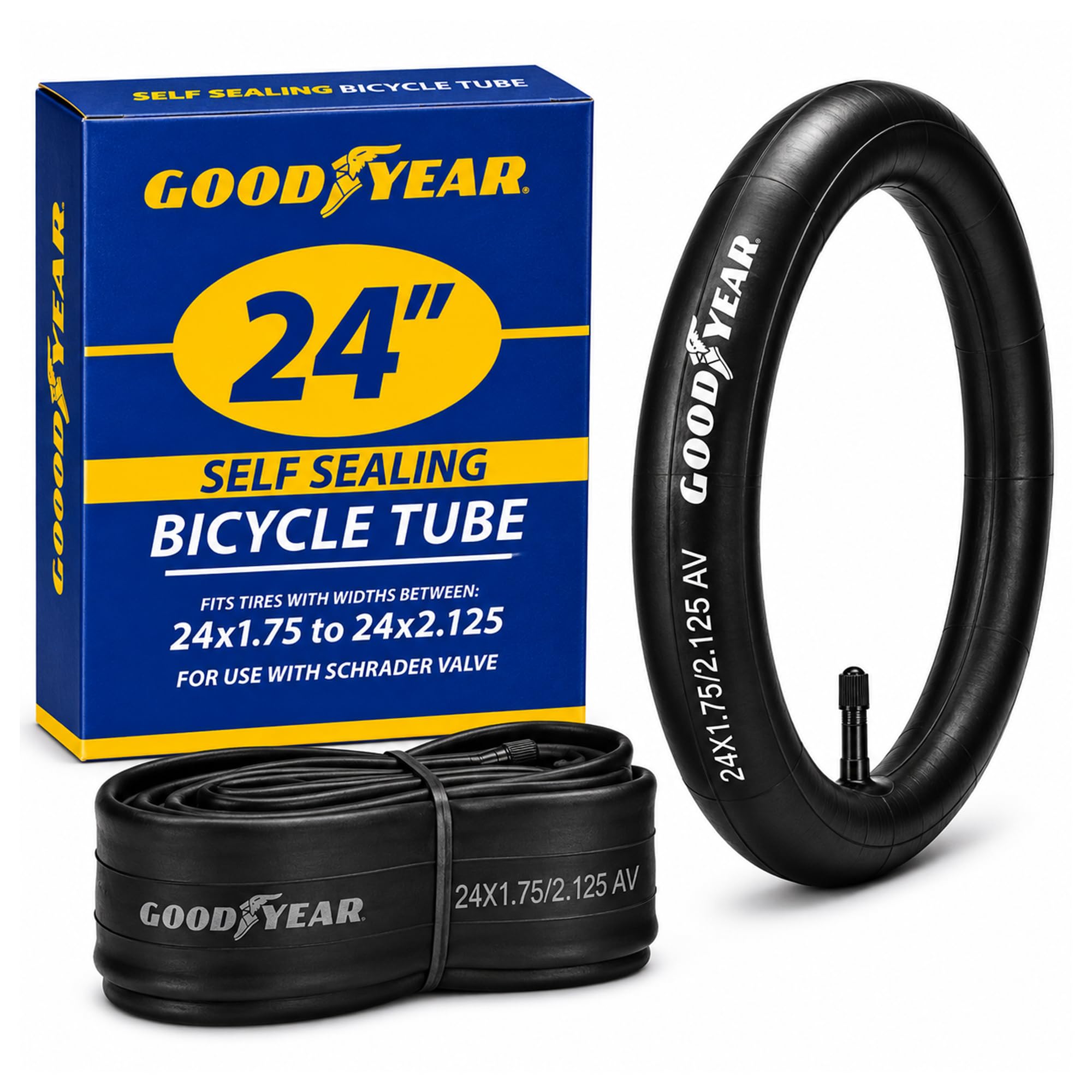
Goodyear 24" Butyl Tube

Goodyear 24" Butyl Tube

Brand-name single

Our Score 8.8/10
Check Price

Worth Noting

  • 30-day defect warranty, shortest here
  • Sold as a single tube
Pack
1 tube
Valve
Schrader
Wheel Size
24 inches
Tire Width Range
44 to 54 mm
Read the full review

Goodyear's name is on the box; the tube inside is made by Kent International, which licenses the brand for bicycle products. That's not a knock — Kent has been building bikes and tubes for a long time — but it tells you what the badge is worth, which is less than the size printed beside it.

The size is what matters, and 44 to 54 mm covers the familiar 24 x 1.75 through 24 x 2.125 tires, with a Schrader valve and butyl rubber doing exactly what you'd expect. For a plain replacement we still point people to Bell's standard tube, which fits the same tires for less, so the Goodyear's case rests on picking one up locally or wanting the name on the box.

The number worth reading twice is the warranty: 30 days on manufacturer defects, the shortest coverage here. A tube that fails at a seam in week six is your problem. Buy it if the brand is what gets you to the counter; the tube itself is an ordinary butyl tube, and ordinary is fine.

Bottom line: A sound standard tube for 44- to 54-mm 24-inch tires; we just wish the badge came with more than a 30-day warranty.

How We Tested 24-Inch Bike Tubes

We started by pulling together 16 tubes from established tire brands, covering the common 24-inch tire sizes and both Schrader and Presta valves. We filtered the shortlist by stated size, measured wall thickness, and price per tube, then put each one into service over four months on a kid’s 24-inch bike, a BMX, and a neighborhood cruiser. That meant driveway flat fixes, after-school laps, gravel-path shortcuts, and the occasional curb hop—real riding, not a shelf test.

Installation was the first hurdle: we mounted every tube by hand with two tire levers, timed the job, and noted whether the tube fought the rim or settled evenly. After inflating, we checked the bead line all the way around and measured the tube’s inflated width against the tire casing to catch size mismatches. We also calipered wall thickness at the seam and opposite the valve, because a tube that runs thin in one spot is a flat waiting to happen.

For air retention, we set pressure with a digital gauge, then rechecked at 24 hours and one week; tubes that drifted got a second look. Suspects went into a bucket of water, where we watched for bubble trails at the seam, valve, and patch area. On the bikes, we rode gravel, broken pavement, and glass-strewn bike paths, then inspected for abrasion and counted every flat.

At the end, we compared cost per tube with how often each one needed replacing—a cheap tube that pinched on installation or lost air overnight was no bargain. The best ones seated without drama, held pressure, and survived the kind of riding that usually produces a slow leak.

How to Choose 24-Inch Bike Tubes

Read the Number on the Tire First

Twenty-four inches describes the wheel's outer diameter, not the rim the tube sits on. Almost every 24-inch kids' bike, cruiser, BMX and mountain bike uses a 507 mm bead seat, and the box will say so: a 47-507 tube suits a 1.75 tire, a 54-507 suits a 2.125. Some juvenile road bikes use 24 x 1 3/8, a 540 mm rim, and a 507 tube will not fit it however confidently the box says 24 inch.

Take the number off your tire's sidewall and match it to the tube's range before you look at anything else.

Choose a Range, Not an Exact Size

Tubes are sold against a band of tire widths because the rubber stretches. A 1.75-to-2.25 tube like the Bell standard covers most of the category; Schwalbe's AV10 spans 40 to 62 mm for tires outside that band. Too narrow a tube thins as it stretches and punctures more readily, while a slightly wide tube simply sits a little folded inside the casing, which does no harm.

Match the Valve to the Rim

Nearly every 24-inch bike sold here takes a Schrader valve, the wide one that looks like a car tire's; Presta, the narrow one, turns up on juvenile road bikes. Buy what your rim already takes, since the hole in the rim is the constraint, not the pump.

Stem length matters as much. A 32 mm valve can disappear inside a deep rim and leave a pump head nowhere to sit, while 35 to 40 mm clears a standard rim and a recessed one.

Plain, Self-Sealing, or Heavy Duty

Three upgrades, three different bills. Sealant, pre-installed in something like Bell's self-sealing tube, closes small punctures as you ride but adds around 110 grams and can gum a valve core if it reaches it. Thicker rubber — the YunSCM pair claims 40% more — resists thorns and chafe at the cost of weight and a slightly deader ride.

On a light kids' bike, plain butyl at standard weight is often the better ride. On a commuter crossing glass every morning, the trade pays for itself.

Singles, Pairs, and What's in the Box

Count the 24-inch wheels in your house before ordering. One bike and one spare tube is enough; two bikes justify a pair like the Calpalmy two-pack, which keeps a spare on the shelf without a second trip. Included tire levers, as with the Ultraverse pair, matter more than they sound — levers are the tool people forget, and a lever is what prevents the pinched tube that sends you back to the shop.

Frequently Asked Questions

Final Verdict

The Bell Standard is what we tell most people to buy. Its 1.75-to-2.25-inch range covers nearly every 24-inch bike in a garage, the 190-gram tube goes in without a fight, and it is the least expensive single tube on this page.

Two situations change the answer. If your rides run through goatheads or roadside glass, the self-sealing Bell earns its extra 110 grams by closing punctures while you pedal. If you are stocking a house with two 24-inch bikes, the Calpalmy pair puts a spare on the shelf. And if your tire sits outside the usual band — a narrow 24 x 1.5 or a wide 24 x 2.4 — only the Schwalbe AV10 is specified for the job.