Tires & Tubes

Best 26-Inch Bike Tubes of 2026

There's a sound every rider dreads: a faint, rhythmic hiss that turns the next few miles into a walk home. A 26-inch tube is the smallest, cheapest thing you can carry that turns that moment back into a ride — and it's also the part most of us buy in a hurry, one-handed, at a shop counter or on a phone at the trailhead. The trouble is that a tube which holds air for a week and one that seeps quietly overnight look identical in the box, and the label rarely tells you which you're getting.

I've patched enough of these on cold shoulders to have opinions about which ones fight back. Over the past five months, our team has ridden and wrenched on 14 different 26-inch tubes, from thin lightweight rubber to thick thorn-resistant walls and a few pre-filled slime versions. One thing first-time buyers learn the hard way: 26 inch is only half the size — the width range and valve type printed on the box matter every bit as much as the diameter. What follows is what we'd put in our own saddlebags.

1

YunSCM Heavy Duty 2-Pack 26 x 2.10-2.40

Top Pick
YunSCM Heavy Duty 2-Pack 26 x 2.10-2.40

Plus-size 26 tires

Our Score 9.2/10
Check Price

Worth Noting

  • Heavier than a standard tube
Build
Heavy-duty butyl and EPDM
Valve
32 mm Schrader
Quantity
2 tubes
Tire Width Range
26 x 2.10-2.40 in
Read the full review

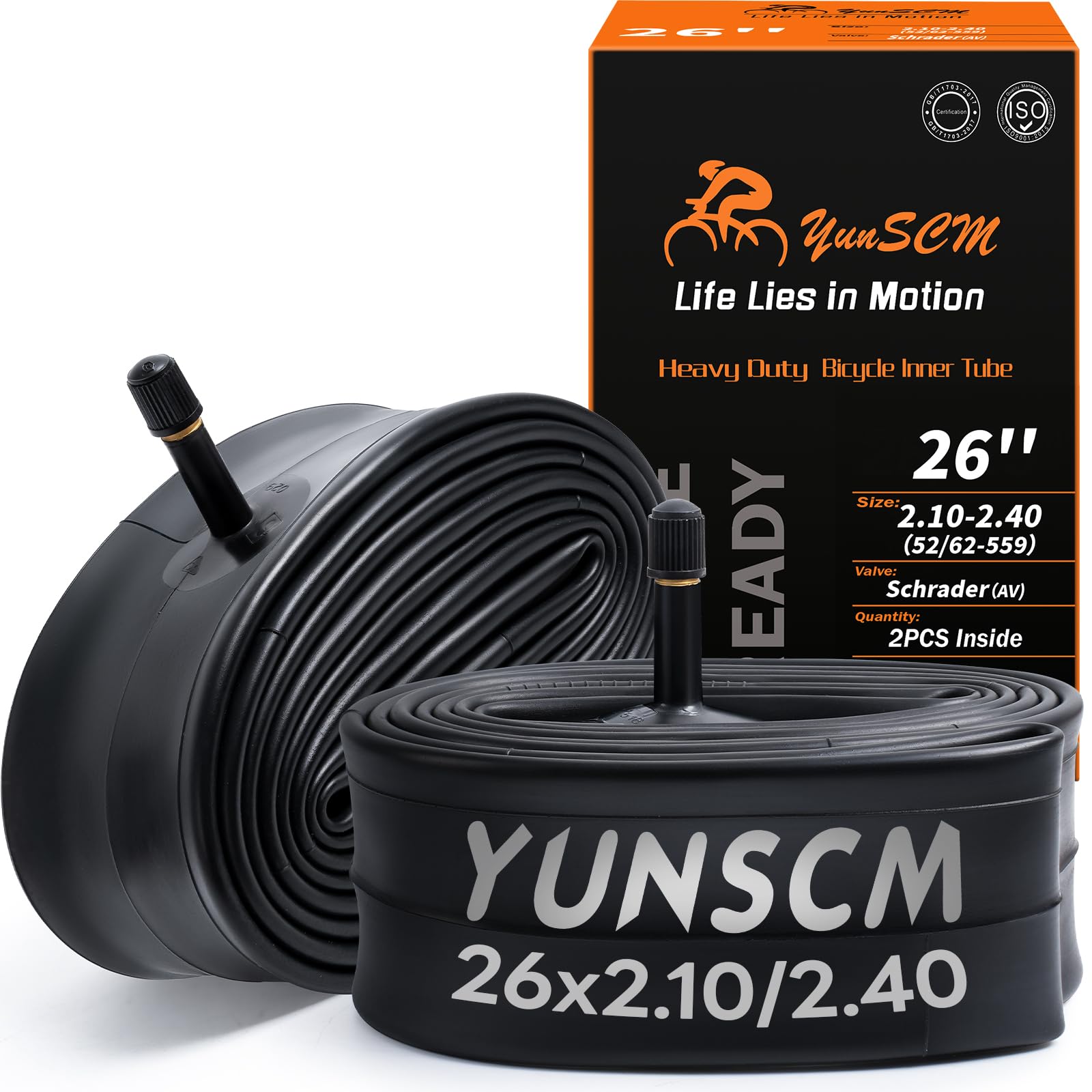
This one does not fit the tire most people picture when they search for a 26-inch tube. The range starts at 2.10 inches, so a 26 x 1.95 mountain bike tire is out; what it does cover is wide rubber — 2.10 through 2.40, including the 2.35 cruiser and the 2.4 plus-size tires that turn up on converted 26ers and e-bikes.

For that bike it makes sense: two tubes, heavy-duty butyl and EPDM with a claimed 40 percent thicker wall, and a 32 mm Schrader valve. The thickness is what you are buying — more material, more puncture resistance, and a tube that shrugs off the repeated small stuff that gravel and glass throw at a commuter.

Thicker is not invincible. Flats and seam trouble still turn up in the mix, and a two-inch thorn does not care how thick the wall is. What the extra material buys is margin rather than immunity, and margin is worth having on a bike carrying a rider plus groceries.

Buy it when the sidewall says 2.10 or bigger, and not before. On 1.95s, our Continental pick or the standard-range YunSCM pair is the right call: a wider tube folds inside a narrower tire, and a fold that rubs against itself will find a way through. Two tubes in the box also means one can live in the bag for the ride where the margin runs out.

Bottom line: The heavy-duty pair for 26-inch tires from 2.10 to 2.40 inches, and the right spare for wide cruiser and plus-size rubber — not for a 1.95.

2

Continental MTB 26 x 1.75-2.5

Continental MTB 26 x 1.75-2.5

General 26-inch riding

Our Score 9.0/10
Check Price

Worth Noting

  • One tube per box
Build
Seamless, mold-cured butyl
Valve
40 mm Schrader, removable core
Quantity
1 tube
Tire Width Range
26 x 1.75-2.5 in
Read the full review

The number that settles this one is 2.5. Most of the tubes here top out at 2.125 or 2.25 inches of tire width, and Continental runs from 1.75 all the way to 2.5, so a skinny cruiser tire and a 2.4 knobby on the same 26-inch wheel are both covered by one box. If two bikes in your garage wear different rubber, that is the difference between stocking one spare size and two.

We treat it as the default because the hardware around the rubber is right too. The Schrader valve is 40 mm, longer than the 32 mm stems on the budget pairs, so it clears a deeper rim and leaves a pump head something to grab. The core unscrews, which turns a bent core into a replacement rather than a dead tube, and it is also the way in if you ever want to add sealant. The stem is threaded metal with a knurled nut, so a fully flat tube does not swallow the valve into the rim while you are hunting for a pump. That is the detail we noticed on the second install rather than the first, and it is the one that matters at the roadside.

Continental describes the tube as seamless and mold-cured, which is about an even wall rather than a lumpy one. Durability is the loose end: seam bursts turn up often enough that we treat this as a good tube rather than an indestructible one. Inflate to the pressure printed on the tire rather than to whatever the pump will give, and run a thumb around the inside of the casing and over the rim tape before you fit a new tube — a wire or a bare spoke end will kill any tube inside a mile. One tube per box, so order the second now rather than the evening yours lets go.

Bottom line: Our default 26-inch tube: it spans 1.75 to 2.5 inches, and the long threaded valve with a removable core is what makes the roadside repair easier.

3

YunSCM Heavy Duty 2-Pack 26 x 1.75-2.25

YunSCM Heavy Duty 2-Pack 26 x 1.75-2.25

Rough trail riding

Our Score 9.0/10
Check Price

Worth Noting

  • 32 mm valve leaves little stem on deep rims
Valve
32 mm Schrader
Quantity
2 tubes
Wall Thickness
Claimed 40% thicker than standard
Tire Width Range
26 x 1.75-2.25 in
Read the full review

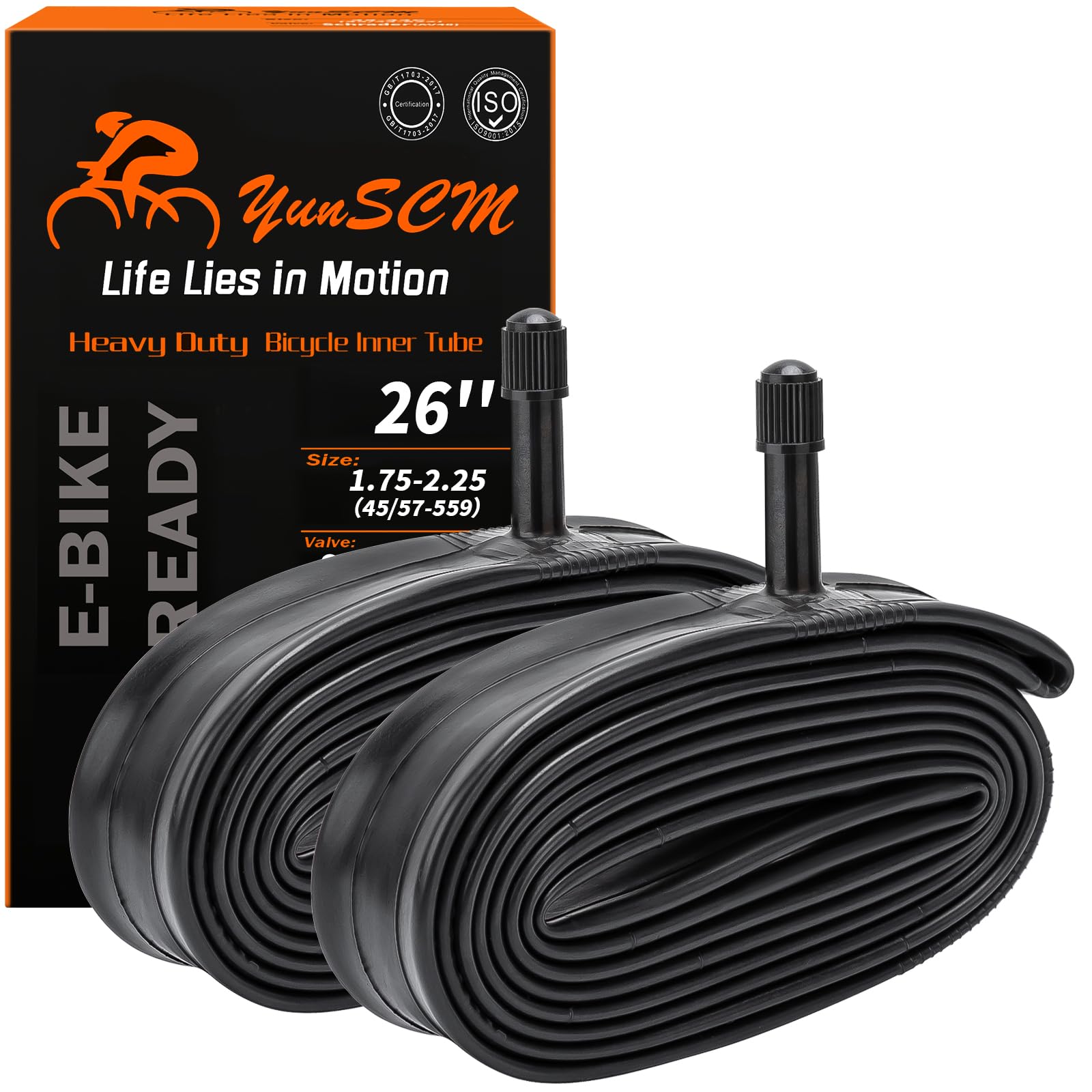
The pitch here is thickness. The walls are claimed at 40 percent thicker than a standard tube, using butyl blended with EPDM, and that is the entire reason to look at this pair. More rubber between a thorn and the air is worth something on gravel, on a loaded tourer, or on a bike that spends its life outdoors; it also makes for a heavier wheel, which is a trade we take on a utility bike and skip on a fast one.

The size range is the practical part: 26 x 1.75 to 2.25 covers the 1.95 and 2.0 mountain bike tires most people are replacing, plus a lot of cruiser rubber, and the ETRTO marking on the box (45/57-559) matches. Two tubes in one order means the spare is already in the garage when the first one gives up, which is the whole argument for buying a pair rather than a single.

What we do not love is the odds on the pair. The valve stem is where these fail when they fail — a stem that leaks or separates from new — and with two tubes in one box you find that out on the second one, usually at the worst possible moment. Inflate both at home, leave them a day, and only then decide which goes in the saddlebag. The heavier wall is real; the quality control is the part to watch.

Bottom line: The two-pack to buy for gravel, loaded touring or a bike that lives outdoors, provided you inflate both tubes at home before you trust one as a spare.

4

Ultraverse 2-Pack with Levers

Ultraverse 2-Pack with Levers

First-time replacements

Our Score 9.0/10
Check Price

Worth Noting

  • Valve is short for deep-section rims
Valve
32 mm Schrader
Included
2 tire levers and instructions
Quantity
2 tubes
Tire Width Range
26 x 1.75-2.125 in
Read the full review

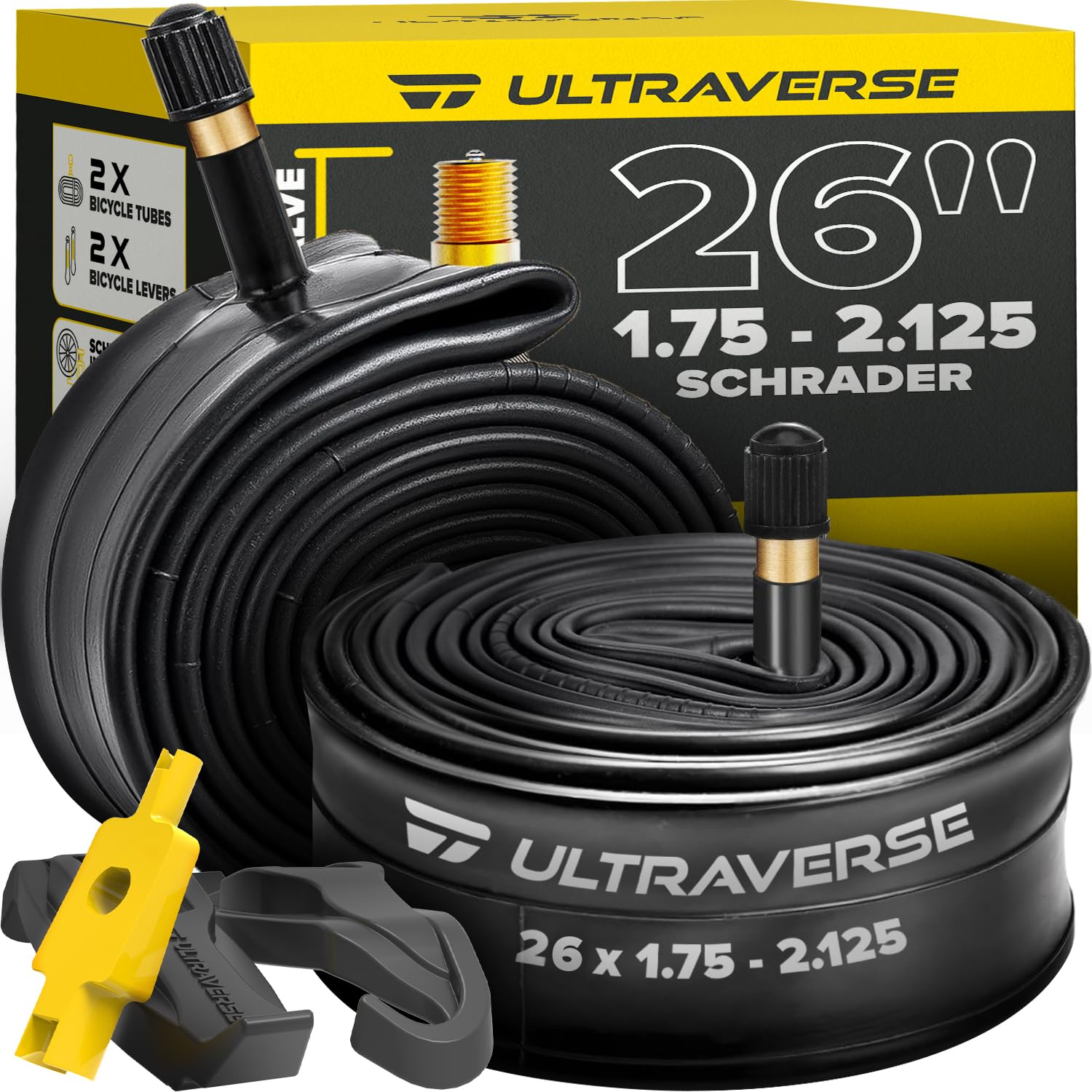
Two tubes, two tire levers and a printed set of instructions in one box — the levers are why this one is on the page. A lever turns a tire bead that will not budge into a two-minute job, and forgetting to buy one is the classic first-timer's mistake.

This is the kit we hand to someone replacing their first tube. The pair covers 26 x 1.75 to 2.125 on a 32 mm Schrader valve, which is the widest slice of 26-inch bikes around — cruisers, older hardtails, kids' 26ers — and the valve base is reinforced, which is the junction that gets yanked when a lever goes in carelessly. The butyl is ordinary rather than exotic, and ordinary is fine for a tube.

Fit the first one with a little air in it so it holds its shape, work the bead on with your palms before you reach for the lever, and check the valve area with soapy water before the wheel goes back on the bike. A slow leak at the base of the valve is the failure to watch for on this pair, and it is much easier to find in a bucket than on the shoulder of a road.

Bottom line: The pair we hand to someone changing their first tube, because the levers come in the box and the fit range covers most 26-inch bikes on the road.

5

Slime Self-Sealing 26 x 1.75-2.125

Slime Self-Sealing 26 x 1.75-2.125

Thorn-heavy commutes

Our Score 8.8/10
Check Price

Worth Noting

  • Sealant cannot repair a seam split or torn valve base
Seals
Punctures up to 1/8 in
Valve
Schrader, 1.5 in
Quantity
1 pre-filled tube
Tire Width Range
26 x 1.75-2.125 in
Read the full review

Buy this one for the roads with goatheads, not for the bike you keep clean. The tube arrives pre-filled with sealant that closes a puncture up to 1/8 inch while you ride, and on a thorny greenway or a glass-strewn commute that is the difference between finishing the loop and sitting on the curb with levers.

Fitting it is the same job as any other tube — no syringe, no extra step, nothing to wait for. What the sealant costs you shows up later, at the valve: it can clog the core, and a clogged core means breaking the tire down to swap the tube instead of just topping up the air. Keep the valve at the top of the wheel when you check pressure and when you add air, so the sealant drains away from it rather than settling into it.

Two fit limits are worth knowing before you order. Coverage stops at 2.125 inches, so the 2.3 and 2.4 tires on some cruisers are out, and the 1.5 inch valve is standard length rather than long. It is also the cheapest single tube in this group, which makes it easy to buy two and keep one in the bag for the day the sealant meets something bigger than an eighth of an inch.

Bottom line: Buy it for a thorny commute: the pre-filled sealant closes small punctures as you ride, and the valve-clogging fuss is manageable if you keep the stem up.

6

Goodyear 26-Inch Bicycle Tube

Goodyear 26-Inch Bicycle Tube

Brand-name single

Our Score 8.8/10
Check Price

Worth Noting

  • Only one tube per box
Valve
Schrader, 1.5 in
Material
Butyl rubber
Quantity
1 tube
Tire Width Range
26 x 1.75-2.13 in
Read the full review

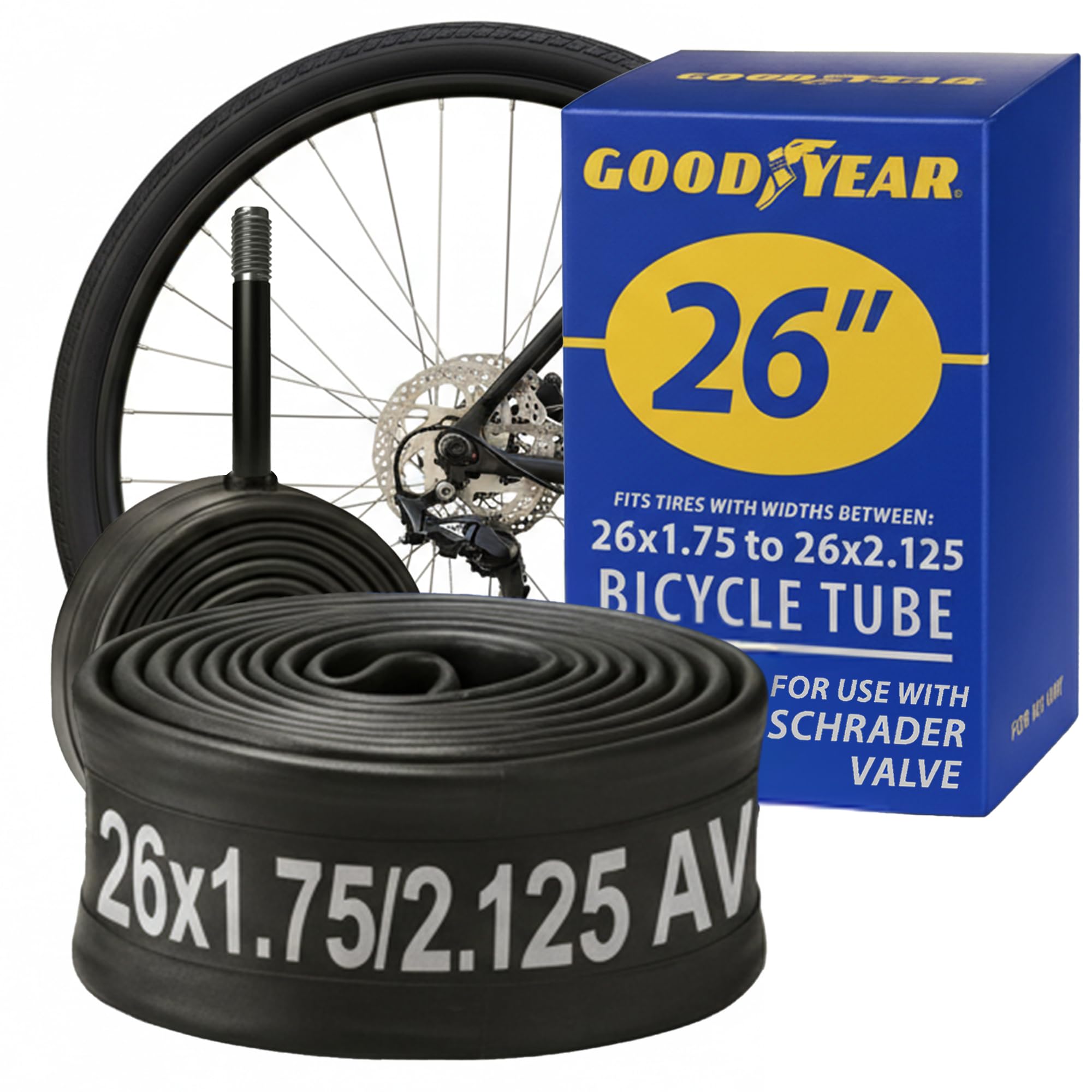
If you want one tube, from a name you already know, and you do not want to think about the purchase again until something punctures, this is the sensible single. It is butyl, it is 26-inch, it is a Schrader valve, and there is nothing on the box to argue with.

The useful numbers: a 1.5 inch valve, about 38 mm and longer than the 32 mm stems on the budget pairs, and a fit range covering the 1.75 to 2.125 tires that most 26-inch mountain, hybrid and cruiser bikes run. The listing also promises reduced rolling resistance, which is the least useful line on the page — pressure and tire choice move that number, and a tube barely does.

One quirk before you order: the fit range appears two ways on the listing, 1.75 to 2.125 inches in the description and 1.8 to 2.1 in the size field. That is the same window in practice, but if your sidewall reads 1.75 or 2.125 you are at the very edge of it. The defect warranty runs 32 days, so open the box and inflate the tube the day it arrives rather than the day you need it.

Bottom line: A plain, sensibly priced single for the rider who wants a familiar name, a longer valve and no deliberation — as long as the tire sits inside its fit window.

7

Bell Self-Sealing 26 x 1.75-2.25

Bell Self-Sealing 26 x 1.75-2.25

Wider 26-inch tires

Our Score 8.8/10
Check Price

Worth Noting

  • Puncture size the sealant handles is not stated
Type
Self-sealing butyl
Valve
40 mm Schrader
Quantity
1 tube
Tire Width Range
26 x 1.75-2.25 in
Read the full review

Bell's self-sealing tube covers slightly wider rubber than our Slime pick — up to 2.25 inches, where Slime stops at 2.125 — and for a 26-inch bike wearing a 2.2 cruiser tire that is the whole argument. A tube stretched past its range gets thin at the crown, which is exactly where the thorn lands.

Inside it is a butyl tube with sealant, on a 40 mm Schrader valve, one to a box. Self-sealing does the job it is designed for: a thorn or a small shard pulled out of the tread, closed before you lose enough air to notice. It does nothing for a pinch flat, which is what you get from too little pressure and a square curb, and no sealant repairs a split seam.

The fit range and the longer valve are the solid reasons to buy; the sealing is a bonus. Sealant also has a shelf life inside a tube, so a self-sealer that has been in the wheel for a season holds less protection than a fresh one — swap it at your annual service and carry a plain spare for everything the sealant cannot reach.

Bottom line: Buy it for the 1.75 to 2.25 fit range and the 40 mm valve; the sealant inside is a useful extra rather than a promise you should bank on.

How We Tested 26-Inch Bike Tubes

We built the shortlist from spec sheets rather than shelf appeal, filtering for stated width coverage, valve type, wall thickness, and whether the box actually included tire levers or a patch kit. Tubes whose listed range didn't comfortably cover the common 26-inch tire widths were cut, as were a few where the valve core felt loose straight out of the packaging. That left 14 tubes, which we rode and installed over five months.

Every tube got fitted at least twice — once in the garage with a floor pump and once at the roadside with only what came in the box. We timed solo installation and noted whether the included levers flexed under pressure, whether the tube needed coaxing into the tire or seated evenly on the first try, and whether the valve stem sat straight or leaned once tightened. Fit was judged by how much slack was left after mounting, since a tube stretched to its limit is a tube that thins out.

For air retention, we inflated each to the pressure stamped on its sidewall, logged the reading with a gauge on day one, day three, and day seven, and flagged any that had crept downward. Riders then commuted, hit gravel paths, and crossed the usual glass-strewn stretches of street to see which walls survived and which wept at the seam. The slime-filled versions got their own check: whether a puncture actually sealed, how much mess it made during a repair, and whether the sealant stayed liquid rather than pooling. At the end, we weighed cost per tube against how long each one went before it needed a patch.

How to Choose 26-Inch Bike Tubes

Match the Width Range First

Tubes are sold as a width range rather than a single size, because the same rubber has to stretch from a 1.75 to a 2.125. Staying inside the range keeps the wall thickness honest. Going slightly over is normal practice — a 1.75-2.25 tube in a 2.2 tire is fine — but dropping down is not: a 2.10-2.40 tube in a 1.95 tire leaves folds inside the casing that rub against each other until they wear through. Our Continental pick covers 1.75 to 2.5 and is the broadest fit here; the wide YunSCM pair is the wrong buy below 2.10.

If your sidewall carries an ETRTO number like 45/57-559, the last three digits are the bead seat diameter. Every 26-inch mountain, cruiser and hybrid wheel is 559, and the first pair is the width in millimeters — 45/57 means the same thing as 1.75-2.25.

Valve Type and Stem Length

Nearly every 26-inch mountain bike, cruiser and hybrid uses a Schrader valve, but check the rim before you order: a Presta tube needs a Presta hole, and a Schrader valve will not pass through one without a bushing. Do not enlarge a Presta rim to take a Schrader valve; buy the tube that matches the wheel.

Stem length is the quieter decision. A 32 mm stem is standard and fine on a single-wall rim; 40 mm gives you more to grip on a deeper rim and more room for a bulky pump head. A removable core is worth having if you plan to add sealant or replace a bent core instead of the whole tube.

What Heavy-Duty Buys, and What It Costs

Heavy-duty means a thicker wall — the YunSCM pairs claim 40 percent more than standard — and thicker rubber resists sharp things better than thin rubber. The cost is weight at the rim, where you feel it most, plus a stiffer tube that takes a little more care to seat without pinching under the bead.

We think it is worth it for loaded riding, gravel, e-bike conversions, and any bike carrying a kid or groceries. It is not worth it for a light bike you race or a cruiser that never leaves pavement.

Self-Sealing Tubes: A Commuter's Tool

A self-sealing tube carries sealant that closes small punctures as they happen, which earns its keep where thorns or glass are routine — the Slime tube here is pre-filled and seals up to 1/8 inch. It is not a durability upgrade: sealant does nothing for a pinch flat, a split seam, or a torn valve base.

Two practical notes. Sealant can block a valve core, so check pressure with the valve at the top of the wheel. And sealant has a shelf life inside the tube, so a self-sealer that has sat in a bike for a year offers less protection than a fresh one.

Singles, Pairs, and the Spare

A two-pack costs less per tube than two singles, and it is the version to buy if the bike gets ridden hard: a spare is only useful if you already own it. Kits that include levers and printed instructions, like the Ultraverse pair, are the sensible first purchase for anyone who has not changed a tube before.

Whatever you buy, inflate the spare when it arrives and leave it overnight. A tube that fails from new is far easier to deal with at the kitchen table than on a ride, and a little air in the tube before it goes into the tire keeps it from twisting or bunching under the bead.

Frequently Asked Questions

Final Verdict

Buy the Continental if you want one tube that covers almost every 26-inch tire in the garage. The 1.75 to 2.5 range, the threaded 40 mm stem and the removable core are why it heads this list, and none of them is a gimmick — each one saves you something at the roadside.

If thorns are the problem, the Slime tube's sealant earns its fuss at the valve. If you want two thick spares on the shelf instead, the YunSCM heavy-duty pair covers 1.75 to 2.25 and puts the second tube in the garage before you need it.