Bikes

Best 24-Inch Kids Bikes of 2026

A 24-inch bike is the one kids ride through the years when the driveway stops being enough. Suddenly they're pedaling to a friend's house, down to the corner store — and every wobble in the frame and every brake lever that needs a hard squeeze gets magnified. That's the problem a good one solves: steady at speed, sturdy under a growing rider, and still light enough that your kid wants to ride it up the hill home instead of walking it.

Over the past seven months, my team and I have lived with 12 of them, from the day the box landed in the garage to the morning we handed one down to a younger sibling. Assembly sorted the field faster than any spec sheet did: some went together in twenty minutes, others had me chasing a brake cable that never sat right. What I'd tell any first-time buyer is that inseam matters more than the age on the box — slightly too small beats slightly too big. The picks below are the ones my riders kept reaching for.

1

Bilbo 24-Inch Kids Bike

Top Pick
Bilbo 24-Inch Kids Bike

Everyday first 24-inch

Our Score 9.2/10
Check Price

Worth Noting

  • Single speed only, so hills are hard work
Fits
Riders 54 in and up
Tires
24 x 1.95 in
Brakes
Front and rear V-brakes
Drivetrain
Single speed
Read the full review

One gear, two hand brakes and a quick-release seat clamp: that's the whole control layout on the Bilbo, and it's exactly why we hand it to families who want a kid riding this weekend rather than learning a shifter first. It arrives 85 percent assembled with the tools in the box, and the saddle and bars adjust as your rider grows.

The brakes are what pushed it to the front of this group. Front and rear aluminum V-brakes with a lever on each side mean a rider coming off a coaster-brake 20-inch has something new to learn, but it's the right thing to learn: both hands on the bars, both levers squeezed together, and no pedal-backwards habit that stops working the moment they ride a friend's bike.

Bilbo lists a 54-inch minimum rider height, which lands it in tall-nine-year-old to twelve-year-old territory, and that adjustable cockpit is what buys the second and third season. The two-year manufacturer warranty is the other quiet advantage here, on the parts that actually wear.

Tires are the underrated part of a 24-inch bike. The Bilbo's 24 x 1.95-inch tires sit in the middle of this group, wide enough not to wash out on gravel and narrow enough not to drag on a bike path. Spin both wheels and squeeze both levers before the first ride; a pad rubbing the rim will make a strong rider feel slow and a tired one feel slower.

Bottom line: Our default 24-inch pick: one gear, two hand brakes and a build that arrives nearly finished, so a first big-kid bike becomes a weekend job rather than a project.
2

WEIZE 24-Inch Cruiser

WEIZE 24-Inch Cruiser

Budget around-town

Our Score 9.0/10
Check Price

Worth Noting

  • One gear only
  • One-year warranty is the shortest here
Fits
Riders 54 to 67 in
Brakes
Front and rear V-brakes
Extras
Front basket and chain guard
Drivetrain
Single speed
Read the full review

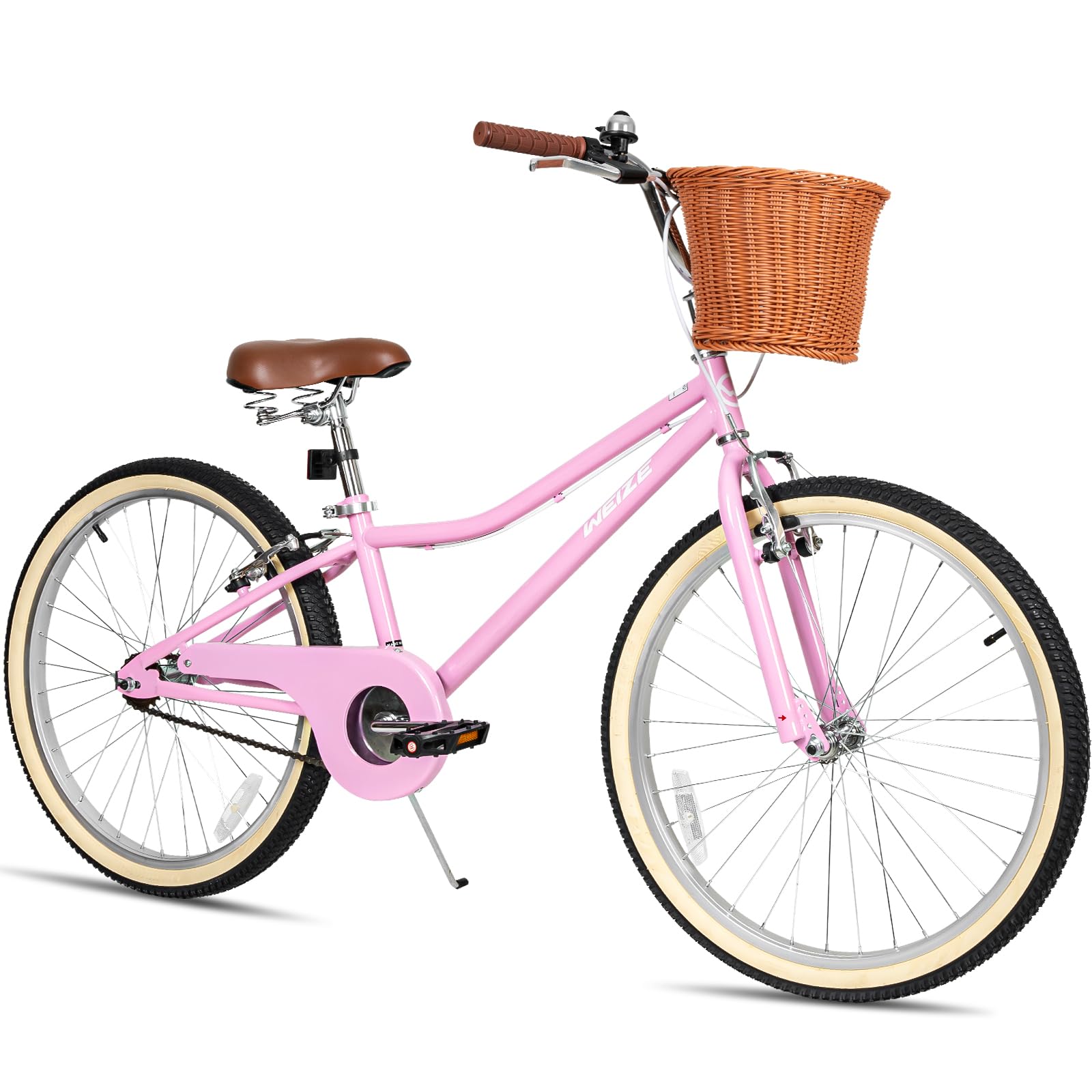
This is the least expensive way into 24-inch wheels in this group, and it doesn't read as a compromise from across the driveway: a step-through steel frame, a front basket, a chain guard and V-brakes front and rear, in a retro shape that looks like a bicycle rather than a toy. It arrives 85 percent assembled.

Where it earns its place is the school run and the park loop. The step-through frame means no swinging a leg over a basket, the chain guard keeps a skirt or a trouser cuff out of the drivetrain, and one gear plus two V-brakes is about as much maintenance as a ten-year-old should be responsible for.

We'd treat the basket as decoration with a job: it carries a water bottle and a snack, not a school bag. And as with every bike here, the brakes want a look before the first ride. Squeeze each lever and spin each wheel to make sure nothing rubs.

The fit range runs from 54 to 67 inches of rider height, which covers a tall nine-year-old through a young teenager, and the adjustable saddle stretches that further. If your rider sits at the bottom of that range and is growing fast, the same money buys a more adjustable cockpit on the Bilbo, with bars that move as well as the seat.

Bottom line: The value choice: a simple, good-looking cruiser for flat neighborhood riding, with a basket and chain guard a school-bound rider will actually use.

3

Glerc Skyline 24

Glerc Skyline 24

Tweens and trails

Our Score 8.8/10
Check Price

Worth Noting

  • Twenty-one gears mean more adjustment and upkeep
Brakes
Mechanical disc
Drivetrain
21-speed
Suspension
Front suspension fork
Minimum Rider Height
54 in
Read the full review

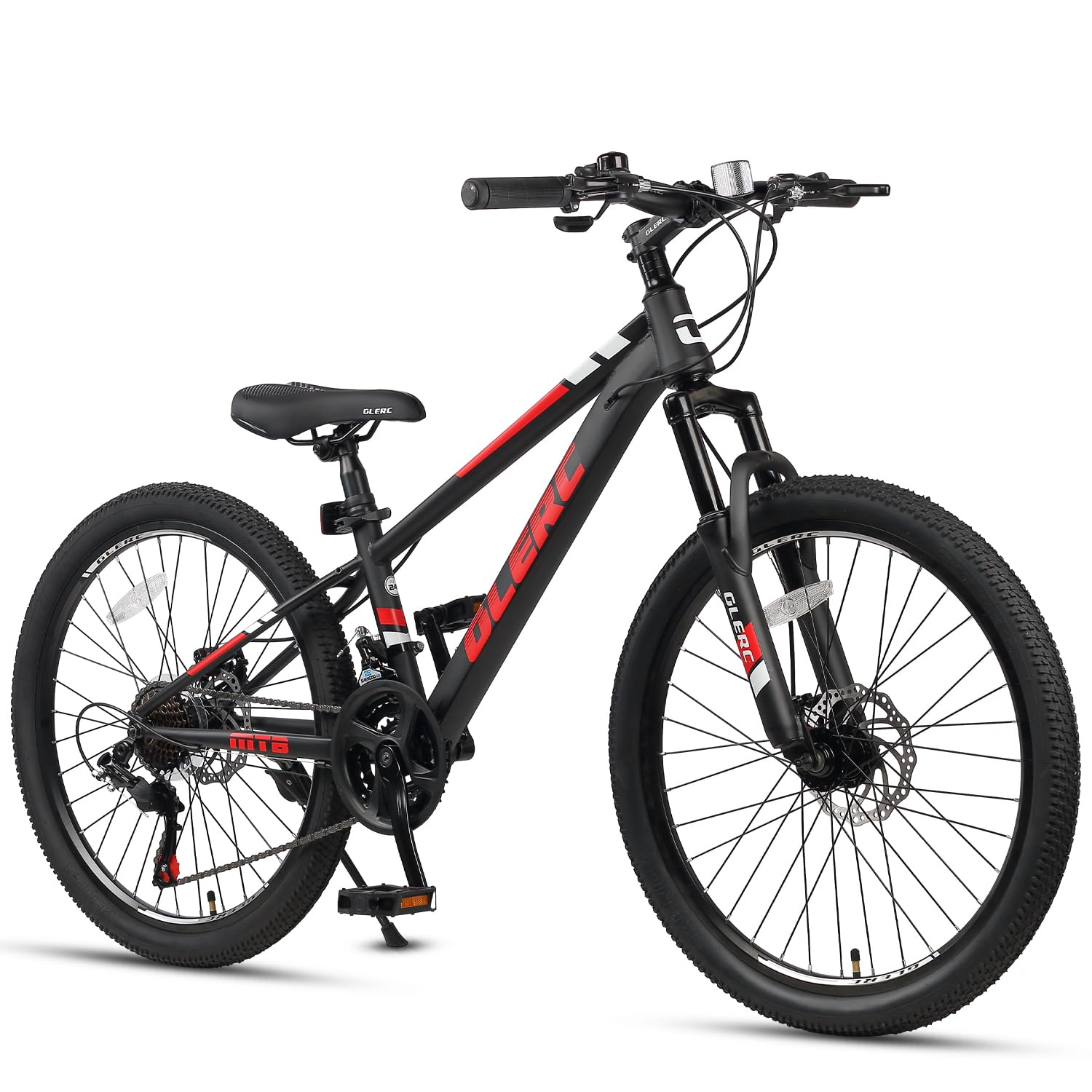
Twenty-one speeds on a kids' bike sounds like overkill until you watch a twelve-year-old try to get up a hill in one gear. That's the case for the Glerc Skyline: a 21-speed drivetrain with trigger shifters, mechanical disc brakes and a front suspension fork, on a high-carbon steel frame with a 54-inch minimum rider height, room to about 66 inches, and a 24- to 29-inch inseam.

We think it's the right bike for a kid who rides to school over hills, keeps up on longer family rides, or has started eyeing the green trails at the local park. The disc brakes are the real upgrade over the rim-brake bikes here, because they keep stopping in wet and mud, and the fork takes the sting out of curbs and root-broken path. The cost is a learning curve: two shifters take practice, and the first few rides will involve some grinding.

The thing we'd check before the first ride is front fork alignment and front derailleur indexing. A fork that's out of line sits the front wheel crooked, and a front mech that's out of index drops the chain the first time a rider shifts down. Neither is unusual on a bike that ships in a box, and both are quick jobs with a good video.

The 54-inch minimum is the number to confirm before ordering. This is the pick for a tall nine-year-old or a twelve-year-old, not for the kid still on the smallest 20-inch in the shed. And if your rider is already close to 66 inches, a 26-inch bike will fit better than any 24.

Bottom line: Buy this for a tall tween who rides hills or wants to try real trails: 21 speeds and disc brakes are a genuine step up, as long as the rider clears the 54-inch minimum.

4

Mongoose Argus 24

Mongoose Argus 24

Off-road and snow

Our Score 8.8/10
Check Price

Worth Noting

  • Twist shifter is easy to knock out of gear
  • The most expensive bike in this group
Tires
24 x 4 in
Brakes
Mechanical disc
Weight
30 lb
Drivetrain
7-speed
Read the full review

Four inches of tire width is the entire argument for the Argus. On sand, packed snow, loose gravel and the rutted grass at the edge of a park, those fat tires stay on top and keep grip where a 1.95-inch tire washes out. It's the only bike in this group built around that idea, and for a rider whose routes leave the pavement it changes what's rideable.

The rest of the build follows: a 7-speed 1x7 drivetrain with a twist shifter, mechanical disc brakes, and a 30-pound bike rated to 175 pounds and sized for riders from 4-foot-8 to 5-foot-6. On pavement the trade shows up immediately. Fat tires are slow to spin up and they hum on asphalt, so a two-mile bike-path ride feels like more work than it does on the Bilbo.

Where we'd keep an eye on it: the twist shifter sits right under the hand, and it's easy to knock a gear or two while changing grip or lifting the bike over a curb. Otherwise the Argus does what a fat bike is supposed to do, which is make bad ground feel ordinary.

The question worth asking before you buy is how much of your rider's week is actually off-pavement. On a paved loop, the money is better spent on gears and brakes they'll feel every ride. On beach, snow or a trail network of loose stone, nothing else in this guide comes close.

Bottom line: The pick for a rider whose routes leave the pavement: four-inch tires and disc brakes make sand, snow and gravel manageable, and nothing else here does that.

5

Glerc Missy 24

Glerc Missy 24

Geared cruiser rides

Our Score 8.8/10
Check Price

Worth Noting

  • Rear fender can work loose at the kickstand bracket
  • Heavy to move around at 18.82 kg
Fits
Riders 51 to 65 in
Brakes
Front and rear V-brakes
Included
Basket, bell and fenders
Drivetrain
6-speed
Read the full review

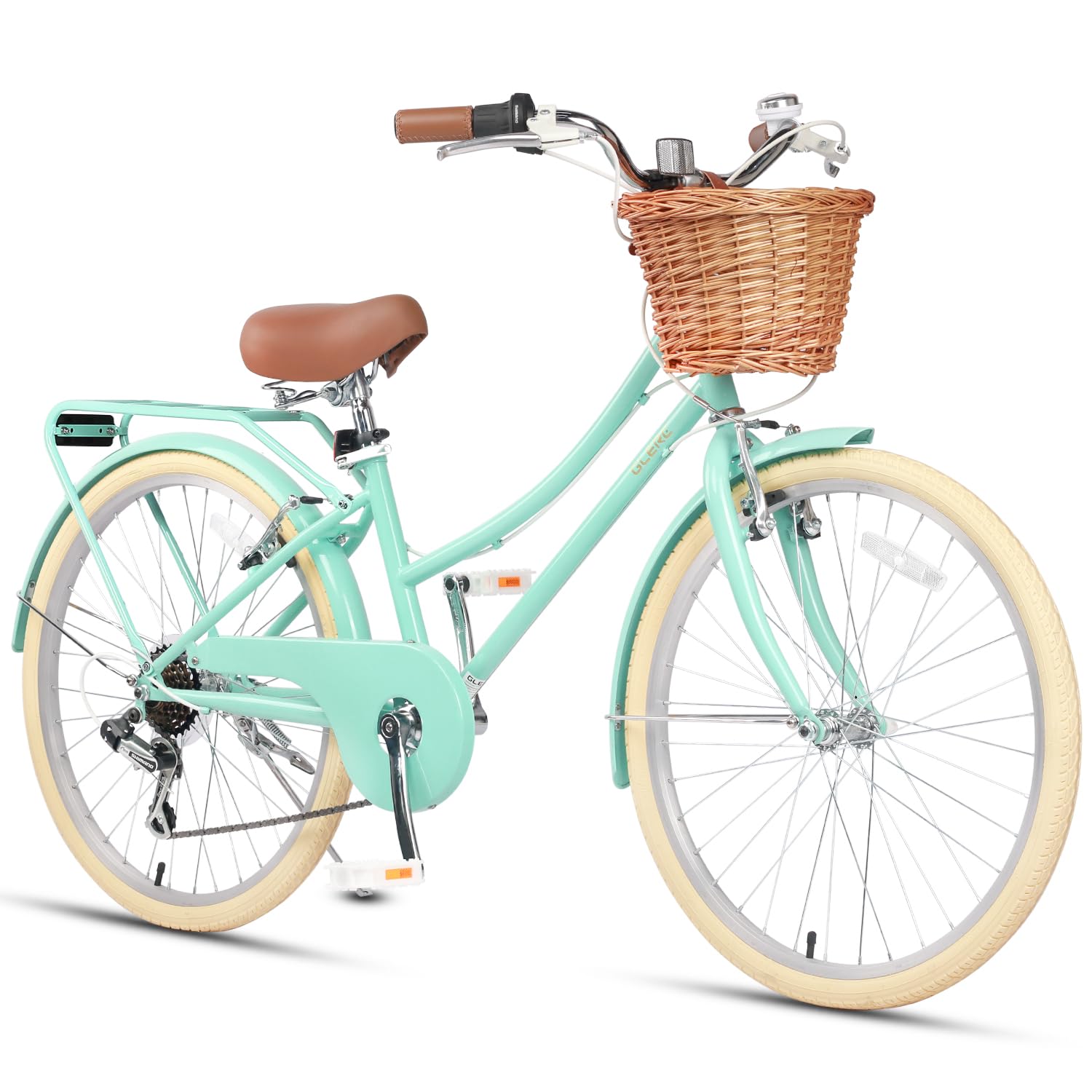
Mint green paint, a brown saddle and a front basket: the Missy is the most decorative bike in this group, and for a certain ten-year-old that's the deciding feature rather than a detail. Under the styling there's a high-carbon steel step-through frame, a six-speed drivetrain, front and rear V-brakes, fenders, a bell and a kickstand, so it's a complete bike rather than one that needs additions.

The step-through frame does real work: no leg swinging over a basket, no jacket catching on a top tube. Glerc's short-travel brake grips are the detail we appreciated most, because a lever that sits close to the bar is the difference between a child braking with confidence and a child braking with three fingers and hope.

We'd point it at the rider who wants to keep up on rolling streets rather than the one heading for a trailhead. Six speeds cover a neighborhood with a couple of hills, the upright position stays comfortable on longer family rides, and the 22- to 30-inch inseam window fits a tall eight-year-old through a young teenager. Glerc's published assembly estimate is about 25 minutes with the video guide; allow longer the first time.

One thing to know about the sizing: a 24-inch bike that's too tall is the fastest way to turn a confident rider cautious. If your child is under the 51-inch minimum, keep them on a 20-inch for another season. The Missy will still be here.

Bottom line: Six speeds, short-reach brake levers and a finish kids ask for by name: the best geared cruiser here for a rider in the 51-to-65-inch range.

6

cubsala Trident 24

cubsala Trident 24

BMX and street

Our Score 8.8/10
Check Price

Worth Noting

  • Not built for distance or hills
Frame
Hi-Ten steel
Brakes
Rear V-brake
Drivetrain
Single speed
Max Rider Weight
220.5 lb
Read the full review

The Trident is not the bike for a school run with a backpack on. It's the one for the kid who wants to jump the curb at the end of the street: a 24-inch BMX with a Hi-Ten steel frame, one gear, two pegs and a single V-brake on the rear wheel. The bars sit high, and the whole bike is built to be thrown around rather than loaded up.

One gear is the right call on a bike like this. A BMX gets ridden in bursts, a few hard pedal strokes and then a coast, and a derailleur hanging off the back is just something else to bend on a curb. The 24-inch wheel is also the largest this style comes in before you're into adult frames, which makes it a natural step for a rider coming off a 20-inch BMX.

We'd choose it for a rider who's already comfortable standing on the pedals and shifting their weight, because that's the skill the bike rewards. Assembly is genuinely easy, with most of it arriving done and the tools included, and the pegs are there from the start rather than being an add-on.

The rear-only brake is the thing to be clear-eyed about. It will skid the back tire, and it won't give the front-wheel bite of the two-brake setups elsewhere in this guide; on dry pavement at BMX speeds that's the familiar arrangement, and in the wet or on a hill it's not enough brake for most riders. Check the stem clamp too, since it's the fastener that takes the landing first.

Bottom line: A big-kid BMX for jumps, curbs and tricks, with one gear and a rear brake: the right toy for a confident rider, and the wrong commuter.

7

JOYSTAR Contender 24

JOYSTAR Contender 24

Bumpy paved paths

Our Score 8.6/10
Check Price

Worth Noting

  • Single gear only, so climbs are out
Brakes
Front and rear V-brakes
Included
Kickstand and fenders
Drivetrain
Single speed
Suspension
Front fork and rear shock
Read the full review

Both ends of the Contender move. A front suspension fork and a rear spring shock is an unusual combination at this size, and on broken pavement, root-heaved paths and curb drops it takes the jolt out of the ride in a way a rigid frame can't.

Around that suspension sits a hi-ten steel frame, a single gear, front and rear V-brakes, fenders and a kickstand. The fenders are a small thing we're glad to see, because a bike ridden to school in October gets ridden in the wet.

The rear shock sits exactly where the seat post wants to travel, so the saddle can't drop as far as it does on a hardtail. If your rider is at the bottom of the size range, that matters more than the suspension does: a bike they can't stand over confidently is a bike they won't ride.

We'd put this in front of a family whose local streets are rough, whose rider is tall enough to fit it, and who'd rather have comfort than gears. If the hills are real, the Glerc Skyline is the better spend; if the pavement is smooth, the Bilbo does the same job with less hardware to look after.

Bottom line: Worth considering if the local pavement is rough: suspension at both ends softens the ride, though one gear and a high saddle minimum keep it a narrow choice.

How We Tested the Best 24-Inch Kids Bikes

We started with roughly 40 models sold in the U.S. and narrowed that list by weight, brake type, frame material, and what came in the box, then bought 12 of them outright. Testing ran seven months, long enough for a kid to outgrow a seat post and for cheap hardware to start rattling.

Every bike got built in a garage using only the tools in the box, and I timed it. I noted whether the brakes and derailleurs arrived adjusted, whether the kickstand and pedals threaded on without a fight, and whether the bolts felt like they'd survive being re-tightened a few times. Fit came next: riders from about 8 to 11 sat on each bike while we checked standover clearance and their reach to the bars, then we raised seat posts as they grew and swapped bikes between kids of different heights.

Riding happened where these bikes actually live — driveways, sidewalk loops, a gravel path, wet pavement after a storm, and one long hill nobody wanted to climb twice. We measured how quickly each bike stopped in the wet, checked cables for stretch after two weeks, listened for creaks and loose headsets, and inspected welds, paint chips, and kickstand play at the end. We also noted what came stock versus what had to be bought separately, and left the bikes where the kids could grab one on their own — which is how we learned which ones they genuinely enjoyed riding.

How to Choose 24-Inch Kids Bikes

Start With Height and Inseam, Not the Age Band

The age printed on the box is the loosest number in this category. The 24-inch bikes here span roughly 51 to 67 inches of rider height, more than a foot of difference, so two bikes with the same wheel can be a whole season apart in fit.

Measure height and inseam, then check two things: your rider can stand flat-footed over the frame, and the saddle rises far enough that the leg is nearly straight at the bottom of the pedal stroke. A saddle that tops out too low is a fit problem no adjustment fixes.

One Gear or Twenty-One?

Single-speed is the right answer more often than parents expect. One gear is simpler to maintain and forces a rider to learn momentum, and on flat ground within a mile of home nothing is lost. Gears start earning their place when the route includes a climb the rider can't stand up, or a longer family ride: six or seven speeds cover rolling streets, and 21 speeds belong on a bike heading for trails.

The trap is buying gears as a feature. A shifter a child plays with on flat pavement is a distraction, and a front derailleur that's out of index drops the chain every time they shift down.

Brakes: Where the Money Shows Up

Three setups run through this group: front and rear rim brakes, mechanical disc brakes, and a single rear brake. Rim brakes are light, cheap to adjust and fine in dry weather. Discs cost more and keep stopping in wet and mud, which is worth paying for on a bike that commutes or rides trails. A rear-only brake skids rather than slows, which is why it belongs on a BMX and not on a school bike.

Whatever the type, check that each lever can be reached comfortably from the grip, and that it doesn't pull all the way to the bar before the brake bites.

Tires and Weight

Tire width decides where a bike feels at home. The 1.95- to 2.125-inch tires on most of these roll easily on pavement and cope with packed dirt; the four-inch tires on the Mongoose Argus float over sand and snow and drag on asphalt.

Weight matters just as much, because a child has to push the bike up the driveway at the end of the ride. The bikes here that publish a weight run from 30 pounds to about 42, and the heavy end is steel frames carrying gears and suspension.

Assembly, Warranty and the Second Owner

Almost everything here arrives 85 percent assembled, and the last 15 percent is the part that matters: front wheel, handlebars, brakes, and on geared bikes the derailleur. If you're comfortable with a brake cable and an index shift, an evening gets it done; if not, budget for a shop check before the first ride.

Warranties vary more than you'd think: one year on the WEIZE, two years from Bilbo, a lifetime frame with two years on parts at Glerc. A quick-release saddle is what lets the same bike serve a second child two years later.

Frequently Asked Questions

Final Verdict

Buy the Bilbo. For most families it's the 24-inch bike that asks the least and gives the most: two hand brakes, one gear, a saddle that moves without tools, and a two-year warranty behind it.

If your rider is tall and already climbing hills, the Glerc Skyline earns its keep with 21 speeds and disc brakes. If the rides are flat and the budget is tight, the WEIZE cruiser does the job with a basket on the front.