Tires & Tubes

Best 650B Gravel Tires of 2026

A 650b gravel tire has to do two jobs that fight each other: bite into loose gravel and still roll fast enough that the pavement link between dirt sections doesn't feel like a penalty. I've had tires feel quick in the driveway and wash out on the first loose descent. The right set changes how confidently you corner, how low you can drop pressure without squirming, and whether a long day out feels playful or punishing.

Over eight months, our team rode 12 650b gravel tires on chunky dirt roads, smooth rail trails, paved connectors, and loaded bikepacking weekends. The differences showed up in unexpected places: how easily each tire mounted tubeless, whether the actual width matched the claimed size, and how much tread survived hundreds of miles. A first-time buyer note: 650b tires can measure several millimeters off the label depending on rim width, so check mounted width before assuming frame clearance. The picks below are the ones that balanced traction, rolling resistance, durability, and value without asking you to baby them.

1

Panaracer GravelKing SK 650x43

Top Pick
Panaracer GravelKing SK 650x43

Fast gravel

Our Score 9.2/10
Check Price

Worth Noting

  • Less cushion than 47 mm tires
Size
650B x 43C
Tread
Directional close-packed knobs
Casing
TuffTex 120 TPI
Weight
1.2 lb
Read the full review

Compared with the Rambler, the GravelKing SK trades a little volume for a sharper turn of speed. Its 43 mm casing and close-packed, directional knobs are built for riders who want gravel grip without the drag of a taller, more open tread. The difference is most obvious on hardpack and pavement, where the SK feels eager to roll.

That is the version we recommend when your rides are more mixed than loaded: club rides, fast gravel loops, and long pavement connectors. The ZSG gravel compound and TuffTex casing give it a supple ride for a 43 mm tire, and the BeadLock bead is designed to stay put when you corner hard. We found the traction easy to trust on packed dirt and light gravel; it is the kind of tire that lets you carry speed into a turn instead of bracing for it.

The SK is not a mud tire, and deep, loose descents will ask for more tread than this. Mounting is the other variable to plan for: the bead can be tight enough to demand levers and patience, especially on a first tubeless setup. Neither issue changes the appeal for fast gravel, but they are the reasons we do not hand it to every rider.

Bottom line: Riders who want a faster 43 mm option should start here; we like its close-packed tread and confident grip on packed gravel.

2

Maxxis Rambler 650x47

Maxxis Rambler 650x47

Mixed-surface gravel

Our Score 9.0/10
Check Price

Worth Noting

  • Less pavement speed than semi-slicks
Size
650 x 47
Tread
Tight center, ample shoulders
Weight
1.2 lb
Protection
SilkShield bead-to-bead
Read the full review

The 650 x 47 Rambler is the tire we recommend first because it sits in the useful middle of this group: enough volume to soften gravel, a tightly packed center that still rolls, and shoulder knobs that show up when the surface turns loose. It is not the fastest semi-slick here, and it is not the most aggressive tread, which is exactly why it works as a default for mixed-surface rides.

Maxxis builds it around a dual compound and a SilkShield layer that runs bead to bead, so the protection is not limited to the center tread. The 1.2-pound casing feels substantial without being a burden, and the 47 mm width gives you useful cushion at gravel pressures. We like that combination for rides that begin on pavement and finish on chunky farm road; you do not have to change tires just because the surface changes.

There is a real trade-off in the durability picture. The SilkShield layer is designed to resist cuts, but sharp, flinty gravel can still find a way through, and no tubeless tire is puncture-proof. Fresh sealant and a sensible pressure are part of owning this tire, not an afterthought. If your routes are dominated by glassy pavement, a semi-slick will feel quicker; if they are dominated by deep mud, a more open tread will be better.

For most 650b gravel riders, though, the Rambler is the easiest single choice here: fast enough to feel lively, wide enough to take the edge off, and protected enough for long days. We keep coming back to it as the tire that makes the fewest compromises across the widest range of surfaces.

Bottom line: For most 650b gravel riders, we make the Rambler the default: a 47 mm casing with a fast center and bead-to-bead protection for mixed surfaces.

3

Panaracer GravelKing SS 650x38

Panaracer GravelKing SS 650x38

Hardpack and pavement

Our Score 9.0/10
Check Price

Worth Noting

  • Narrow 38 mm casing limits cushion
Size
650B x 38C
Tread
Semi-slick
Weight
16 oz
Protection
TuffTex casing
Read the full review

The GravelKing SS is built around a semi-slick tread and a 38 mm casing, which makes it the speed-focused 650b option here. The smooth center rolls quickly on pavement and hardpack, while the small shoulder knobs give you a hint of grip when the surface gets loose. It is a focused brief, but a useful one for riders who spend more time on smooth gravel than chunky rock.

Panaracer uses its ZSG gravel compound and TuffTex casing, along with a BeadLock bead, so the tire is set up for tubeless use and aggressive cornering. At 16 ounces, it is one of the lighter tires in this group, and that shows up in how willingly it spins up. The ride is quick and communicative rather than plush, which is the point.

There is a limit to how far the semi-slick tread will take you. On soft dirt and loose-over-hard corners, it gives up bite earlier than the knobbier tires here, and that is the trade you make for its low rolling resistance. The bead can also be stubborn to mount, so patience and good levers are part of the first setup.

We still recommend the SS for the rider who wants a fast 650b tire for pavement, hardpack, and light gravel, and who is willing to swap to something with more tread when the route turns deep or loose. It is the specialist in this group, not the default, and it is very good at the job it was designed for.

Bottom line: Choose the GravelKing SS when speed on pavement and hardpack matters more than cushion; we rate its semi-slick roll highly.

4

Continental Terra Trail 650x40

Continental Terra Trail 650x40

Technical gravel

Our Score 8.8/10
Check Price

Worth Noting

  • Less cushion than 47–50 mm tires
Size
650b x 40
Tread
Large shoulder knobs
Weight
15.5 oz
Protection
ProTection layer
Read the full review

The shoulder tread is the first thing we look at on the Terra Trail. Continental gives this 40 mm tire a much taller, more open set of shoulder knobs than the semi-slicks here, while keeping the center relatively quick. That shape is aimed at the moment a gravel ride turns technical and the line you want is outside the hardpack.

BlackChili compound and the ProTection layer round out the package. The casing is rated for 34-72 PSI and works on hooked or hookless rims, which makes it easier to fit into an existing wheel setup. We like that the tire is not a one-surface compromise: it rolls quietly enough for pavement links, then gives you a real shoulder to lean on when the road turns to loose over hard.

Our recommendation is for riders who regularly meet loose, rocky, or technical gravel and want a 40 mm casing that stays lively. It is the priciest tire in this group, and that premium buys the BlackChili compound and a more aggressive shoulder. If your rides are mostly smooth hardpack, the Terra Trail is more tread than you need.

Bottom line: When the route turns loose and technical, we reach for the Terra Trail's shoulder knobs and BlackChili grip before the wider, faster picks.

5

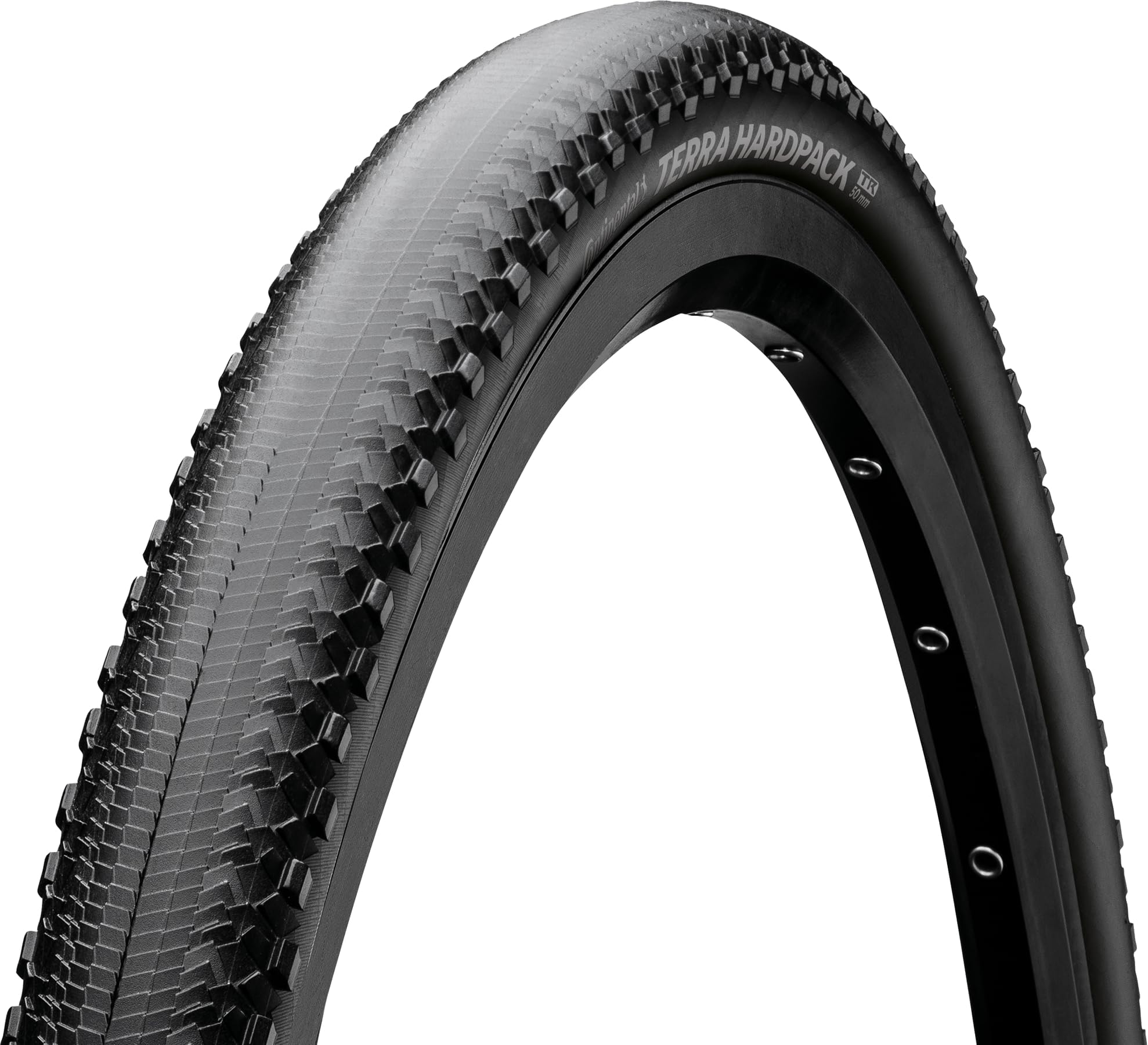
Continental Terra Hardpack 650x50

Continental Terra Hardpack 650x50

Loaded bikepacking

Our Score 8.6/10
Check Price

Worth Noting

  • Heavier than narrower 650b tires
Size
650b x 50
Tread
Semi-slick center
Weight
1.29 lb
Protection
ShieldWall
Read the full review

If your frame clears a true 50 mm casing, the Terra Hardpack opens up a different kind of 650b ride: more air, more cushion, and a contact patch that can handle washboard and loaded descents. That clearance is the first thing to check. A 50 mm tire can look right on paper and still rub a chainstay or fork crown once it is inflated on a wide rim.

The tread is a semi-slick with a textured center and robust shoulders, which is a sensible shape for hardpack and mixed surfaces. Continental's PureGrip compound and ShieldWall layer are there for grip and cut resistance, and the semi-slick center keeps it rolling on hardpack. We recommend it for bikepacking and long, rough days where comfort and load stability matter more than outright speed.

At 26-65 PSI, there is enough range to tune the ride for load and rim, including hookless setups within the marked limits. The semi-slick center is not a mud tread, so deep, sticky climbs will leave you wanting more bite. It is also E25 rated for pedal-assist bikes up to 25 km/h, a useful detail if your gravel bike has a motor. For everything from chunky hardpack to paved connectors, the extra volume earns its place.

Bottom line: Our high-volume pick is the Terra Hardpack, provided your frame clears 50 mm and your rides favor hardpack, load, and comfort over light weight.

6

American Classic Udden 650x47

American Classic Udden 650x47

Budget gravel

Our Score 8.6/10
Check Price

Worth Noting

  • Limited bite on aggressive, loose trails
Size
650b x 47
Tread
Low-profile center knobs
Tubeless
Ready
Protection
Stage 5S Armor
Read the full review

The Udden is the value pick of this group, and it earns that spot by getting the basics right rather than by feeling cheap. You get a 47 mm tubeless-ready casing, low-profile center knobs, and a more aggressive shoulder for cornering, all in a package that we recommend to riders who want capable gravel performance without paying premium prices.

American Classic's Stage 5S Armor runs bead to bead, and the Rubberforce G compound is tuned for mixed terrain. On dry hardpack and gravel, the low center tread rolls well while the shoulder knobs give you something to lean on. We like the 47 mm width for its cushion; it makes rough farm roads feel less punishing without turning the bike into a truck. It is not the plushest casing here, but the volume does a lot of the comfort work.

The bead is the catch. It can be tight enough to make mounting a genuine wrestling match, so warm the tire, use proper levers, and do not plan to install it for the first time on a cold driveway. Once seated, the Udden is a lot of tire for the money. For everyday gravel and mixed-surface exploring, it makes the budget case convincingly.

Bottom line: We think the Udden is the budget choice to beat for 47 mm gravel volume and dependable dry-surface grip.

7

Maxxis Receptor 650x47

Maxxis Receptor 650x47

Light gravel

Our Score 8.4/10
Check Price

Worth Noting

  • Pricier than the top pick
Size
650 x 47
Tread
Semi-slick
Weight
1.12 lb
Protection
EXO sidewall
Read the full review

A 47 mm semi-slick sounds like a contradiction: the width says cushion, the tread says speed. The Maxxis Receptor leans into that combination for pavement, hard-packed dirt roads, and light gravel, and for the right rider it is a clever way to get volume without dragging a knobby tread around.

The dual-compound rubber and EXO sidewall protection are aimed at balancing grip and cut resistance, and the 120 TPI casing is built to feel supple. At 506 grams it is light for a 47 mm tire, which helps it spin up quickly and makes the width feel less ponderous than you might expect. We like it as a fast all-road option for riders whose unpaved miles are mostly smooth and dry.

Our recommendation comes with a clear boundary: this is not the tire for loose gravel, mud, or rocky descents. The center tread is designed for hardpack and pavement, and the shoulder is there for light cornering rather than serious bite. If your 650b bike spends most of its time on smooth mixed surfaces, the Receptor is a light, quick specialist; if your gravel is chunky, look at the Rambler or Terra Trail instead.

Bottom line: The Receptor is the light, fast 47 mm semi-slick we choose for pavement and hardpack, not for loose gravel.

8

American Classic Kimberlite 650x47

American Classic Kimberlite 650x47

Road-leaning gravel

Our Score 8.2/10
Check Price

Worth Noting

Size
650b x 47
Tread
Low-profile
Tubeless
Ready
Protection
Stage 5S Armor
Read the full review

The Kimberlite is not trying to be a loose-gravel tire, and that clarity is its appeal. American Classic designed this 47 mm casing to perform like a road tire on pavement and hook up on hardpack and dirt roads, so it makes the most sense for riders whose unpaved miles are smooth and fast rather than rocky and technical.

The tread is low-profile, and the Rubberforce G compound is tuned for mixed terrain. Stage 5S Armor adds bead-to-bead protection without making the tire feel like a garden hose. We found the rolling resistance easy to live with on pavement, and the 47 mm width gives it a more comfortable, confident stance than a narrow road casing.

The Kimberlite is happiest when you are linking pavement to hardpack and keeping the speed high. Once the surface turns loose or wet, the low tread gives up grip sooner than the knobbier picks here. That is not a defect in the design; it is the boundary of what this tire is for.

Our recommendation is for the 650b rider who wants a fast, road-leaning gravel tire for smooth mixed-surface routes and is willing to trade loose-surface bite for rolling speed. If your rides regularly include chunky descents, the Rambler or GravelKing SK will be the better companion. The Kimberlite knows what it is, and for the right rider that is enough.

Bottom line: For road-leaning 650b gravel, we prefer the Kimberlite's fast roll and 47 mm comfort, with the clear caveat that loose terrain is not its job.

How We Tested the 650b Gravel Tires

We started by pulling together more than 30 650b gravel tires from brands we've ridden and ones that kept surfacing in shop conversations and rider forums. We filtered for tubeless-ready construction, a claimed width between 40 and 50 millimeters, and a spread of tread patterns—file-tread, center-slick, and proper knobby—so the list covered everything from fast gravel racing to loaded backcountry riding. We also included budget options alongside premium casings to see whether the extra money bought real durability. That left 12 tires, which we rode over eight months.

Each tire went on the same 650b tubeless-ready wheelset, and I noted whether it seated with a floor pump or needed a compressor, how many tire levers it took, and whether it held air overnight. After 24 hours at 30 psi, I measured actual width with calipers and checked frame clearance on two bikes—one with generous room, one tighter—because a tire that measures wide can rub a chainstay. Out on the road and trail, we rode a repeatable mix: a Tuesday-night gravel sprint, a paved commute, and weekend bikepacking routes with loaded bags.

Traction and stability got judged on loose-over-hardpack climbs and fast descents: I noted when a tire spun, when it washed, and how much pressure I could drop before the sidewall squirmed or burped. For rolling resistance, we coasted from a fixed point on the same paved hill and compared how far each tire carried us, then repeated the test on smooth dirt. Durability came down to post-ride inspections—sidewall cuts, tread wear, and whether knob edges rounded off—and we weighed that against cost, since a cheap tire that lasts two seasons can be better value than a premium one that cuts early.

How to Choose 650B Gravel Tires

Start With the Surface You Ride Most

Tread is the first decision, and it should follow the surface you ride most, not the surface you aspire to. A semi-slick center, as on the GravelKing SS or Maxxis Receptor, rolls quickly on pavement and hardpack but gives up bite early in loose dirt. A taller shoulder, as on the Continental Terra Trail, is what you want when corners are loose or rocky. The Maxxis Rambler sits between them, which is why we make it the default for mixed gravel. If your rides are mostly smooth, buy for the majority and accept the compromises elsewhere.

Match Width to Frame Clearance

Width changes both comfort and fit. A 38 mm casing feels quick and leaves mud room; a 47 mm or 50 mm casing adds cushion and contact patch but can rub a chainstay or fork crown once inflated on a wide rim. We check frame and fork clearance at the tire's widest point, not just the nominal size, and leave a few millimeters for mud. The 50 mm Continental Terra Hardpack is the obvious high-volume choice, while the 43 mm GravelKing SK is a safer fit for frames that are tight around 47s. Measure first; a tire that rubs is not a bargain.

Treat Tubeless Setup as Part of the Purchase

Tubeless-ready is a starting point, not a promise that the tire will seat with a hand pump. Bead diameter, rim tolerance, and tape quality all affect the install, and some casings are tighter than others. We budget for sealant, a proper track pump, and a plan for the first setup; a compressor or charger can save a frustrating evening. If you change tires often, how easily the bead breaks and reseats matters as much as tread. A tire that rides well but fights you at the roadside is a poor companion on a long gravel ride.

Weigh Protection Against Ride Feel

More casing protection usually means more material, and that can dull the ride. SilkShield, ProTection, ShieldWall, and Stage 5S Armor all add cut resistance, but none makes a tire immune to sharp flint or glass. We prioritize protection on loaded rides and rocky routes, and accept a lighter casing on smooth hardpack where speed matters more. The 506-gram Maxxis Receptor and 440-gram Terra Trail show the range: one leans on volume and a light casing, the other on a reinforced tread for rougher ground. Pick the protection level for the worst surface you actually ride.

Check Pressure and Rim Compatibility

Pressure is where a good tire can be made to feel bad. A 47 mm casing can run lower than a 38 mm one, but the rim and tire both have limits, and hookless rims are stricter about maximum pressure. Follow the pressure printed on the tire and the rim, then tune by feel and terrain. Wider casings like the Terra Hardpack list 26-65 PSI, while the narrower Terra Trail lists 34-72 PSI; treat those ranges as starting points, not targets. If you are new to tubeless, start a few psi higher and work down.

Frequently Asked Questions

Final Verdict

The Maxxis Rambler is the 650b gravel tire we recommend first. Its 47 mm casing, fast center, and bead-to-bead SilkShield protection make it the easiest single choice for riders who split their time between pavement, hardpack, and mixed gravel. If your rides are faster and smoother, the GravelKing SK is the better match; if they are loose and technical, the Terra Trail earns the upgrade. The Rambler remains the default because it compromises less than the other picks across the widest range of surfaces.