Security & Locks

Best Bike Alarms of 2026

The worst part of bike theft is how quiet it is. A lock can be cut in the time it takes to pay for coffee, and unless someone happens to look over, the bike vanishes. A bike alarm doesn't replace the lock; it helps by putting a loud siren on your frame the second someone starts messing with it. I've ridden with 14 alarms over four months, on commutes, cafe stops, and overnight in a shared garage, and the good ones are loud enough to startle a thief without wailing at every passing truck, simple enough to arm one-handed, and sturdy enough to live outside.

Battery life and remote range matter more than spec sheets suggest. An alarm that dies in a week or forces you to dismount to disarm it is one you'll stop using. I also paid attention to fit across commuter bikes, e-bikes, and a kid's bike, since an alarm that only works on one frame is a weak security upgrade. The picks below are the ones I'd trust on my bike and recommend to a friend.

1

POWVINE Max Bike Alarm

Top Pick
POWVINE Max Bike Alarm

Long-range arming

Our Score 9.4/10
Check Price

Worth Noting

  • Weather resistance claimed but never IP-rated
Siren
110 dB
Battery
700 mAh, USB rechargeable
Remote Range
100 m
Alarm Duration
30 seconds
Read the full review

Thirty seconds is the figure we keep coming back to. That's how long the siren runs once it's triggered, which is enough time for whoever set it off to leave the street, and enough that you'll want the remote in your hand rather than buried in a bag. A 110 dB siren that keeps going for half a minute is a real deterrent.

The remote is the headline: up to 100 meters, the longest reach in this group by a wide margin, which is enough to arm or silence the alarm from inside a building. Seven sensitivity levels and three volume settings match the tuning range of the more established picks, and the 700 mAh cell charges over USB with a claimed one to three months between charges.

What it lacks is the track record of the Fosmon or the WSDCAM, so treat that 100-meter figure as the claim it is and try the remote from your usual parking spot before you rely on it. If it reaches, this is a lot of alarm for the money: a 30-second siren, seven sensitivity steps, and a remote that works from indoors.

Bottom line: Arming from inside a building is what this one is for: a 100-meter remote, a 30-second siren, and seven sensitivity steps on a rechargeable battery.

2

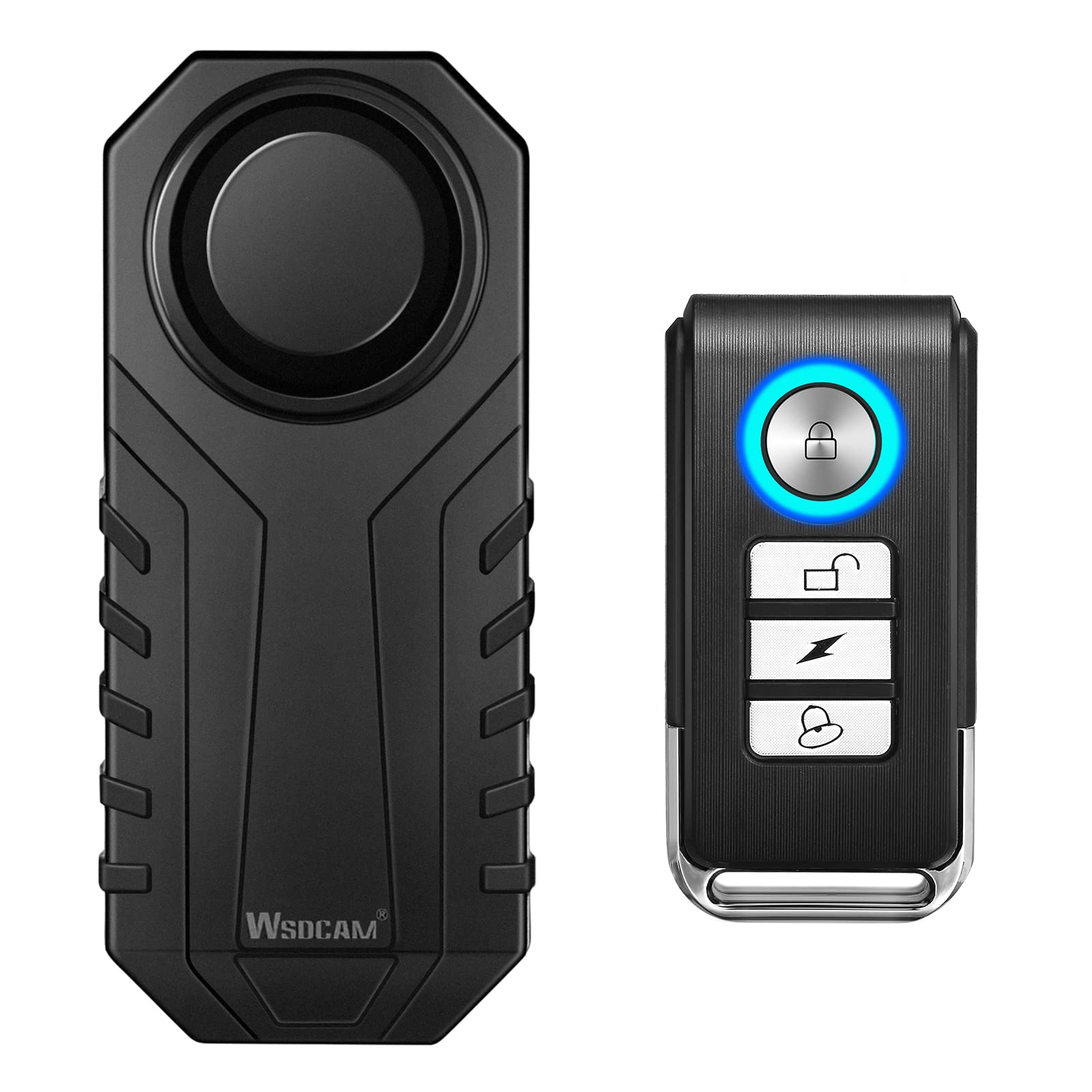
WSDCAM USB Bike Alarm

WSDCAM USB Bike Alarm

No battery swaps

Our Score 9.2/10
Check Price

Worth Noting

  • 110 dB, at the bottom of this group's siren ratings
Siren
110 dB
Battery
700 mAh, USB rechargeable
Mounting
Bracket, cable ties, tape
Remote Range
260 feet
Read the full review

Three fittings come in the box: a screw-on bracket, cable ties, and double-sided tape. The bracket is the one to use, because this is a rechargeable alarm and the bracket lets you lift the unit off, plug it into USB, and click it back on without cutting anything. Anyone who has sawed through a zip tie to change a battery knows what that convenience is worth.

A 700 mAh cell charged from any USB port handles the power, and the remote reaches 260 feet, comfortably beyond the 66-foot units here. We think the pairing of a bracket and a rechargeable cell is what turns an alarm into one you actually keep armed, because the two chores that break the habit, hunting for cells and refitting a zip-tied unit, both disappear from the routine.

Two things to know before you fit it. There's no clear charge indicator, so topping up becomes a routine you impose rather than one the alarm asks for, and a recurring reminder on your phone is the workaround. The remote's keyring loop is thin plastic as well, so keep the fob in a pocket rather than on a loaded keychain. Neither changes what the alarm does; both change how you look after it.

Bottom line: Recharge instead of buying cells: the bracket lifts off for USB charging, the remote reaches 260 feet, and the 700 mAh battery keeps it armed.

3

Fosmon 113dB Bike Alarm

Fosmon 113dB Bike Alarm

Everyday bike security

Our Score 9.0/10
Check Price

Worth Noting

  • Runs on AAA cells, with no recharge option
Siren
113 dB
Sensitivity
7 levels
Remote Range
230 feet
Weather Rating
IP65
Read the full review

Two figures decide this one for us: IP65 and 230 feet. IP65 means a dust-tight case that shrugs off rain and a direct spray, which is the difference between an alarm that stays fitted to the bike and one you keep taking indoors whenever the sky darkens. The 230 feet is the remote's reach, long enough to silence the siren from a shop doorway or a second-floor window. That pairing is the whole argument for putting it first.

Setup is a short job: clean the frame, mount the unit, then work through the seven sensitivity levels and three volume settings until a hand on the bars sets it off and a passing gust doesn't. We favor a hard mount over a soft one where the frame allows it, because a vibration sensor held tight against metal behaves more predictably than one resting on foam. Ten minutes here buys you months of not thinking about it.

At 113 dB the siren is loud enough that nobody mistakes it for a car-lock chirp, and the three volume steps let you dial it back for a shared garage or a campsite. The low setting is a courtesy, not a stealth mode. It is still a bike alarm going off, and everyone within a block knows it.

Power comes from AAA cells rather than a built-in battery, which we don't mind here: fresh cells from a gas station beat a dead rechargeable and a wasted evening. What you give up is the routine, since there's no cable to plug in and no reminder that the alarm is alive. Against the rechargeable WSDCAM below, the difference is maintenance rather than security. The 230-foot remote is the part you'll appreciate every time you walk toward the rack.

Bottom line: The alarm we fit first on our own bikes: IP65 sealing, a 230-foot remote, and a limited lifetime warranty make it the easiest one to live with.

4

PADONOW A2 Bike Alarm

PADONOW A2 Bike Alarm

Loud, hidden alarm

Our Score 9.0/10
Check Price

Worth Noting

  • Three sensitivity levels, against seven on most here
  • 20-meter remote, so you disarm within sight of the bike
Siren
115 dB
Weight
1.23 oz
Battery
400 mAh, USB-C rechargeable
Weather Rating
IPX5
Read the full review

The warning chirp is the detail we noticed first. Touch the bike and it gives a short beep; keep going and the siren opens up. On a busy rack outside a café that two-stage response saves everyone a scene, because someone brushing past the bars gets a warning rather than a full alarm and a street full of annoyed people.

At 115 dB it carries the loudest rating in this group, and at 35 grams it's also the lightest, small enough to tuck under a saddle or behind a seat tube where it stays out of sight until it fires. We're also taken with the remote's extra buttons: a panic button that sounds the siren on demand and a horn button for the times you want to be heard without triggering the alarm. USB-C charging rounds it out, so there's no proprietary cable to lose.

The trade-offs are narrow but worth knowing. IPX5 covers rain but carries no dust rating, so a muddy trail bike or a pressure-washed garage floor is not where this one belongs, and it's the only alarm here with that gap. For a machine parked outside a shop or a station rack for an hour at a time, the limitation never comes up.

Bottom line: The loudest alarm here in the smallest body: 115 dB, 35 grams, a warning chirp, and a panic button, for e-bikes and scooters parked in short bursts.

5

USUPERINK 2-Pack Alarm

USUPERINK 2-Pack Alarm

Two-bike households

Our Score 9.0/10
Check Price

Worth Noting

  • Remote reach of 66 feet, short next to the singles here
Siren
113 dB
Pack Size
2 alarms
Remote Range
66 feet
Weather Rating
IP65
Read the full review

Two bikes, one order. USUPERINK sells these in pairs: two 113 dB units, each with seven sensitivity levels, three volume settings, and IP65 sealing, plus the straps and adhesive to fit both. For a household with a commuter and a weekend bike, or a bike and a trailer, that's the sensible buy, and the pair comes in cheaper than two of the single units here.

Nothing about the hardware reads as bulk-pack. IP65 is the same sealing our top pick carries, 113 dB is loud enough to clear a bike shed, and the sensitivity range matches the more expensive alarms. Fit them at the same height on each frame and set both the same way, and the second installation takes about half the time of the first.

Two units also means two power checks, and the second alarm is the one that gets forgotten. Put both on the same monthly reminder, or you'll discover which one died the next time you go to arm it. The matched pair is the quiet advantage here: one routine, one spare mounting strap on the shelf, and no remembering which bike uses which procedure.

Bottom line: For a household with two bikes, this pair delivers the same IP65 sealing and 113 dB siren as our top pick for less than two singles.

6

Wsdcam SF22R Bike Alarm

Wsdcam SF22R Bike Alarm

Simple, proven setup

Our Score 9.0/10
Check Price

Worth Noting

  • Battery changes mean cutting ties and refitting
  • 66-foot remote, short next to the top picks
Siren
113 dB
Sensitivity
7 levels
Remote Range
66 feet
Weather Rating
IP55
Read the full review

Sensitivity is the first thing you'll form an opinion about. A gentle bump is enough to set this one off, and it sounds a warning beep before the siren. That's good behavior for a rack outside a café, and less good for a bike that sits where a bus idles or a shutter rattles in the wind.

The seven levels are set with a musical scale, do through si, and the highest sensitivity is the default out of the box. Following the notes is easy enough once you know what you're listening for, but it's an odd way to configure a security device, and arriving at maximum means the alarm is twitchy until you spend five minutes on it. Drop it two or three notes and test with a palm against the rear wheel. It also takes replaceable cells, worth knowing before you fit it.

The rest is competent: 113 dB, three volume settings, IP55 sealing, and a vehicle-find function that rings three different bells so you can pick your bike out of a crowded lot. Set against our top pick it gives up sealing and a great deal of remote reach for a small saving, which is why it sits behind the leaders rather than beside them.

Bottom line: A dependable 113 dB alarm for a bike parked close to home, with a vehicle-find bell that earns its keep in crowded racks.

7

KCMYTONER 113dB Alarm

KCMYTONER 113dB Alarm

Budget with warranty

Our Score 8.8/10
Check Price

Worth Noting

  • Waterproof claimed, with no IP rating published
  • 66-foot remote reach
Siren
113 dB
Warranty
2 years
Sensitivity
7 levels
Volume Settings
3 levels
Read the full review

The box tells you something before you've fitted anything: alarm, remote, cable ties, double-sided tape, a screwdriver, and a manual. Supplying the screwdriver is a small gesture, but it means the mounting screws are sized to the job, and you aren't hunting through a drawer halfway through an install you've already started.

On the unit you get 113 dB, three volume settings, seven sensitivity steps, and an SOS function that sounds the alarm on demand. That's the same working set as the pricier picks here, and it covers everything a vibration alarm needs to do. Push the sensitivity down a couple of steps before you fit it, the way you would on any of these, and the first week won't be a series of false alarms.

The two-year manufacturer warranty is the clearest thing it has over the rest of this group, since several of these alarms come with no stated term at all. For a small electronic device that lives outdoors and gets rained on, a stated two-year term is worth more than a slightly longer feature list, and it's the reason this one keeps a place on the page.

For a bike that sleeps in a garage or a shed and gets parked at the same rack every day, this is the one we point people toward: the same 113 dB siren and seven sensitivity steps as the top pick, a warranty behind it, and a screwdriver in the box.

Bottom line: The value pick: the same 113 dB siren and seven sensitivity steps as our top pick, plus a two-year warranty, for a bike that sleeps indoors.

How We Tested Bike Alarms

I started with every bike alarm I could find at major retailers and cycling shops, then filtered the list to models with adjustable sensitivity, a remote that worked beyond a few feet, and a mount that could move between bikes without a toolbox. That left 14 alarms. Each spent at least a week on my commuter bike, with swaps to a cargo e-bike and a kid's bike, and lived through wet morning rides, cafe stops, and overnight parking in a shared garage. Testing ran four months.

I armed and disarmed each alarm while holding a helmet—one hand only, no instructions—and noted whether setup took seconds or required a manual. For loudness, I set each siren off from 10 feet away and again from inside a stairwell to hear whether it cut through street noise or chirped. Sensitivity got the most work: I bumped handlebars, lifted kickstands, jiggled locks, and rolled bikes a few inches, then logged every false alarm from wind, rain, or a passing truck. I tested remote range across a parking lot and through a garage wall, and tracked battery life by leaving each alarm armed on daily commutes until the low-battery warning appeared.

I checked durability during ordinary rides: I left each unit mounted through rain and road grit, then looked for water in the battery compartment, loose brackets, and buttons that stuck. For security, I noted whether the alarm was obvious enough to deter someone, whether it had a tamper alert, and whether a thief could silence it by yanking the unit off. Value came last: I compared what each alarm actually delivered—volume, sensitivity adjustment, remote range, battery life, mounting hardware—against its cost. The winner wasn't the cheapest but the one I'd trust on three bikes for a month between battery swaps.

How to Choose Bike Alarms

Loudness Is Only Half the Siren

Siren ratings across this group run from 110 to 115 dB, and the gap between them is smaller in practice than on paper. What varies more is how the sound escapes: a unit bolted hard to the frame with its speaker facing open air carries further than a louder unit muffled inside a saddlebag or tucked behind a pannier. We mount ours high under the saddle with the opening unobstructed, then walk away and set it off once so we know what a passer-by actually hears.

Sensitivity, Tuning, and False Alarms

Every alarm here triggers on vibration, and none can tell a thief from a gust, a slammed door, or a dog investigating your wheel. That is what the sensitivity steps are for. Seven steps give you finer control over where the trigger sits; three are quicker to set and coarser once set. Start in the middle, arm the alarm, bump the rear wheel with the flat of your hand, and step back. No response means go up a level; a siren every time a car door shuts nearby means go down.

Remote Reach Decides How Often You Arm It

Remote range quietly decides whether you bother arming the alarm at all. If you lock up at the same rack every day, 66 feet is plenty, because you are standing beside the bike. If you park in a garage under an office or watch from a fourth-floor window, you need one of the longer-range units, because a remote that doesn't reach leaves you with a siren you can't silence. Quoted ranges assume open air, so test from your usual spot before you rely on it.

Batteries, Charging, and the Reinstall Tax

Two power designs, two habits. Replaceable cells mean the alarm is never out of action waiting for a charger, but you keep buying batteries, and a zip-tied unit has to come off the frame before you can open it. Rechargeable units skip the cell cost, and a bracket mount is what makes them practical: the unit lifts off, charges over USB, and clicks back on. If you buy a rechargeable that mounts with ties, budget for the reinstall every time it runs flat.

Sealing, Mounting, and the Limits of an Alarm

IP55, IP65, IPX5: the first digit is dust, the second is water, and an X means the maker never rated dust at all. All of them shrug off rain; none enjoy a pressure washer aimed at a seam. Position matters as much as the rating, so mount high on the frame, clear of the wheel's spray line, speaker unobstructed. Keep the limits in view too. An alarm makes noise; it doesn't stop a bolt cutter. It is a second layer alongside a lock, never a replacement for one.

Frequently Asked Questions

Final Verdict

Fit the Fosmon and stop thinking about it. IP65 sealing handles rain and road grit, the 230-foot remote lets you arm or silence it without walking to the rack, and the limited lifetime warranty backs it up. It isn't rechargeable, and that is the trade: cells instead of a cable.

If you want to plug in rather than buy batteries, the WSDCAM's bracket mount turns charging into a thirty-second job. If two people in the house ride, the USUPERINK pair covers both frames for less than two singles.