Security & Locks

Best Bike Cable Locks of 2026

A cable lock is a compromise you make on purpose. It's light enough to wrap around a frame and a rack without hauling a chain, flexible enough to grab a tree or a fat lamppost, and honest about the fact that it won't stop someone with bolt cutters. What separates a lock you keep reaching for from one that ends up in a drawer usually isn't the price — it's whether the key turns smoothly when your hands are cold, whether the cable still coils flat after a month in a bag, and whether there's enough length to actually reach what you need to lock to.

I've spent the past five months locking up with 14 different cable locks, and the pattern showed up fast: the ones I liked were the ones that took one hand and about four seconds. My team and I used them on commutes, at coffee shop racks, on a porch railing overnight, and on a couple of kids' bikes that get abandoned in the yard more than ridden. The thing first-time buyers underestimate is length — a cable a foot too short gets left at home, and a lock left at home protects nothing. The picks below cover that whole spread, from short and packable to long enough for two bikes at once.

1

Titanker Keyed Bike Lock

Top Pick
Titanker Keyed Bike Lock

Everyday locking

Our Score 9.2/10
Check Price

Worth Noting

  • 4 ft reach is tight for two bikes
Lock Type
Key lock, 2 keys
Cable Length
4 ft
Cable Diameter
12 mm
Mounting Bracket
Included
Read the full review

Twelve millimeters across, this is the thickest cable in our top group, and it is the reason we hand it to someone who wants one lock for everyday errands. Most of the keyed locks here run 8 mm, so there is simply more steel to get through before anything gives. The head snaps shut without the key as well: feed the cable through the frame and around the post, push the bolt home, and the key only comes out to open it. One hand at the rack, no fishing in a pocket.

The mounting bracket is the detail that made this our default. Two rubber shims in the box let the clamp fit different seat tube diameters, so the lock rides on the frame between trips instead of filling a pocket or a bag. A lock that lives on the bike is a lock you actually use, and day to day that is worth more than another foot of cable.

Four feet is where it asks something back. That is enough for one bike on a standard rack — frame, wheel, post — but not for two bikes, and not comfortably around the fat square posts some racks use. If you ride with a friend and plan to lock up together, one of the longer picks here saves an argument.

The rest is quiet competence: a PVC coating to keep the cable off your paint, a zinc alloy core, two keys, and a coil that holds its shape when you hang it up. No cable lock is high security and nothing here pretends otherwise; this is the one that makes the deterrent easy enough to bother with every single time.

Bottom line: The lock we point most riders to: a 12 mm cable, a head that snaps shut without the key, and a bracket that keeps it on the frame for every errand.

2

Amazon Basics Cable Lock

Amazon Basics Cable Lock

Budget carry-along

Our Score 9.2/10
Check Price

Worth Noting

  • No mounting bracket in the box
Coating
Weather-resistant plastic
Lock Type
Key lock, 2 keys
Cable Length
70 in
Cable Diameter
8 mm
Read the full review

Seventy inches is a shade under six feet, and that length is the whole argument for this one. It threads through a frame, both wheels, and still has room to go around a rack or a post, which is more coverage than most locks this simple offer. The cable is 8 mm, so it is a middleweight: enough to send a casual thief looking for an easier bike, light enough to coil and carry.

Two small details earn their keep. The plastic coating is weather resistant and keeps the steel off your paint, and a cover over the keyway shuts out grit and water — the sort of thing you notice a year in, when the key still turns on the first try. At 0.28 kg it disappears into a backpack, which is where ours usually lives.

It is the least expensive lock here, and we think it is the best value of the group for a bike that is never far from you: a café stop, a school rack, a lobby. Nothing about it feels precious, which is the point — you won't baby it, and you won't leave it at home because it is awkward to carry.

Bottom line: The pick for a tight budget and a bike that's never far away: 70 inches of cable, light enough to forget you're carrying it.

3

Master Lock Python 8417TEC

Master Lock Python 8417TEC

Adjustable multi-use

Our Score 9.2/10
Check Price

Worth Noting

  • 5 mm cable is thin for bike duty
Lock Type
Key lock, adjustable
Pack Size
2 locks, 4 keys
Cable Length
6 ft
Cable Diameter
5 mm
Read the full review

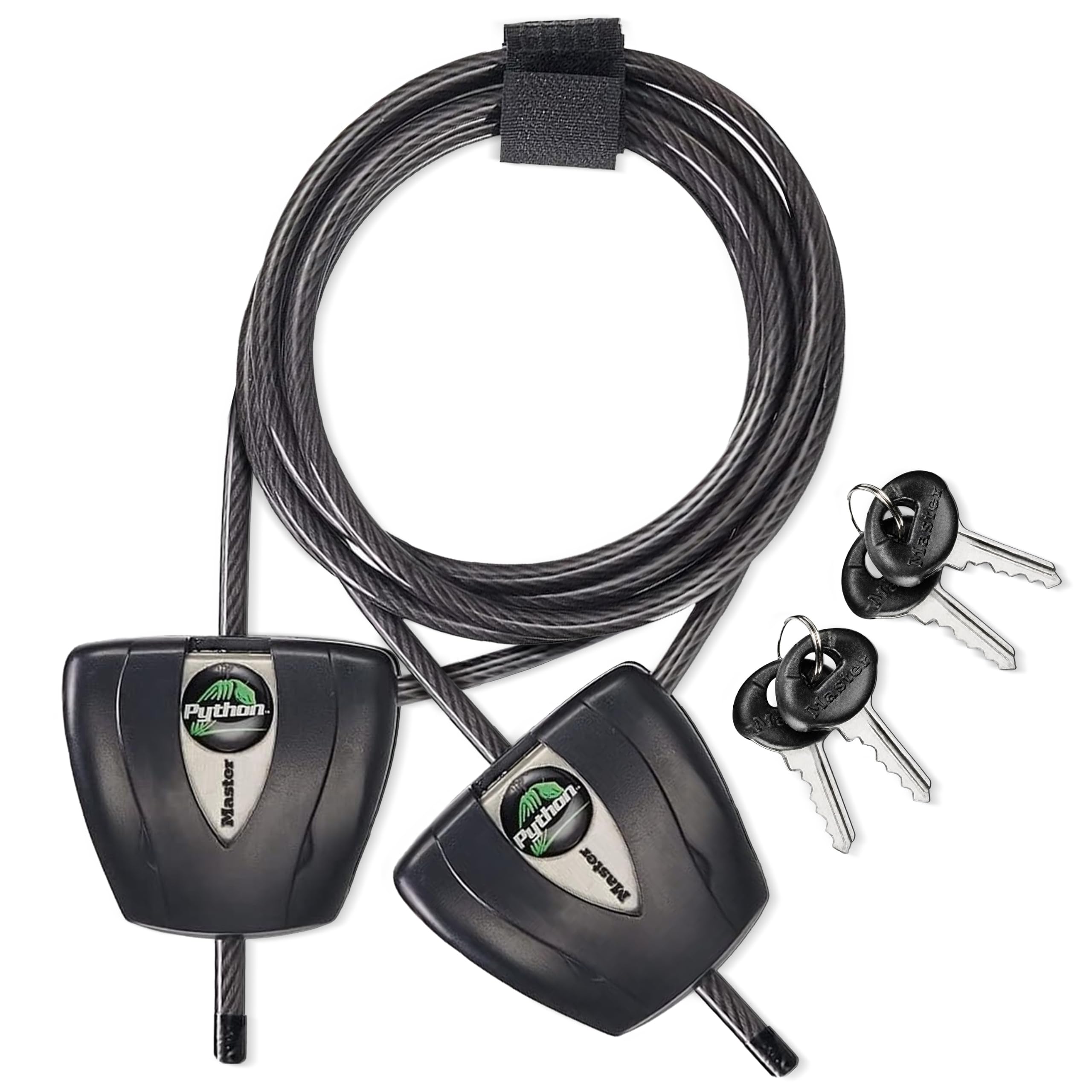
The head slides along the cable and locks wherever you stop it, which is a different idea from a fixed loop. Thread it through a wheel, a frame, a kayak handle, a trail camera housing, pull it snug, and nothing hangs slack for someone to work with. We like that for anything with an awkward shape and a hole in it, because the lock takes the shape you give it.

It comes as a two-pack with four keys, and six feet of cable wraps a tree trunk or a roof bar with room to spare. The catch is the cable itself: 3/16 inch, about 5 mm, which is thin even for a cable lock. This is a lock for keeping gear from walking off, and for keeping honest people honest.

As a bike lock it sits behind the thicker picks here — 5 mm of steel is a deterrent, not a defense, and a bike parked downtown all day deserves more. As the lock that lives in the trunk for cameras, kayaks, ladders, and job boxes, it is the most versatile thing in this group.

Bottom line: For gear rather than bike duty: the sliding head locks anywhere on the cable, which is what makes it useful for kayaks, cameras, and roof loads.

4

DocksLocks 10 ft Cable Lock

DocksLocks 10 ft Cable Lock

Multi-bike hauling

Our Score 9.2/10
Check Price

Worth Noting

  • Heaviest, bulkiest lock in this group
Lock Type
4-digit resettable combination
Cable Length
10 ft
Cable Diameter
10 mm
Cable Material
Marine-grade steel
Read the full review

Ten feet sounds like more than you need until you are gathering four bikes onto one rack. The number to hold loosely, though, is the working length: a coiled cable pulls back on itself, so what you can actually thread is shorter than ten feet. Size up if you are close to the limit rather than assuming the figure is generous.

What you are buying is reach plus hardware: 10 mm marine-grade steel under a vinyl coating, a zinc alloy combination lock, and an end slim enough to pass through tight openings like kayak scupper holes. It is designed for water sports and happens to be very good at bikes, which is the reverse of most locks here.

The four-digit combination is resettable, so you can set something you will remember, and the coil stores small on a rack or in a car. Set that code at home with the instructions to hand, rather than in a parking lot on the first morning you own it.

For us this is the pick for a family's worth of bikes, a bike plus a trailer, or a roof load of kayaks — the jobs where four feet simply cannot reach. It is the one lock here that turns an awkward load into a single lock-up instead of three.

Bottom line: For the jobs a short lock can't do: ten feet gathers several bikes or a bike and a trailer, and the coil stores small afterwards.

5

Schwinn Key Cable Lock

Schwinn Key Cable Lock

Long reach

Our Score 9.0/10
Check Price

Worth Noting

  • Unlocking can stick after wet weather
Cable Length
6 ft
Cable Diameter
8 mm
Security Level
Level 1
Mounting Bracket
Included
Read the full review

Schwinn labels this a Level 1 lock, and we appreciate the honesty. Level 1 means deterrent: it stops someone walking off with your bike, and it will not stop anyone who came prepared. Knowing that up front is genuinely useful, because it tells you where this lock belongs — short stops, busy places, daylight.

Six feet of cable is why it earns a place. On a crowded rack that is the difference between getting around the post at all and giving up and locking the bike to itself; with the frame, both wheels, and a helmet on board, there is still cable to take up. The bracket keeps it on the bike between trips, two keys come in the box, and the vinyl jacket protects the paint.

The trade-off is the 8 mm cable. It is easier to handle and lighter on the frame than the 12 mm picks here, but it is also the diameter a bolt cutter goes through first. If the bike sits outside a train station all day, put your money into heavier security; for errands, school runs, and holiday racks, the reach is worth more than the extra steel.

Bottom line: Reach is the reason to buy it — six feet lets you take in frame, wheels, and helmet on a crowded rack, with a bracket to keep it on the bike.

6

GRIFEMA 12mm Cable Lock

GRIFEMA 12mm Cable Lock

Rainy-day commuting

Our Score 9.0/10
Check Price

Worth Noting

  • 4 ft reach won't stretch to two bikes
Lock Type
Key lock, 2 keys
Cable Length
4 ft
Cable Diameter
12 mm
Mounting Bracket
Included
Read the full review

GRIFEMA's pitch is weather. The lock body is sealed, the finish is built for rain and humidity, and the cable is 12 mm — the same diameter as our top pick — on a 4 ft coil with a bracket, two keys, and a head that snaps shut without the key.

That makes it the sensible choice for a bike that lives outside and gets ridden through winter. The sealed body is the part we care about most: grit and water in a keyway is what turns a working lock into a fight at the end of a wet ride, and the coating does the same favor for your frame. Nothing about it is fussy, and for a commuter bike parked in the same spot every day, that is the entire brief.

Bottom line: The commuter's pick for a bike that lives outdoors: a sealed, weatherproof body and a 12 mm cable, in a package that asks for nothing.

7

Master Lock 8143T Combo 2-Pack

Master Lock 8143T Combo 2-Pack

Two bikes keyless

Our Score 8.8/10
Check Price

Worth Noting

  • Preset code can't be changed
Lock Type
4-digit preset combination
Pack Size
2 locks, shared code
Cable Length
4 ft
Cable Diameter
8 mm
Read the full review

No key to lose is the whole argument here, and for a family's bikes it is a good one. Two 4 ft cables come in the pack, and both open on the same four-digit code, so a kid can lock up without a key ring and you can open either bike without hunting for the right key.

The cable is 8 mm braided steel in a vinyl jacket — standard for the money — with jog-dial wheels you spin rather than pull. It is a deterrent for the ten minutes you are inside a shop, and the pair covers two bikes or a bike and a trailer without much thought.

What tips it for us is how little there is to go wrong: no key to bend, snap off in the keyway, or leave in a coat pocket at home. For school runs and campsite bike piles, that simplicity is worth more than another two millimeters of cable.

Bottom line: A pair for two bikes and no keys to lose — the simplest way to get a family riding, as long as the fixed code suits you.

How We Tested the Best Bike Cable Locks

We built the shortlist by reading specs and customer reviews for cable locks sold everywhere from bike shops to hardware stores, then narrowed by cable diameter, overall length, locking mechanism, key count, and price. Fourteen made the cut for hands-on testing, and over five months they lived where locks actually live: on commutes, wrapped around coffee shop racks, looped through a porch railing overnight, and clipped onto kids' bikes that get dropped on the lawn.

Every lock got the same walk-through. I locked and unlocked each one bare-handed and then in winter gloves, counting the seconds and noting whether the key went in on the first try or needed jiggling and a second look at the keyhole. I coiled each cable, stuffed it into a bag, and pulled it out a day later to see whether it held a shape or flopped open. Length got measured against real objects — a fat lamppost, a wooden fence post, a rack with one bike and then two — and I checked how much slack was left and whether the frame and wheel both fit.

Then came the abuse. Each cable was dropped on pavement a dozen times, left out in the rain for a week, and dragged across a rack; I looked for split sheathing, frayed strands, and grit in the lock head that made the key stick. To judge security honestly, I took hand cutters to a scrap length of each cable and watched how the sheath split, how the strands held, and how long it took — a lock that fights back for thirty seconds buys you something a soft one doesn't. Value came last, weighed against what each lock actually asked you to pay for the length, the mechanism, and the spare keys.

How to Choose Bike Cable Locks

Measure Reach, Not Cable Length

Stated length is where the number starts, not where it ends: a coiled cable keeps some of its curve, so what you can actually thread around a post and a frame is shorter than the figure on the box. Four feet handles one bike on a standard rack; six feet lets you take in both wheels and a helmet as well; two bikes or a fat square post want more. If you lock to the same rack every day, walk the cable's route once before you buy.

What Cable Thickness Buys

Diameter is the closest thing to a security rating a cable has. A 5 mm cable is a deterrent for gear and quick stops; 8 mm is the everyday middle, light enough to coil and thick enough to need real effort; 12 mm is the heaviest option in this group and what we choose for a bike parked outside daily. None of them defeats bolt cutters — a cable buys time and convenience, not immunity — and thicker steel is also heavier and stiffer to handle.

Keys, Codes, And Who Else Needs In

Keyed locks are faster at the rack and need no code remembered, but a lost or snapped key can strand the bike, which is why two keys matter and why a stiff key should never be forced. Combination locks suit shared bikes and kids because there is nothing to lose. Check before you buy whether the code can be reset: a preset code that opens more than one lock in the pack is a fixed secret you cannot retire.

How It Travels On The Bike

A bracket is the difference between a lock you own and a lock you carry. Most clamp to the seat tube, and the better ones include shims for different tube diameters, which is worth checking if your frame is fat or unusually shaped. Without a bracket the lock lives in a bag or looped around the top tube — fine until the day you forget it. Coil memory matters too: a stiff coil is awkward to store and slower to thread.

Weather, Coating, And Where The Bike Sleeps

Vinyl and plastic coatings exist for your frame as much as for the steel: they stop the cable rubbing paint off a top tube and keep water off the cable itself. A cover over the keyway keeps grit out, and a sealed lock body helps where the bike sits outside year-round. None of that makes a cable lock suitable for overnight parking in a high-theft area, so decide where the bike sleeps first and buy accordingly.

Frequently Asked Questions

Final Verdict

Of everything we looked at, the Titanker keyed lock is the one we point most riders to: a 12 mm cable, a head that snaps shut without the key, and a bracket with shims that keeps it on the frame. If your racks are awkward or you lock up with a friend, the Schwinn's six feet solve a problem the Titanker cannot. And if the lock is going to live in a bag, the Amazon Basics is the lightest, least expensive way to stay covered.