Accessories

Best Bike Mirrors of 2026

A bike mirror solves one very specific problem: you need to know what's behind you, and a shoulder check at 15 mph means taking your eyes off the road ahead. A mirror buys you a half-second glance — is that car drifting into the lane, is that cyclist committed to passing — without breaking your line. The trouble is that mirrors live in the worst real estate on a bike, clamped to a handlebar end or stuck to a helmet, where every pothole, curb brush, and door frame hits them first. The right one holds its angle through all of it and shows you enough road to actually trust what you see.

I rode with a bar-end mirror for years before switching to a helmet mount, and I've talked more people into trying one than any other piece of gear. Over the past five months, my team and I have ridden with 14 different mirrors, from thumbnail-sized helmet dots to broad handlebar glass, on commutes and long weekend loops. One thing first-time buyers don't expect: bigger isn't better. Past a certain size, road buzz turns the whole view into a smear, and a well-shaped small mirror beats a big shaky one every time. The picks below were chosen for what they show and how little attention they demand.

1

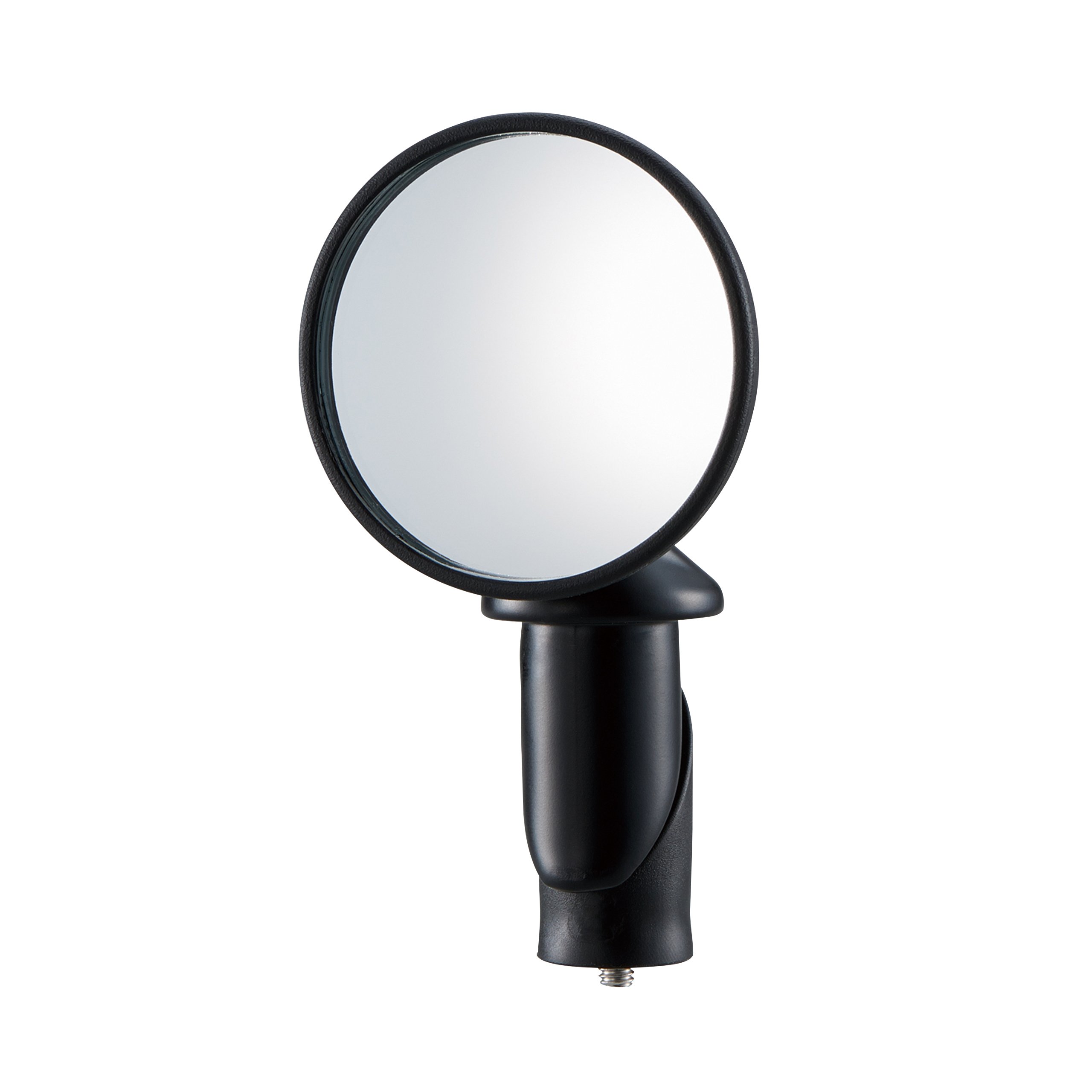
Mirrycle Mountain Mirror

Top Pick
Mirrycle Mountain Mirror

Flat-bar all-rounder

Our Score 9.2/10
Check Price

Worth Noting

  • Sits proud of the bar end
Lens
3 in round convex glass
Mount
Bar end
Weight
4 oz
Bar Fit
13.75–22.5 mm inside diameter
Read the full review

Every mirror here does the same basic job, so the one worth fitting first is the one that asks the least of you. The Mirrycle presses into the open end of your handlebar, expands to grip it, and adjusts by hand from there. Its 13.75 to 22.5 mm inside-diameter range covers more flat bars than any other bar-end pick in this guide, and that breadth is most of why it takes the top spot.

We paid close attention to how it holds an angle, because a mirror that drifts is worse than no mirror at all. The head runs on a friction pivot that stays where you leave it over washboard and broken pavement, and mounted outboard of the grip it sits clear of your forearm, the obstruction that ruins most bar-end designs for road use.

The lens is a three-inch round convex, which is the sweet spot for us: wide enough to place a car behind you, small enough that it does not turn into a wind sock at the end of the bar. Fitting takes about ten minutes with the wrench in the box, and the only irreversible step is opening or trimming the end of your grip.

Something you rarely get to say about bike accessories: Mirrycle sells replacement mirror heads separately, so damage to the glass is a small repair rather than a new purchase. That quietly answers the one real weakness of any bar-end design, and it is a large part of why this stays our default rather than a one-season experiment.

Bottom line: Wide bar compatibility, a steady three-inch lens, and replacement heads you can actually buy make this the flat-bar mirror we recommend first.

2

BriskMore 76mm Pair

BriskMore 76mm Pair

Two bikes at once

Our Score 9.2/10
Check Price

Worth Noting

  • Grips must have open ends
Lens
76 mm round glass
Count
Pair, left and right
Mount
Bar end
Bar Fit
14–24 mm inside diameter
Read the full review

Two mirrors for close to what one costs elsewhere makes this the set we point households at: one for your bike, one for your partner's, or a matched pair on an e-bike. Each lens is 76 mm of convex glass with a shatterproof film behind it, and the frame is nylon reinforced with glass fiber rather than plain plastic.

What decides a bar-end mirror's fate is the expansion plug inside the bar, and this one is a proper wedge on a 304 stainless screw rather than a rubber bung that creeps. It covers 14 to 24 mm inside diameters, a wider band than most here, and a 4 mm hex key and a cleaning cloth come in the box.

Clarity is the reason it lands this high. The glass is sharp enough to name the make of the car behind you, and the heads hold their angle over bumps instead of drooping toward the tarmac. Having a right-side mirror as well is more useful than it sounds in traffic where you are boxed on both sides, and the spare covers the most common accident of all: a bike that goes over on its left.

Bottom line: Two clear, steady mirrors for roughly the price of one elsewhere makes this the sensible buy for a household with more than one bike.

3

BriskMore Wing Pair

BriskMore Wing Pair

Broad wing-shaped view

Our Score 9.2/10
Check Price

Worth Noting

  • Wide head catches wind and doorframes
Lens
4.7 by 2.4 in wing glass
Count
Pair, left and right
Mount
Bar end
Bar Fit
14–24 mm inside diameter
Read the full review

The wing shape is what separates this pair from the round BriskMore mirrors above. The lens is 4.7 by 2.4 inches, wider than it is tall, so the horizontal band behind you, the one with the traffic in it, fills the glass instead of crowding into a circle.

Glass-fiber nylon and a 304 stainless screw hold it in the bar, and the expansion plug covers 14 to 24 mm inside diameters, so it fits most flat bars and plenty of e-bikes. Two mirrors ship in the box, which means both sides of the bar get one if you want them.

We like the shape for wide shoulders, and for anyone riding a recumbent or a long-wheelbase e-bike, where a round lens tends to show a lot of sky and not much road. The angle of the wing takes a ride or two to trust, and once it is set the horizontal view reads faster than a circle does.

Bottom line: A matched pair with a wide wing-shaped lens that suits broad shoulders and long-wheelbase bikes better than a small round mirror.

4

Hafny HF-MR095

Hafny HF-MR095

No-cut clamp mounting

Our Score 9.0/10
Check Price

Worth Noting

  • Head can work loose on rough ground
Lens
5.5 by 2.45 in oblong glass
Mount
Clamp-on handlebar
Bar Fit
21–26 mm outside diameter
Drop Bars
Not compatible
Read the full review

Trimming the end of a grip is the step that stops most people from fitting a bar-end mirror at all, and the Hafny HF-MR095 skips it entirely. The clamp wraps around the outside of the handlebar next to the grip and tightens with the 5 mm hex key that comes in the box. It fits bars measuring 21 to 26 mm across.

Looks matter more with mirrors than with most accessories, and this is the one we find easiest on the eye. The oblong head and high-impact nylon body sit close to the bar and read as part of the bike rather than a bolt-on, and the anti-glare glass stays sharp when the sun is behind you. The head folds in against the bar for parking too, which keeps it out of trouble in a crowded rack. What it does not do is drop bars: the clamp needs a straight round section of tube, so this is a flat-bar mirror.

It is the priciest mirror here and you get a single left-side unit rather than a pair. Measure your bar's outside diameter at the grip before ordering, since 21 to 26 mm covers most flat and city bars but not every one, and check that the clamp position will not foul a bell or a display.

Bottom line: For a new bike you would rather not modify, this clamp-on Hafny is the neatest way to add a mirror without touching a grip.

5

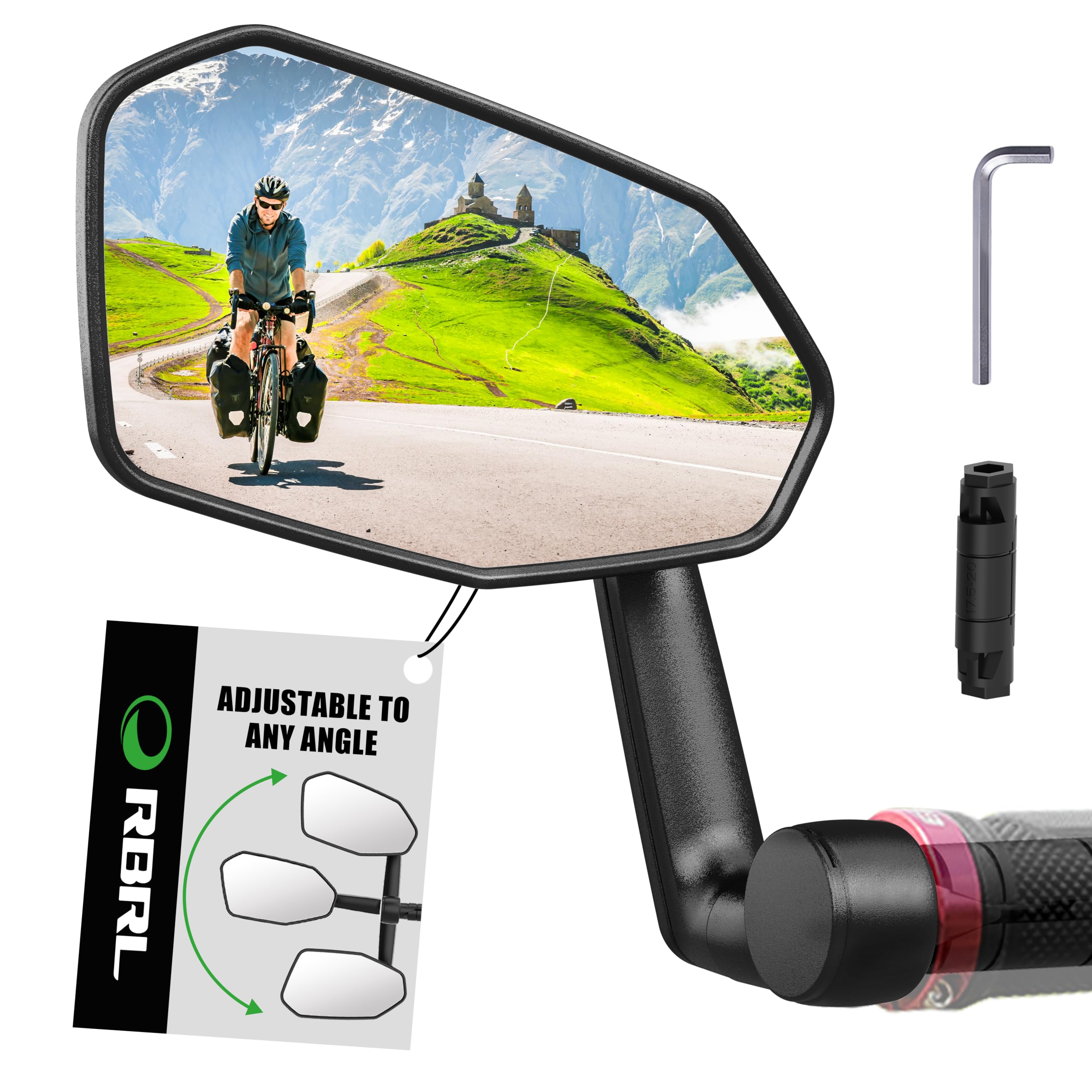
RBRL Extra-Large Mirror

RBRL Extra-Large Mirror

Wide, clear view

Our Score 9.0/10
Check Price

Worth Noting

  • Fits only 15 to 20 mm inside diameters
  • Connecting rod can break in a fall
Lens
124 by 67 mm glass
Mount
Bar end
Bar Fit
15–20 mm inside diameter
In The Box
Two expander sizes, hex key
Read the full review

At 124 by 67 mm, the glass on the RBRL is the largest lens in this guide, closer in size to a scooter mirror than to the bar-end plugs most of us ride with. Set it once and the lane behind arrives in a single look: you can place a car's width and read its closing speed without hunting around a small circle.

We think that size earns its bulk for anyone with broad shoulders, a child trailer, or a fast e-bike, where a narrow slice of road is not enough information to make a decision. The head rotates through a full turn, so it can sit above the bar, below it, or angled outboard past your elbow, and the hardware in the box is more thorough than most, with two expansion sizes and the hex key you need.

It is a single left-side mirror, and the size cuts both ways. That big head catches wind on an exposed stretch and finds doorframes when you wheel the bike through a hallway, which is worth thinking about if the bike lives indoors or on a crowded rack.

Bottom line: The mirror to buy when a normal lens is not showing you enough road: huge, adjustable, and best on a wide bar.

6

MEACHOW ME-006LS

MEACHOW ME-006LS

Sturdy clamp mount

Our Score 9.0/10
Check Price

Worth Noting

  • Clamp fits 22.2 mm bars only
Lens
Anti-glare safety glass
Count
Single, left side
Mount
Aluminum clamp
Bar Fit
22.2 mm handlebar
Read the full review

The clamp is the reason to look at this one. Where most clamp-on mirrors use a plastic collar, the ME-006LS uses a high-strength aluminum alloy clamp on a fiber-reinforced nylon body, the sort of hardware that usually turns up on motorcycle fittings rather than bicycle ones.

The glass is blast-resistant safety glass with an anti-glare coating, cut in a hexagon that looks purposeful and earns its keep on an evening commute, when the headlights behind you are the thing you are trying to read. The silver lens on this variant is the lighter of the two glare grades the maker offers.

The clamp is also the limitation: it fits a 22.2 mm bar, which is what most flat bars measure at the grip, and nothing else. If your bar is 25.4 or 31.8 mm at the point you want to mount, this is not the mirror for you. Measure at the grip rather than at the stem, where almost every bar is a different diameter.

We came away thinking of it as the serious option in this set: heavier-looking than the rest, with a clamp that does not shift and a lens that handles glare without washing out. The maker asks for 2 Nm on the clamp bolt, which is barely more than hand-snug, so there is no reason to lean on the wrench. It is one left-side mirror, and it is the pick if you want metal holding the glass.

Bottom line: A metal clamp and anti-glare glass for the rider who wants the mirror bolted on solidly and does not mind a one-size fit.

7

Cat Eye BM-45

Cat Eye BM-45

Drop-bar road bikes

Our Score 8.6/10
Check Price

Worth Noting

  • Small lens shows a narrow slice of road
Lens
2 in flat glass
Mount
Bar end
Weight
1.28 oz
Bar Fit
Drop and flat handlebars
Read the full review

The BM-45 is the smallest mirror here: a flat-glass disc about two inches across on a short aluminum stalk, barely wider than the bar end it plugs into. It is also the only mirror in this guide listed for drop bars as well as flat ones, which is why we keep it here for road bikes.

Small is the design, not the compromise. The lens is flat rather than convex, so what you see sits where it actually is, with no compressed distance to misjudge when a car is closing behind you. The aluminum stalk does not flex, the head holds its setting, and the whole thing adds barely an ounce and a quarter to the bike.

For a road bike that is the right trade. You check it with a flick of the eyes rather than a full head turn, and it does not make a light bike look like a delivery mule. It is a glance tool rather than a rear-view camera, and it works alongside a shoulder check rather than instead of one.

Fitting follows the usual bar-end rules: you need a hollow bar end, and bar tape wrapped over the opening has to be trimmed back. The supplied Allen key is the only tool required, and Cat Eye backs it with a two-year manufacturer warranty.

Bottom line: For drop-bar riders who want a mirror that disappears into the bar, this small, flat, steady disc is the one to fit.

8

Wittkop Bike Mirror

Wittkop Bike Mirror

Cheap second bike

Our Score 8.4/10
Check Price

Worth Noting

  • Single left-side mirror
Lens
Convex real glass
Count
Single, left side
Mount
Handlebar clamp, above or below
Weight
5.93 oz
Read the full review

Vibration is the first thing we noticed here, and it is the thing to weigh before you buy. On smooth pavement the view is fine; on chip seal and gravel the image blurs enough that you have to pause to read it. The arm is short and the whole head hangs off a single screw, so there is very little between the bar and the glass to soak up the shake.

What it gets right is the mount. The clamp goes on with the supplied screw and can sit above or below the bar, and the head rotates and tilts through a full turn to reach your eyeline. At 168 g it is light enough for a city bike, and the convex real-glass lens is clear when the road is.

You get one mirror, left side only, and the saving shows in the plastic where the head meets the arm. It is the least expensive mirror in this guide, and that is the honest way to read the spec sheet: reinforced materials and a one-year warranty, at a price that says second bike rather than daily commuter.

For a cruiser, a station bike, or a paved-path runabout it does enough: you will see headlights and silhouettes, which is the job. It is not the one for a fast commute over broken surfaces, where the shake costs you the glance you paid for. Check the mounting screw after the first week, since a single fastener on a vibrating bar is the part that works loose first.

Bottom line: A cheap, adaptable clamp mount for a second bike or a paved-path cruiser, as long as you do not expect a steady image on rough ground.

How We Put 14 Bike Mirrors Through Five Months of Riding

We started by pulling together everything we could find in three mount styles — bar-end, handlebar-clamp, and helmet or glasses-mounted — and cut the list by reading spec sheets for lens shape, claimed field of view, and mounting hardware. We eliminated models with proprietary clamps that couldn't be swapped between bikes, and anything that required tools beyond a hex key to install. That left 14 mirrors, which we bought ourselves so nothing arrived pre-tuned by a brand.

Each mirror was installed from scratch, solo, with only the hardware in the box, and we timed it. Then it went onto a commuter bike for weekday rides through traffic and a rail-trail bike for longer weekend miles, plus a loaded grocery run to see whether a mirror survived being leaned against a rack. We noted whether screws bottomed out or stripped, whether plastic clamps flexed when tightened, and whether the mirror stayed where we set it after a stretch of patched asphalt. Field of view got measured the practical way: a second rider trailed at two and four bike lengths, and we checked whether the mirror caught them before a shoulder check did.

Adjustability was tested with cycling gloves on and, where the mount allowed, at a red light — the question was always whether a thumb and forefinger could nudge the angle without the whole arm moving. We rode through rain, left mirrors mounted in direct sun for weeks, and dropped two onto pavement to see how the housings held up. Size got weighed honestly against vibration: at speed, we watched whether lane markings behind us stayed legible or dissolved into a blur, and whether a larger lens was worth the extra shake. Versatility came down to how cleanly a mirror moved between a hybrid, a road bike, and a helmet, since most people don't own just one bike.

How to Choose Bike Mirrors

Fit Is a Measurement, Not a Promise

Bar-end mirrors are sold by inside diameter, clamp-on mirrors by outside diameter or a single fixed bar size, and universal means the maker covered a range rather than your bike specifically. The Mirrycle spans 13.75 to 22.5 mm inside, the BriskMore pairs cover 14 to 24 mm, the RBRL stops at 20 mm. Hafny's clamp wants 21 to 26 mm across the outside of the bar; the MEACHOW clamp is one size, 22.2 mm.

Measure where the mirror will actually sit, which is at the grip rather than at the stem, because many bars taper. A ruler across the open end of the bar answers the bar-end question in ten seconds.

Bar End or Clamp-On

Bar-end designs put the glass outboard of your hand, which gives the cleanest look down the road behind you and leaves the bar itself uncluttered. The cost is commitment: the grips need open ends, or you cut them, and the mirror is the first thing to touch the ground when the bike falls.

Clamp-on mirrors bolt around the bar in a minute and leave your grips alone, which matters on a new bike or one you are about to sell. They sit inboard, so the head is closer to your hand and can foul a bell, a display, or a bar bag.

Lens Size, Shape, and Glass

Bigger glass shows more road and catches more wind. A three-inch round lens is the useful middle and most of this list uses one; the RBRL's 124 by 67 mm is the extreme, and it suits wide shoulders and trailers better than a light road bike. Wing and oblong shapes trade height for width, which is where the traffic actually is.

Convex glass buys field of view at the cost of compressed distance. Flat glass shows true distance and less road. Safety glass with a shatterproof film is the standard here; a stainless lens will not shatter at all but scratches more easily.

Position It Around Your Arm, Not Behind It

Most disappointing mirrors are badly placed rather than badly made. Mount it outboard of the grip and set the angle with your hand actually on the bar, because the position you choose standing beside the bike is rarely the one you need at speed.

Above the bar gives a wider view over your hand; below the bar keeps the head clear of knees, doorways, and the first thing a fall finds. Set the arm short so there is less leverage to shake the joint loose.

Frequently Asked Questions

Final Verdict

Start with the Mirrycle. It fits the widest spread of bar ends in this guide, holds its angle over rough pavement, and takes a cheap replacement head when a bike tips over, which between them decide whether a mirror stays on your bike for years or ends up in a drawer.

If you do not want to trim a grip, the Hafny HF-MR095 clamps on instead and never asks you to cut anything. If you ride drop bars, the Cat Eye BM-45 is the only mirror here built for them.