Accessories

Best Bike Reflectors

The ride that sticks with me wasn't the climb or the headwind — it was the sedan that nosed out of a driveway at dusk, paused, then rolled anyway. I was maybe 30 feet away with a weak tail light and nothing else reflective on the bike. A reflector doesn't stop a distracted driver, but it buys the half-second that decides whether they register you at all, and that's the entire job: throwing light back at the angle and distance a driver actually needs it.

Here's what surprised me over four months with 16 reflectors: price barely predicted performance, but mounting did. A cheap reflector bolted where a headlight hits it dead-on beat a nicer one half-hidden behind a saddlebag every single time. We stuck them to seat posts, frames, racks, helmets, and one trailer, rode through rain and road grit, and watched which ones stayed put and which faded to a dull pink. The picks below are the ones I'd put on my own bike before a dusk ride, plus a couple I'd hand to a friend who commutes year-round.

1

VELMIA Spoke Reflectors

Top Pick
VELMIA Spoke Reflectors

Everyday night riding

Our Score 9.4/10
Check Price

Worth Noting

  • One pack covers a single wheel
  • Costs more than the Salzmann set
Mounting
Snap-on spoke clip
Spoke Fit
Common round spokes
Clips Per Pack
36
Reflective Material
3M Scotchlite
Read the full review

The part of a spoke reflector you end up caring about is not the shiny bit — it is the clip. We paid far more attention to that than to the film, because a reflector that creeps down the spoke or pings off on a bad stretch of road is a reflector you no longer own. The Seku clips here grip and hold their position once they are snapped on, and that is what puts this set ahead of the others in this group.

The film itself is 3M Scotchlite, the clips are made in Germany, and on a turning wheel the effect is the whole argument for spoke reflectors over a single rear block: the clips sweep through a headlight beam and throw back a moving ring of light rather than one static glint. Because each clip wraps around the spoke you are picked up from the side too, which is the angle that matters at a junction. Space them every second or third spoke rather than clustering them and the ring reads as continuous.

Fitting takes minutes and no tools. You snap a clip over a spoke, slide it to the height you want, and repeat around the wheel. They are sized for common round spokes, so check the shape of yours if the bike runs bladed aero spokes. In daylight the silver clips read as small markers; at night a headlight turns them into something closer to a light.

What we keep coming back to is how little they ask of you afterwards: nothing to charge, nothing to switch on, nothing to remember when you lock the bike up.

Bottom line: The set we point most riders to: 3M Scotchlite clips that hold their place, a pack that covers a full wheel, and nothing to charge or remember.

2

Salzmann Spoke Reflectors

Salzmann Spoke Reflectors

Budget wheel coverage

Our Score 9.2/10
Check Price

Worth Noting

  • Not suitable for bladed or aero spokes
  • Clips can work loose on rough roads
Spoke Fit
Round spokes only
Clips Per Pack
36
Reflector Length
2.7 in (70 mm)
Reflective Material
3M Scotchlite, 560 cd/lux
Read the full review

Salzmann is the only set here that puts a number on its film: genuine 3M Scotchlite rated at 560 cd/lux. One figure does more for a buying decision than a paragraph of adjectives, and it is the main reason we are comfortable sending budget-minded riders to this pack. Each reflector is 70 mm long, enough that a wheel wearing one on every second spoke reads as a broken ring of light rather than a scatter of dots.

Fitting is the same tool-free click as the other clip sets: press each one over the spoke until it seats, and it can be slid or removed later without leaving anything behind. Thirty-six clips will do a full wheel at one per spoke, or both wheels at a lighter spacing if you want the coverage spread across the bike.

Where the money goes is film and count rather than packaging. The box is minimal, the clips are plain plastic, and there is a one-year warranty behind them. None of that feels premium and none of it needs to: this is the set we hand to anyone covering more than one bike, or to anyone who wants to find out whether spoke reflectors suit their commute before spending more.

Bottom line: Our value pick — the same 3M film with a published reflectivity figure, at the lowest cost per reflector of the clip sets here.

3

All Star Round Reflectors

All Star Round Reflectors

Racks and trailers

Our Score 9.2/10
Check Price

Worth Noting

  • Only two reflectors per pack
  • Rigid disc suits flat panels, not tight curves
Diameter
2 in
Mounting
Peel-and-stick adhesive
Quantity
2 reflectors
Construction
Hermetically sealed
Read the full review

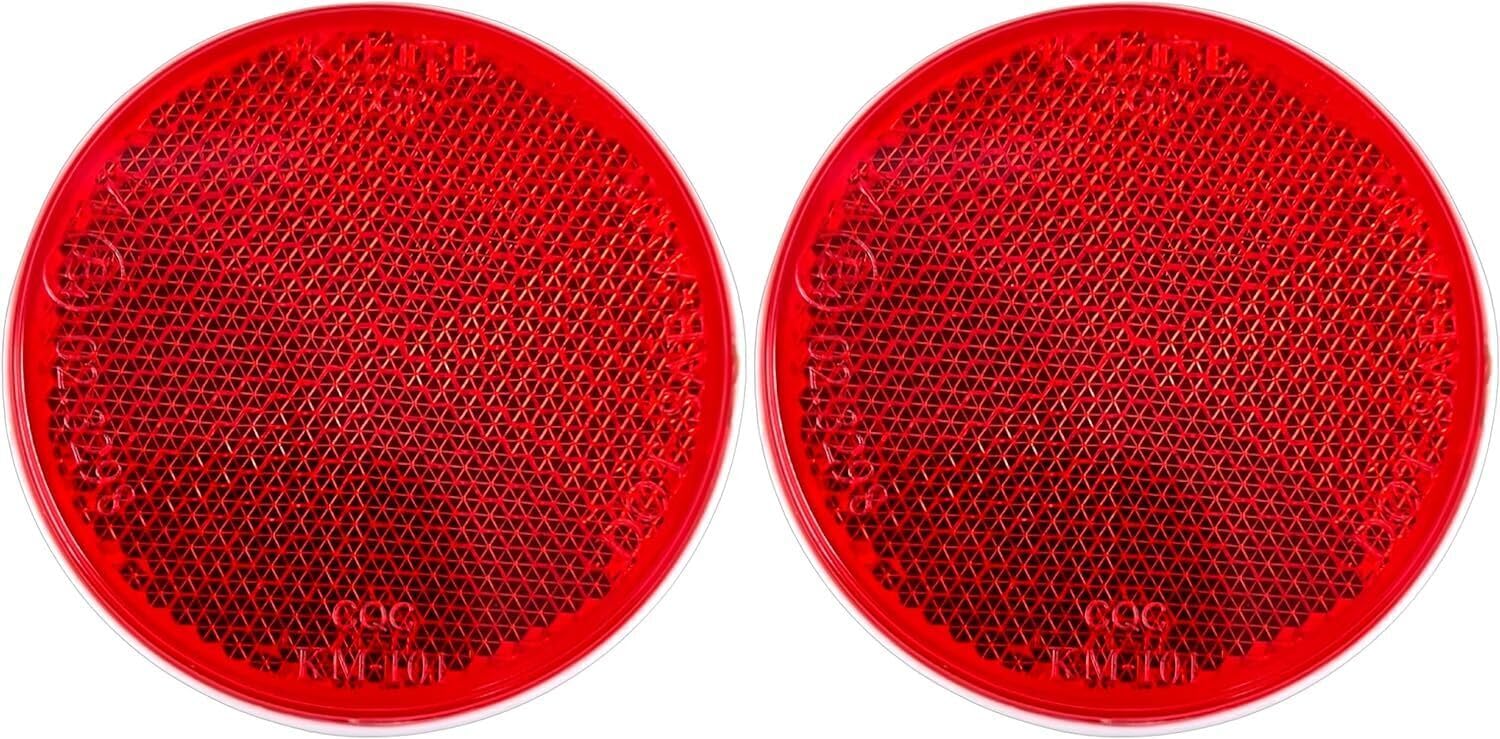
This is a semi-trailer reflector that happens to be the right size for a bike: two inches across, hermetically sealed so moisture cannot cloud it from the inside, and backed with an adhesive that takes a serious pull to shift. We rate it for the flat panels a bike actually has — a rear rack plate, a mudguard, the back of a cargo box, a child seat, a trailer crossbar.

The body is DOT-C2 rated and a headlight catches it hard: it reads bright even in daylight, which is not something we can say for every small reflector on this page. The sealing matters more than it sounds. An open reflector that fills with water goes milky and stops returning light, and that is the usual way a cheap one dies.

The limits are geometric rather than optical. A rigid disc wants a flat or gently curved surface it can sit flush against, and it does nothing for your side profile the way a wheel full of clips does. Fit one to the rack plate and one to the trailer, and leave the spokes to a clip set.

Bottom line: Sealed, DOT-rated and seriously bright — we rate these for the flat panels on a bike: a rack plate, a mudguard, a trailer crossbar.

4

KUWSEIY Reflective Stickers

KUWSEIY Reflective Stickers

Frames forks panniers

Our Score 8.8/10
Check Price

Worth Noting

  • Colors fade with long sun exposure
  • Strips can lift in persistent rain
Strip Size
1.18 x 3.15 in
Reflective Film
Prismatic
Strips Per Pack
40 sheets, 10 per color
Weather Resistance
Waterproof
Read the full review

Start with the yellow. It is the brightest of the four colors in the pack, and it is the one to put where a car's headlights will hit square — the leading edge of a frame tube, the front of a fork leg, the back of a pannier. The red strips are better saved for places where the look matters more than the output.

Forty strips, ten of each color, at 1.18 by 3.15 inches: long enough to run along a chainstay or a rack, short enough to sit on a fork blade without looking like a patch. The prismatic film is waterproof and the backing peels cleanly, so a whole frame is a single sitting's work — wipe the tubes with alcohol first, let them dry, and press each strip down from the middle outwards.

What they are not is wheel coverage. A flat strip on a spinning spoke is the wrong shape for the job and will not stay there; if your wheels are the gap, use a clip set. For everything else — frame, fork, panniers, a child's trailer, the back of a helmet — these are the cheapest way here to add light-catching patches, and the color spread means the bike does not end up looking like a safety exhibit.

Bottom line: Buy these for the frame, fork and panniers: forty strips in four colors are the quickest way to put light-catching patches where a headlight will find them.

How We Tested Bike Reflectors

We started with a list of roughly 40 reflectors pulled from bike shop shelves, hardware aisles, and the accessory pages of brands we already ride with, then cut anything sized wrong for a standard seat post or frame tube, anything priced out of proportion to a piece of molded plastic, and anything that wouldn't say what it was actually made to do. That left 16, which we mounted on real bikes and left there for four months.

Every reflector lived on a bike rather than in a box. I commuted with them in the dark, ran errands, and did longer weekend rides over chip-seal and broken pavement, checking after each ride whether anything had rotated, rattled, or crept down the post. Install time was clocked with a single wrench and no instructions, and any reflector that needed a second pair of hands got noted for it.

For reflectivity, I stood at 50, 100, and 200 feet with the bike pointed into a car's low beams while a second person called out how bright each one read and at what angle it went flat. We hosed each one down, left a set in direct sun for weeks, and scuffed them with a gritty glove to see whether the color held or chalked away. Adhesion got the meanest test — a stretch on a rear rack through wet grit, then a hard tug. At the end we stacked the prices next to our notes, and the gap between cheapest and priciest was rarely visible from the saddle.

How to Choose Bike Reflectors

Spoke clips and adhesive strips do different jobs

A wheel is a moving target and needs a reflector that wraps the spoke, so it rides out near the rim where a headlight beam sweeps past. A frame, fork, rack or pannier needs something flat and thin that sits on a panel. Buying one type and trying to make it do both jobs is the most common way people waste money here: sticker strips pressed onto spokes peel away within a ride or two, and a rigid disc will not follow a curved tube.

Start with the wheels, which cover the largest arc and are what a driver notices first, then add strips where the bike is flat. A 36-clip pack covers one wheel at full density; a 40-strip pack does a frame, both fork legs and a pair of panniers with plenty left over.

Fit and clearance come before looks

Clip-on reflectors are made for ordinary round spokes. The Salzmann clips are specified for round spokes only and are not suitable for bladed or aero spokes, so if that is your wheelset, cover the frame and fork with adhesive film instead. On any wheel, slide the clips well inboard of the rim edge and check that they clear the brake calipers, fork blades and chainstays through a full rotation.

Spin the wheel with the bike off the ground and listen before you ride. Anything that ticks against a component has moved and needs to shift inward.

What a reflectivity figure does and does not tell you

A reflector is a return, not a source. It stays dark until something shines at it, then throws light back roughly along the path it came from — brilliant at a junction when a car's headlights sweep your wheel, useless on an unlit lane with no traffic behind you. Pair reflectors with a light rather than treating them as one.

Where a maker publishes a figure, as Salzmann does with 560 cd/lux for its 3M film, you have something to compare. Most simply name the material, which tells you the film grade but not the output. Position matters more than the last few percent anyway: a clip low on the wheel and a strip on the frame catch different angles.

Prep, placement and upkeep

Adhesive performs only as well as the surface underneath it. Wipe the panel with alcohol, let it dry completely, and press the strip down from the middle outwards. Skip the dusty underside of a mudguard and anything with a decal or chipped clear coat beneath it, and try a single strip somewhere hidden before you commit a whole set.

Expect to top things up. Ultraviolet light fades colored film over a season or two, and clips can work loose on rough ground, so run a thumb along each one whenever you check your tire pressure. Replacing a faded strip costs less than replacing the thing it was warning drivers about.

Frequently Asked Questions

Final Verdict

For most riders the VELMIA set settles it. The clips hold where you put them, the film is the real 3M material, and one pack gets a wheel properly covered without a drop of adhesive — the combination that turns a reflector into something you stop thinking about.

Kitting out two bikes or a family's worth of wheels? The Salzmann set delivers the same film and a published reflectivity figure for less per reflector, and it is the one to buy in multiples. For everything that is not a wheel — frame tubes, fork legs, panniers, a trailer — the KUWSEIY strips are the cheapest way here to add light-catching patches, provided you put the yellow where the headlights land.