Tires & Tubes

Best Bike Tire Repair Kits of 2026

Your Saturday ride is going perfectly until the rear tire starts to squirm, and by the time you coast to the shoulder you can hear the air hissing out — a good bike tire repair kit turns that moment from a ride-ending phone call into a ten-minute pause. What separates the kits worth carrying is how well the patch actually bonds, whether the glue has dried up since last season, and if you can find the right patch size without dumping the whole tin into the dirt. After years of saddlebag mismatches, my team and I spent four months putting 14 kits through the wringer — commuting, weekend loops, and one very dusty gravel detour. The best ones disappeared into a jersey pocket and got me home without a second thought.

The right kit depends on how you ride — a pocket-sized option looks different from a workshop box. We weighed that capacity tradeoff against how reliably each kit sealed a puncture.

1

PRO BIKE TOOL Tubeless Kit

Top Pick
PRO BIKE TOOL Tubeless Kit

Tubeless road and MTB

Our Score 9.2/10
Check Price

Worth Noting

  • Bulkier in a pocket than a bare plug tool
Case
2.91 x 1.34 x 1.22 in
Tool
Combined reamer and inserter
Plugs
10
Plug Sizes
1.5 mm and 3.5 mm
Read the full review

Sealant closes the pinholes. It's the thorn that leaves a slit, or the screw that leaves a hole the sealant can't bridge, that ends a ride — and that is the repair a plug kit exists for. You ream the hole, push a sticky strip into it, reinflate, and let the sealant finish the seal from the inside.

PRO BIKE TOOL's version carries ten plugs in two widths: 1.5 mm strips for road tires and smaller holes, 3.5 mm for the bigger stuff, with the reamer and the inserter combined into a single tool. The machined aluminum canister is the handle during the repair and the storage case afterwards, and it measures just under three inches.

Two plug widths in one pocket-sized tool is what makes this the kit we reach for on a bike that runs 28s one weekend and 2.4s the next. Keep a CO2 or a pump beside it — the repair doesn't inflate itself — and treat the plug as a trail fix worth replacing properly once you're home.

Bottom line: The tubeless kit to keep on the bike: two plug widths, a combined reamer and inserter, and an aluminum canister that doubles as the handle.
2

LEZYNE Tubeless Repair Kit

LEZYNE Tubeless Repair Kit

Minimalist tubeless

Our Score 9.2/10
Check Price

Worth Noting

  • Plugs are a poor fit in narrow road tires
Body
Machined aluminum
Tool
Reamer and inserter
Plugs
5 extra-tacky
Weight
1.17 oz
Read the full review

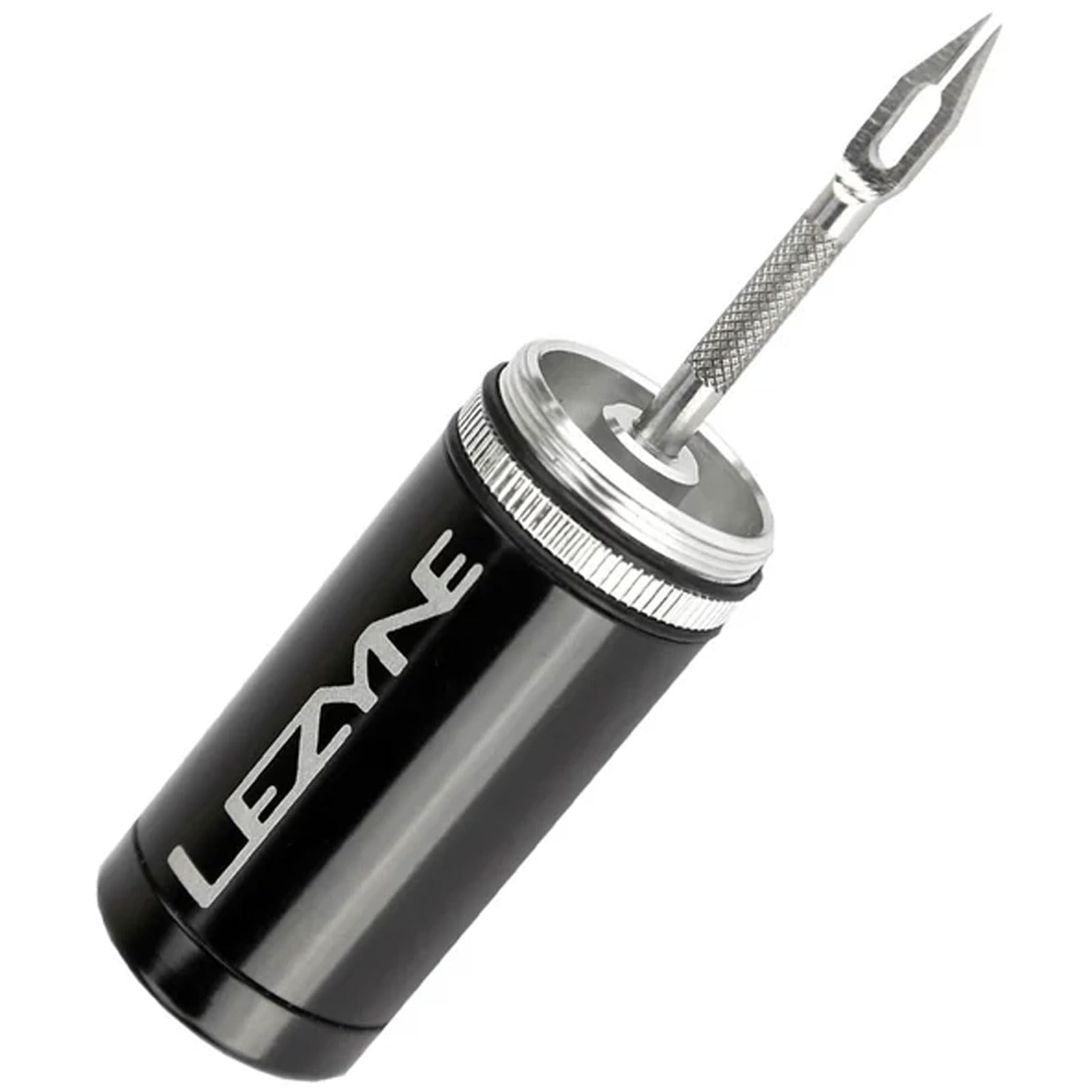
Thirty-three grams is the sort of number you appreciate only when the alternative is walking. LEZYNE's kit is a machined aluminum capsule with a stainless steel reamer, an insertion tool and five extra-tacky plugs living inside it, and it drops into a jersey pocket or a saddlebag without a rattle.

Open it and the body becomes the handle: ream the puncture, load a plug on the insertion tool, push it home, pull the tool out and leave the strip behind. Because the plugs are stored in the same cylinder, there's nothing loose to lose and nothing going sticky in the bottom of a bag between rides.

Volume is where it narrows. These are chunky strips, and a narrow high-pressure road or cyclocross tire leaves less rubber around the hole for them to grip, so the plug can work its way out where a fatter mountain bike tire holds it happily. On gravel and trail volume, it's the neatest thing here.

Bottom line: Ultralight tubeless insurance for mountain and gravel riders — 33 grams of machined aluminum with five plugs inside, though narrow road tires are a stretch.

3

cyctravel 20-Patch Kit

cyctravel 20-Patch Kit

Budget tube repairs

Our Score 9.0/10
Check Price

Worth Noting

  • Plastic levers can snap on a tight bead
  • Case is too bulky for a jersey pocket
Patches
20
Patch Type
Vulcanizing glue-on
Also Included
2 levers, 4 rasps, 4 sandpapers
Vulcanizing Fluid
24 ml
Read the full review

Twenty patches in a spread of sizes, 24 ml of vulcanizing fluid, two levers, four metal rasps, four squares of sandpaper and a printed manual, all in a case about the size of a large phone. Opening this box is the moment a rider stops buying tubes out of habit.

The rasps and abrasives are the underrated half of it. A patch only holds on a properly dulled surface, and having four rasps and four sandpapers means running out of abrasive mid-repair never becomes its own small disaster. The patch sizes cover the difference between a thorn pinhole and a pinch flat, which is exactly the spread you want when you're repairing a tube by feel at the side of a path.

Our take is that this is the kit for the rider who flats often and wants enough material to deal with it without a shop trip. A crooked first attempt costs a patch rather than the whole kit, and the fluid is there in a quantity that lets you be generous. It's the one we point at when someone asks what to buy before a season of commuting.

Bottom line: For riders who flat often, this is the box to buy: twenty patches, fluid, levers and rasps for less than a couple of spare tubes, in a case that keeps every piece findable.

4

NDakter Frame Bag Kit

NDakter Frame Bag Kit

Long rides

Our Score 9.0/10
Check Price

Worth Noting

  • Bag can foul your knees on a small frame
Pump
120 PSI, Presta and Schrader
Patches
6 glueless
Multitool
16-in-1
Bag Capacity
2 L
Read the full review

Two liters of bag is the headline here, not the tools. The frame bag swallows a phone, keys, a wallet, a spare tube and the pump it ships with, straps on and off with velcro, and keeps the weather out well enough for a wet commute.

The kit inside covers the basics sensibly: a mini pump rated to 120 PSI that fits both Presta and Schrader valves, a folding 16-in-1 tool in stainless steel, and six self-adhesive patches. For a commuter or a day-tripper it's the right combination — everything needed for a flat, in one thing you grab off the shelf on the way out.

Mounting is where it gets fussy. A full triangle bag can sit wide enough to brush a knee on a small frame, and step-through bikes often need a different spot than the usual seat-tube-to-top-tube position. Hold it against your own frame before you commit to it.

What keeps us coming back to this one is the consolidation: one bag, one grab, no patching a tube and then realizing the pump is on the other bike. For long days out, that's worth more than the individual quality of any single tool in the box.

Bottom line: Buy it for the bag as much as the tools: two liters of frame storage with a 120 PSI pump and a 16-in-1 tool, ready for a long day out.

5

Park Tool GP-2 Patch Kits

Park Tool GP-2 Patch Kits

Mess-free fixes

Our Score 9.0/10
Check Price

Worth Noting

  • Adhesive can lift at high road pressure
Packs
3 waterproof packs
Patches
18
Included
Sandpaper
Patch Type
Pre-glued
Read the full review

The moment you're kneeling at the roadside with glue on cold fingers and a tube that won't hold still, the appeal of a pre-glued patch becomes obvious. Park Tool's GP-2 packs are the clean version of a flat repair: peel one off the backing, press it down, ride. Three waterproof packs of six patches, each with a scrap of sandpaper, is enough to be generous with.

The adhesive was developed with 3M and flexes with the tube, which is what stops a flat patch from peeling at the edges as the tire works underneath it. What it doesn't have is forgiveness: a pre-glued patch is one attempt, and once it has touched the tube it's committed. Line it up before you peel.

Where this kit stops being the right answer is pressure. The adhesive is doing the job that vulcanizing fluid does chemically, and a narrow road tire is the hardest place for it to hold — a patch over the tube seam is the classic failure. On a commuter, a hybrid, a mountain bike or a kid's bike, the speed is worth the trade.

Bottom line: The fastest fix here — peel, press and ride with no glue — as long as your tires run at hybrid or mountain pressure rather than road.

6

Park Tool VP-1 Patch Kit

Park Tool VP-1 Patch Kit

Tube punctures

Our Score 8.8/10
Check Price

Worth Noting

  • Only six patches in a single kit
  • No tire levers in the box
Weight
0.35 oz
Patches
6
Included
Sandpaper and instructions
Patch Type
Vulcanizing glue-on
Read the full review

A vulcanizing patch doesn't sit on a tube so much as weld into it, and that's the difference you notice months later when the repair is still holding at pressure. Park Tool's VP-1 is the plainest version of the idea: six thin patches with tapered edges that follow the tube's curve, a small tube of self-vulcanizing fluid, a square of sandpaper and a plastic box that keeps everything together.

It's our top pick because the whole job fits in a box that disappears into a saddlebag, and nothing in there fails on you — no pump to seize, no lever to snap, just a bond that sets. The patches are thin enough that a repaired tube doesn't thump in the tire at speed, which matters on a road bike more than most people expect before their first lumpy patch job.

The method matters as much as the contents. Rough the tube until the surface is dull, spread the fluid thin, give it a moment to tack up and then press and hold; the instructions in the box walk you through it, which is more than some kits here bother with. Do that and the repair is permanent. Skip the prep and any kit in this guide will let you down.

What you're paying for is the quality of the bond rather than the volume of stuff in the box. The riders who get the most out of it are the ones who fix a tube properly and put it back into service instead of tossing it — which is the entire point of carrying patches rather than a stack of spare tubes.

Bottom line: Buy this if you ride tubes and want a repair that stays fixed: the fluid welds the patch into the tube, the box weighs ten grams, and there's nothing in it to break before you need it.

7

Slime 1022-A Patch Kit

Slime 1022-A Patch Kit

Cheap spare patches

Our Score 8.8/10
Check Price

Worth Noting

  • Cement can leak from the cap
  • Only five patches per kit
Weight
0.96 oz
Patches
5
Included
Metal scuffer and cement
Patch Type
Rubber cement
Read the full review

Five patches, a metal scuffer and a tube of rubber cement in a package small enough to lose in a toolbox. This is the kit that lives in the drawer and saves a Saturday, and it's the one that also covers the mower, the wheelbarrow and the air mattress.

It earns a place here as the garage spare rather than the kit we carry on a ride. Five patches is not many, and the cement is the entire bond — it only works if you scuff the tube down to dull rubber before spreading it. Do that and it holds. Skip the scuffing and you'll be redoing the job in a week.

Where it beats the purpose-built bike kits is reach. The same patch fixes a bike tube, a stroller tire or a trailer tube, and the metal scuffer outlasts the sandpaper squares that come in most cycling boxes. Bag the cement tube separately, though — the cap has a habit of leaking into whatever it's stored with.

Bottom line: A cheap kit to keep in the garage for bike tubes, mower tires and inflatables — as long as you rough the tube properly before the patch goes on.

How We Tested Bike Tire Repair Kits

We started by pulling together every kit we could find that was actually small enough to carry on a ride or tidy enough to live in a garage toolbox, then filtered the shortlist by patch variety, glue type, and the price per patch. That left 14 kits, which we used over four months on commutes, weekend loops, and one very dusty gravel detour. Each kit rode in a jersey pocket or saddlebag so we could note how much room it ate and whether the case stayed shut over washboard pavement.

To test adhesion and leakage, we punctured spare tubes with a clean nail, applied each kit’s patch exactly as directed, and let them cure before inflating to the tire’s recommended pressure. We then checked for slow leaks by submerging the tube in a bucket and watching for bubbles, and we revisited the same repaired tubes a week later to see if the patch had lifted. Patch selection got its own pass: we noted whether the kit offered the right size for a pinprick versus a pinch flat, and whether the patches were clearly labeled or all looked the same in a dim garage.

Ease of use came down to fumbling in the cold: we timed how long it took to open each kit, find a patch, and get the tube back in the tire with numb fingers, and we noted whether the glue tube recapped without cross-threading. Durability meant checking each kit after four months of bag life — dried-out glue, cracked cases, curled patch edges. Value for money wasn’t the lowest price; it was whether the patch count and reusable parts justified its spot. The best kits were the ones we forgot we were carrying until we needed them.

How to Choose Bike Tire Repair Kits

Tube or Tubeless Decides the Kit

Start here, because the two systems fail differently. A tubed tire goes flat when something pierces the tube; you pull the wheel, take out the tube, find the hole and patch it, or fit the spare you're carrying. A tubeless tire usually seals pinholes with liquid sealant, so what you need is a fix for the hole the sealant can't close — a plug pushed through the tread from outside, with the wheel still on the bike.

Buy patches for tubes and plugs for tubeless. A plug kit won't rescue a tubed tire, and patches alone leave a tubeless rider walking. If you own one of each kind of bike, carry both; the plug tool weighs almost nothing and takes up less room than a second patch kit.

Glue or Glueless

Vulcanizing fluid bonds the patch into the butyl; a pre-glued patch is a sticker held by pressure-sensitive adhesive. Glueless is faster, cleaner and there's nothing to spill, but you get one attempt at placing it, and the higher your tire pressure the harder that adhesive has to work to stay put.

A glue kit takes longer at the roadside: rough the tube, spread the fluid thin, let it go tacky, then press. In exchange it forgives a slightly crooked patch and it holds on a narrow road tire. Commuters and mountain bikers can go glueless; if you run road pressures, carry glue.

Consumables Age Faster Than the Patches

The patches will outlast the box; the fluid won't. A tube of vulcanizing cement that lives in a saddlebag through a hot summer can be solid when you finally open it, and pre-glued patches baked and frozen for a couple of seasons lose their grip. Squeeze the tube before a long ride — if it's stiff or stringy, replace the kit at home rather than discovering it on the shoulder.

Patch count matters too. Six patches is a season for a casual rider and a fortnight for someone commuting through goathead country, which is why the twenty-patch cyctravel kit earns its place for high-mileage riders.

A Repair You Can't Inflate Isn't Finished

The most common way a kit lets you down isn't a bad patch — it's a flat tire with a perfectly good repair inside it. Every kit here needs air from somewhere else, so the pump or CO2 inflator belongs in the same bag, along with levers if the kit doesn't include them. A patch kit alone won't get the tube out from under the tire bead.

That's the argument for the NDakter bundle: a 120 PSI pump, a folding tool and patches in one frame bag means nothing gets left on the workbench. Build the whole flat kit once, check it at the start of the season, and stop thinking about it.

Carry Size and Where It Lives

Size decides what you actually bring. A patch kit the size of a matchbox disappears into a saddlebag or jersey pocket and gets used; anything bigger needs a deliberate home and a reason to be there. A two-liter frame bag carries a pump, a tube, a jacket and snacks, but it won't suit a small frame triangle or a step-through bike, and it can brush your knees if it sits wide.

Minimalists should look at the LEZYNE capsule at 33 grams. Riders who want one bag for everything should hold that bag against their own frame before buying, not after.

Frequently Asked Questions

Final Verdict

Buy the Park Tool VP-1 if you ride tubes. Six patches, a tube of fluid and a scrap of sandpaper in a box that lives in a saddlebag, with a bond that welds the patch into the tube and holds at road pressure — that's the repair you want waiting for you.

Then finish the kit: a pump or inflator and a set of levers, because a patch with no air behind it is just a flat tire with extra steps. If your tires are tubeless, skip patches entirely and carry the PRO BIKE TOOL canister, whose two plug widths and built-in reamer cover the punctures sealant can't.