Tires & Tubes

Best Mountain Bike Tires of 2026

A mountain bike tire rarely fails somewhere convenient. It lets go on a loose off-camber turn, or it hisses sealant two miles from the trailhead with no spare. The right tire is the cheapest performance upgrade on any bike—it decides how much grip you have, how well the bike tracks through rocks, and how often you're standing on the side of the trail. Over eight months our team rode 12 tires across hardpack, rooty singletrack, and rock gardens, and the gaps between them were wider than we expected.

Here's what first-time buyers learn the hard way: the tread photo tells you almost nothing. Casing thickness, rubber compound, and the width you actually measure matter more than the pattern, and a sturdier tire that lasts two seasons beats a light one you replace twice a year. Installation counts, too—some seat with a floor pump and thumbs, others need levers, a compressor, and patience. The picks below run from fast-rolling cross-country rubber to burly enduro casings; the right one depends on where you ride, not how much you spend.

1

Maxxis Minion DHF

Top Pick
Maxxis Minion DHF

Trail and enduro

Our Score 9.6/10
Check Price

Worth Noting

  • Listed here only in 26 x 2.30
Size
26 x 2.30 in
Casing
EXO
Weight
1.76 lb
Tire Type
Tubeless ready
Read the full review

Tall, square-shouldered cornering knobs and a ramped center make the Minion DHF one of the most copied treads in mountain biking, and a lap on it explains the imitation. The shoulders stand proud enough to bite when you lean the bike over, while the center rolls faster than that knob count suggests.

What we keep coming back to is how calm the front end feels. Grip on loose-over-hardpack, wet roots, and rock is the most confidence-inspiring in this group, and the dual compound does part of the work: harder rubber down the center for rolling speed, softer shoulders for the corners. EXO adds a cut- and abrasion-resistant layer to the sidewalls, so you get that grip without a full downhill casing.

Mounting is the tax. The bead is tight, and of the tires here it is the fussiest to seat tubeless — plan on a compressor or a fast floor pump, and find that out in the garage rather than at the trailhead.

There is also an E25 rating, which clears it for light-duty e-bikes with assistance up to 16.1 mph, a small line on the sidewall that matters more every year. Check the width against your frame before ordering, because 2.3 inches of knobby rubber can graze a chainstay that a narrower original cleared.

Bottom line: For trail and enduro riding on 26-inch wheels, this is the front tire we recommend first: the most aggressive cornering tread here, with a tight bead to wrestle at the rim.

2

Maxxis Aggressor

Maxxis Aggressor

Fast hardpack trails

Our Score 9.4/10
Check Price

Worth Noting

  • Rear-specific tread gives less bite up front
  • Short center knobs pack up in wet clay
Size
29 x 2.30 in
Casing
EXO
Weight
1.86 lb
Tire Type
Tubeless ready
Read the full review

Where the DHF digs in and drags, the Aggressor rolls. Its center knobs are short and closely spaced for hardpack and rock, the shoulders carry enough shape to lean on, and Maxxis builds it as a rear tire to pair with a Minion DHF or Assegai up front.

Both Maxxis picks share the dual compound and EXO casing, so the choice comes down to where you want your speed. At 845 g in 29 x 2.30 this one spins up quickly, and the fast center is what makes it our pick for the back of a trail bike that spends its summer on dry, rocky ground. Braking bite is better than the short knobs suggest, and the shoulders keep it from feeling like a compromise once the trail tilts down.

We rate it the best hardpack tire of the ones covered, and the more useful buy for anyone on 29-inch wheels — tubeless ready, E25 rated, and light enough that you do not notice it on the climb. The one thing to watch is wear: on dry rock the tread goes before the casing does, so a rider logging real mileage replaces it sooner than the build suggests.

Bottom line: Our pick for 29-inch bikes that live on dry, rocky hardpack — it rolls faster than the Minion DHF and still brakes and corners with confidence.

3

Blackburn Mountain Tire

Blackburn Mountain Tire

Cheapest 26-inch swap

Our Score 9.4/10
Check Price

Worth Noting

  • Upper width can crowd older frames
Bead
Carbon steel
Size
26 x 1.75-2.25 in
Pressure
35 to 65 PSI
Read the full review

This is the least expensive tire in the group, and nothing about it feels like a penalty box: the casing is straight, the knobs are properly molded, and it goes onto a rim without a fight.

The 1.75 to 2.25 inch range is the practical part. One tire covers the narrow original-equipment size on an old hybrid-turned-trail bike and the wider casing someone might want out back, and the carbon steel bead folds for storage without kinking. At 35 to 65 psi it is comfortable at the low end on dirt and at the high end on pavement, and it carries a one-year limited warranty.

Where it stops being a bargain is wear. The tread is soft and the knobs are shallow, so a hard-used center can go smooth within a month of regular riding, and the casing outlasts the tread by a wide margin.

We treat it as a stopgap, and a good one — the tire to buy when a bike needs to be rideable this weekend and the budget is thin. Keep a folded spare on the shelf; at this end of the market, having one ready is the sensible way to own it.

Bottom line: The cheapest way to get a 26-inch bike rolling again, and it mounts without drama — just do not count on the tread lasting a full season.

4

WTB Trail Boss

WTB Trail Boss

All-round trail riding

Our Score 9.2/10
Check Price

Worth Noting

  • Sidewalls can fail before the tread wears out
  • Wire bead will not pack down small
Bead
Wire, 30 TPI
Size
26 x 2.25 in
Weight
16 oz
Tire Type
Clincher
Read the full review

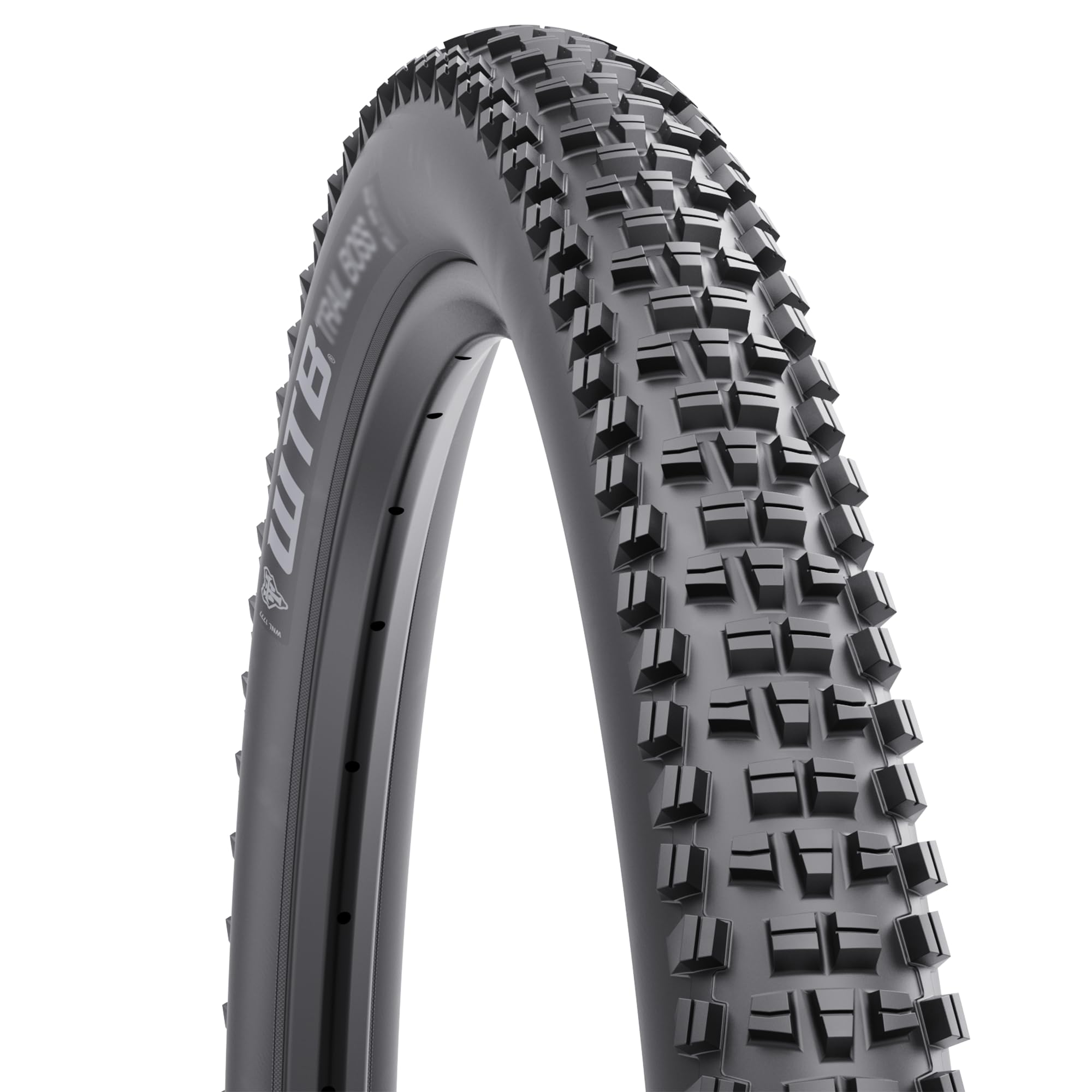
What a trail tire mostly needs to do is disappear: roll quietly on the way up, hold its line on the way down, and not cost so much that you baby it. The Trail Boss does that better than anything else in this group. It is a wire-bead, 30 TPI clincher in 26 x 2.25, and the tightly spaced knobs roll far faster than the tread depth implies.

Directional siping is the detail that earns it a place. The center and intermediate knobs are cut with fine slits that let the rubber flex and find an edge under braking or on a loose climb, so a fast tire still bites when you stand on the pedals. The knobs are spaced tight enough to resist squirming under hard braking, which is usually where a fast-rolling tire gives up.

Two things to accept. The wire bead will not fold down small enough for a pack, and 30 TPI is a stiffer casing than the higher-count tires here, so you feel more of the trail through the bars. The sidewalls can also give out on sharp rock before the tread is done, which makes this a two-season tire on rough ground rather than a long-term one.

Bottom line: For riders who want one tire that handles dirt, hardpack, and the pedal to the trailhead, the Trail Boss is the best all-round value in this group.

5

Schwinn 26-Inch Mountain Tire

Schwinn 26-Inch Mountain Tire

Budget 26-inch bikes

Our Score 9.2/10
Check Price

Worth Noting

  • Center tread wears toward slick within a year
Bead
Steel
Size
26 x 1.95 in
Rim Fit
19 to 29 mm internal
Pressure
40 to 65 PSI
Read the full review

There are a lot of 26-inch bikes still doing real work — older hardtails, a first mountain bike, the one that lives at a cabin. The Schwinn is the least fussy way to put knobby rubber back on those rims. It is a 26 x 1.95 steel-bead tire with a 40 to 65 psi range that fits rims from 19 to 29 mm internally, which covers most of what an older bike is likely to have.

Blocky center knobs and shoulder lugs that stand proud of the sidewall give it more bite on dirt and gravel than the tread depth suggests, and those outer knobs double as a little protection when you scrape a rock. Mounting is the easy part: the steel bead seats with a floor pump rather than a compressor.

Wear is where it gives ground. The compound is soft enough to grip loose gravel, and it also wears away faster than the rest of the tire — a year of regular riding can take the center down toward slick. On a bike that does a few miles a week that is a fair trade; on a daily rider that doubles as a trail bike, plan on replacing it every season.

Bottom line: For an older 26-inch bike that needs knobby rubber without a project, this one mounts easily and grips better than it should — expect to replace it within a season or two.

6

Hapleby 26 x 1.95 Pair

Hapleby 26 x 1.95 Pair

Replacing both tires

Our Score 9.2/10
Check Price

Worth Noting

  • Thin sidewalls flex on rocky ground
Pack
Two tires, two levers
Size
26 x 1.95 in
Casing
60 TPI
Pressure
40 to 65 PSI
Read the full review

A matched pair of 26 x 1.95 tires with two levers in the box is a straightforward proposition, and the Hapleby pair is the tidier of the budget options here: a 60 TPI casing, a rotation arrow molded into the sidewall so you cannot fit one backward, and a 40 to 65 psi range that suits dirt and pavement alike.

The casing is the part that matters at this end of the market. Sixty threads per inch is a step up from the plainest budget tires, the bead goes on with hands and a lever rather than a fight, and the symmetrical tread rolls smoothly on pavement without feeling vague on packed dirt.

We rate it the pick of the two-tire options for anyone refreshing both wheels at once, and the levers in the box mean you can finish the job without hunting for tools. The caveat is sidewall thickness: these walls flex more than a trail tire's and do not take rock strikes the same way, so treat them as a dirt, gravel, and pavement set.

Bottom line: If both tires on a 26-inch bike are done, this pair plus levers covers the job in one order — keep it off sharp rock and expect light-duty wear.

7

Fincci Oncamp 27.5 Pair

Fincci Oncamp 27.5 Pair

27.5 trail bikes

Our Score 9.0/10
Check Price

Worth Noting

  • Tread and casing suit moderate trails only
Bead
Kevlar folding
Pack
Two tires
Size
27.5 x 2.10 in
Pressure
40 to 60 PSI
Read the full review

Two tires in one box is the pitch, and it is the right one for a particular rider: someone whose 27.5 bike sees packed dirt, gravel paths, and a stretch of tarmac on the way there. The Oncamp pair covers all of that with a regular directional tread, and the Kevlar folding bead means both tires store flat on a shelf or in a car.

We think the case here is the pair rather than any single feature. Buy them together and you replace front and rear at once, so the tread wears evenly and you are not matching a tired rear to a fresh front. Each tire is rated to 105 kg and listed at 650 g, which is reasonable for a 27.5 x 2.10, and the 40 to 60 psi range is easy to live with.

Where we temper it is terrain and fit. Three millimeters of tread and a 30 TPI casing are fine on hardpack and gravel, less so on sharp rock or in deep mud, where the pattern fills and the sidewall takes hits. And 27.5 x 2.10 needs a 27.5 fork and enough frame clearance — check both before you commit, because this is a size that will not squeeze into every frame that ran something narrower.

Bottom line: A pair of folding 27.5 tires that handle dirt and tarmac without fuss — the sensible buy if you split your riding and want a spare in the garage.

8

Bell Flat Defense

Bell Flat Defense

Debris-heavy paths

Our Score 9.0/10
Check Price

Worth Noting

  • Tread wears out before the casing does
Bead
Carbon steel
Size
26 x 1.75-2.125 in
Weight
2.1 lb
Protection
Flat Defense layer
Read the full review

Flat Defense is the whole pitch: a protective layer bonded under the tread to stop thorns, glass, and goatheads before they reach the tube. On a bike that lives on gravel paths and cinder trails, that layer earns its keep in a way a fancier tread pattern does not.

The tread is tall and knobby, and it is happiest on mixed surfaces — packed dirt, gravel, grass, a stretch of pavement — rather than deep loam. The carbon steel bead folds without taking damage, so a spare can live in a saddlebag or a drawer, and at 2.1 pounds it is not a tire you will notice on a knockaround bike.

Our reservation is fit. One tire covering 1.75 to 2.125 inches has to stretch across a lot of rim widths, and a loose bead is the trade-off — if it does not seat firmly, it can burp or roll at the pressure you normally run. Measure your rim, mount it dry, and check the bead line all the way around before you inflate to full pressure.

Where it makes most sense is a bike that splits its life between pavement and gravel: a rail-trail bike, a campus commuter with dirt shortcuts. Nothing here is a race tire, and this one is not trying to be.

Bottom line: The protective layer is a real advantage on thorny, debris-strewn paths, and if it seats firmly on your rim it is a smart budget choice for a 26-inch bike.

How We Tested Every Mountain Bike Tire

We started with spec sheets, rider forums, and a lot of squinting at claimed numbers, then narrowed the field by casing type, compound, claimed width, and price so the shortlist covered cross-country, trail, and enduro riders rather than one niche. Twelve tires made the cut. Each one got mounted on the same two test bikes and run at the pressures we'd use on our own rides.

Testing ran eight months, from late-winter slop through a dry summer. Every tire spent at least four weeks on a bike, rotating through a weekly loop of hardpack climbs, rooty descents, and a rock garden that eats sidewalls, plus weekend trips to rougher terrain. We noted where grip held and where it let go—whether a tire drifted predictably in loose corners or snapped without warning, and how it behaved under hard braking on gravel.

Every set was mounted dry first, no sealant, to see whether it seated with a floor pump or needed a compressor, and we timed how long each took with levers in hand. We measured actual width with calipers at 25 psi, since a claimed 2.4 often isn't one, and checked whether the casing sat true or wobbled.

Then we rode them into the ground, tracking punctures, sidewall scuffs, and knob wear as the months piled up. At the end we cut the retired tires open to compare casing thickness and rubber depth in person. Value got judged on cost per season of real use, not sticker price.

How to Choose Mountain Bike Tires

Fit First: Diameter, Width, and Clearance

A 26-inch tire will not go on a 29-inch wheel, and no tread pattern makes up for the wrong diameter. Read the sidewall of the tire you are replacing for the diameter and the ETRTO number — 54-559 is a 26-inch casing, 54-584 a 27.5 — and match it exactly. Width is the second check. A 2.3-inch casing is meaningfully wider than the 1.95 that came on an older bike, and chainstay clearance is where that shows up first.

The trap is the size range printed on the box. A tire listed as fitting 1.75 to 2.25 inches is one casing that has to sit slack or stretch across that whole span, which is handy for covering old bikes but can seat loosely on a narrow rim. The Schwinn's stated 19 to 29 mm internal rim fit is the more useful figure to hold against your own rims.

Tubeless or Tube-Type

Tubeless lets you run lower pressure without pinch flats, and sealant closes small punctures while you ride. It also demands a tubeless-ready rim, tape, and a valve, and it commits you to topping up sealant through the season. The Maxxis picks here are tubeless ready, which is the setup we choose for trail riding.

If your rims are not tubeless-ready, a clincher and a fresh tube is the straightforward route, and on a bike doing school runs and gravel paths there is no performance argument for converting. Decide this before you shop, because it changes which tires are worth comparing at all.

Match the Tread to the Dirt You Ride

Short, tightly spaced center knobs roll fast and hold on hardpack and rock; taller, more open knobs with square shoulders dig into loose ground and shed mud. The Aggressor and the Trail Boss are built around the first idea. The Minion DHF is built around the second.

The trap is buying for the worst trail you ride rather than the one you ride most. A mud-capable tread feels vague and slow on the hardpack that fills most of a season, and it wears faster on rock. Pick for your typical weekend, and accept that two wet rides a year will be less fun than they might have been.

Casing, Sidewall Protection, and Weight

The casing is the fabric under the rubber, and its thread count and reinforcement decide whether a tire shrugs off rock or slices. Maxxis's EXO layer is a cut- and abrasion-resistant addition to the sidewalls; a tire without something like it is lighter and more supple, and more vulnerable on sharp ground. Weight follows: across these picks it runs from 16 ounces to 2.1 pounds.

Pay for sidewall protection if you ride rock, and skip it if your trails are dirt and gravel. The opposite trap is assuming a puncture belt under the tread protects the whole tire — on sharp ground it is usually the sidewall that fails first, and a tread layer does nothing for it.

Frequently Asked Questions

Final Verdict

It comes down to your wheel. On a 26-inch trail bike, the Maxxis Minion DHF is the tire we recommend: the most aggressive cornering tread in this group, a dual compound that still rolls, and a bead that makes you work for it. On 29-inch wheels, the Aggressor is the better default — faster on hardpack, still confident when the trail points down.

If budget decides, the Schwinn or the Blackburn will get an older bike back onto dirt, as long as you accept a shorter tread life. And if both tires are finished at once, the Hapleby pair handles the whole job in a single order.