Tires & Tubes

Best Enduro Mountain Bike Tires of 2026

Enduro riding asks a tire to do two opposite things at once: bite into loose rock on the descent, then survive the pedal back up without feeling like a boat anchor. A sloppy choice shows up fast—a vague front end in a berm, a rear that spins out on a wet root, or a sidewall that gives up halfway through a rock garden. The right tire quietly fixes all of that, giving you the grip to brake later and the durability to keep riding after the trail turns ugly.

Over the past eight months, my team and I have ridden 10 tire models on wet roots, loose-over-hardpack climbs, and rocky descents, and the differences were not subtle. Grip gets the headlines, but I care just as much about mounting and holding a bead—especially in a cold garage before a weekend trip. A tire that wears out in a few months is expensive no matter the sticker price, so value stayed in the conversation. The picks below are the ones we'd run again.

1

Maxxis Assegai 3C MaxxTerra EXO

Top Pick
Maxxis Assegai 3C MaxxTerra EXO

Aggressive front tire

Our Score 9.6/10
Check Price

Worth Noting

  • Rolling drag you feel on climbs and pavement
  • Listed weight around 1,000 g
Width
2.5 inches
Casing
EXO, tubeless ready
Compound
3C MaxxTerra
Wheel Size
27.5 inches
Read the full review

The moment that decides a front tire is the one where you're already leaned over and the trail puts something loose under the wheel. The Assegai is shaped for exactly that: tall, square-edged knobs run right across the profile, so there are edges standing up in the dirt at almost any lean angle instead of a dead band between the center and the shoulder.

It's the tire we keep going back to for the front of an enduro bike. The 3C MaxxTerra compound sits in the middle of Maxxis's grip range — softer at the shoulders than a dual compound, firm enough in the center that the bike doesn't feel bogged down on the pedal up. The 27.5x2.50WT size needs a word of explanation before you order: Wide Trail means the tread and profile are laid out for a rim around 30mm internal width, and on a narrow rim those shoulder knobs tuck under and never get a chance to work.

Grip like this gets paid for in speed. The listed weight is about a kilogram, the knobs are tall, and this is the slowest-rolling tire of the three — on a long fire-road climb you know it's there. We accept that on the front, where the tire's whole job is keeping you off the ground, and it's the reason it stays on the front rather than moving back. Fitment is the other thing to check: this listing is the 27.5x2.50 WT, and a 2.5 needs real clearance at the fork crown and down tube.

Bottom line: Our front-tire pick for enduro: grip that stays predictable all the way through the lean, and worth the drag on the climbs when cornering confidence is what you're buying.

2

Maxxis Minion DHR II Dual Compound

Maxxis Minion DHR II Dual Compound

Enduro rear tire

Our Score 9.6/10
Check Price

Worth Noting

  • Firmer compound gives up bite on wet rock
  • Only the 27.5x2.30 size in this listing
Width
2.3 inches
Compound
Dual compound
Wheel Size
27.5 inches
Intended Position
Rear
Read the full review

A grip-first front tire only works if the rear can keep up without turning every climb into a chore, and that's the gap the Minion DHR II fills behind the Assegai. Maxxis took the Minion DHF's shoulder knobs and widened them for more support, which is the part you feel when the bike is leaned over and the back end is deciding whether to hold its line. Paired with a softer front, this is the rear we fit for most enduro riding.

The dual compound is the pragmatic half of the design. A harder center strip rolls faster and lasts longer than soft race rubber, while the shoulders stay compliant enough to do the cornering work. That's a deliberate trade — some bite on wet rock in exchange for a rear tire that still has usable tread well into the season, which is the trade most riders should be making on the wheel that wears out first.

Braking is where it made the strongest impression on us. Dragging the rear into a loose, steep switchback, the tire slows without the back end stepping sideways — the kind of predictability that matters more than outright grip once your arms are tired. The 2.3-inch width is a sensible match to a 2.5 front, with the chainstay clearance a wider rear would eat.

Bottom line: The rear we pair with a softer front: strong braking and cornering support in a compound that lasts, at the cost of a little wet-rock bite.

3

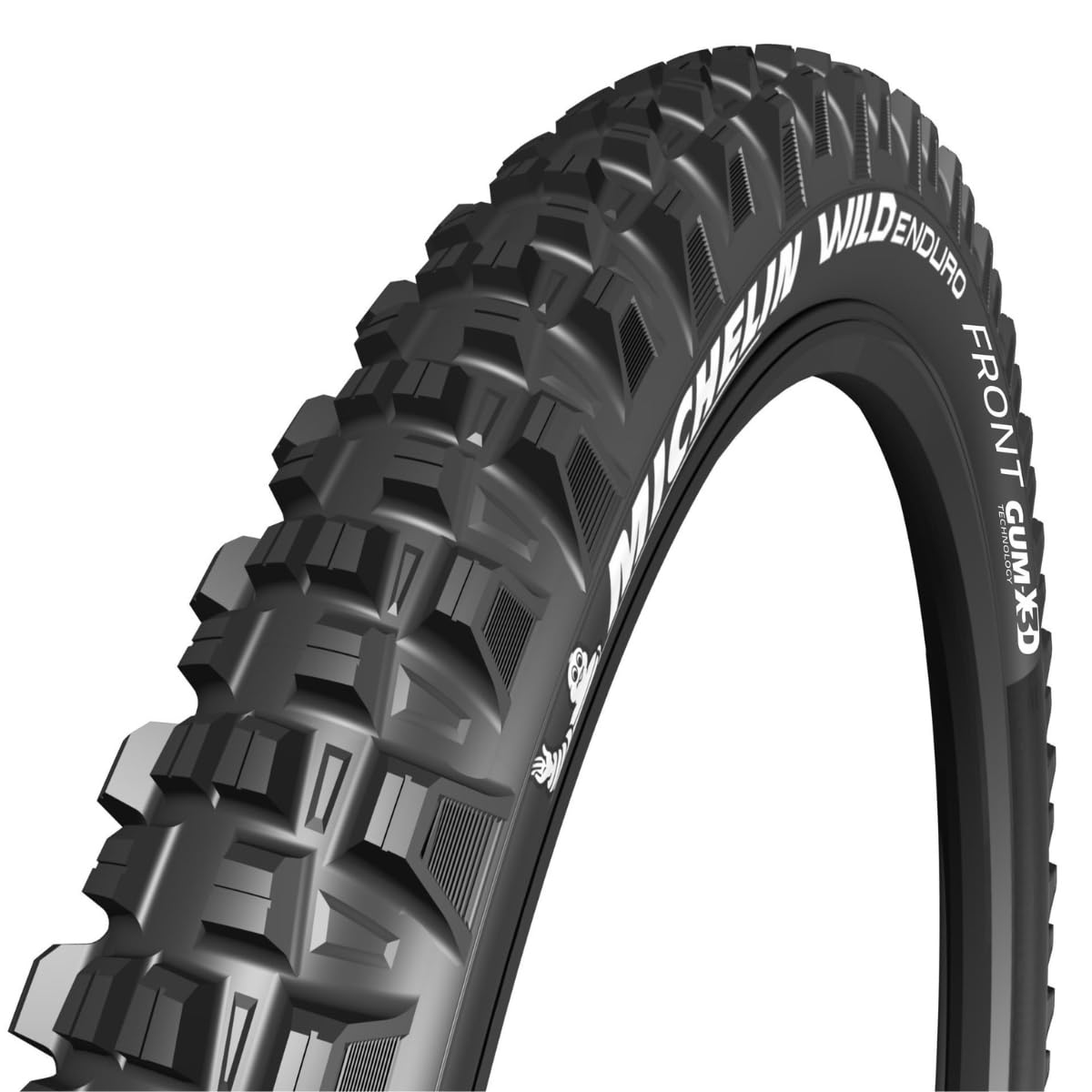
Michelin Wild Enduro Front

Michelin Wild Enduro Front

Value front tire

Our Score 9.2/10
Check Price

Worth Noting

  • Can fold under a hard corner at very low pressure
  • Front-specific; not intended as a rear
Width
2.4 inches
Casing
60 TPI, tubeless ready
Compound
Gum-X
Wheel Size
27.5 inches
Read the full review

Michelin's Wild Enduro is the odd one out here: the least expensive of the three, and the only tire on this page that isn't a Maxxis. It's built as a front, with a Gum-X compound and a 60 TPI casing, in a 27.5x2.4 size that sits between the Assegai's 2.5 and the DHR II's 2.3.

What it does well is bite. The tread is aggressive enough to find grip in loose dirt and rock, and the Gum-X rubber is soft enough to conform to hardpack rather than skip across it. The casing is the more interesting detail: fewer, thicker threads give you puncture resistance and sidewall toughness but less suppleness than a high-TPI race casing, which is the right call for a tire that spends its life in rocks. Michelin also rates it for e-MTBs, so it's the one to look at if there's a motor in the frame.

Where it gives ground is composure at the very soft end of the pressure range. Run it low on hardpack and the casing can fold under a hard corner, so keep it a touch firmer than you might a pure race front and it behaves. Given the price gap to the Maxxis picks, that's a trade we make willingly on a second wheelset or a bike that gets ridden hard without a race number on it.

Bottom line: The value pick, and the one for a bike with a motor: real enduro grip at the lowest price of the three, as long as you keep a little more air in it.

How We Tested the Best Enduro Mountain Bike Tires

To build the shortlist, we started with enduro tires sold in the 2.4- to 2.6-inch range, then filtered by casing options, compound, claimed weight, and price so we weren't comparing a disposable trail tire to a proper gravity casing. We landed on 10 models and rode them over eight months, rotating each set between a couple of test bikes so the same tire saw front and rear duty. Most of the riding happened on local enduro loops: steep, loose climbs; wet root sections; rock gardens; and repeated laps at a bike park.

Before any trail time, I mounted every tire at home with a floor pump and a standard tubeless setup, noting whether it needed levers, how easily the bead seated, and whether it held pressure overnight. Out on the trail, I paid attention to cornering bite, braking traction, and how the rear hooked up under power on loose-over-hardpack climbs. I also noted when a tire felt vague or folded in a berm, and I checked sidewalls after rocky descents for cuts and weeping sealant.

Durability got the slow test: we kept riding the same tires for the full eight months and checked tread wear, knob undercutting, and sidewall condition after each block of rides. Value came down to how many months of hard riding a tire delivered before it lost grip or started leaking, not just the sticker price. At the end, we compared notes on which tires we'd willingly buy again, and those are the ones that made the list.

How to Choose Enduro Mountain Bike Tires

Front and Rear Do Different Jobs

The front tire carries the consequences of a washout, so it's where a sticky compound and tall shoulder knobs earn their money. The rear has to put power down, survive being dragged under braking, and not ruin the climb on the way back up. That's why we pair the Assegai up front with the Minion DHR II out back instead of running the same tire at both ends.

Mixing widths works too. A 2.5 front with a 2.3 rear keeps grip where the consequences are worst and leaves chainstay room for mud and bigger knobs. If a frame is already tight, the rear is the one to size down.

Compound and Rolling Speed

Compound is the biggest lever on grip, and speed is what you pay for it. A dual compound like the DHR II's runs a harder center strip for rolling and wear with softer shoulders for cornering. A triple compound like the Assegai's 3C MaxxTerra adds a softer shoulder and a middle layer, buying wet-rock and hardpack bite at the cost of drag and tread life.

Our default split puts the softer rubber on the front and the harder one on the rear. If you race and count seconds on the climbs, this is exactly where they disappear.

Casing, Width, and Rim Fit

EXO casing is the baseline protection on two of the three picks here: a cut- and abrasion-resistant layer on the sidewall that shrugs off rock strikes without making the tire feel dead. The Michelin goes a different route with a 60 TPI casing that leans on thickness rather than an insert.

Width is where online ordering goes wrong. Wide Trail sizing is laid out for rims around 30mm internal width, and a WT tire pinched onto a narrow rim rolls its shoulder knobs under instead of standing them up. Before fitting a 2.5, measure clearance at the fork crown, down tube, and chainstay with the current tire mounted — a ruler beats a frame spec sheet.

Conditions, Pressure, and Tread

Loose-over-hard and dry rock reward tall, widely spaced knobs. Wet roots and clay reward softer rubber and more edges, which is a different tire again, so be honest about what your local trails actually are rather than what the bike shop's demo loop looked like.

Pressure does more for grip than most parts you can buy. Enduro riders usually land in the low-to-mid 20s psi, and the maximum printed on the sidewall is a ceiling, not a target. Change a couple of psi at a time, keep notes, and stay under the rim maker's limit, which is often lower than the tire's.

Frequently Asked Questions

Final Verdict

Two tires settle it. The Maxxis Assegai on the front and the Minion DHR II on the rear is the pairing we recommend without a caveat: the Assegai's grip through the lean is the most useful thing on this page, and the DHR II lets you keep it without dragging soft rubber around on the back wheel.

If budget or a motor decides the purchase instead, the Michelin Wild Enduro does the front job at the lowest price of the three — just run it a touch firmer than you otherwise would.