Kids & Family

Best Child Bike Seats of 2026

The first time you feel a bike go top-heavy with a toddler aboard, the math of a family ride changes: every curb, every wobble, every sudden lean becomes something you notice. A good child bike seat is the difference between a white-knuckle loop around the block and a ride you both actually look forward to. It has to clamp onto your frame like it was built there, hold a helmeted head steady over potholes, and be simple enough to load and unload when you're already late for daycare pickup. Get any of that wrong — a rattly mount, a harness that fights you, a seat that doesn't fit your frame — and the whole thing ends up hanging in the garage.

We spent seven months riding with 12 different seats, front-mounted and rear, on paved greenways and lumpy gravel, and the pattern held: the price tag told us very little about how secure a seat felt at speed. A seat that installs correctly in ten minutes and adjusts one-handed while a kid squirms beats one with plusher padding every time. The picks below are sorted by the kind of riding you actually do.

1

Kids Ride Shotgun Pro

Top Pick
Kids Ride Shotgun Pro

Trail and e-bikes

Our Score 9.4/10
Check Price

Worth Noting

  • Needs a threadless headset and exposed steerer
  • The most expensive seat in this set
Mount
Front, headset and seat post
Includes
Handlebars and foot mudguard
Child Limit
60 lb, 18 months–5 years
Frame Contact
None
Read the full review

If the rides you care about happen on dirt, this is the seat the rest of the group can't answer. The Shotgun Pro mounts to your headset and seat post instead of clamping the frame, so carbon frames, wide down tubes and e-bikes are all fine, and it's rated from 18 months to five years and up to 60 lb — enough for a solid preschooler on real trails.

What arrives is a system, not just a seat: the child gets their own handlebars to hold, a gel pad to sit on, and a mudguard that keeps feet away from the front wheel. The mudguard is the detail we appreciated most, because feet and spinning wheels are a bad combination and most front seats here leave that gap for you to solve.

The catch is the bike. A threadless headset and enough exposed steerer for the supplied spacers are non-negotiable, and the whole design assumes a mountain bike rather than a town bike with a quill stem and swept bars. Once it's spaced and fitted, taking it off for a solo ride is a matter of seconds, which is more than most bolted-on seats can say.

Bottom line: The trail answer: if your riding happens on dirt and your bike has a modern headset, this is the only seat here designed for that job, and it's priced like it.
2

Thule Yepp 2

Thule Yepp 2

Rack-equipped bikes

Our Score 9.2/10
Check Price

Worth Noting

  • Needs a rear rack, which isn't in the box
Mount
Rear rack mount
Extras
Key lock and reflector
Harness
5-point, childproof buckle
Child Limit
40 lb, 9 months–5 years
Read the full review

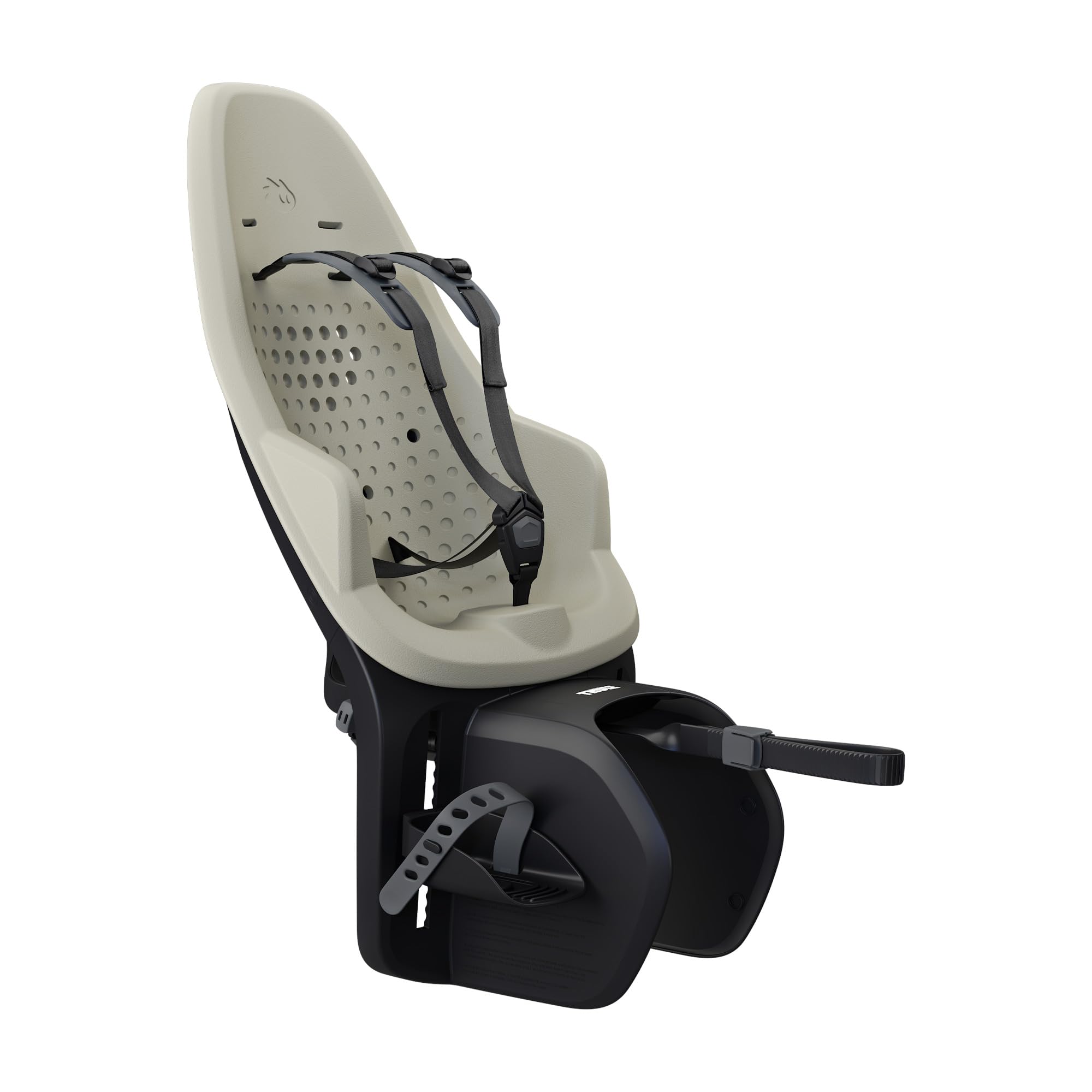
Thule's rack-mounted Yepp 2 is the most expensive seat here after the Shotgun, and the money lands where you touch it: a padded five-point harness, a buckle a small child can't pop, and a foam seat that absorbs pavement instead of passing it through.

The daily-rider details are what separate it from cheaper rack seats. The cover is water-repellent, so a bike that lives outside doesn't leave a wet patch on a daycare run. Footrests and footstraps adjust through several years rather than one growth spurt, and there's a built-in reflector plus a mount for a rear light — small things that matter from March to November.

The mount is the standard rack type, and it's among the quickest to live with: it drops onto a rear carrier, and moving it to a second rack-equipped bike is minutes of work rather than an evening. Thule also includes a keyed lock that pins the seat to the rack. We rate that as the most underrated feature in this whole category, because it means the seat can stay on the bike while you're inside the shop.

So the honest question is whether you already own the rack. If you do, and the bike gets used most weeks, this is the one we point to: nothing else here combines the harness, the lock and the finish in one package. Thule rates it from nine months and directs parents to a pediatrician before riding with a child under one — advice worth taking literally.

Bottom line: Buy it if your bike already carries a rear rack and you ride often: the five-point harness, keyed lock and water-repellent cover are the most polished combination in this guide.

3

Alaxciax Front Seat Set

Alaxciax Front Seat Set

Tight budgets

Our Score 9.2/10
Check Price

Worth Noting

  • Handlebar and peg clamps can slip without a shim
  • Sized for ages two to five only
Mount
Front top-tube clamp
Includes
Handlebars and foot pegs
Frame Fit
Flat or slightly sloping tubes
Child Range
Ages 2–5
Read the full review

One box, three pieces: the Alaxciax set arrives with the front seat, a pair of child handlebars and foot pegs, for less than any other seat in this guide. If you want to try riding with a two- or three-year-old before committing to a premium seat, that bundle is the entire argument.

Fitting takes the supplied Allen key and a quick-release clamp on the top tube — flat or slightly sloping tubes only, which covers most hardtails and hybrid frames. The frame is aluminum alloy, the saddle is a leather-covered pad, and the pegs and bars adjust for a growing child. The loose ends are the clamps: on bars without a rubber shim the handlebar mounts can slip, and the pegs can work loose, so a strip of old inner tube under each clamp turns a wobbly accessory into a solid one.

The seat suits roughly ages two to five, which makes it a two-summer purchase rather than a decade-long one, and no cheap front seat rides like a premium one. Still, the child is right where you can talk to them, the pegs give small feet somewhere to go, and nothing about the setup feels fragile once it's snugged down properly.

Bottom line: The cheapest front seat here and a smart first buy: the seat, handlebars and pegs arrive together, and your child rides right where you can talk to them.

4

Schwinn Deluxe Child Carrier

Schwinn Deluxe Child Carrier

Most family bikes

Our Score 9.0/10
Check Price

Worth Noting

  • Fit varies on bikes with a built-in rear rack
  • Harness is three-point rather than five
Mount
Rear quick-release
Harness
3-point with leg restraints
Includes
Rear carrier rack
Child Limit
40 lb, ages 1+
Read the full review

The part that decides whether a child seat works isn't the seat — it's the mount. Schwinn solves that in the box by including its own rear carrier rack: you fit the rack once, and the seat clicks on and off it with a quick-release lever. That's why this is our default pick. It works on the hybrid, cruiser or 29er most families already own, and it doesn't send you shopping for a rack before you can ride.

The seat itself is built to span a few years rather than one. It holds a child from about age one up to 40 lb, with a three-point harness running over a padded crossbar, leg restraints that have their own straps, footwells that move, and a headrest that comes off as your passenger grows. The padding is generous where it counts, under the seat and behind the back. A five-point harness is the one thing we miss at this price; the crossbar and leg straps do much of that work instead.

Fitting is where you need to look at your own bike. The rack bolts to the frame near the rear axle and wants a clear stretch of tube to sit against, so a bike with a welded-in rack or a very small cruiser frame can fight it, and some setups finish with different bolts than the ones in the bag. Dry-fit the rack before you tighten anything and give yourself an evening rather than ten minutes.

The bonus is what's left when the seat comes off. The rack stays on the bike and takes panniers or a grocery run, which makes the package easier to justify than a seat that only exists on riding days. Because the seat lifts away in seconds, the bike stays a bike between trips.

Bottom line: Our default recommendation: the included rear rack makes it the one seat here that fits most adult bikes without a shopping trip first, and it's rated for years of preschool passengers.

5

Peg Perego Orion

Peg Perego Orion

Toddlers up front

Our Score 9.0/10
Check Price

Worth Noting

  • Outgrown at 33 lb, often around age three
Mount
Front frame clamp
Footrests
3-position adjustable
Frame Fit
32–52 mm tubes
Child Limit
33 lb, 12 months+
Read the full review

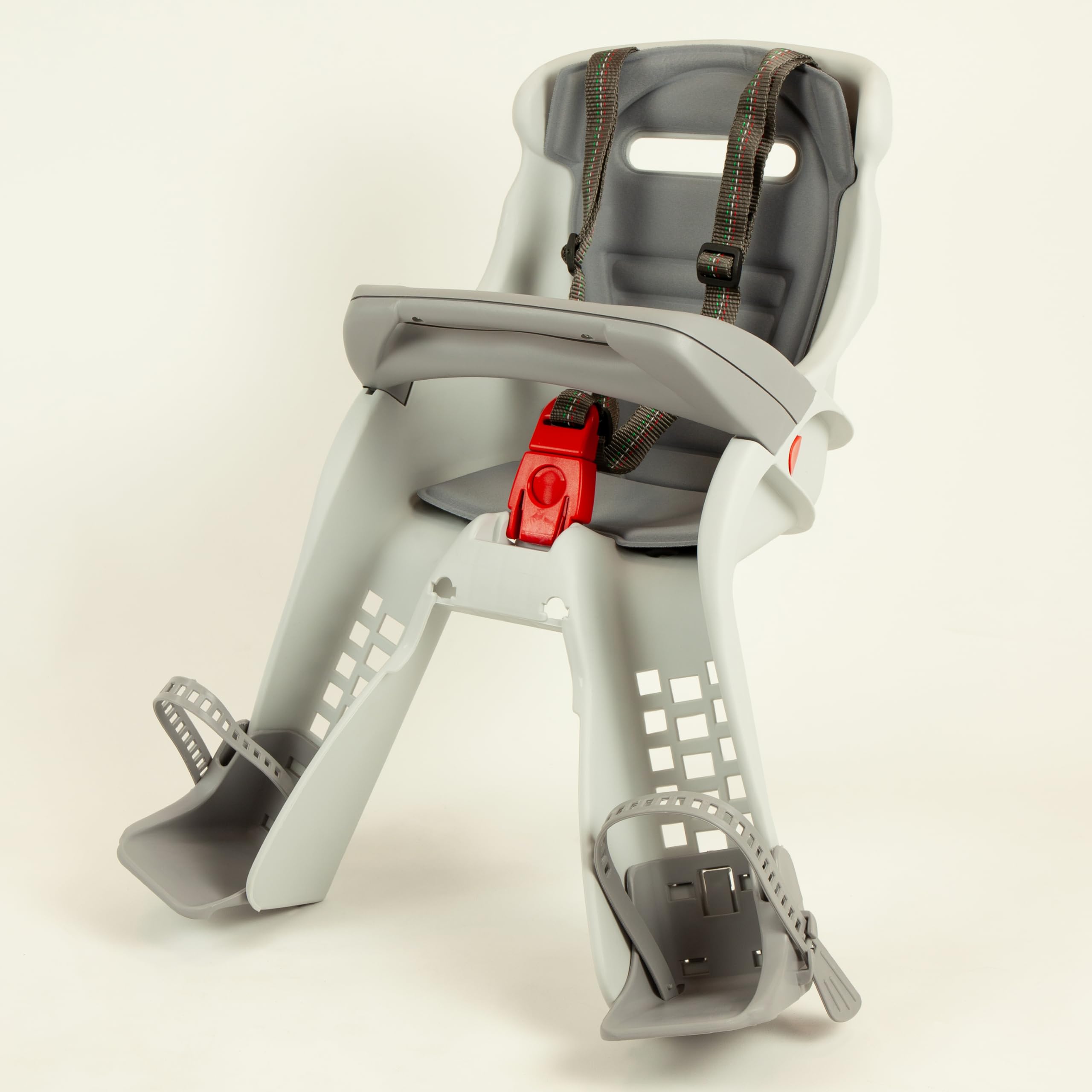
Peg Perego sizes the Orion for the smallest passengers — 12 months to 33 lb — and that ceiling is the whole story of the seat. You get a front-mounted chair that keeps a toddler between your arms, in your line of sight, close enough to talk to at a stoplight. You give up the years after about three.

Installation is quick-release in the real sense: a bracket clamps to your frame tube, and the seat drops onto it and lifts off again when you want the bike to yourself. The clamp spans tubes from 32 to 52 mm, the three-position footrests and length-adjustable three-point harness move as the child grows, and the waterproof pad wipes clean after a snack. The bracket is the part that takes patience — getting it centred and tight on a curved tube can take a few attempts, so fit it with the bike steady and check that the seat doesn't foul your knees before you commit.

For a city bike and a toddler, this is the tidiest front seat in the group: the mounting block stays small on the frame, the child's weight sits where you can feel it rather than where you can't, and the whole thing feels sturdier than its weight suggests. When it's outgrown, the seat lifts away and leaves a bracket small enough to forget about.

Bottom line: The neatest front seat for a one-to-three-year-old: it clips on and off a small frame bracket in seconds, though you'll be shopping again once your child passes 33 pounds.

6

UrRider Front Seat

UrRider Front Seat

Small homes

Our Score 9.0/10
Check Price

Worth Noting

  • Longer-legged riders end up pedaling bowlegged
  • Not built for long days in the saddle
Mount
Front, tool-free quick release
Storage
Folds for travel
Child Limit
60 lb (27 kg), ages 2–6
Seat Post Fit
2.5–3.5 cm
Read the full review

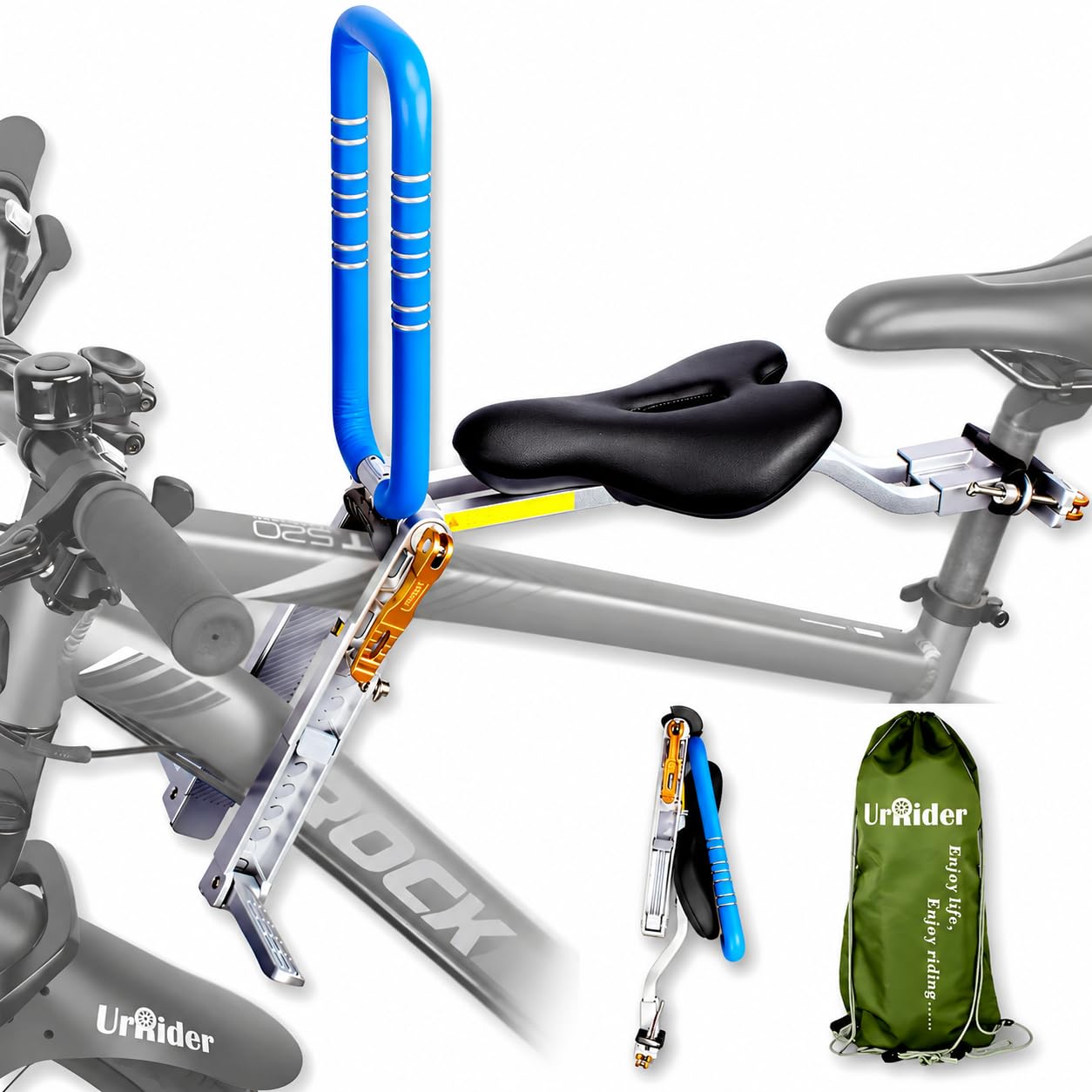
UrRider's seat is the one that folds. The aluminum frame collapses into a shape you can put on a shelf or in a car trunk, the mount is tool-free, and the seat comes off in about the time it takes to lock a bike — which changes how you use it. A bike stored in a shared hallway or carried up two flights becomes realistic again.

It's rated for ages two to six up to 60 lb, generous for a front seat and enough to cover the years when a child is too big for a Peg Perego Orion but not ready to ride alone. The saddle is ventilated and padded, the U-shaped rail gives small hands something to hold, and the footrests adjust. What it asks in return is your pedaling style: the seat sits between your knees, so longer-legged riders end up splayed around it.

We rate it for short trips and for households where storage is the real constraint, not for long days out. Twenty minutes to the playground and back is its natural habitat; a two-hour rail trail is not. The fit spec is fussier than it looks, too — the seat post needs to be 25 to 35 mm across with clear space below the saddle for the clamp.

Bottom line: The travel pick: it folds, mounts without tools and comes off in seconds, which is what makes a front seat practical in a small apartment or a car boot.

7

Bwcece Rear Seat

Bwcece Rear Seat

Older children

Our Score 9.0/10
Check Price

Worth Noting

  • Needs a flat rear frame section to clamp onto
  • 8.4 lb of seat to haul around off the bike
Mount
Rear flat-frame clamp
Includes
Backrest, handrail, tools
Age Range
18 months–8 years
Seat Weight
8.4 lb
Read the full review

Several seats here stop at 40 lb or less, which lands somewhere around a four-year-old. Bwcece rates its rear seat from 18 months to eight years, and that's the gap it fills: the child who has grown out of the seat you bought at one but still wants to come along.

The build is a chunky 8.4 lb of alloy with a thick cushion, so a bigger child has something to sit into rather than perch on. There's a backrest, a handrail and footrests, the frame clamps to a flat section of rear frame, and the assembly tools and instructions come in the box. For a family with a six- or seven-year-old who still wants the wind in their face, this is the seat that keeps the ritual going for another two summers.

The backrest is what sells it to a taller child, since they can lean back on the school run instead of balancing. It's also worth being honest about the bulk: this is a lot of hardware hanging off the back of a bike, and on a small frame you'll feel it when you lift the bike onto a carrier.

Bottom line: Best for the older passenger: it's the only seat here rated to age eight, with the backrest and handrail a school-age child actually needs.

8

iBert Front Seat

iBert Front Seat

Preschool chatterboxes

Our Score 8.8/10
Check Price

Worth Noting

  • Noticeable play between seat and mounting rail
  • No tilt adjustment
Mount
Front stem-bolt mount
Harness
3-point
Child Limit
38 lb
Stem Spacing
52–62 mm
Read the full review

The iBert puts a preschooler between your arms with a small dashboard in front of them. The molded green shell has a recessed tray that children treat as a cockpit, and it's the reason the seat feels less like a carrier and more like a toy the child gets to ride in.

The mount is the unusual part: two bolts replace your stem bolts and hold a rail above the top tube, so the seat slides on from the front instead of clamping the frame. You need 52 to 62 mm between stem bolt centres — measure that before ordering, because no amount of adjustment fixes the wrong spacing. Once it's on, the foot cups adjust for leg length, the three-point harness is padded, and the molded resin shell shrugs off sun and light rain.

Two things we don't love. The seat rides on its rail with noticeable side-to-side play, so it's worth checking and tightening before each season. And there's no tilt adjustment, which means the seat takes whatever angle your fork and head tube give it — barely noticeable on a hybrid, more so on a laid-back cruiser that already feels light at the front.

On the right bike it's the most fun seat here: the child is close, the eye contact is constant, and the dashboard gives small hands something to do on a slow loop. The 38 lb limit buys you a few years of preschool runs, and the whole thing comes off with two bolts when you want the bike to yourself.

Bottom line: A front seat with real charm for a preschooler on the right bike — measure your stem bolt spacing of 52 to 62 mm before you fall for it.

How We Tested 12 Child Bike Seats on Real Rides

We started by rounding up every child bike seat sold by the major retailers — more than 30 models — then narrowed by weight range, mounting style, price, and whether the seat would actually fit the frames people ride. That last filter eliminated more seats than anything else: a few popular models wouldn't clear a step-through frame, and others crowded the brake cables. Twelve made the cut, and we rode them for seven months.

Each seat went onto at least two bikes, including a compact hybrid and a step-through city frame, and we timed the first installation solo using only the tools in the box. We noted what the mount did to the rest of the bike — blocked a rear rack, pinched a cable, made the kickstand useless. Before any kid climbed in, we loaded each seat with a weighted bag, watched how the base flexed, and listened for rattles over a deliberately rough stretch of pavement.

Then came the daycare run, the park loop, and the gravel cut-through behind the library. We buckled in kids from about 18 months to four years and watched for what you notice at mile two: a seat that shifts on a standing climb, a harness that loosens, a footrest that puts a heel near a spoke. Straps got adjusted with cold hands and with gloves on, footrests and recline got cycled through their full range as kids grew, and we tracked size — whether a taller kid's helmet bumped the rider's back or their knees crowded the harness.

Value we judged last, once we knew which extras earned their keep on a Tuesday morning and which just added weight. We're still riding most of these and will update as they wear.

How to Choose Child Bike Seats

Match the Mount to the Bike You Own

Three attachment families cover this category. Rack seats clamp onto a rear carrier, frame seats clamp a bracket around a tube, and stem or headset seats bolt on at the front. Each depends on one measurement: the Peg Perego Orion wants a frame tube between 32 and 52 mm across, the iBert needs 52 to 62 mm between stem bolt centres, and the UrRider wants a seat post 25 to 35 mm in diameter.

Measure before you order, because universal is a marketing word. A bike with a welded-in rack, a rear suspension linkage or a very small cruiser frame can rule out whole categories, and a quill stem rules out the headset-mounted seats. One shortcut worth knowing: the Schwinn Deluxe includes its own carrier rack, so a bike with no rack and no rack mounts isn't automatically out.

Front or Rear? It Changes the Ride

A front seat keeps a small child in your line of sight and close enough to talk to, and it puts their weight over the front wheel. Steering feels different at low speed and the bike is heavier to hold upright at a light, but you can see every expression. Rear seats leave the steering alone and carry bigger children, though you can't see your passenger and, on a short frame, the seat can sit close enough to crowd your knees.

Capacity usually settles it. Front seats run out sooner — the Orion stops at 33 lb, the iBert at 38 — while rear seats and the trail-oriented front designs go to 40 and 60 lb. Choose front for a toddler and the conversation, rear for weight and years.

Weight Limits Decide How Long You Keep It

Every seat states a maximum, from 33 lb at the low end to 60 lb at the top, and that number rather than the age range is what ends its useful life. A 40 lb seat generally lasts to about four; a 60 lb front seat covers five or six. Weigh your child instead of guessing from their shoe size, and remember the limit belongs to the seat, not the bike — a rear rack has its own rating, usually printed in the bike's manual.

Harness, Feet, and Getting Them In and Out

A five-point harness holds the shoulders as well as the waist; three-point designs lean on a padded crossbar and leg straps to keep a small child upright. Feet are the other half of the job: rear seats should have footwells or a spoke guard, front seats need footrests the child's feet actually reach, and a buckle you can open one-handed in gloves is worth more than it sounds on a cold morning.

If the seat will move between two bikes, prioritise tool-free removal — a bolted bracket turns a two-minute swap into a garage session.

Frequently Asked Questions

Final Verdict

Start with the Schwinn Deluxe unless your bike rules it out. The included carrier rack is the difference between riding this weekend and researching rack mounts for a fortnight, the seat is rated to 40 lb, and it lifts off in seconds when you want your bike back.

If your bike already carries a rear rack and you ride most weeks, the Thule Yepp 2 is the better long-term buy — the five-point harness, the water-repellent cover and the keyed lock justify the step up. And if your passenger belongs in front of you, the Peg Perego Orion suits a toddler while the Kids Ride Shotgun Pro is the only one here built for trails.