Kids & Family

Best Front-Mounted Child Bike Seats of 2026

Put a kid on the front of your bike and the ride changes in a hurry: they see everything, you hear every thought, and a trip to the playground starts to feel like an outing. The catch is that a front-mounted seat also puts a wriggling weight between your arms and your handlebars, so a sloppy mount or a flimsy harness turns a fun idea into a white-knuckle ride. What you want is a seat that clamps down solidly, leaves room for your knees, and keeps your child comfortable enough to actually enjoy the view.

We've spent the past nine months riding with 12 front-mounted seats, from stem-mounted models to frame-mounted designs, on daycare runs, greenway loops, and one regrettably gravelly shortcut. The differences showed up fast: some seats had us stopping to retighten hardware, others had my toddler asking for 'one more lap.' A good one should fit your bike, your kid, and your daily routine without making you dread the next hill.

1

Kids Ride Shotgun Pro Combo

Top Pick
Kids Ride Shotgun Pro Combo

Carbon and e-bikes

Our Score 9.4/10
Check Price

Worth Noting

  • Highest price in this set
Mounting
Headset and seat post
Weight Limit
60 lb
Frame Contact
None
Child Age Range
18 months to 5 years
Read the full review

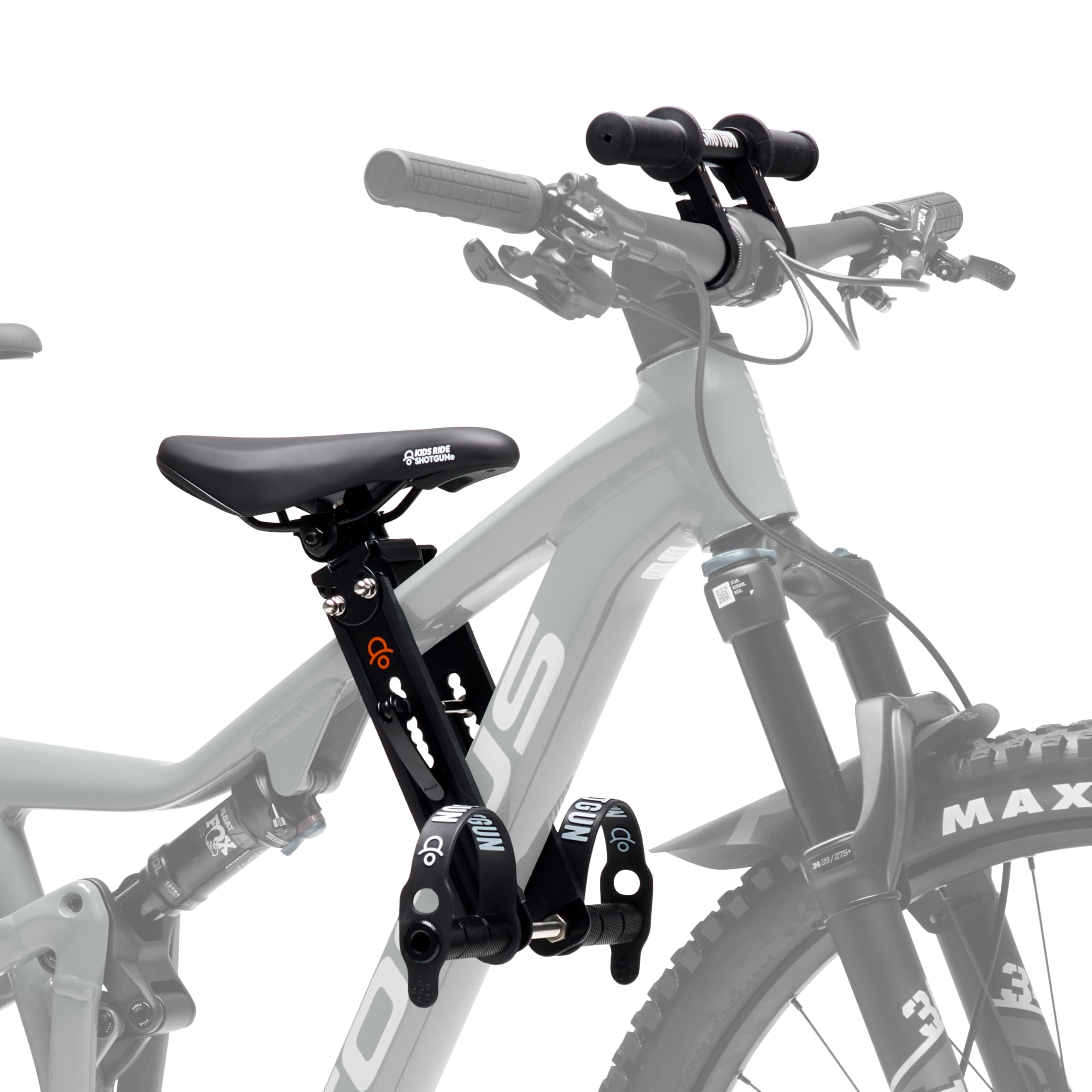
Carbon frames, wide down tubes and e-bike batteries are exactly what a clamp-on child seat doesn't want. The Shotgun Pro avoids the problem by mounting to the headset spacers and the seat post instead, so nothing grips a painted tube and nothing has to be fitted around a battery bracket.

It carries the same saddle and kid-sized handlebars as the standard combo, adds a mudguard, and takes a child up to 60 pounds from 18 months. The kit includes headset spacers, so you're replacing part of the bike's stack rather than adding to it — which is why it comes off so fast and why the bars don't shift once they're set.

This is a specialist's seat at the top of the range, and we think it justifies the position: if your frame is carbon, or the down tube is too fat for a clamp, nothing else here fits. If it isn't, the standard combo does the same job on a metal frame for a great deal less.

Bottom line: If your frame is carbon or your down tube is too wide for a clamp, the Shotgun Pro is the answer here — everything else about it is a bonus.

2

Alaxciax Front Mounted Set

Alaxciax Front Mounted Set

Budget first seat

Our Score 9.2/10
Check Price

Worth Noting

  • Handlebars grip less firmly than the seat
  • Flat or barely sloping top tubes only
Bike Fit
Flat or slightly sloping top tubes
Included
Seat, handlebars, foot pedals
Seat Weight
3.55 lb
Child Age Range
2 to 5 years
Read the full review

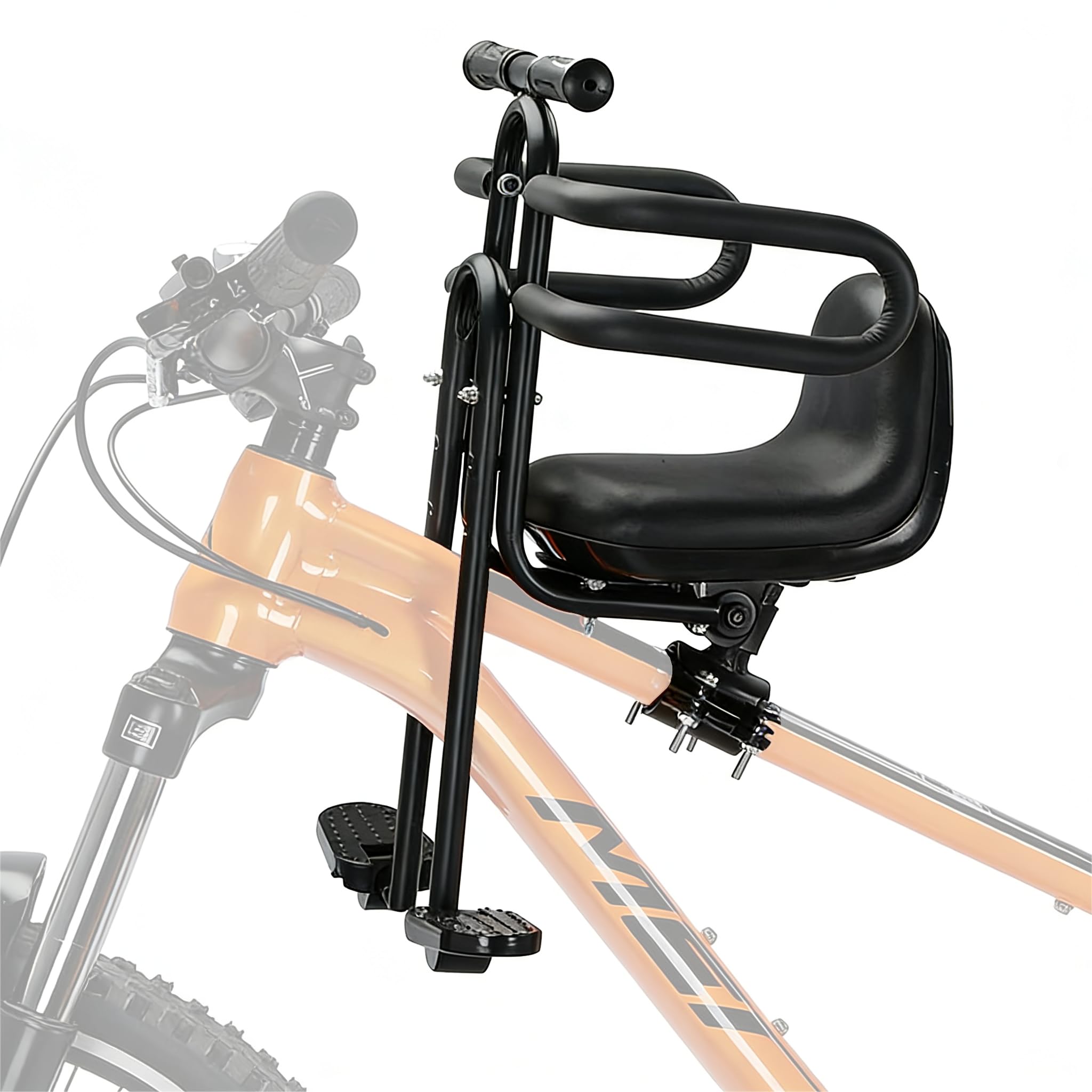
One box, three pieces: the seat, a set of child handlebars and a pair of foot pedals, plus the Allen key you need to fit them. Nothing else here bundles that much hardware, and for a family still working out whether a front seat suits their riding, getting the whole setup in one order is the sensible way in.

The seat itself is aluminum with a padded saddle, and it clamps to a flat or barely sloping top tube. It stayed put through our rides — no creak, no shift under a passenger — and the foot pedals swing out of the way when the child isn't aboard. With the key in the box, fitting is a ten-minute job rather than an evening.

The handlebars are the weak link. They clamp to your own bar without the rubber facing that the seat and footrests get, so they can rotate under a child who pulls on them. Seat them firmly, check them before each ride, and don't let a child use them to haul themselves up.

We think it earns the budget slot because the parts that do the work — the clamp, the footrests, the padded saddle — are sound, and the bars and pedals come along with them. For a family adding a passenger to a bike with a straight top tube, it's the cheapest way to find out whether front-seat riding suits you.

Bottom line: A sensible first front seat: the Alaxciax bundles bars and pedals with a stable seat for the least money here, as long as your top tube is close to flat.

3

Peg Perego Orion

Peg Perego Orion

First toddler rides

Our Score 9.0/10
Check Price

Worth Noting

  • Outgrown at 33 pounds or 36.5 inches
Harness
3-point, adjustable
Mounting
Frame clamp, 32-52 mm
Child Fit
9 months to 33 lb, up to 36.5 in tall
Seat Weight
4.9 lb
Read the full review

Nine months is as young as any seat in this set will take a child, and the Peg Perego Orion is the one we hand to a parent who wants to start riding before the first birthday. It earns that with the parts that matter rather than the ones that photograph well: a three-point harness that adjusts in length, footrests with three positions, and a padded seat that holds a small passenger low and close between your arms.

Fitting it is the annoying part. The bracket clamps around a frame tube between 32 and 52 mm, and you want the spot where the seat clears your knees, misses the cables and still lets you steer — expect to loosen and shift it once before you're happy. After that the seat drops onto the bracket and clicks off in seconds, which is what turns it into an everyday seat: we had it off for a solo ride and back on before the next trip out.

The reward is a bike that still feels like a bike. Because the child sits between your hands rather than out over the front wheel, steering stays predictable and a shifting toddler doesn't drag the bars around. The padding is adequate rather than plush, but the position does the work — a child who nods off ends up leaned against your chest instead of hanging in the harness.

It is a small seat, though, and that is the whole trade. The rating stops at 33 pounds or 36.5 inches, which a tall three-year-old reaches well before the harness wears out. Buy it for the two years when a harness is non-negotiable, and plan on a bigger frame or a rear seat after that.

Bottom line: We recommend the Orion as the best front seat here for a child from about nine months to three years, because the harness, footrests and one-click bracket make everyday rides easy.

4

Kids Ride Shotgun Combo

Kids Ride Shotgun Combo

Trail riding

Our Score 9.0/10
Check Price

Worth Noting

  • No harness, so the child holds the bars
Included
Seat, handlebars, mudguard
Bike Type
Mountain bikes
Weight Limit
48 lb
Child Age Range
2 to 5 years
Read the full review

The Shotgun kit is built for people who ride singletrack with a toddler rather than run errands. A saddle, a set of child-sized handlebars and a small mudguard bolt to the seat post and top tube of a modern mountain bike, and the whole assembly is meant to be leaned into a corner rather than sat in.

We think the handlebars are the making of it. Your child grips their own bar instead of a plastic dashboard, which keeps their hands busy and their weight centred over the frame, and the result is a ride that feels shared — they lean when you lean, and they get a sense of speed and terrain that a rear seat can't give them. The catch is the age floor: from two, a child can be trusted to hold on for a whole ride, and below that they can't.

Check two things before ordering. Your seat post needs enough exposed length to take the clamp, and that clamp wants to be genuinely snug — if it isn't, the saddle can creep backwards on the post as you ride. The full rubber protection keeps the worst of the scuffs off your paint, and the mudguard does real work keeping small feet clear of the front wheel.

Bottom line: Buy the Shotgun if you ride trails and want a two-year-old leaning into the turns beside your hands; it is the most engaging setup here for a confident child.

5

UrRider Front Mounted Seat

UrRider Front Mounted Seat

Travel and storage

Our Score 9.0/10
Check Price

Worth Noting

  • Wants a straight top tube and a 2.5-3.5 cm post
Folding
Folds flat, tool-free
Mounting
Seat post clamp, 2.5-3.5 cm
Weight Limit
60 lb
Child Age Range
2 to 6 years
Read the full review

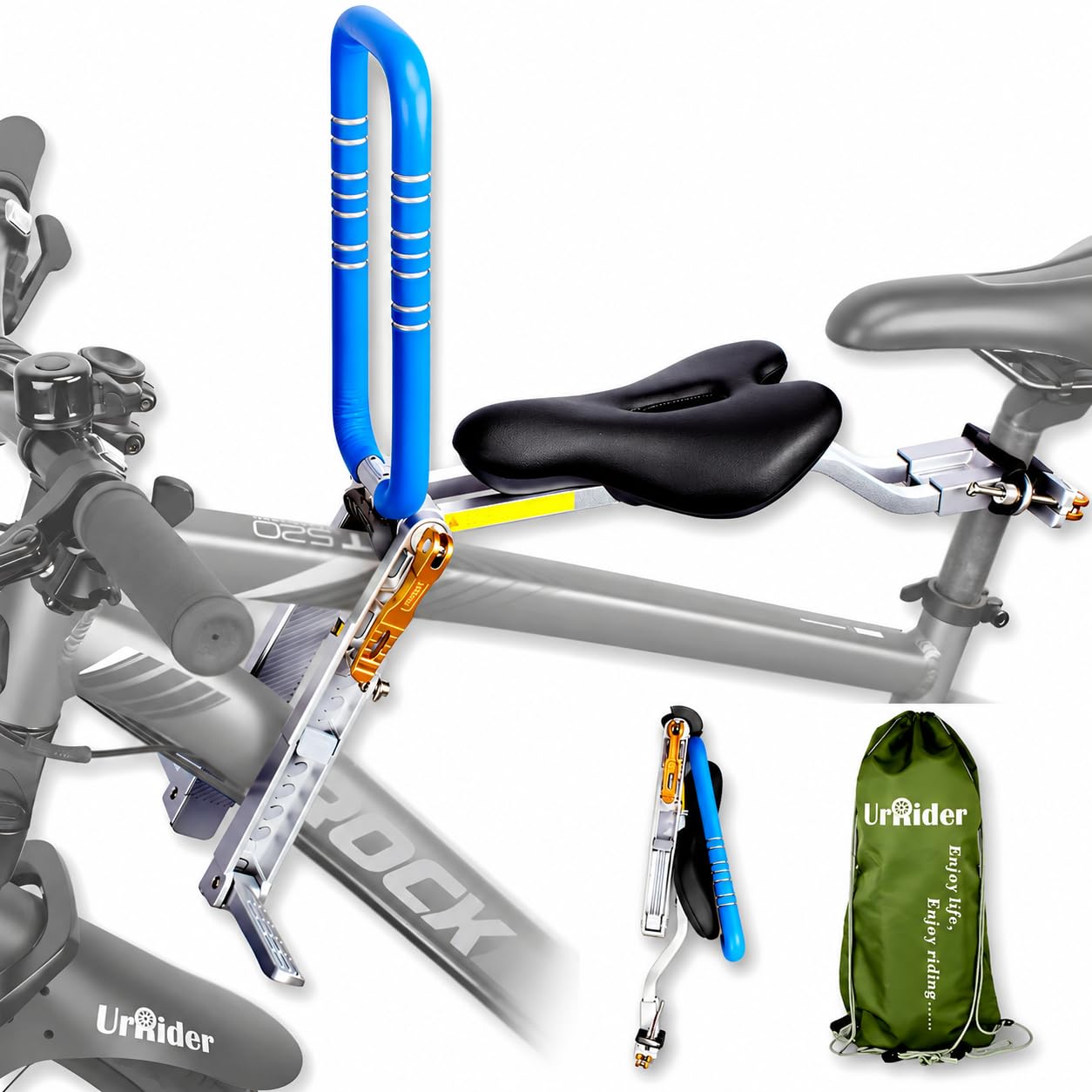
Most of these seats live on one bike and never leave it. The UrRider is the one that folds: the frame collapses, the seat is listed at about 2.9 pounds, and it releases without tools, so it goes into a car trunk or a hallway cupboard between rides.

We rate it as the best travelling seat in this set, and the ride is the price of that. It sits on the top tube between your knees, so you pedal around it — you'll likely ride with your knees turned out, and over an hour in the saddle that's what you notice. For the ten-minute run to the playground and back, it never crosses your mind.

The fit is fussier than the seat. It wants a fairly straight top tube, a seat post between 2.5 and 3.5 cm across, and a mounting width inside the stated limit, so step-through frames and steeply sloping mountain bikes are out. Get it right and it carries a child up to 60 pounds and moves to a second bike without hunting for tools.

Set the footrests up carefully. They need to sit high enough that a dangling heel can't reach the front tire, and a child who likes to kick their feet out of them needs a harnessed seat instead. That isn't a reason to avoid it — it's the same conversation you have with any seat that doesn't strap a child in.

Bottom line: The UrRider is the seat we take when the bike has to earn its keep afterwards — light, tool-free and quick to stash, with a knees-out ride that's fine for short trips.

6

iBert Front Mounted Seat

iBert Front Mounted Seat

Around town

Our Score 8.8/10
Check Price

Worth Noting

  • Needs 52-62 mm between the stem bolts
  • Little clearance on swept cruiser bars
Harness
3-point, adjustable
Mounting
Stem bolts, 52-62 mm apart
Seat Weight
3.7 lb
Weight Limit
38 lb
Read the full review

The iBert takes a different route to the same place. Instead of clamping a frame tube, it bolts a bracket to your stem — the two stem bolts need to sit 52 to 62 mm apart — and the seat then slides onto a rail and pins in place. Nothing grips the paint, and there's no bracket left behind once the seat comes off.

That makes it quick to switch around: the seat lifts away and leaves the mount on the stem, the foot cups adjust without tools, and the seat is light enough to carry in one hand. The built-in dashboard gives small hands something to hold that isn't your brake lever, which is the sort of small idea that makes a daily trip easier.

It ranks near the top of this set for convenience and near the bottom for mounting security, and that combination is worth understanding before you buy. The seat meets that rail through a channel, and one with slack in the channel will rock under a child however carefully you fit it. Check yours the moment it's on: if there's play, send it back rather than reaching for tape or shims.

The other constraint is bar shape. Cruiser bars sweep back toward the rider, and on a beach cruiser there can be barely a hand's width between the grips and the seat; you also need enough room between bars and chest that the child isn't in your lap. On a bike with flat bars and some top-tube length, it's a perch with a view no rear seat can match.

Bottom line: For a flat-bar hybrid or commuter, the iBert is the quickest front seat here to live with: it bolts to the stem, lifts off in seconds, and puts a small passenger right up front.

7

Fediman Front-Mounted Seat

Fediman Front-Mounted Seat

Growing toddlers

Our Score 8.8/10
Check Price

Worth Noting

  • No handlebars in the box
Seat
Padded, with backrest
Bike Fit
Mountain, commuter, cruiser, folding
Child Age Range
2 to 5 years
Height Positions
3
Read the full review

Three height positions is the detail no other seat here offers. The Fediman's seat moves through a set of fixed settings so the same saddle can hold a two-year-old high enough to see over the bars and a five-year-old settled lower with their legs at a comfortable angle, rather than relying on the footrests alone to cover the difference.

The rest is built around keeping a small passenger contained: a padded seat with a backrest, a semi-enclosure fence wrapped in foam, a chest pad and a belt, and foot pedals that fold flat when they aren't in use. It is the most furniture-like seat in this set — closer to a little armchair than to the bucket-and-harness designs — and that is exactly the point if your child is a wriggler.

It clamps to the frame and is listed for mountain, commuter, cruiser and folding bikes, which covers the step-through and folder frames several of the others rule out. At this end of the market that breadth is unusual, and it is the reason to look past the plain finish.

We think this is the seat for a family whose child needs more containment than a saddle and a handrail, and whose bike isn't a modern mountain bike. On a folding frame or a step-through commuter, it is one of the few seats here listed for the job.

Bottom line: For a fiddly toddler on a commuter or folding bike, the Fediman's backrest, chest pad and three height settings make it the most contained budget seat here.

8

Thule Yepp 2 Front

Thule Yepp 2 Front

Smallest passengers

Our Score 8.6/10
Check Price

Worth Noting

  • Tops out at 33 pounds
Harness
5-point, adjustable
Seat Weight
2,400 g
Weight Limit
33 lb
Child Age Range
9 months to 3 years
Read the full review

It costs more than any other harnessed front seat here, and the Thule Yepp 2 is the one we trust most with a baby. The harness has five points and a buckle that takes a deliberate squeeze to open, the footrests and straps move as legs grow, and the padding is finished in a water-repellent fabric that wipes clean instead of soaking up juice.

Thule rates it from nine months to three years and 33 pounds, with a padded bar in front of the child to hold on to. In use it's the quiet kind of good design: the fabric wipes down in seconds, the footstraps keep a wriggling foot where you put it, and the buckle needs a real squeeze — irritating at the school gate, reassuring everywhere else.

What you're paying for is a short run. Thirty-three pounds arrives fast with a big toddler, and the seat itself is compact, so this is a first-seasons purchase rather than a long-term one. If you have two small children in sequence, the build and the limited lifetime warranty start to make more sense.

Bottom line: Choose the Yepp 2 for a first riding season with a baby: the five-point harness, childproof buckle and wipe-clean fabric are the most reassuring combination in this set.

How We Tested Front-Mounted Child Bike Seats

We started by narrowing a long list of front-mounted seats by mounting style, published weight limits, frame compatibility, and price. Then we ordered 12 that covered the range from basic stem clamps to padded frame-mounted designs. Over nine months, every seat went onto at least two bikes — a hybrid, an e-bike, and an older mountain bike — because a seat that fits one head tube can foul the handlebars or brake cables on another.

Installation was timed with the tools in the box, then rechecked after a week of riding for wobble, loosening bolts, and any shift in the mount. On the road, we did slow figure-eights in an empty parking lot, rolled over cracked pavement and root-heaved greenway paths, and paid attention to how much the bike wanted to tip when a 30-pound passenger leaned to point at a dog. A secure harness got a firm tug test while the kid was strapped in, and we watched for pinch points near the footrests and brake cables.

Comfort and adjustability got checked on longer weekend rides: whether knees cleared the seat, whether the child's helmet bumped the handlebars, how easy it was to move footrests as legs grew, and whether the child stayed happy looking around rather than squirming. We also removed and refitted each seat for storage, wiped down padding after snack spills, and noted which hardware showed rust after a rainy commute. Value came down to what extra features actually earned their keep, not just the sticker price.

How to Choose Front-Mounted Child Bike Seats

Front of the Bars or Between Your Arms

Every seat here does one of two things. A stem-mounted seat like the iBert sits ahead of the handlebars, putting the child over the front wheel: a wonderful view, lighter steering at walking pace. The rest sit between your arms or on the top tube, closer to your chest, which keeps the steering familiar but asks your knees to work around a passenger.

Before you order, sit on the bike and look down. If your knees already brush the top tube when you pedal, a between-the-arms seat will feel crowded on the first ride, and no amount of saddle adjustment fixes it.

Harness or Handlebar

A child who can't hold on needs to be held in. Under about two, that means a three- or five-point harness and a seat with sides to lean against; past two, a saddle-and-handlebars design works because the child is gripping and leaning with you rather than being carried.

The weight ceilings follow the same logic. Harnessed front seats here top out around 33 pounds, while the mid-mount designs run to 60. Don't put a one-year-old in a 60-pound seat, and don't expect a 33-pound seat to see a tall child to their fourth birthday.

Check the Bike Before the Seat

Universal fit means fits a standard bike, and it's worth finding out whether yours is one. Stem-mounted seats need two stem bolts a stated distance apart; frame-clamped seats need a tube within a stated diameter and clearance for the bracket; top-tube seats want a tube that's roughly straight and a seat post within range.

Swept cruiser bars, step-through frames, cables running along the top tube and suspension linkages are where installs go wrong. Measure first — the seat you like may not be the seat your bike takes.

How Long You Actually Get

A front seat is a phase, not a decade. Between the weight ceiling and the seat's own footprint, most children are finished with one by three or four, and a compact seat is outgrown before a generous one. A tall three-year-old can hit a 33-pound limit while the harness is still in good shape.

Decide whether you're buying for one child or two in sequence. A small harnessed seat often does a second baby; a 60-pound mid-mount can carry one child from two to five.

Brackets, Boxes and Second Bikes

Two bikes and one child is the commonest household problem here. Seats that click onto a bracket are the easy answer: the bracket stays on the frame, and a spare one turns the second bike into a front-seat bike in seconds. Moving the bracket itself every time is the version that gets tiresome.

Check what's actually in the box, too. Several sets here include the child's handlebars and footrests, one is the seat alone, and one adds a mudguard.

Frequently Asked Questions

Final Verdict

The Peg Perego Orion is the front seat we point most parents to, because it does the unglamorous things well: a harness that fits a nine-month-old, footrests that adjust as legs grow, and a bracket that turns fitting into a two-second job. Its one real limit is size, and a tall three-year-old will reach it.

If your riding is trails rather than the neighborhood loop, buy the Kids Ride Shotgun combo instead — the child grips their own bars, and past two they don't need to be strapped in.