Cycling Apparel

Best Cycling Leg Warmers of 2026

Spring riding is a negotiation with the weather: 42 degrees when you roll out, 65 by the last climb, and a knee that never quite forgives you for either. Leg warmers are how you split the difference — on for the first hour, off at the coffee stop, stuffed into a jersey pocket, and you're still riding in November without buying a second pair of tights. The catch is that a bad pair announces itself immediately: sliding down the thigh, bunching behind the knee, or trapping so much sweat that you're damp by mile ten.

Over four months of shoulder-season riding, our team tested 12 pairs, and the ones that stayed in the saddlebag shared a few traits: a thigh gripper with enough silicone to hold without tourniquet pressure, fabric thick enough to block wind on a descent but thin enough to layer under a shell, and a flat seam behind the knee. Fit matters more than anything — a pair that stays put on a 6-foot-2 rider will sag on someone a foot shorter, so check the size chart against your thigh circumference, not your height. These are the pairs we kept reaching for.

1

GripGrab Spring/Autumn Leg Warmers

Top Pick
GripGrab Spring/Autumn Leg Warmers

Mild-weather speed

Our Score 9.0/10
Check Price

Worth Noting

  • Too light for genuinely cold rides
Build
Lightweight, breathable
Season
Spring and autumn
Department
Unisex-adult
Read the full review

Start with what these are not: a cold-weather warmer. They are lightweight, breathable spring-and-autumn sleeves, and if your winter riding means scraping frost off the saddle, no amount of layering turns a vented knit into a fleece-lined one. That is the setting they do not serve, and it is worth knowing before you spend the most anyone spends in this group on a pair of leg warmers.

What they are for is the ride that starts cold and finishes warm. A breathable knit over a hard effort is far more comfortable than fleece, which goes clammy once you are working, and a light sleeve rolls down to the calf and stuffs into a pocket without a fight. Owning one pair of these and one warm pair covers more weather than owning two warm pairs.

The catch is cost. These sit at the top of the price range here for the sleeve that insulates least, which is a hard sell as a first purchase and a reasonable one as a second. We think they earn their place as the pair for fast mornings in the 50s and rides where you know you will be pulling them off at the summit. As your only set, they will leave you cold in exactly the weather leg warmers exist for.

Bottom line: A breathable, light sleeve that shines on fast mild-weather rides, provided you already own something warmer for the cold.
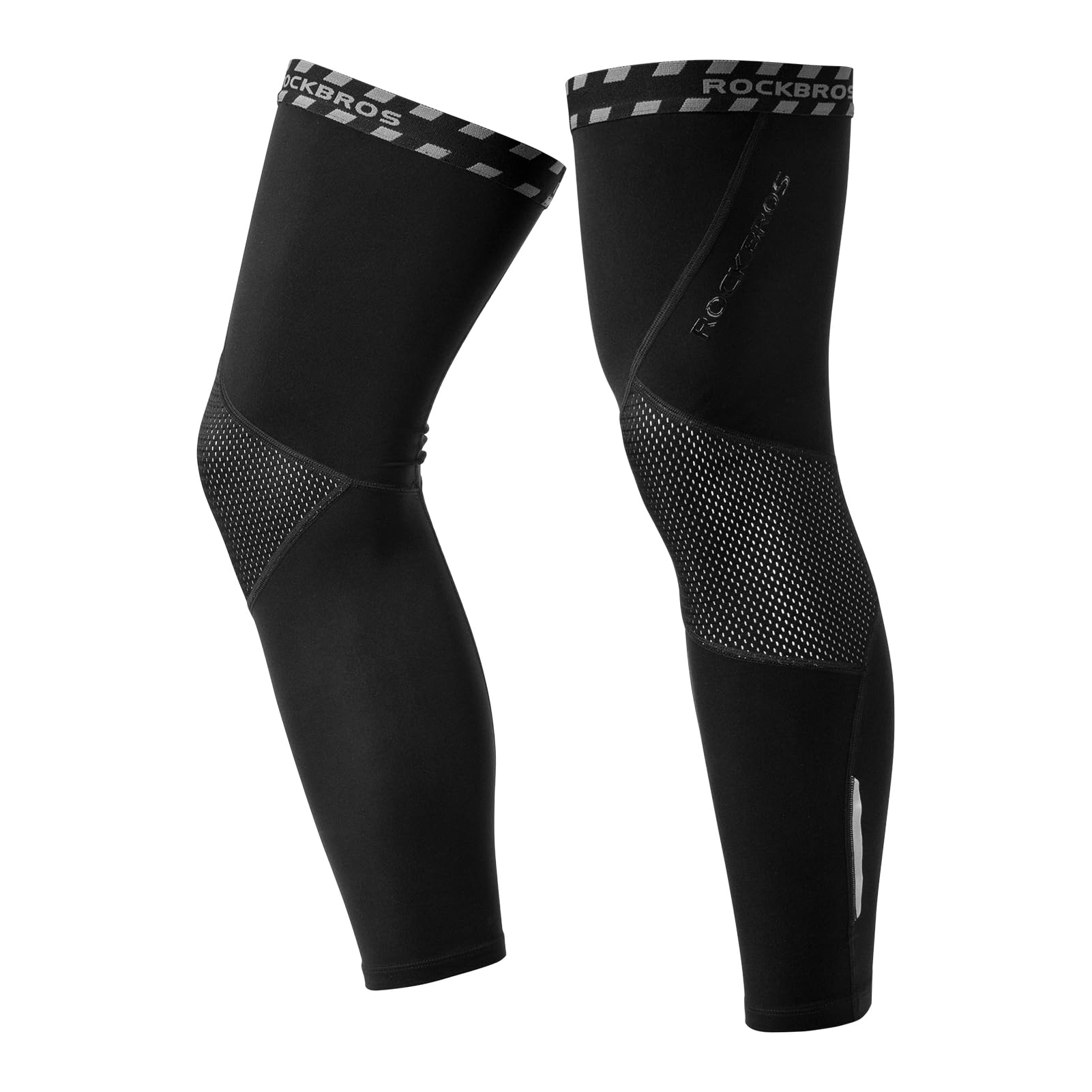
2

ROCKBROS Thermal Leg Warmers

ROCKBROS Thermal Leg Warmers

Firm thigh grip

Our Score 8.6/10
Check Price

Worth Noting

  • Mid-leg panel seam can rub behind the knee
  • Top band stitching is the weak point
Lining
Thermal
Package Size
8.86 x 4.92 x 1.77 inches
Listed Weight
6.17 oz
Read the full review

Set beside our top pick, these are the heavier, more old-school sleeve: a thicker knit, a separate panel of fabric across the middle of the leg, and an elastic band at the top that bites harder than any other here. That band is why they are on this list. If your history with leg warmers is a sleeve that creeps down a little at a time until it is bunched behind the knee, the elastic is the part worth paying for.

Warmth is dependable rather than remarkable. This is a sleeve for the 40s and low 50s, heavy enough that you notice the fabric in your hand before you pull it on. The mid-leg panel is the design decision we are not sold on: it is a different, less soft fabric from the rest of the sleeve, and the join sits exactly where the knee flexes, so anyone with sensitive skin behind the kneecap will feel it on every stroke.

The band comes with a condition. It bites on a thigh it fits and slides on one slimmer than it expects, which explains a pair that can feel immovable on one rider and useless on the next. Measure your thigh at its widest and buy to that number rather than your height, because going a size up gets you a sleeve bunched at the ankle. Check the stitching where the band joins the sleeve when they arrive; that is the weak point.

Bottom line: The elastic band here grips harder than anything else in this group, and warmth in the 40s is dependable, provided you match the band to your thigh.

3

Skylety 4-Piece Leg Warmers

Skylety 4-Piece Leg Warmers

Cheap spare pairs

Our Score 8.4/10
Check Price

Worth Noting

  • Runs small and short, so coverage stops high
Pieces
4
Package Size
10.63 x 9.45 x 0.63 inches
Listed Weight
7.3 oz
Read the full review

The budget pick here, and a two-pack at that: four sleeves, or two full pairs, for less than the fleece-lined pairs in this group. The fabric is genuinely thin, thin enough that a printed short shows through it, and that sets the job description for you. These are a layer for cool mornings, commutes and wearing under trousers, not a cold-weather sleeve in their own right.

Where they surprised us is the grip. The elastic lining at the top holds, and on a sleeve this light that is the part most likely to go wrong; a pair this cheap that stays where you put it is most of the battle. Warmth is honest for the weight as well, enough to take the edge off a cold start with no bulk to bunch up behind the knee. Keep a pair in the bag for the ride home when the temperature drops faster than the forecast promised, and treat the second pair as the one that is always clean.

Bottom line: Four sleeves for the price of a budget single pair, thin enough to wear under trousers and grippier than anything this cheap has a right to be.

4

CYCEARTH Winter Fleece Leg Warmers

CYCEARTH Winter Fleece Leg Warmers

Bitter cold

Our Score 8.4/10
Check Price

Worth Noting

  • Top band stitching can fail and drop the sleeve
Lining
Thermal fleece
Department
Men's
Weather Protection
Windproof
Read the full review

The pitch here is wind: a fleece lining wrapped in a windproof face, aimed at the morning when the climb is fine and the descent is not. On an exposed road, blocking airflow matters more than adding thickness, and that is the difference between this pair and the fleece sleeves that trap heat but let the cold straight through the front of the knee.

For real cold, this is the pair we point to. The fleece holds warmth and the windproof face keeps it there, which is the combination that counts when the road is open and the wind is steady rather than gusting. Comfort runs a close second: the lining is soft against the skin, and for a windproof sleeve these are less stiff than the build suggests.

Sizing is the caveat, and a real one. The cut does not run true from one size to the next, so a pair that fits one leg perfectly can hang loose on another of the same height. Go by the thigh measurement on the chart rather than your usual jersey size, and think about what you want the band to do, because a loose top edge on a windproof sleeve sends cold air straight down the leg.

Bottom line: Windproof fleece makes this the warmest-feeling pair here for genuinely cold starts, as long as you buy to a measured thigh rather than your usual size.

5

qualidyne Fleece-Lined Leg Warmers

qualidyne Fleece-Lined Leg Warmers

Cold-weather riding

Our Score 8.2/10
Check Price

Worth Noting

  • Warmth suits the 40s and 50s, not hard freezes
  • Wide gripper band takes a firm tug to seat
Model
QD-1007
Lining
Thermal fleece
Ride Conditions
Cold weather
Read the full review

Built for the ride where you would otherwise be cold for the first hour: brushed fleece inside, a smooth knit outside, and a cut that runs from mid-thigh to the ankle. Of the pairs here, this is the one we trust for a genuinely cold day rather than a crisp one, because the lining traps a layer of air against the leg instead of only blocking wind. Warmth is what earns it the top spot. An hour in, when a thin sleeve has stopped doing much, this one is still working.

The cut is generous in both directions, which is how they reach the ankle without tugging at the knee, and that same generosity is what you feel at the thigh. If you are between sizes, take the smaller one. Sizing up to gain length only buys a looser band, and a looser band is how leg warmers end up bunched around your ankles halfway through a ride.

Care matters more than it should here. The elastic in the top band is the part that ages first, so wash cold and hang them dry rather than tumbling them, since heat is what takes the stretch out. Otherwise the fabric is unfussy and takes an ordinary cold cycle without complaint.

Set against the rest of this group they are the middle path: warmer than the Skylety two-pack, less windproof than the CYCEARTH, and the pair that asks the least of you in exchange for either.

Bottom line: The warmest all-round pair here for riding in the 40s and 50s, with a fleece lining that lasts the whole ride and a band that mostly stays put.

6

Castelli Pro Seamless Leg Warmer

Castelli Pro Seamless Leg Warmer

Seamless comfort

Our Score 0.0/10
Check Price

Worth Noting

  • Medium weight, so it is a cool-weather sleeve
  • Slim fit in a narrow small-medium size run
Care
Machine wash
Size
Small-Medium
Fabric
15% nylon, 7% Lycra, 78% polyester
Listed Weight
2.47 oz
Read the full review

There are no seams to speak of, because the Pro Seamless is knitted as a single piece rather than cut and stitched from panels. That sounds like marketing until you have spent three hours with a stitched warmer rubbing behind a flexing knee; the join is exactly where you do not want one, and here there is nothing there to rub.

The fabric is a stretchy polyester, nylon and Lycra blend with high stretch and a slim cut, so it hugs the leg rather than hanging off it. No flapping on a fast descent, no bunching behind the knee, and no gripper doing the work that stretch does instead. It is a medium-weight knit rather than a fleece, which puts it in cool-weather territory, and the listed weight of 0.07 kg means it vanishes into a pocket. Machine washable, which is more than some race kit manages.

We recommend it for anyone whose complaint about leg warmers is chafe or fabric bunching rather than warmth. The seamless build is the reason to choose it over the warmer, bulkier fleece-lined qualidyne pair, and the trade is honest: you get a close, quiet sleeve in a narrow size run instead of insulation for the coldest mornings.

Bottom line: A seamless, high-stretch knit that removes the seam most warmers put behind your knee, in a slim fit that suits riders who chafe before they chill.

How We Tested the Best Cycling Leg Warmers

We started with a shortlist of more than 30 pairs from brands that build cold-weather cycling kit, then filtered by the things that change an actual ride: fabric weight, gripper construction, whether the ankle had a zipper or just stretch, the size range, and price. That left 12 pairs, which we rode for four months — from thin, lightly brushed styles built for 50-degree mornings to fleece-backed ones meant for genuine winter.

Each pair went on at least eight rides. We wore them on dawn starts in the low 40s, on long shaded descents where wind chill does the damage, and on 60-degree afternoons when we pulled them down to the ankles mid-ride and shoved them into a jersey pocket. Riders ranged from 5'4" to 6'2" so we could see how one size behaved on different leg lengths. We noted where the thigh gripper landed, whether it left a red ring after two hours, whether the panel behind the knee bunched or chafed while pedaling out of the saddle, and how far up the shin the ankle cuff crept. Fit was judged standing and pedaling both, since a pair that feels right in the driveway often isn't.

For warmth, we rode in damp fog and logged the mile where the front of the knee first went cold, and held each fabric up to a window to compare density instead of trusting the claimed weight. Thickness was judged by how the pair layered under a shell and whether it fit cleanly inside a shoe cover. Durability came out of the laundry: every pair went through a dozen wash cycles, after which we checked for pilling, gripper stretch, and seams opening at the cuff. Value was tallied at the end — a cheaper pair that sags by February costs more per season than one that holds its shape.

How to Choose Cycling Leg Warmers

Match the fabric to your coldest ride

Leg warmers live in a narrow band of weather, roughly from the low 50s down to the mid 40s, and the fabric should suit the bottom of that range rather than the top. Fleece-lined sleeves, like our qualidyne pick, trap a layer of warm air and keep working when the temperature refuses to climb. A lightweight breathable knit, like the GripGrab pair, vents heat instead and suits a fast ride that starts chilly.

The trap is the word thermal. Plenty of thin, smooth synthetics carry it, and a sleeve you can see a printed short through is not going to do much below the mid 50s. Look for a brushed or fleece inner face if warmth is what you need, and a windproof outer face if your rides are exposed.

The band decides the ride

Nothing ruins a pair faster than a top band that creeps down a centimetre at a time. Slipping is usually a matching problem rather than a manufacturing one: grip depends on the band suiting the thigh, not on the band being well made, which is why the same sleeve can feel immovable on one leg and hopeless on the next. Measure your thigh at its widest point and buy to that number, not to your height or your usual clothing size.

If you land between sizes, take the smaller one. A roomier band has more room to slide, and a slightly firm band settles once the fabric warms up.

Length, layering and mid-ride changes

Full-length means down to the ankle. A warmer that stops short leaves a cold gap between fabric and sock, and one that is too long bunches behind the knee on every stroke, so check the stated length against your own leg rather than assuming. Thin pairs layer under trousers for a commute; fleece-lined pairs do not.

Rolling them down to the calf is the standard mid-ride move when the sun comes out, so how small they pack matters more than it sounds. A light sleeve disappears into a jersey pocket; a thick one takes up the space you wanted for a gilet.

Seams, washing and how long a pair lasts

The seam across the knee is the detail nobody inspects until it rubs. A paneled warmer puts a join exactly where your leg flexes, sometimes in a different and less soft fabric; a seamless knit costs more and removes the problem entirely. If you have ever finished a ride with a red mark behind the kneecap, that is the specification to look at first.

Elastic is the first thing to age. Wash cold and hang dry rather than tumbling, because heat is what takes the stretch out of a band, and a band that has gone soft turns a good pair into a pair that lives around your ankles.

Frequently Asked Questions

Final Verdict

Our pick is the qualidyne pair. For the cold-weather riding most people actually do, mornings in the 40s and 50s, commutes and long base rides, its fleece lining and grippy band do the two things leg warmers have to do, and it does them at a midrange price.

If your rides start at or below freezing and stay there, take the CYCEARTH instead. The windproof face is worth giving up some breathability for, as long as you buy to a measured thigh rather than your usual size.