Cycling Apparel

Best Cycling Shoe Covers of 2026

The first cold morning of the season feels fantastic for about ten minutes. Then the wind finds the vent holes in your shoes, your toes go numb, and the rest of the ride turns into a negotiation with your feet. Shoe covers are the fix — a snug layer over your shoes that blocks wind and water and holds warmth in without adding bulk to your pedal stroke. Simple idea, but the details are where most pairs fall apart: a zipper that seizes when your hands are cold, a sole that shreds the first time you walk across a parking lot, a cuff that bunches behind your ankle.

I've ridden through enough damp winters to be fussy about that layer, and over the past eight months my team and I have logged miles in 12 pairs, from wafer-thin race shells to fleece-lined winter covers. The pattern that emerged: the warmest cover isn't automatically the best one, and a pair that's miserable to pull on before dawn stops getting used no matter how good the membrane is. The ones below are the pairs we kept reaching for.

1

GripGrab Primavera Cover Socks

Top Pick
GripGrab Primavera Cover Socks

Mild, windy days

Our Score 8.6/10
Check Price

Worth Noting

  • Knit soaks through in real rain
Sizes
One size (6-12)
Warmth
Light, spring and fall
Closure
Zipperless
Material
87% polyamide, 8% elastane knit
Read the full review

Spring and fall are the awkward seasons: cold enough for numb toes, warm enough that neoprene turns your shoe into a sauna. The GripGrab Primavera is built for exactly that gap.

Its job is windchill, and it does that with almost no bulk. The knit stretches over a road shoe, the high cuff sits flush where your tights end, and there is no zip to press into your ankle bone. On a windy morning it is the difference between comfortable and miserable, and you stop noticing it after a mile.

One size covers 6 through 12, which is a bolder claim than it sounds: the knit has enough stretch to span that range, but the fit is a compromise at both ends. At the small end expect a little slack at the ankle; at the large end expect to work at the cuff. Like the other zipperless designs here, they go on before your shoes do.

And they are for road shoes only. The knit has no opening for a lugged tread, and GripGrab says not for mountain or everyday shoes. Within those limits, this is the pair we keep for the shoulder seasons when nothing else in the drawer is quite right.

Bottom line: The pair to own for windy, mild rides when neoprene is too much and bare shoes are too little.

2

GripGrab RaceThermo X

GripGrab RaceThermo X

MTB and gravel

Our Score 8.4/10
Check Price

Worth Noting

  • Sizing is unforgiving; a wrong size will not go on
Closure
Zipperless cuff
Material
80% rubber, 19% polyamide, 1% polyurethane
Shoe Type
MTB, gravel, CX
Water Resistance
Waterproof
Read the full review

There is no zip anywhere on the GripGrab RaceThermo X, and that single design choice is the reason we reach for it over half this list. The cuff is a stretchy neoprene tube you pull over your foot before the shoe goes on, and the ankle closes with nothing but the fabric's own tension.

We take the extra minute at the door. A zip is the first thing to break on an overshoe, and once it goes, a warm, waterproof cover is just a sock. Pulling these on before your shoes takes a couple of tries to get used to and then becomes part of kitting up. What you get back is a cuff with no seam to rub and nothing to jam halfway up your ankle.

The fit is uncompromising, and that is the real risk: too small and they do not go on at all, which is why the size chart matters more here than anywhere else on this page. Measure the shoe rather than the foot, and go up near a boundary. They are built for cold and wet rather than a monsoon, so the neoprene sheds mud and road water, though a long soaking still finds the cuff.

The catch is the sole. These are cut for race-oriented mountain, gravel, and cyclocross shoes with a recessed cleat and lugs, and GripGrab says plainly they are not for sneakers or trekking shoes. That is the only reason they are not our overall pick: a road rider with an exposed three-bolt cleat wants a different shape. If your winter riding happens on gravel or singletrack, this is the pair we put on.

Bottom line: Buy this if you ride gravel or mountain bikes in cold, wet weather and want a cover that will not die at the zip.

3

ROCKBROS Cycling Shoe Covers

ROCKBROS Cycling Shoe Covers

Dry, freezing mornings

Our Score 8.4/10
Check Price

Worth Noting

  • Zip and hem wear early
Weight
6.88 oz
Closure
Zip with hook-and-loop strap
Material
Nylon and polyester with Kevlar sole
Water Resistance
Water-resistant
Read the full review

At just under seven ounces, these are the pair we do not think twice about stuffing in a jersey pocket when a cold morning turns mild by noon. They go on in one motion over a road shoe, and the hook-and-loop strap under the arch lets you snug them down without fighting a zip.

Underneath the convenience is a nylon and polyester shell with a thermal lining, a Kevlar patch where the sole meets the ground, and reflective trim at the heel. They are windproof and water-resistant rather than waterproof: spray and a passing shower bead off, but a steady rain reaches your socks.

For dry, freezing mornings the warmth is out of proportion to the weight. The lining holds heat on a slow, cold ride better than most of the neoprene here, and the cuff seals without pinching. Size up if you are between sizes or you ride thick wool socks, because the ankle is where these run tight. Everything else about them is unfussy, which is most of the appeal.

Bottom line: For dry, freezing mornings these are the easiest warm covers to live with; just do not count on them in steady rain.

4

Fizik Winter Road Overshoe

Fizik Winter Road Overshoe

Winter road riding

Our Score 8.4/10
Check Price

Worth Noting

  • Scuffs through at the toe if you walk much
Season
Winter
Shoe Type
Road
Water Resistance
Waterproof (stated)
Read the full review

The Fizik overshoe is the most expensive pair on this page, and what the money buys is fit rather than extra warmth: a close, quiet cover that sits on a three-bolt road shoe like it was cut for it. For road riders who want winter protection without the baggy-neoprene feeling, that is a trade worth making.

It is a winter cover rather than an arctic one. Warmth is enough for a cold morning and not for a deep freeze, and the shape stays slim enough to leave your pedaling stroke alone. The construction feels like a premium product should, which is the sort of thing you notice mostly when a cheaper cover starts flapping.

Water is where we temper expectations. The box says waterproof, and in showers and road spray it behaves; in a long, sustained rain the upper wets out and your socks pay for it. If your winters are wet rather than merely cold, the neoprene picks here are the safer bet.

Getting them on takes real effort. They are tight by design, and the trick is to sit down and work them over the heel rather than tugging at the cuff. Once they are on they stay put, which is more than we can say for some of the looser covers here.

Bottom line: A close-fitting, well-made road overshoe for riders who want winter warmth without neoprene bulk and ride in showers rather than downpours.

5

CXWXC Neoprene Overshoes

CXWXC Neoprene Overshoes

Wet, cold rides

Our Score 8.2/10
Check Price

Worth Noting

  • Zip is the first part to fail
  • Wears at the toe and seams with use
Sizes
S to 3XL
Closure
Locking zip with storm flap
Material
Neoprene with microfleece lining
Water Resistance
Waterproof
Read the full review

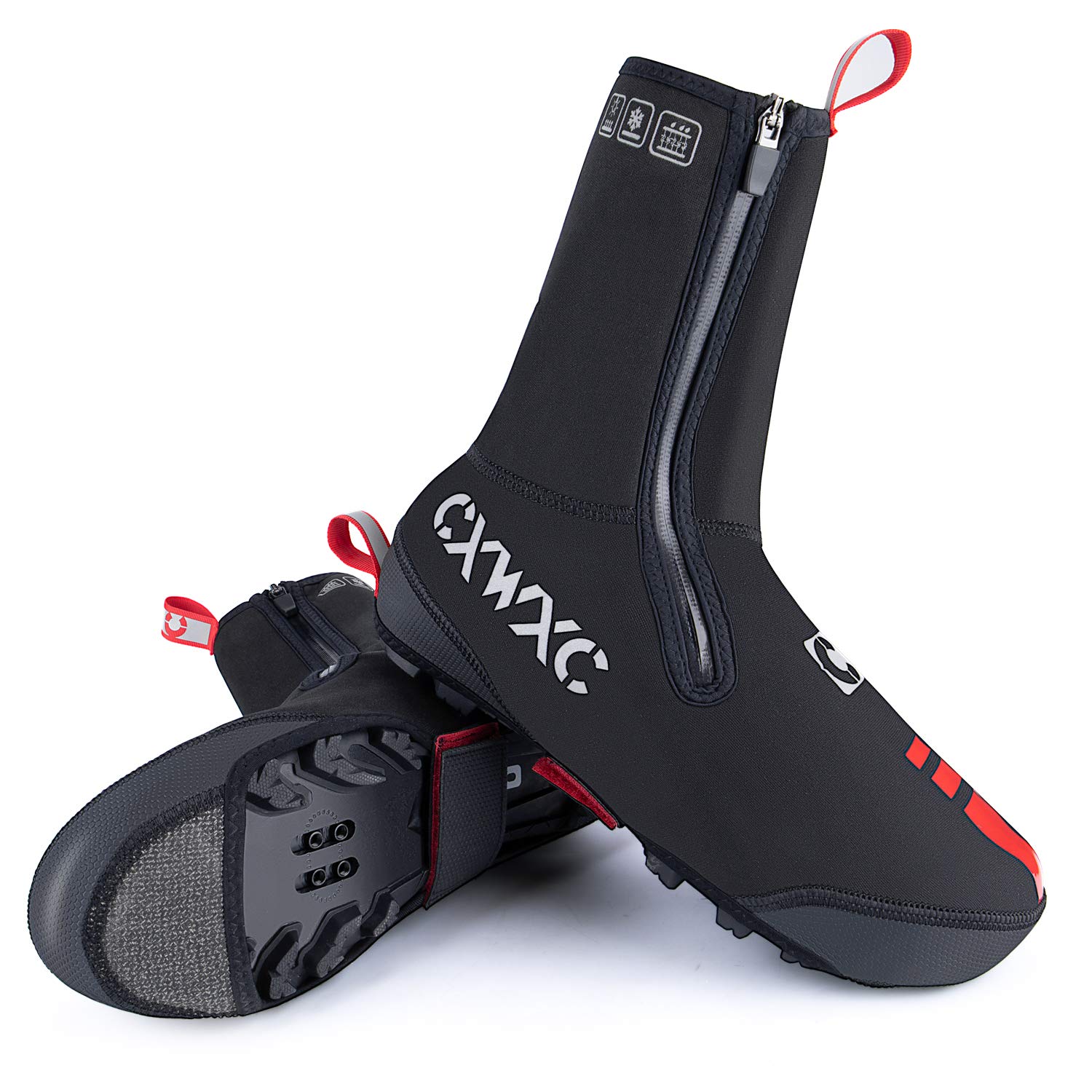
Cold feet end more winter rides than cold hands do, and this is the pair we hand people first. CXWXC's neoprene overshoes are among the warmest covers in this group, a thick shell over a microfleece lining that holds heat on long, slow, frosty rides, and they are the ones we trust in real rain rather than just road spray.

The build explains both. Neoprene outside, fleece inside, a Kevlar-reinforced base where the sole meets the road, and reflective panels down the sides. The zip runs up the outside of the ankle behind an internal storm flap, and a wide rubber strap under the arch keeps the whole thing from creeping up your heel. Sizes run S through 3XL, and the cut clears a road cleat as readily as a mountain tread.

Sizing is the one thing to plan around. These run small and the cuff sits snug, so if you are between sizes, or you ride thick wool socks from November on, go up one. That snugness is also what stops water running down your leg into the shoe, so it is not a fault we ask them to fix.

Where they earn their keep is over a long, ugly ride: the strap holds without pinching, the reflective panels show up in headlights, and the whole cover wipes clean with a damp cloth when you get home. We keep a pair by the door for exactly that.

Bottom line: Warm, genuinely waterproof, and cut to fit road and mountain shoes alike, this is the pair we point most riders to first.

6

GIYO Neoprene Overshoes

GIYO Neoprene Overshoes

Dark, cold commutes

Our Score 8.2/10
Check Price

Worth Noting

  • Shell wets through in steady rain
Sizes
S to 3XL
Lining
Microfleece polyester
Reflectivity
Three reflective sides
Outer Material
Waterproof neoprene
Read the full review

Most covers here offer a reflective logo and not much else. The GIYO puts reflective material on three sides, at the heel, the side, and the toe, which is the kind of thing we notice on an unlit commute and nowhere else.

The rest is familiar neoprene done well: a thick outer, a microfleece lining, Kevlar fabric at the sole, and a zipped side entry with a seal behind it. Sizes run S through 3XL, so there is a reasonable chance of a fit without guessing your way into it.

Warmth is the headline. The fleece lining holds heat on a cold ride, the shell blocks wind the way good neoprene should, and the cover stays clear of your pedal stroke. Order up a size, because these run small and the cuff is snug even then. For a dark, cold, mostly dry commute, it is a lot of cover for the money.

Bottom line: A reflective, fleece-lined cover for dark, cold commutes, provided you size up and keep them for dry weather.

7

GORE Shield Thermo Overshoe

GORE Shield Thermo Overshoe

Hard, sweaty rides

Our Score 0.0/10
Check Price

Worth Noting

  • Water-resistant, not waterproof
Weight
8 oz
Closure
Zip
Material
GORE-TEX INFINIUM, 92% polyester
Water Resistance
Highly water-resistant
Read the full review

The Shield Thermo uses GORE-TEX INFINIUM, a different approach from the neoprene most of this list is made of: windproof and highly water-resistant, but genuinely breathable. If you have finished a cold ride with socks soaked through when it never rained, this is the problem it addresses.

The details are what we expect at this end of the market: a zip for pulling them on over the shoe, reflective accents, a close fit, and machine washing. At eight ounces they are not featherweight, but most of that is fabric rather than hardware.

The warmth is wind-blocking rather than insulating, so pair them with a wool sock instead of expecting the cover to do all the work. The neoprene pairs here feel warmer standing still; these feel better the harder you ride.

That is who these are for: a fast commuter, a paceline in February, anyone whose feet overheat before they get cold. For a slow, bitter-cold ride, neoprene still wins.

Bottom line: Choose these if your feet overheat before they get cold; the breathable shell is the point, and light rain is its limit.

How We Tested Cycling Shoe Covers in Real Weather

We started with a list of more than 30 models from brands we've ridden for years, then narrowed it by closure type, claimed temperature range, and price until 12 pairs were worth putting on our feet. Testing ran across eight months, from the first cool mornings of fall through a salty, wet winter and into spring. As much as possible, the same shoes and the same routes got used for every pair, so the differences we noticed came from the covers rather than the calendar.

Fit and sizing came first. We pulled each pair over road, gravel, and mountain bike shoes, held them against the manufacturer's size chart, and noted where the cleat cutout fought the pedal or the ankle cuff bunched up. Ease of use got tested the way it actually happens: standing in a cold parking lot before dawn, timing how long it took to haul them on with stiff fingers and again to peel them off at a mid-ride coffee stop.

For water resistance, each cover went under a faucet for five minutes while we watched whether water beaded up, soaked in, or ran straight through the seams, then went back out into road spray and slush. Warmth was judged honestly — by the temperature at which our toes went numb, not by what the packaging promised.

Durability and zipper quality came last, because they only reveal themselves over time. We zipped and unzipped each pair several hundred times, walked across pavement and gravel in them, and inspected toe caps, heel seams, and zipper pulls for fraying and popped stitches at the end of the season. Value came down to one plain question at the close: at the asking price, would we buy a second pair?

How to Choose Cycling Shoe Covers

The Closure Is the Weak Point

Most covers on this page close with a zip, and across this set the zip is the part that fails first: grit works into the coil, the pull tab takes the load when you tug, and a broken zip turns a waterproof cover into a sock. A storm flap behind the zip slows water and keeps the coil cleaner, but it does not stop the eventual failure.

Zipperless designs, like the GripGrab RaceThermo X and Primavera here, stretch on and have nothing to break, at the cost of going on before your shoes rather than after. If you commute through winter and want several seasons out of one pair, that is the trade to make.

Buy for Your Sole, Not Your Shoe Size

Road shoes have a smooth sole, an exposed three-bolt cleat, and a heel pad. Mountain, gravel, and cyclocross shoes have lugs and a recessed cleat. A cover cut for one strains over the other, and the cleat opening will not line up, which is how you end up fighting the pedal at a traffic light.

Look at the bottom of your shoe before ordering: if the cleat stands proud of the sole, you want a road-specific cover; if it sits inside a tread pocket, you want an off-road one. Universal usually means it fits neither well.

Waterproof Is a Spectrum

Closed-cell neoprene blocks wind and sheds spray, and for most winter riding that is enough. What it does not do is seal: water runs down your leg, collects at the cuff, and works through seams on a long ride. Waterproof membranes, like the GORE-TEX INFINIUM in the Shield Thermo, resist water and breathe better, but they cost more and still cannot stop rain running in at the top.

Why the cuff matters as much as the fabric: tuck your tights over the cover rather than inside it, and a shower stays out. Leave the cuff as a bucket and no membrane will save your socks.

Warmth Follows Thickness, and Fit Follows Your Socks

Insulation runs from thin knit cover socks for mild, windy days to thick neoprene for near-freezing starts. Thickness also means bulk inside a shoe that was never designed for it, which is why road riders in tight shoes often prefer a knit.

Size for the shoe and the sock together. Most covers here run small, and the cuff is where tightness shows up first; if you are between sizes or you ride wool socks from November on, go up. The exception is the one-size Primavera, where the knit does the work and fit is a compromise at either end.

The Sole Is What You Walk On

You are clipped in for most of the ride, but the walk from the car, the cafe, and the garage is where covers die. Aramid or Kevlar patches under the toe and heel, as on the CXWXC, ROCKBROS, and GIYO pairs, slow the wear without stopping it.

Expect the toe and mid-foot to scuff through first, especially if you walk far in them. Take them off for long stops and you get another season out of the pair.

Frequently Asked Questions

Final Verdict

Buy the CXWXC neoprene overshoes if you want one pair that handles cold and wet on road and mountain shoes alike. They are among the warmest and most convincingly waterproof covers here, and sizing is the only thing you need to think through before ordering.

If your winter riding is gravel or singletrack, the GripGrab RaceThermo X is the better long-term buy: no zip to break, and a cut made for lugs. If your cold rides are dry and mild, the Primavera's thin knit disappears inside a road shoe for less money.