E-Bikes

Best Electric Mountain Bikes of 2026

The first time an electric mountain bike carried me up a climb I normally walk, I got it. Then the battery indicator dropped two bars in ten minutes, and I remembered why these things make people nervous. A good e-MTB should feel like a capable trail bike with a quiet helper, not a heavy scooter with knobby tires. That's the balance I went looking for: enough power to make the climb fun, enough quality that you trust the bike on the way back down.

Over eight months, my team and I rode six electric mountain bikes through steep fire-road climbs, rocky descents, and wet, rooty singletrack. We assembled each one out of the box, adjusted the brakes and shifting, and noted whether the bike felt sturdy when we landed badly. Battery drain, loose bolts, brake fade, and odd motor behavior all went into our notes. A sloppy build can disguise a good bike; a few small setup fixes changed how some of these rides felt. The picks below are the ones that held up and felt worth the money.

1

ESKUTE M300F

Top Pick
ESKUTE M300F

Plush long-range rides

Our Score 9.2/10
Check Price

Worth Noting

  • 20-inch wheels give up rollover on rocky terrain
Motor
1200W peak
Tires
20 x 4.0 in
Battery
52V 20.8Ah
Suspension
Full
Read the full review

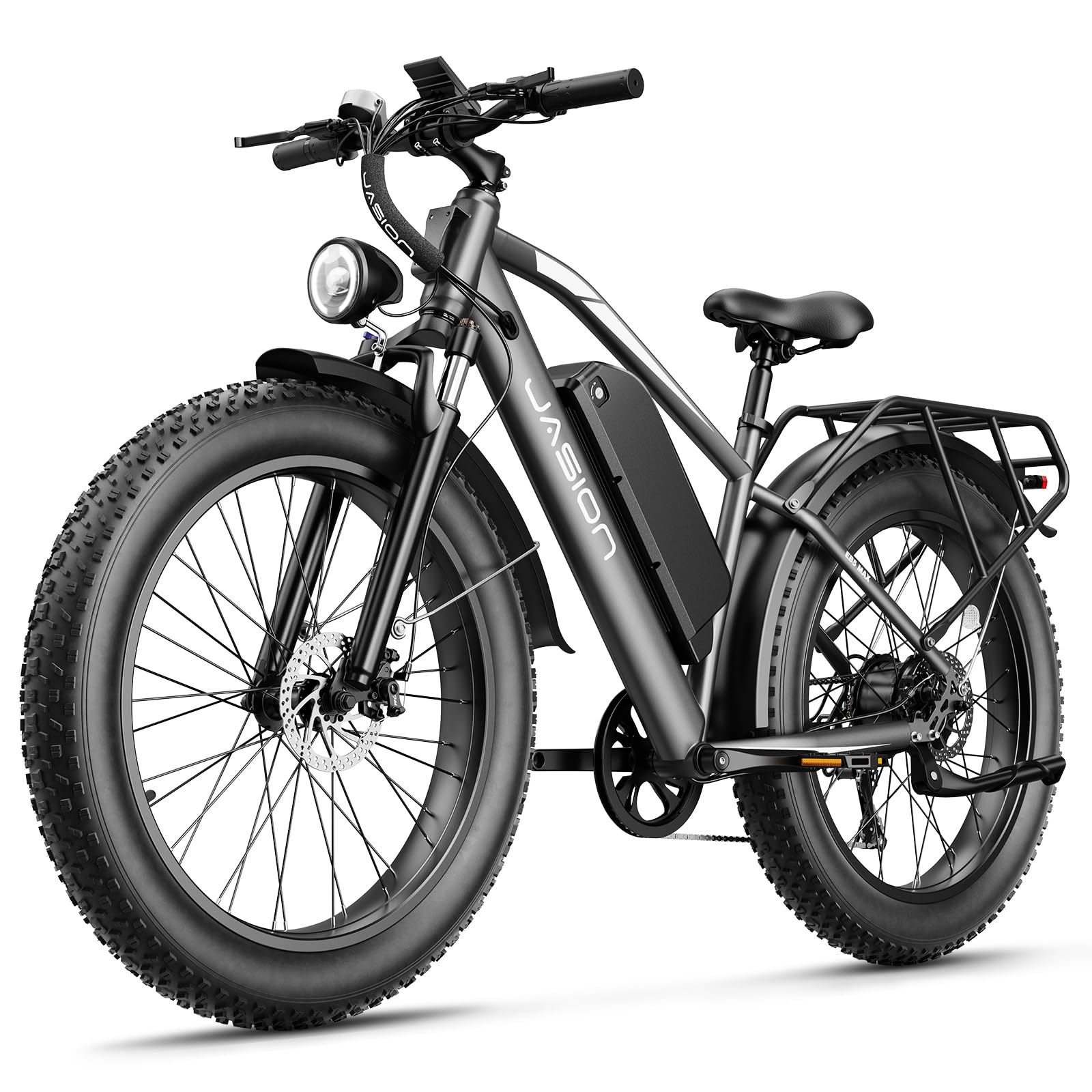
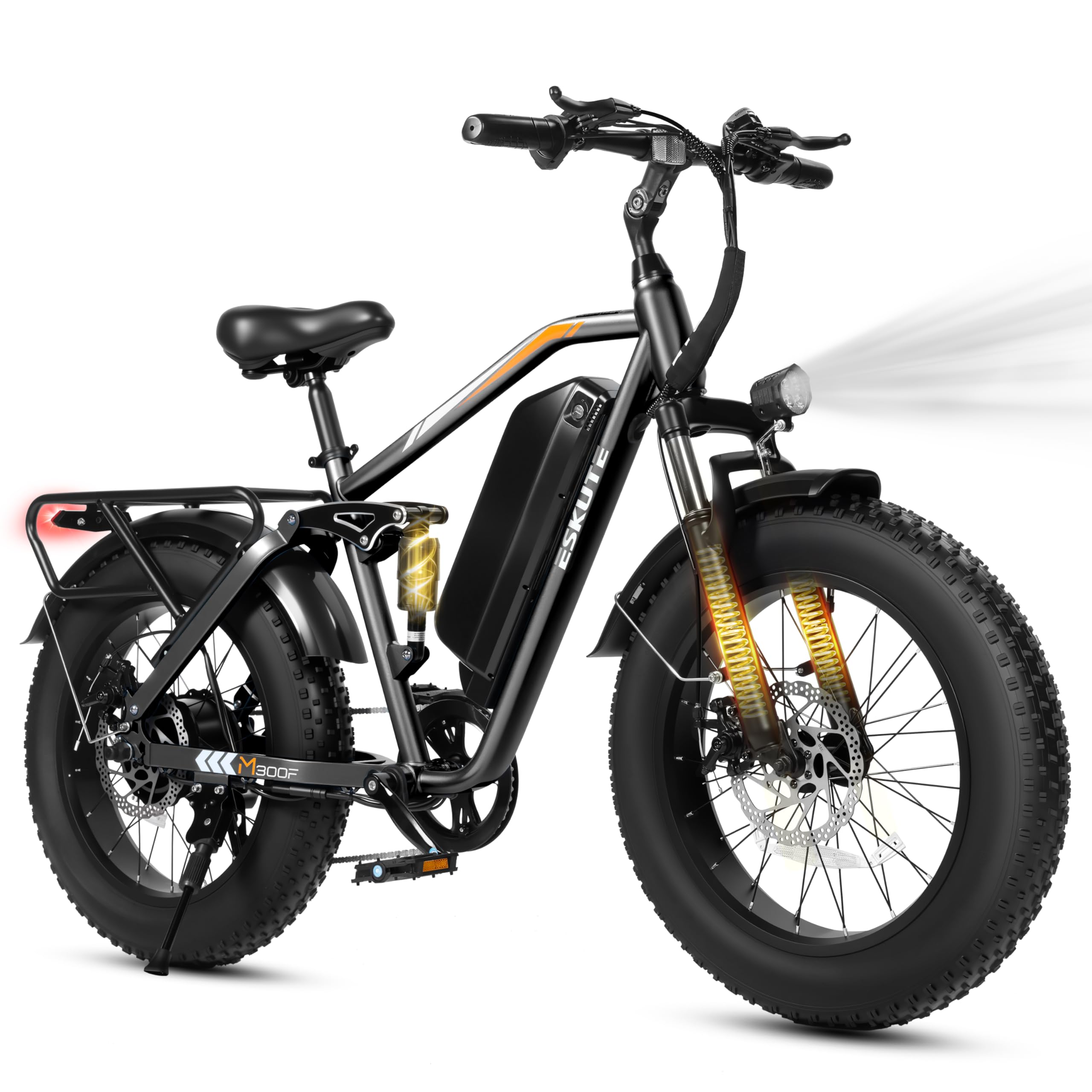
Full suspension is the feature that sets the ESKUTE M300F apart in this group. Add 20 x 4.0-inch fat tires and a 52V 20.8Ah battery, and you have the most comfort-focused, longest-range package here on paper. The 1200W peak motor and 33 mph top speed are more than trail riding needs, but the extra capacity is useful when you are climbing fire roads or carrying gear.

We like the M300F for riders who want a plush ride without moving to a much heavier machine. The 20-inch wheels make it more compact and quicker to steer than the 26- and 27.5-inch bikes here, and the full suspension takes the edge off roots and washboard. The trade-off is rollover: a 20-inch wheel does not absorb square-edge rocks the way a larger wheel does, so this is the pick for smoother trails and doubletrack rather than technical rock gardens.

The 80-mile pedal-assist figure is a best-case number, and the 33 mph top speed will drain the battery quickly if you use the throttle. The M300F comes with a rear rack and mud flaps, which makes it more useful for long days than its sporty numbers suggest. The rack and mud flaps are the practical details that keep it from being a one-trick speed machine.

Bottom line: We pick the ESKUTE M300F when full suspension and the longest battery matter most; its 20-inch wheels are the trade-off on rocky trails.
2

Loeook EB-S1

Loeook EB-S1

Trail-ready all-rounder

Our Score 9.0/10
Check Price

Worth Noting

  • Seat post can slip under heavier riders
  • Throttle and hills cut into range
Motor
500W nominal, 1000W peak
Tires
26 x 4.0 in
Battery
48V 13Ah
Certification
UL 2849
Read the full review

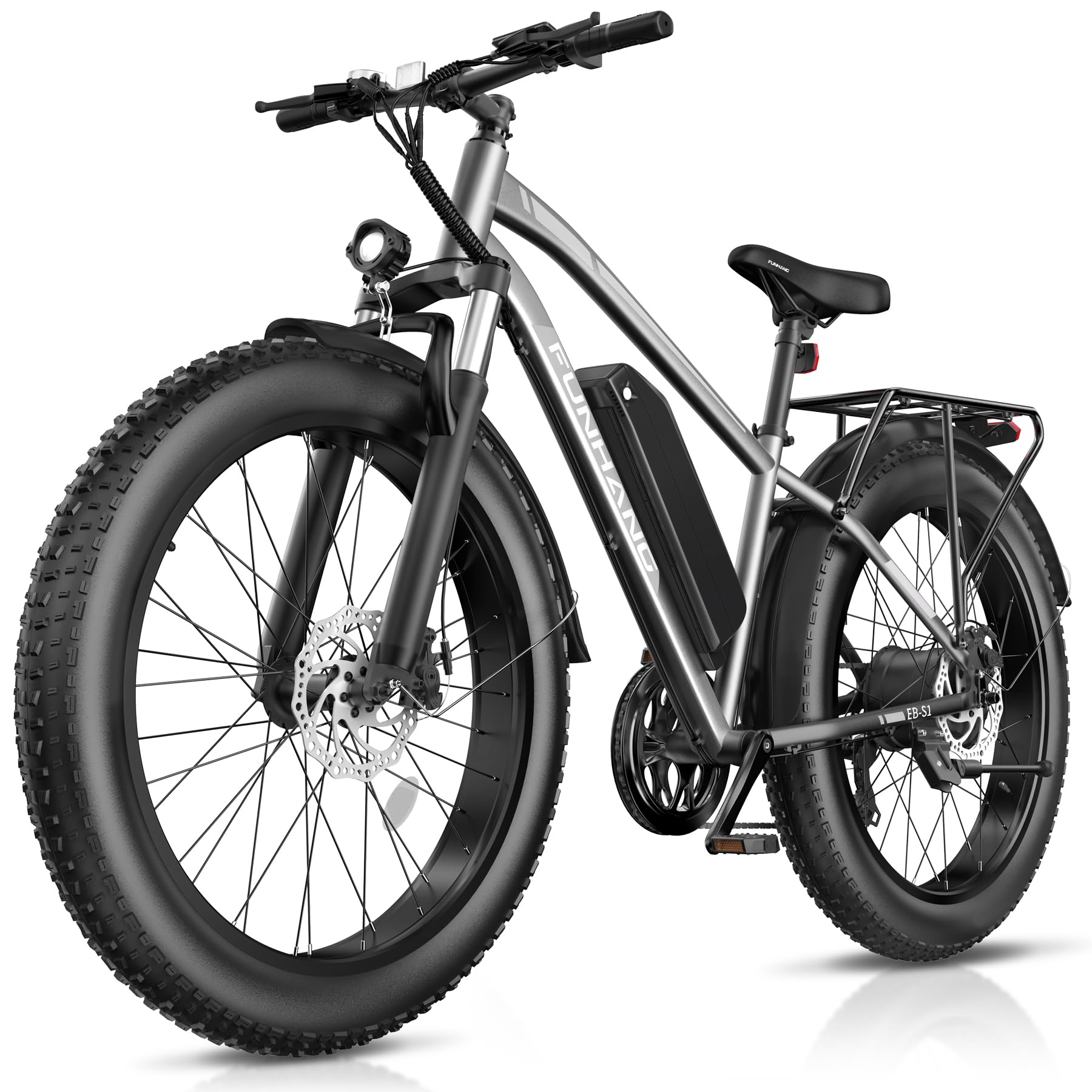
UL 2849 certification is the first thing we check on an e-MTB, and the Loeook EB-S1 has it. That matters because the battery and motor are the parts you cannot inspect by squeezing a tire. Around that certification, Loeook builds a genuinely trail-ready package: 26 x 4.0-inch fat tires, a front suspension fork, a 48V 13Ah removable battery, and a 1000W peak motor. We like that combination for rocky fire roads and loose gravel because the fat tires add stability without making the bike feel like a toy.

The 7-speed drivetrain and five pedal-assist levels give you more range to work with than a single-speed fat bike. It is not the plushest or the most powerful bike here, but it is the best balance in this group of trail geometry, safety certification, and range. We found the rack, fenders, lights, and turn signals useful beyond the trailhead; this is one of the few picks here that can run errands without adding accessories. The 55-60 mile pedal-assist claim is best-case, though. With throttle and hills, plan on less, and the 48V 13Ah battery is not the biggest in this group—the ESKUTE and Jasion carry more energy.

The high-carbon steel frame and fat tires are built for abuse rather than featherweight lifting, and the seat post is the part we watch: it can slip under heavier riders. The rear tire is also exposed to thorns and debris. Neither issue undoes the recommendation. The rack and fenders are the quiet win: they turn a trail bike into something you can use on a wet Wednesday.

Bottom line: Our top pick is the Loeook EB-S1: it pairs UL 2849 certification with 26-inch fat tires, a long-range battery, and a complete rack-and-fender kit.

3

Qlife Racer

Qlife Racer

Lighter trail riders

Our Score 8.8/10
Check Price

Worth Noting

  • 375Wh battery limits long trail days
Gears
21-speed
Motor
1000W peak
Weight
48.1 lb
Battery
48V 7.8Ah
Read the full review

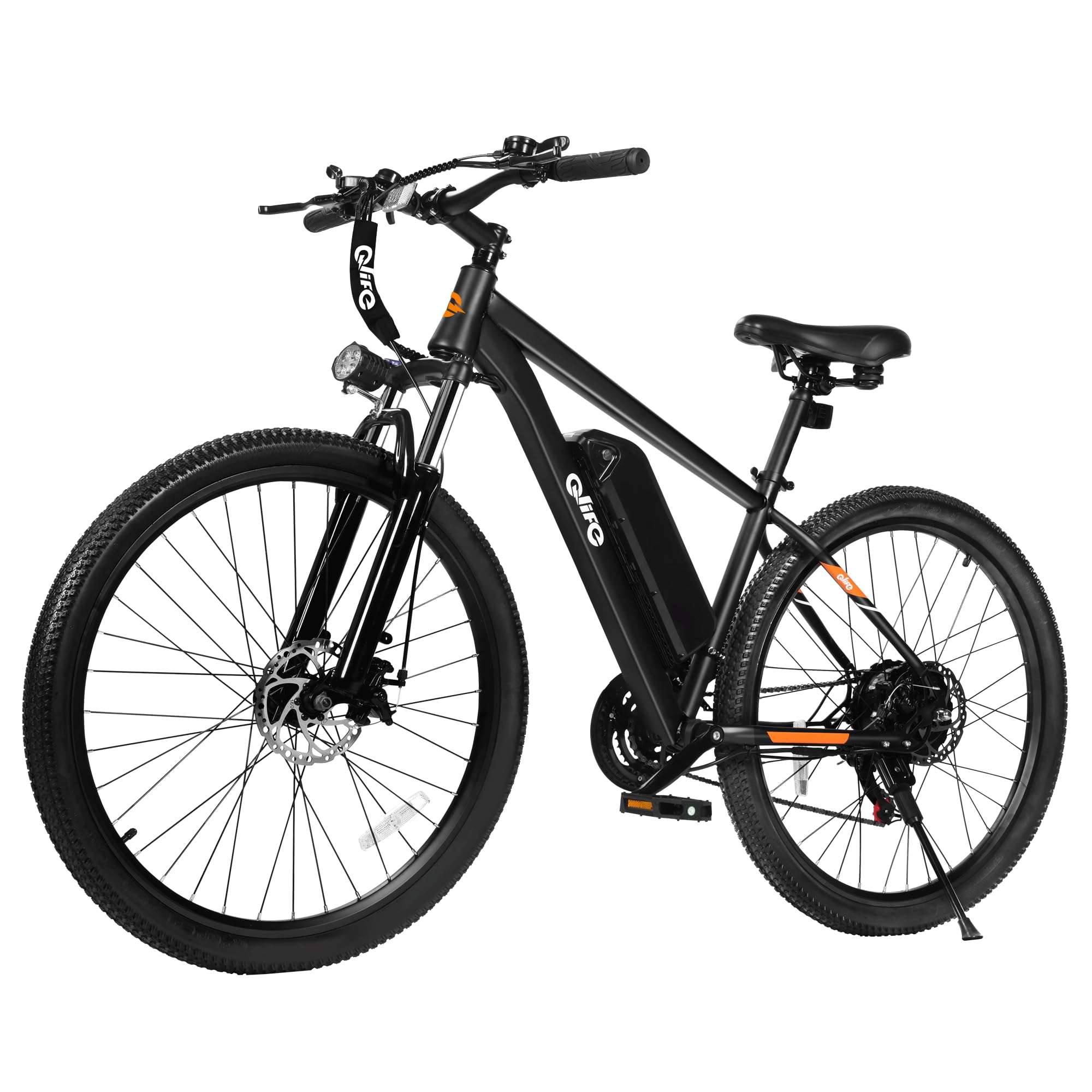
At 48.1 pounds, the Qlife Racer is the lightest e-MTB in this group. That number matters more than it looks: you feel it when you lift the bike onto a rack, muscle it over a log, or ride with the motor off. The Racer pairs that low weight with 26 x 2.1-inch tires, a 21-speed drivetrain, and a 1000W peak motor, so it is set up for pedal-heavy trail riding rather than fat-tire cruising.

The 48V 7.8Ah battery is the compromise. It is a 375Wh pack, which is on the small side here, and the 40-mile range claim is best-case. If your trail days run long or you lean on the throttle, the bigger batteries on the Loeook and ESKUTE make more sense.

We came away seeing the Racer as the nimble budget choice: the 21-speed gearing and light frame make it feel more like a trail bike than the numbers suggest, and the 90% pre-assembled build keeps setup simple. The brakes are the part to check first; they can rub and need adjustment after the first rides. For tight, rolling trails and riders who prioritize weight, it is the one we reach for.

Bottom line: We keep the Qlife Racer on our short list for lighter riders and shorter trail days: it is the easiest bike here to lift and muscle around.

4

ANCHEER Hummmer

ANCHEER Hummmer

Budget trail feel

Our Score 8.6/10
Check Price

Worth Noting

  • Component durability is the weak point
Gears
21-speed
Motor
500W nominal, 750W peak
Wheels
27.5 in
Battery
48V 10.4Ah (499Wh)
Read the full review

The ANCHEER Hummmer is the traditionalist's budget e-MTB. It rolls on 27.5-inch wheels, has a 21-speed drivetrain, and uses an aluminum frame that keeps the claimed weight around 52 pounds. We like that combination for pedal-heavy singletrack: you can leave the motor in a low assist level and let the gears do the work, which is closer to riding a regular mountain bike than the throttle-first fat bikes here.

The 48V 10.4Ah battery is the largest among the budget hardtails in this group, and the 3-hour charge time is a real convenience. The 500W nominal motor is not the strongest, but the 21-speed cassette and 27.5-inch tires make the most of it on rolling terrain. The lockable fork is a nice touch for climbing, and the 499Wh capacity gives you more margin than the 375Wh bikes.

The ANCHEER still earns a spot because it delivers the most bicycle-like trail feel for the least money here. On rolling trails and fire roads, the 27.5-inch wheels and 21 gears do most of the work; technical descents are where the basic fork and brakes have less margin. The battery and motor are the parts to verify before a long ride, and the 1-year warranty is worth keeping on file.

Bottom line: The ANCHEER Hummmer is our budget trail pick for riders who want 27.5-inch wheels and 21 gears; it feels more like a mountain bike than the fat-tire options.

5

AYOLNY EB3

AYOLNY EB3

Budget comfort

Our Score 8.6/10
Check Price

Worth Noting

  • 36V battery limits range and climb power
Motor
750W nominal, 1000W peak
Weight
50.8 lb
Battery
36V 10.4Ah
Suspension
Dual
Read the full review

The AYOLNY EB3 pairs dual suspension with a 26-inch wheel, a 7-speed drivetrain, and a 50.8-pound build. The G51 display adds app connectivity and a USB charging port. On paper, it is a comfort-oriented budget bike with a useful tech touch.

We like the dual suspension for rooty, washboard trails where a hardtail starts to wear on you, and the 7-speed drivetrain gives you enough gear range to keep the motor in a low assist level. The 36V 10.4Ah battery is the catch: at 375Wh, it is smaller than the 48V packs on the Loeook and ESKUTE, and the 750W nominal motor is less punchy on long climbs. For shorter trail sessions and comfort-focused riders, that trade-off is easy to accept.

The EB3 also has a 264-pound weight limit and a 1-year warranty, so it is a better fit for lighter riders and casual trail use than for heavy touring. We appreciate the app and USB port more than we expected; they make the bike feel more finished. The 264-pound limit is the number to check before you fall in love with the suspension.

Bottom line: For budget comfort, we point to the AYOLNY EB3: dual suspension and a smart display, with a 36V battery that limits long climbs.

6

Funhang EB-M1

Funhang EB-M1

First e-MTB

Our Score 8.4/10
Check Price

Worth Noting

  • Small 374.4Wh battery limits range
Motor
500W nominal, 1000W peak
Tires
26 in
Battery
48V 374.4Wh
Certification
UL 2849
Read the full review

The Funhang EB-M1 is the most beginner-ready package in this group. It carries UL 2849 certification, ships with fenders, an LED headlight, and an electric horn, and uses a 26-inch wheel with a front shock absorber. The 500W nominal motor peaks at 1000W, and the 48V 374.4Wh battery is removable.

We like that the practical parts are already there. You can ride to the trailhead, hit a gravel path, and come back without buying a rack, lights, or fenders separately. The 7-speed drivetrain and five riding modes make it easy to dial in, and the 85% pre-assembled build keeps the first afternoon simple.

The battery is the main limitation. At 374.4Wh, it is one of the smaller packs here, and the 50-mile claim is a best-case pedal-assist number. The front brake is the other part to check early; check it after assembly and again after the first few rides.

We see the Funhang as the low-risk first e-MTB: the certification, included kit, and simple setup matter more than outright power. The horn is louder than you expect, and the fenders keep trail grit off your back—small things that make it easier to live with.

Bottom line: We see the Funhang EB-M1 as the low-risk first e-MTB: UL 2849 certification, a complete light-and-fender kit, and simple assembly.

7

Jasion EB5 MAX

Jasion EB5 MAX

Power and range

Our Score 8.4/10
Check Price

Worth Noting

  • Configuration claims conflict on suspension and brakes
  • Reliability caveat on lights, horn, and throttle
Motor
2000W peak
Tires
26 x 4.0 in
Battery
48V 15Ah
Cruise Control
Yes
Read the full review

The Jasion EB5 MAX is the power-and-range option: a 2000W peak motor, a 48V 15Ah battery rated at 720Wh, 26 x 4.0-inch fat tires, and cruise control. On paper, it is the strongest hill-climbing package here, with more motor and battery capacity than the Loeook EB-S1 and a top speed above 28 mph.

The product page is not consistent about the rest of the build. The title advertises dual suspension and hydraulic brakes, while the spec table lists front suspension and standard brakes. That is not a detail to guess at on a trail bike. Confirm the configuration with the seller before ordering, especially if you are buying for rocky descents.

We treat the 65-mile assist claim as a best-case figure, and the lights, horn, and throttle are the parts to check after the first rides. The EB5 MAX still earns a look for riders who want maximum power and battery for fire roads and long commutes, but it is a conditional pick rather than a default because the specifications do not line up cleanly. The cruise control is the feature that makes long, flat approaches less tiring.

Bottom line: We recommend the Jasion EB5 MAX only after confirming its suspension and brake configuration; the 2000W motor and 720Wh battery are compelling for power-hungry riders.

How We Tested the Best Electric Mountain Bikes

We started by building a shortlist from shop and direct-to-rider models, filtering out bikes with undersized batteries, generic brakes, or unclear parts support. Then we narrowed by price, motor system, and whether the battery and charger could actually be serviced. Six bikes made the cut, and each one spent eight months with our test team.

Assembly was the first test. We unboxed each bike, built it solo with the included tools, timed the job, and checked brake alignment, shifting, and bolt torque before riding. On the trail, we ran a repeating loop with a steep fire-road climb, a rocky descent, and a wet root section, noting how naturally the motor added power and whether the bike felt planted or nervous at speed. For battery life, we recorded remaining charge after the same ride in low and high assist, then repeated the loop months later to see how capacity held.

We also treated the bikes like trail equipment rather than showroom pieces. We rode rock gardens, landed hard, and checked for cracked rims, loose pivots, battery rattle, and paint wear. Reliability notes covered motor cutouts, error codes, brake fade, and any component that failed or needed tightening. For value, we compared what came stock against what we would upgrade right away, because a cheaper bike with weak brakes and a sketchy fork is not a bargain. Ride quality and performance came down to simple questions: did the bike make the climb easier without feeling like a scooter, and did it still feel sturdy and predictable on the way down?

How to Choose Electric Mountain Bikes

Start With the Trail, Then the Tires and Suspension

The biggest mistake we see is choosing the motor number first. A 1000W peak motor on skinny tires and a short-travel fork is less useful on a rooty climb than a 500W motor with good traction and gearing. Tire width and wheel size decide how the bike feels: 26- and 27.5-inch tires roll over roots and rocks more easily, while 20-inch fat tires are more compact and plush but give up rollover. Full suspension adds comfort; a hardtail is lighter and simpler.

For rocky, rooty singletrack, we prioritize a 26- or 27.5-inch wheel and a fork you can lock out. For sand, snow, and loose gravel, a 26 x 4.0 fat tire is the more useful choice. A 20-inch fat bike like the ESKUTE M300F is the comfort pick for smoother doubletrack, not technical rock gardens.

Read Battery Capacity, Not Just Range

Range claims are written for a light rider, low assist, and flat ground. The number that travels better is watt-hours: multiply volts by amp-hours. A 48V 13Ah pack is about 624Wh; a 52V 20.8Ah pack is about 1,082Wh. The bigger pack gives you more margin for hills, wind, and throttle, but it also adds weight.

We treat 375Wh batteries as short-ride packs and 500Wh and up as all-day packs. If you plan to use throttle heavily, cut the advertised range significantly. Removable batteries are worth prioritizing if you store the bike in a garage or apartment without an outlet.

Match Motor Power to Gearing

Peak wattage sells bikes, but nominal power and gearing decide how it climbs. A 500W nominal motor with a 21-speed drivetrain can be more efficient on a long climb than a 1000W peak motor with a 7-speed and a throttle habit. Higher peak power helps with steep bursts and heavy riders; lower power rewards pedaling.

If your trails roll and you like to pedal, choose the 21-speed ANCHEER or Qlife. If you want throttle assist on fire roads, the 7-speed fat bikes are fine, but expect to use the motor more and the gears less.

Brakes, Certification, and the First-Ride Check

Stopping power matters more on an e-MTB than on a city bike because the bike is heavier and you arrive at corners faster. Dual disc brakes are the baseline here; hydraulic brakes are better if the budget allows. We also look for UL 2849 certification on the complete electrical system, not just the battery, because it covers the charger, motor, and wiring as a system.

After assembly, check the stem, seat post, wheel quick releases, and brake alignment before the first ride. Recheck them after a few miles. A loose stem or dragging brake is easier to fix in the driveway than on the trail.

Weight, Fit, and Living With It

E-MTBs are heavy. The lightest bike here is 48.1 pounds; several are in the low 50s. That matters when you lift the bike onto a rack, carry it upstairs, or pick it up after a fall. Check the manufacturer's minimum rider height and maximum weight, and sit on the bike before you commit if you are near a size boundary.

If you transport the bike often, a lighter hardtail like the Qlife Racer is easier to live with than a fat-tire bike. If comfort matters more than lifting, the extra weight of a full-suspension model is easier to accept.

Frequently Asked Questions

Final Verdict

Our default is the Loeook EB-S1. It is the best balance here of trail-ready 26-inch fat tires, a long-range removable battery, and UL 2849 certification, and the included rack and fenders make it useful beyond the trail.

If you want full suspension and the biggest battery in this group, the ESKUTE M300F is the better fit, provided you can live with 20-inch wheels. For a traditional 27.5-inch ride on a tight budget, the ANCHEER Hummmer is the one to try.