Bike Racks & Transport

Best Front Bike Racks of 2026

A front bike rack is the difference between balancing a grocery bag on your handlebars and riding home with both hands. It gives you a flat, stable place to strap a backpack, a farmers market haul, or a pizza box without turning every bump into a juggling act. The catch is fit. Front racks mount to wildly different bikes, so the hardware, brake clearance, and handlebar space matter as much as the rack itself; a loose clamp or a tray that flexes under weight can make a simple errand feel sketchy.

I've spent the past eight months riding 11 front racks around town, loading them with groceries, library books, and the occasional takeout order. My team and I cared about build quality you can feel, capacity that matches real errands, and installation that doesn't require a shop appointment. The best ones disappeared under cargo, and the weaker ones announced themselves with rattles, sway, or a mounting puzzle. The picks below are the ones I'd trust with a full load.

1

Thule Tour Rack

Top Pick
Thule Tour Rack

Front or rear

Our Score 9.4/10
Check Price

Worth Noting

  • Side frames and fender sold separately
  • Caps at 29 x 2.6-inch tires
Mount
Strap-on, front or rear
Rails
10 mm aluminum
Tire Fit
Up to 29 x 2.6 in
Front Load
10 kg / 22 lb
Read the full review

One rack, two positions: the Tour Rack straps to the fork for front duty and to the rear stays for everything else, rated to 22 lb up front and 25 lb at the back. For a bike that commutes all week and tours twice a year, that flexibility is worth more than a slightly higher front rating on a dedicated rack.

The rails are 10 mm aluminum, shaped for pannier hooks rather than a bungeed box, and the deck and rail positions adjust so you can set the angle for pedaling clearance. There's a mount for a light or a reflector built in, which matters more than it sounds: a front rack usually takes over the spot on the fork crown where your light used to live.

Two costs to plan for. It fits tires up to 29 x 2.6 inches and no further, so fat bikes are out, and the side frames that give a pannier extra support are sold separately, as is the custom fender. If you want the complete touring setup, budget for the accessories alongside the rack.

What we like most is how little it commits you to. Nothing is bolted permanently, the straps come off, and the same rack can move to a second bike or to the back of the same one. Check the straps after the first couple of rides and again whenever you change bikes; that's the trade for a rack you can move, and it's a fair one.

Bottom line: We rate it the best front rack here for panniers, and the bonus is that the same rack straps to the rear stays when you need it there.

2

PINNAMAX Front Rack

PINNAMAX Front Rack

Commuting and errands

Our Score 9.0/10
Check Price

Worth Noting

  • 22 lb ceiling is modest for touring loads
Mount
Fork crown and fork legs
Weight
2.76 lb
Load Capacity
10 kg / 22.05 lbs
Leg Adjustment
11 to 15.35 in
Read the full review

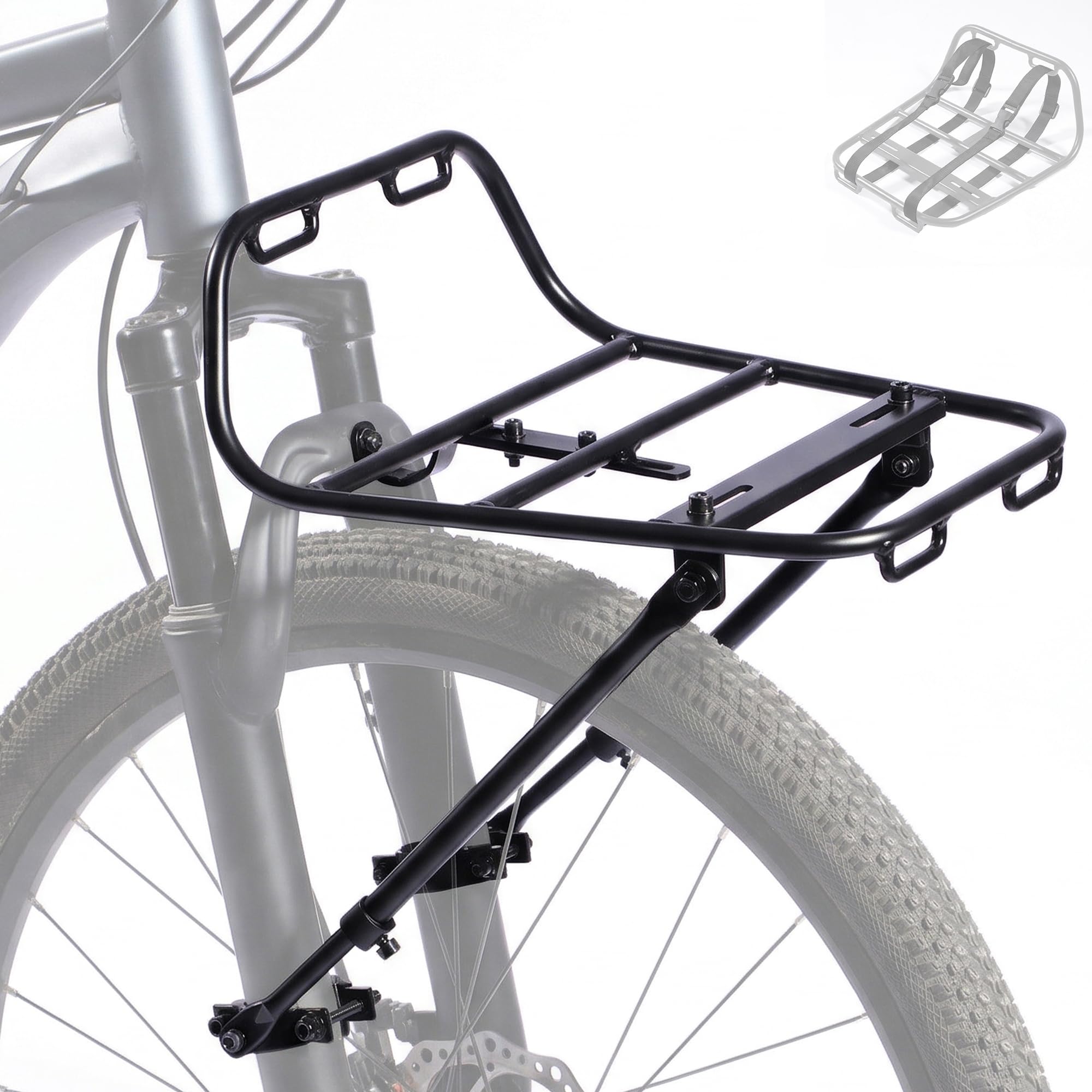
The bag of hardware is the reason this rack wins. Along with the crown bracket and two struts, PINNAMAX includes fork mounts for bikes that don't have threaded eyelets halfway down the legs, and that's the piece most inexpensive front racks leave out. Plenty of commuters, gravel bikes, and older mountain bikes have a crown bolt and nothing else.

That completeness is why we think it's the best all-rounder in this group. The 6061-T6 frame weighs 1.25 kg and carries a stated 10 kg (22.05 lbs), and the two legs extend from 11 to 15.35 inches, enough travel to reach a low-rider boss, a fender eyelet, or the crown of a suspension fork. The load sits low over the wheel rather than perched at handlebar height, so the bike still steers like a bike. Bolts, brackets, and the hex key are all in the box; we assembled one with nothing else on the table.

The finish is better than the price suggests. The black coating came through installation without marking, and it hides road grime in a way the bare aluminum racks don't. It's the rack we keep coming back to for a bike that does errands, a commute, and the occasional long Saturday.

Bottom line: We recommend it to anyone who wants a light, inexpensive front rack and doesn't yet know whether their fork has eyelets, because the box covers both cases.

3

Origin8 Rush Messenger Rack

Origin8 Rush Messenger Rack

Heavy, bulky cargo

Our Score 8.8/10
Check Price

Worth Noting

  • Requires a caliper hole and axle mounts
Mount
Caliper hole and front axle
Platform
16 x 16 in
Wheel Fit
26, 27.5, 29 in, 700c
Load Capacity
55 lb
Read the full review

Sixteen inches square is a lot of platform to hang over a front wheel, and it's the first thing we noticed about the Rush Messenger. That deck is the point: a case of bottles, a pizza box, a bag of potting soil, or anything else that refuses to fit in a pannier straps down flat and stays there. If your cargo is shaped like a brick rather than a bag, this is the shape you want.

The frame is AL6061-T6 and rated to 55 lbs, the highest stated capacity in this set, with an integrated guard at the back that keeps cargo off the head tube and away from the cables. Carrying weight over the front wheel instead of the rear changes how the bike feels: planted, a little slower to turn, with the load where you can see it.

Mounting is what decides whether it's right for you. It attaches at the caliper hole and the front axle, and it adjusts to fit 26, 27.5, 29-inch, and 700c wheels, but it needs both of those anchor points to be usable on your fork. Where they line up, the result is solid and quiet; where they don't, there's no adjustment that rescues it. Check the caliper hole and the dropout on your own bike before ordering, because this is the least universal rack here in the best possible way.

Bottom line: This is the front rack we point to when the load is a case of beer or an odd-shaped box rather than a neat bag, as long as your fork has the mounts.

4

Basil Portland Front Rack

Basil Portland Front Rack

City bikes

Our Score 8.8/10
Check Price

Worth Noting

  • Needs a crown bolt and axle mounts
  • 10 kg rating suits errands, not touring
Mount
Front axle and fork crown
Securing
Removable adjustable belt
Load Capacity
22 lb
Front Light Mount
Built in
Read the full review

This is the rack we pick when the bike itself is the point. The Portland is a proper porteur: aluminum, with low sides that stop a bag sliding off, a removable belt that straps it down, and a shape that makes a city bike look finished rather than accessorized. Nothing else here has that effect on a bike's appearance.

It mounts to the front axle and the fork crown with a fixed arrangement, so check both before ordering. There's little adjustment to work with, and a fork without a crown bolt or usable axle ends is a non-starter. The 10 kg rating matches most of the aluminum racks here, which makes it a commuter and shopping rack rather than a touring one.

The built-in front light mount is the detail we appreciate most. Front racks tend to swallow the spot on the fork crown where a light used to live, and Basil gives it somewhere to go instead. You keep your visibility and you gain a platform for a bag.

Bottom line: This is the rack we choose when the bike itself is the point, and it's the nicest-looking way here to carry a bag across town.

5

YONTUO Front Rack

YONTUO Front Rack

Fine-tuning fit

Our Score 8.8/10
Check Price

Worth Noting

  • Platform runs small for bulky loads
  • Installation instructions are thin
Mount
Fork crown and clamps
Included
Hex key and cargo strap
Adjustment
Height, front, rear, side
Load Capacity
10 kg / 22.05 lbs
Read the full review

Height, fore-aft, and side to side: the brackets on this rack move in three directions before you tighten anything down, which is more adjustment than most racks at this end of the price range offer. On a fork with an awkwardly placed boss, or a fender crowding the crown, that slack is what gets the deck level.

It's the closest thing here to the PINNAMAX, and for most riders the PINNAMAX's included eyelet adapters still make it the better default. Where the YONTUO earns its place is a bike that needs the rack moved forward, back, or sideways to clear a brake, a bag, or a fender. The 6061-T6 frame carries the same 10 kg (22.05 lbs), the built-in hex key and the cargo strap come in the box, and a tent and camp chair strapped on top sit well inside what it will take.

The platform is the part to look at twice. It runs small once a big duffel is on it, so it suits a compressed load rather than a wide one. For a road or touring fork that needs a nudge to line up, though, the adjustment is the whole reason to buy it.

Bottom line: Worth considering if your fork needs the rack pushed forward, back, or sideways to sit level, which is where its adjustment beats the cheaper racks.

6

Topeak TetraRack M1

Topeak TetraRack M1

Bikes without eyelets

Our Score 8.6/10
Check Price

Worth Noting

  • Straps can creep under a bouncing load
  • Too narrow for 4-inch fat-bike forks
Mount
Fork straps, no eyelets
Weight
2 lb
Bag System
QuickTrack MTX/RX, RackTime Snapit
Load Capacity
10 kg / 22 lb
Read the full review

The top plate on this rack adjusts to sit level whatever angle your fork sits at, and on a raked fork that's the difference between a bag resting flat and a bag sliding toward the bars. It's a small mechanism and the most thoughtful one in this group.

The rest of the design follows the same idea: nothing is drilled, nothing is clamped to a frame that was never meant to take cargo. Hook-and-loop straps wrap the fork legs, the plate levels, and you're done. It's also part of Topeak's QuickTrack system, so MTX and RX trunk bags and RackTime Snapit bags slide on and lock instead of being strapped down, and there's a clamp for a reflector plus a light mount.

Strap mounting is the whole system, though, and straps can creep once a load starts bouncing. Keep your cargo well inside the 22 lb rating, re-check tension after the first few rides, and give the rack a shake before every trip. Fat-bike forks are out as well, since this one comes up narrow against a 4-inch tire. Neither point troubles a commuter with a laptop bag and a jacket, which is where this rack makes the most sense.

Bottom line: This is our pick for a fork with nothing to bolt to, since straps and a self-leveling plate get you a solid front rack without drilling anything.

7

Sunlite Gold Tec Front Rack

Sunlite Gold Tec Front Rack

Simple flat platform

Our Score 8.0/10
Check Price

Worth Noting

  • Not rated for pannier bags
Mount
Fork bosses
Weight
13.6 oz
Wheel Fit
26 in / 700c
Load Capacity
40 lb
Read the full review

Forty pounds is the number worth noticing: this is the highest rating among the low-priced racks here, on a tubular 6061-T6 frame that weighs about 13.6 ounces. If your fork has bosses and you want to carry a crate, a six-pack, or a bag of tools, it will do the job for very little money and add almost nothing to the bike.

Fit and hardware are where it gets fussy. It bolts to standard fork bosses, and on the right fork it goes on in a few minutes; on the wrong one the brackets don't line up cleanly, and the mounting kit doesn't always arrive complete. Look at both legs of your fork before ordering and confirm there are threaded bosses on each.

What we like is the honesty of it: a light, flat platform with a clean paint finish, simple construction, and a rating that covers a crate of groceries. Load it like a flatbed, keep the weight well inside 40 lb, and it disappears under the cargo.

Bottom line: We recommend it to riders with fork bosses who want a light, cheap platform for a crate and don't need panniers, since that's exactly what it does.

How We Tested Front Bike Racks

We started by pulling together front racks from brands we trust and a few newer names, then cut the list by mounting style, stated weight limit, platform size, and whether the hardware was included. Price mattered, but only after we confirmed the rack could fit common fork and brake setups without extra adapters. That left 11 racks, which we rode for eight months on commutes, grocery runs, and weekend errands.

Installation was a Saturday-morning job in my garage: I timed each solo install with the included hardware, noted whether I needed a hex key, torque wrench, or extra shims, and checked for brake and cable clearance before the first ride. On the road, I loaded each rack with a grocery tote, a stack of books, and a U-lock, then added weight toward the stated capacity with bags of rice. I watched for flex in the platform and struts, listened for rattles over curb cuts and gravel, and checked whether straps or rails kept the load from shifting.

For capacity and build quality, I looked at whether a standard paper grocery bag, a pizza box, or a small backpack sat flat and left room for a lock, and I inspected welds, clamps, and finish after repeated wet rides. The racks that scored best stayed quiet on bumpy streets, installed with the parts in the box, and still felt solid when loaded. The ones that didn't fit cleanly or flexed under weight fell out of contention.

How to Choose Front Bike Racks

Start at the fork, not the rack

Look at your fork before you look at any listing. A crown bolt under the fork, threaded bosses halfway down each leg, or both, is what most front racks expect. A bike with neither needs a rack that ships with adapters or one that straps on instead. Caliper-hole and axle mounts are the other common system: rigid and rattle-free when they line up, but entirely dependent on your frame having those two anchor points.

If the fork carries no mounts and its maker publishes no load rating for it, don't bolt cargo to it. That applies to most carbon forks and to plenty of lightweight alloy ones.

Match the deck to the load

A flat deck is for boxes, crates, and bags you strap down; rails or low sides are for panniers and totes that need a hook or a wall to lean against. The Thule's 10 mm rails and the Basil's porteur sides do completely different jobs for different luggage, and neither is a better version of the other.

If you carry a bit of everything, a flat platform plus a strap is the more flexible buy. If you already own front panniers, buy for the panniers, not for the platform, because a flat deck gives a pannier hook nothing to hold.

Know what a front load does to the steering

Almost every rack here is rated around 10 kg / 22 lb, and that ceiling exists because the cargo sits on the wheel you steer. Weight low and centered over the hub feels planted; weight high or off to one side makes the bars want to flop, especially at walking pace or when you're pushing the bike through a shop door.

Keep the heaviest item nearest the frame and low on the deck, strap it so it can't shift, and accept that a front rack is for the load you want to keep an eye on rather than the load you want to forget.

Stability is mostly a hardware question

Bolts work loose and straps creep; that is the maintenance a front rack asks for. Check every fastener after the first ride, then every few weeks or after any loaded trip, and use a strap or a net rather than trusting friction to hold a bag.

Strap-mounted racks need their tension re-checked whenever the weather or the load changes. A rack that rattles is usually one loose bolt away from being a rack that shifts, and a rack that shifts under a full load is the one failure mode worth taking seriously.

Clearance covers tires, brakes, cables, and fenders

Universal fit means universal with conditions. Check the stated wheel and tire range, then check the gap between the fork legs and the brake caliper, and route the cables so nothing rubs when the bars turn. Fenders are the usual casualty: a rack that sits level on a bare fork can end up resting on the mudguard.

Hold the rack in position against the bike before you tighten anything, turn the bars lock to lock, and look for contact. Two minutes there saves a return.

Frequently Asked Questions

Final Verdict

Buy the PINNAMAX if you want one rack that fits almost any fork, carries a day's cargo, and asks nothing beyond ten minutes with a hex key. It's the one we recommend to most riders, and the included eyelet adapters are the reason: they make it fit bikes that would otherwise need a workaround.

If your loads are crates and boxes rather than bags, the Origin8's 55 lb deck earns its higher price. If your fork has nothing to bolt to at all, the Topeak's strap mounting and self-leveling plate solve a problem the others can't.