Bike Racks & Transport

Best Trunk Bike Racks of 2026

A trunk rack is the simplest way to carry bikes without a hitch, but it’s also the accessory most likely to make you nervous: Will it fit? Will it stay put at highway speed? Will it scratch the paint? I’ve had a strap slip on a borrowed rack and one hold two bikes steady for a 300-mile weekend. Over the past six months, my team and I installed and lived with 12 trunk racks; the right one turns a white-knuckle install into a five-minute job and keeps your bumper intact.

The biggest surprise for first-time buyers is that trunk racks are not one-size-fits-all: the shape of your trunk lid, the spoiler, and the rear window angle change which rack sits securely. Assembly is a one-time job; installation is what you repeat every weekend, so watch strap tension and how the rack feels when you lift a loaded bike. Value isn’t the cheapest price—it’s the rack you don’t have to re-strap halfway to the trailhead. I sorted the 12 by errands and trail days; picks below earned their spots.

1

Capstone 3-Bike Trunk Rack

Top Pick
Capstone 3-Bike Trunk Rack

Three-bike value

Our Score 9.0/10
Check Price

Worth Noting

  • Heavier to lift and position than a two-bike rack
Rack Weight
13 lb
Frame Finish
Powder coat
Bike Capacity
3 bikes
Load Capacity
120 lb
Read the full review

Three bikes is an awkward size for trunk racks. Two-bike carriers leave you short, and four-bike racks are often more frame than the job needs. The Capstone 3-Bike sits in that gap with a 120-pound rating, a 13-pound frame, and a simple strap layout.

The 120-pound rating is the useful part. It leaves margin for three adult bikes, or two bikes plus a heavier hybrid, without pushing you into a four-bike carrier. The 13-pound frame is the platform for that rating. The powder-coat finish and rubber straps are honest rather than fancy, and the universal mounting is a starting point, not a promise.

We recommend the Capstone for the household that needs a third bike occasionally and does not want to pay for a premium four-bike carrier. It is sturdier than its simple layout suggests, and the three-bike size is easier to live with than a four-bike frame when the third bike is not always there. Check the vehicle guide before ordering, because trunk shape and spoiler clearance still decide whether the rack sits cleanly. It is at its best when the third bike is an occasional passenger, not a daily load.

Bottom line: The Capstone is the three-bike value pick: a 120-pound rating and a simple, sturdy frame for households that do not need a four-bike carrier.

2

Allen Sports Deluxe 102DN-R

Allen Sports Deluxe 102DN-R

Two-bike everyday use

Our Score 8.8/10
Check Price

Worth Noting

  • Hooks can mark paint if grit gets under them
Warranty
Limited lifetime
Rack Weight
7.5 lb
Bike Capacity
2 bikes
Load Capacity
70 lb
Read the full review

The 102DN-R is the trunk rack we recommend first because it does the two-bike job without turning installation into a project. It arrives fully assembled, weighs 3.4 kg, and uses a single frame configuration with side straps and individual tie-downs. We like that there is no pile of arms to sort through: the rack goes on the way it comes out of the box. The 70-pound rating is enough for two typical adult bikes, and the padded lower frame keeps the main contact points off the paint.

The side straps are the quiet reason this rack feels more planted than its price suggests. They pull against the trunk in two directions, so the rack resists the side-to-side walk that cheaper two-bike carriers develop at highway speed. The individual tie-downs are equally simple, though they reward a careful hand: a loose tail or a hook seated at an angle is where security starts to fade.

Fit is the caveat. The 102DN-R is a universal-fit rack, not a universal guarantee, and trunk shape, spoiler clearance, and glass all change the answer. We treat the maker's vehicle guide as mandatory before ordering. What remains is a two-bike rack that puts its money into the frame and straps, not into hardware you have to adjust. That is why it stays our first recommendation.

Bottom line: For most two-bike buyers, this is the trunk rack we recommend first: light, fully assembled, and rated for 70 pounds, with the one caveat that fit varies by vehicle.

3

Allen Sports Premier S104

Allen Sports Premier S104

Four-bike families

Our Score 8.6/10
Check Price

Worth Noting

  • Plastic cradle contacts can scuff bike paint
Carry Arms
21 inches
Rack Weight
12 lb
Bike Capacity
4 bikes
Load Capacity
140 lb
Read the full review

Four bikes is where a trunk rack stops being a convenience and becomes a small logistics system. The Premier S104 meets that with 21-inch carry arms and a 140-pound rating, double the capacity of our top pick. We think the arm length matters more than the headline count: it gives you room to space the cradles and keep brake levers, pedals, and saddle rails from tangling.

The trade-off is heft. At 12 pounds, the Premier is a two-hand lift onto the trunk, and its larger frame takes more garage space than a two-bike rack. For a family loading four bikes a few times a season, that is a fair exchange. For one person putting a rack on alone every weekend, it is more carrier than the job requires. The extra-large pads and the sure-strap lower straps are the details we appreciate most, because paint contact and creeping bottom hooks are the two places a four-bike load usually goes wrong.

Fit is not universal in practice. The Premier works on many SUVs and minivans, but small frames, children's bikes, and some hatch shapes can be awkward. Check the vehicle guide and test the lower strap path before you commit. The reward is a four-bike rack that spaces bikes far enough apart to load without a tangle. The rack is at its best when two people load it together.

Bottom line: For families carrying up to four bikes, the Premier S104 is the capacity pick, with a 140-pound rating and a layout that keeps bikes apart, provided your vehicle fits.

4

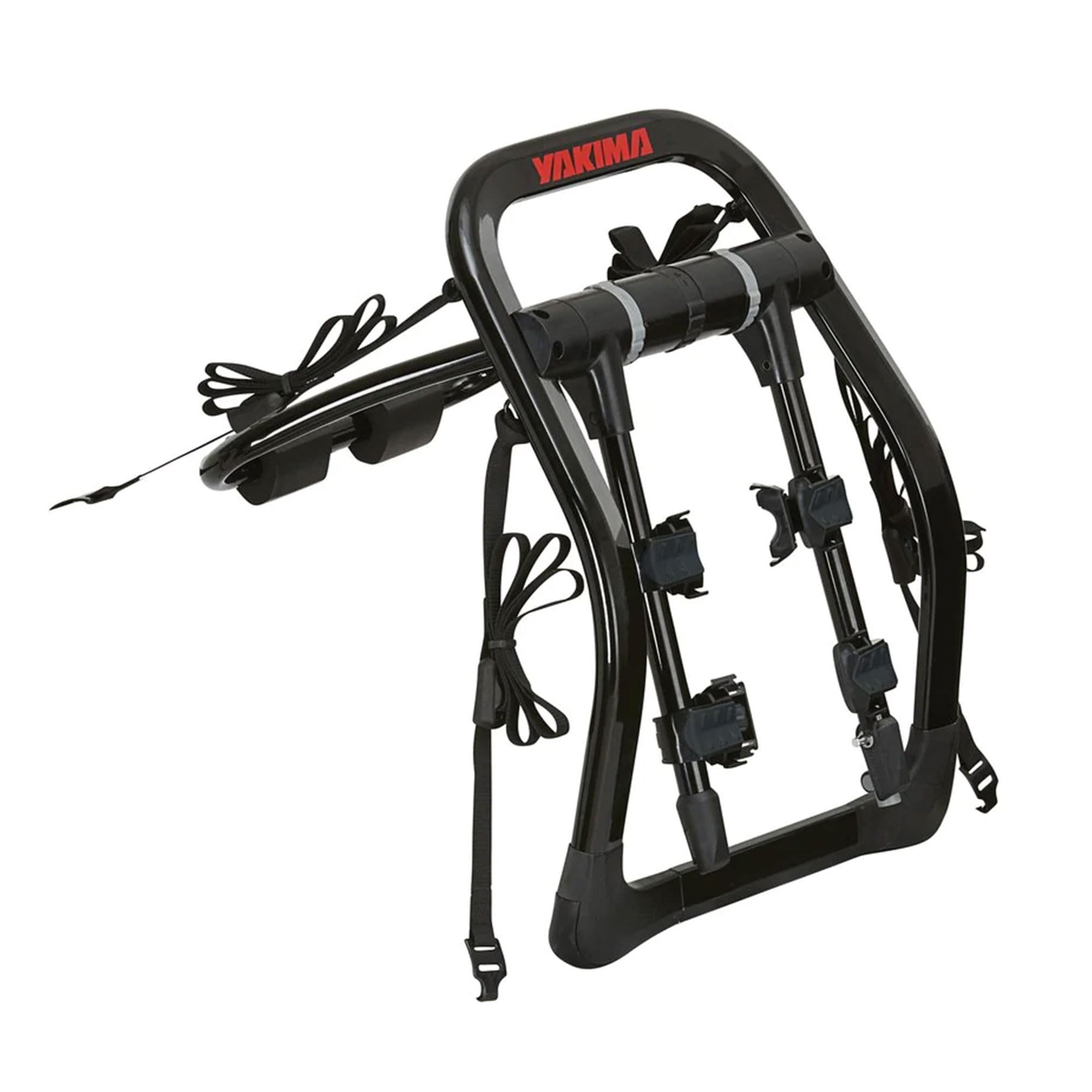
Yakima FullBack 3

Yakima FullBack 3

Frequent install/removal

Our Score 8.4/10
Check Price

Worth Noting

  • Heavy to lift and store at 22 pounds
Locks
SKS locks
Rack Weight
22 lb
Bike Capacity
3 bikes
Load Capacity
165.3 lb
Read the full review

The FullBack 3 is the premium rack in this group, and the difference shows up before the bikes go on. The four-strap attachment is designed to go on without tools, the arms fold, and the bike contacts use SuperCush ZipStrips. We like that for a rack you take on and off often: the less hardware you have to fiddle with in a parking lot, the more likely you are to use it.

The 22-pound frame is part of the package: it gives the rack a solid feel and supports the 75 kg load rating, which is more headroom than the two-bike racks here. The SKS locks add a useful layer of security when the rack is mounted, and the bottle opener is a small touch that makes the rack feel designed rather than assembled. The arms fold for storage, so the rack takes less space than its footprint suggests.

Fit is still the great equalizer. The FullBack 3 works best when the four straps can pull evenly against the trunk, and spoilers or curved hatch panels can spoil that geometry. Check the vehicle guide and plan the strap paths before you load. If you install a rack weekly and want the hardware to feel finished, this is the upgrade; if you want the lightest possible two-bike carrier, the 102DN-R is the easier choice.

Bottom line: For frequent installers who want premium hardware, the FullBack 3 offers tool-free mounting, folding arms, and locking details, with a heavier frame to manage.

5

Thule Passage 910XT

Thule Passage 910XT

Light road bikes

Our Score 8.2/10
Check Price

Worth Noting

  • FitDial still depends on trunk shape
Rack Weight
9.7 lb
Bike Capacity
2 bikes
Load Capacity
35 lb
Folded Dimensions
22 x 17 x 24 inches
Read the full review

The 35-pound load limit is the first thing to know about the Passage 910XT. That is not a typo in the table: it is a two-bike rack for light road bikes, not a general-purpose carrier for hybrids or e-bikes. We include it because the FitDial system and folding arms are genuinely useful on small cars, and the rack weighs only 9.7 pounds.

We like the soft rubber cradles and the anti-sway cages, which keep bike-to-bike contact down when two frames are close together. The FitDial is a real convenience: it lets you set the rack's angle to the car instead of fighting a fixed frame. The folding arms also make it easier to leave the rack on the car between rides without it sticking out like a scaffold.

Where it falls short is the weight ceiling. Two ordinary hybrids can exceed 35 pounds, and an e-bike is out of the question. Stability also depends on getting the hooks seated squarely; a loose hook changes the whole load. If you and a partner ride light road bikes and want a low-weight rack for a sedan, this is a reasonable specialist. If you need to carry two hybrids, the 102DN-R's 70-pound rating is the better match.

Bottom line: For light road bikes on a small car, the Passage 910XT's FitDial and folding arms are useful, but its 35-pound limit rules out most everyday bikes.

How We Tested the Best Trunk Bike Racks

We started with a shortlist of 28 trunk racks and narrowed it by vehicle fit, bike capacity, rack weight, and price, then bought 12 to test for six months. Each rack was installed on a sedan, a hatchback, and a small SUV. I timed the first assembly out of the box, then timed solo installation and removal every weekend, noting where straps tangled, which buckles needed two hands, and how much fiddling it took to get a snug fit around spoilers and rear windows.

Once loaded with two bikes, each rack went on the same loop: a 70-mph highway stretch, a washboard gravel road, and a rainy errand run. I watched for side-to-side sway, checked strap tension at every stop, and tested security by leaving the car parked in a busy lot and seeing whether the rack or bikes could be shifted by hand. Stability and sturdiness were judged by how the rack recovered after speed bumps and hard braking, not by how it looked in the driveway.

Back home, I inspected the foam pads and frame cradles for scratches on the car’s paint, then left each rack mounted for a week of sun and rain to see whether straps frayed, buckles seized, or pads flattened. I also weighed each rack packed in its box and carried it one-handed from garage to car, because a bulky rack feels very different after a long ride. Value came down to whether the rack still felt solid after repeated installs—not whether it was the cheapest in the group. We’ll keep using these through another season and update if anything changes.

How to Choose Trunk Bike Racks

Start With the Car, Not the Bike Count

A trunk rack hangs from body panels, glass, and gaps that vary from one hatchback to the next. The same rack that sits cleanly on a sedan can foul a spoiler or put a hook where the maker does not approve a load. We treat the vehicle fit guide as the first filter, before capacity or price. Check your exact year, make, and model, then look at the trunk lid shape and hatch clearance. The Allen 102DN-R is a good example: it is a universal-fit design, but universal does not mean guaranteed.

Count Bikes and Pounds Together

Bike count and weight are two different limits. A pair of carbon road bikes can sit far below a pair of hybrids, and one e-bike can exceed a trunk rack's rating on its own. Add the bikes you actually own, then leave margin for pedals, locks, and racks. The Allen 102DN-R's 70-pound rating suits two typical adult bikes; the Premier S104 doubles that to 140 pounds for four bikes. The Thule Passage 910XT's 35-pound limit is a specialist's number, not a family-car number. More capacity usually brings more rack weight and a higher price.

Look at How It Attaches and How It Sways

Stability comes from even tension, not from cranking one strap harder. Side straps control lateral movement, lower hooks keep the feet planted, and padded contacts spread the load. We pay close attention to the lower attachment because that is where a trunk rack can creep. After loading, recheck every strap; after the first few miles, do it again. The Allen's side straps and the Yakima's four-strap tool-free system are different expressions of the same idea: the rack should sit tight before the bikes go on.

Decide Whether It Lives on the Car

If the rack lives on the car, folded size matters less than a sturdy frame and arms that stay put. If you take it on and off weekly, weight and folding hardware become the daily difference. The Thule's arms fold down, the Yakima's arms fold, and the Allen 102DN-R is a light fixed frame that is easy to lift and store. The Premier and Capstone are heavier, so plan to use two hands and give them shelf space. We prefer a rack that is easy to remove over one that is merely easy to leave on.

Protect the Paint and the Straps

Paint damage usually starts with grit under a hook or a pad, not with the rack's main frame. Wipe the contact points before installation, keep hooks off bare edges, and add a small patch of protective film if your car's finish is soft. Then look after the straps: sun and repeated tension are hard on webbing, and a frayed strap is not a spare. Replace worn parts before a trip rather than after. The extra-large pads on the Premier and the padded lower frame on the 102DN-R help, but clean contact points do more.

Frequently Asked Questions

Final Verdict

For most two-bike buyers, the Allen Sports Deluxe 102DN-R is the rack we recommend first. It is light, fully assembled, and rated for 70 pounds, and its side straps do the stability work without a lot of hardware. Check the vehicle fit guide; that is the one thing that can undo the recommendation.

If you need four bikes, the Premier S104's 140-pound rating and 21-inch arms justify the extra weight. If you install and remove the rack often, the Yakima FullBack 3's tool-free frame is the premium alternative. The Thule Passage 910XT remains a light-road-bike specialist because of its 35-pound limit.