Bike Racks & Transport

Best Hitch Bike Racks of 2026

The worst sound in cycling isn't a snapped chain — it's the clunk of a bike shifting behind your car at highway speed. A hitch rack is what stands between your frame and the asphalt, and the gap between a solid one and a flimsy one lives in small details: how the arms clamp, how much the mast rocks on an on-ramp, whether anything works loose by mile 200. Get it right and your bikes vanish behind you for the whole trip.

Here's what the spec sheet won't tell you: the rack has to match your receiver, not your car, and a 1¼-inch hitch narrows your options more than the product photos suggest. Bike count is the easy number to compare, but weight per bike is where e-bikes blow past a rating. I've spent ten months hauling on eight different racks, from a kid's 20-inch bike to a 60-pound cargo e-bike, and the ones that held up were the ones that were easy to live with — most of them not the priciest. The picks below earned a permanent spot on the hitch.

1

Allen 542QR 4-Bike Rack

Top Pick
Allen 542QR 4-Bike Rack

Four-bike daily hauling

Our Score 9.2/10
Check Price

Worth Noting

  • Cradle spacing is tight for four full-size bikes
  • Step-through frames need an adapter bar
Hitch Fit
2-inch receiver
Hitch Lock
Included, two keys
Bike Capacity
4 bikes
Total Load Limit
140 lb
Read the full review

The locking quick-install hitch is why this one leads our list. It threads into the receiver, draws the rack tight against the hitch, and takes a key, so the anti-rattle hardware and the lock are the same piece instead of a bolt, a pin, and a cable you have to remember. On a car that parks outside, that's the difference between a rack you leave on and one you unbolt every night.

Four bikes and 140 pounds is the working envelope, which works out to about 35 pounds a bike — adult hybrids, road bikes, and most kids' bikes, but nothing with a motor. Each frame gets its own tie-down cradle, the arms fold out of the way when the rack is empty, and the mast tilts back with bikes loaded so the hatch still opens. We loaded a mixed set of frames over and over and the straps stayed where we set them; nothing needed retightening between trips.

The lock is the part to look after. Road grit and salt make it stiff, and a stiff lock holding four bikes is a bad afternoon, so keep the keyway clean and ease the rack off the receiver before you force anything. Allen's lifetime warranty against workmanship defects covers the rest, and that backing is a large part of why we're comfortable sending most people to a hanger rack rather than a platform.

Bottom line: For four conventional bikes on a 2-inch hitch, this is the one we recommend: the locking connection kills the rattle and the theft worry in one motion.

2

Thule Outpace 3-Bike Rack

Thule Outpace 3-Bike Rack

1.25-inch receiver cars

Our Score 9.2/10
Check Price

Worth Noting

  • 110-pound total rules out e-bikes
  • 43 pounds is heavier than the aluminum build suggests
Warranty
Limited lifetime
Hitch Fit
1.25 in and 2 in
Bike Capacity
3 bikes
Total Load Limit
110 lb
Read the full review

The Outpace is the only rack here that fits a 1.25-inch receiver and a 2-inch one without a separate purchase. The adapter is in the box, and you take it out for the smaller hitch. For a sedan, a wagon, or any car with the light-duty receiver, that single fact shortens the shopping list to almost nothing.

Above that you get Thule's frame clamp: a head that rotates and slides so it can grab a tube anywhere from 0.8 to 3.5 inches, backed by straps on both wheels. Three points of contact, locks in the hitch and in the hooks, and a folded footprint small enough to hang on a garage wall. The carrier tilts with the bikes loaded, which is the feature we used most. At 43 pounds it isn't as light in the hand as the aluminum build suggests, but it's still a one-person job on a 1.25-inch hitch.

Whether it earns the premium depends on what you carry. At 110 pounds across three bikes, it's a little under 37 pounds a bike, so it's a superb rack for road, gravel, and light mountain bikes and the wrong one for anything with a motor. For that use the case is durability and handling: aluminum, a limited lifetime warranty, and hardware that feels like it belongs on the car.

Bottom line: If your car has a 1.25-inch receiver, start here — three bikes, three points of contact, and a build that justifies the premium.

3

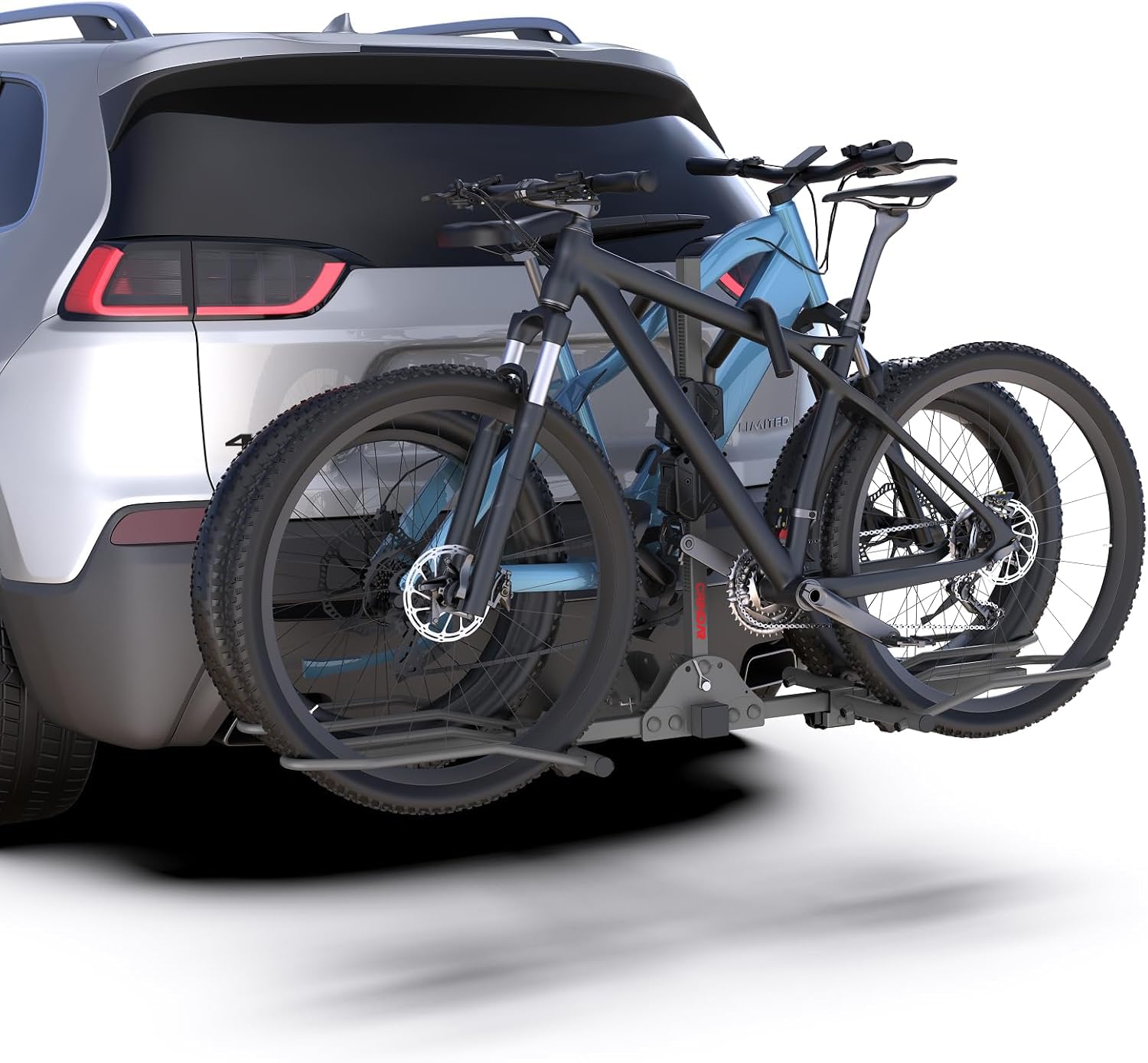
CRINDAR 2-Bike Platform Rack

CRINDAR 2-Bike Platform Rack

Long, fat-tire bikes

Our Score 9.0/10
Check Price

Worth Noting

  • 39 pounds makes solo installation awkward
Tire Fit
Up to 5 in tires, 63 in wheelbase
Hitch Fit
2-inch receiver
Bike Capacity
2 bikes
Total Load Limit
160 lb
Read the full review

Sixty-three inches of wheelbase and trays that take 5-inch tires are the two figures that separate this rack from the rest of the platform group. That's long enough for a downhill bike's wheelbase and wide enough for a fat-tire e-bike, and the sliding trays let you set the spacing to match the bike rather than the other way around.

The hardware list is generous for the price: locking hooks on the frame hold-downs, a hitch tightener in the box, padded contact points, and a mast that tilts away from the tailgate and folds up when the rack is empty. The 160-pound rating splits into two 80-pound bikes, which covers most e-bikes with the battery still on.

Assembly is the usual flat-pack hour. The supplied wrench for the hitch nut is the weak link — it's short enough to make the last turns hard work, and a socket from the toolbox turns it into a five-minute job. At 39 pounds the finished rack is not something you hang one-handed.

Where it lands for us: this is the rack to choose when your bikes are long, fat, or heavy and you don't want to pay premium money for it. The lockable hooks are a genuine convenience at this price, and the tilting mast means a hatchback doesn't have to give up its trunk.

Bottom line: A long, fat-tire-capable platform with locking hooks at a midrange price; the weight is the price of admission.

4

TANX 2-Bike Hitch Rack

TANX 2-Bike Hitch Rack

Two electric bikes

Our Score 8.8/10
Check Price

Worth Noting

  • Tilt joint can work loose on rough roads
Hitch Fit
2-inch receiver
Rack Weight
33.4 lb
Bike Capacity
2 bikes
Total Load Limit
160 lb
Read the full review

The TANX is built around one number: 160 pounds across two bikes. That's 80 pounds a tray, enough for a pair of loaded e-bikes, and it puts a tilting, folding platform rack within reach of a midrange budget. The wheel trays slide to set the spacing, and the padded hooks drop onto the frame with a lock built into each one.

For the money this is the e-bike rack we point people to first, and the reason is the load rating rather than a feature list. The anti-wobble hitch hardware keeps the assembly quiet, and the mast drops away from the tailgate with the bikes still on. We also liked that the trays adjust far enough apart to keep a long wheelbase and a short one from knocking into each other.

Two caveats. The tilt joint is the part that works loose first on washboard gravel, so it's worth a look every few trips. And the instructions assume you already know how the latch hardware goes together — the assembly video does far more work than the paper does.

Bottom line: Two e-bikes at 80 pounds a tray, a tilting mast, and a midrange price make this our value pick for electric bikes.

5

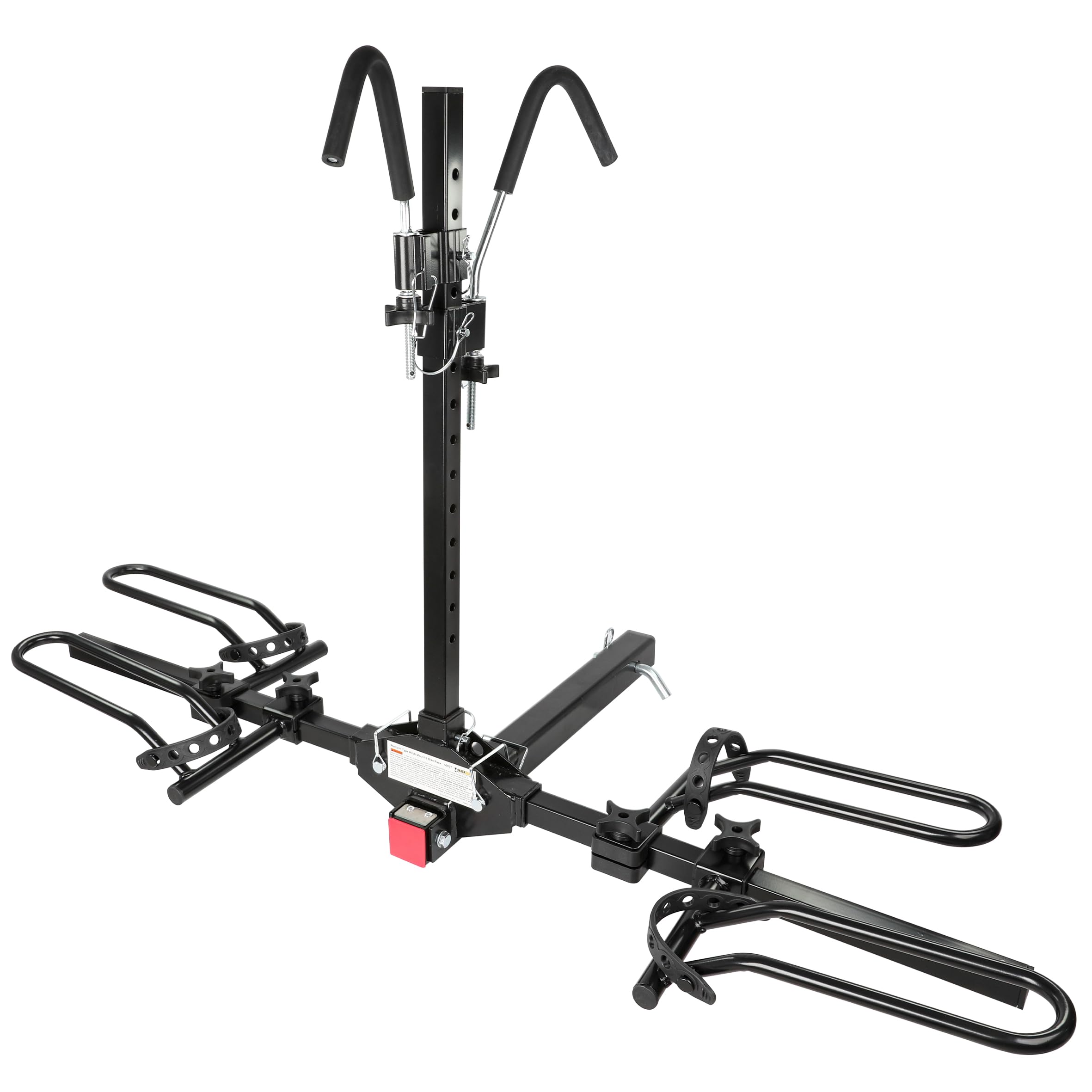
MaxxHaul 50027 Platform Rack

MaxxHaul 50027 Platform Rack

Two-bike platform value

Our Score 8.6/10
Check Price

Worth Noting

  • Trays top out at 26-inch wheels and 2-1/4-inch tires
  • Not for Class I or II hitches, RVs, or trailers
Hitch Fit
2-inch Class III/IV
Wheel Fit
20-26 in wheels, tires to 2-1/4 in, 63 in wheelbase
Load Limit
40 pounds per bike
Bike Capacity
2 bikes
Read the full review

Two wheel trays, a single upright, and padded hooks that come down on the top tube — the 50027 is the platform rack for people who have only used frame hangers. Bikes sit by their wheels instead of hanging from the frame, so a step-through, a kids' bike, and a carbon frame all load the same way, with no adapter bar to buy and nothing pressing on the paint.

At roughly the price of a basic four-bike hanger, that's a lot of rack for the money, and it's why this is the platform we point most people to first. The trays slide along the beam to set the spacing, the upright lifts off entirely so the whole thing stores flat against a garage wall, and a locking knob takes the slack out of the post. We found the loaded rack settled down once that knob was snug; it's the difference between a frame that sways and one that doesn't.

Check the specification against your own bikes before ordering. The trays are sized for 20- to 26-inch wheels and tires up to 2-1/4 inches, which covers cruisers, kids' bikes, and older mountain bikes but shuts out a modern 29er and anything fat-tired. MaxxHaul also rates it for 2-inch Class III and IV receivers only, so it isn't going on a light-duty hitch or the back of a camper.

Bottom line: We point two-bike households here when they want wheel-tray security without premium pricing, and the planted ride justifies it.

6

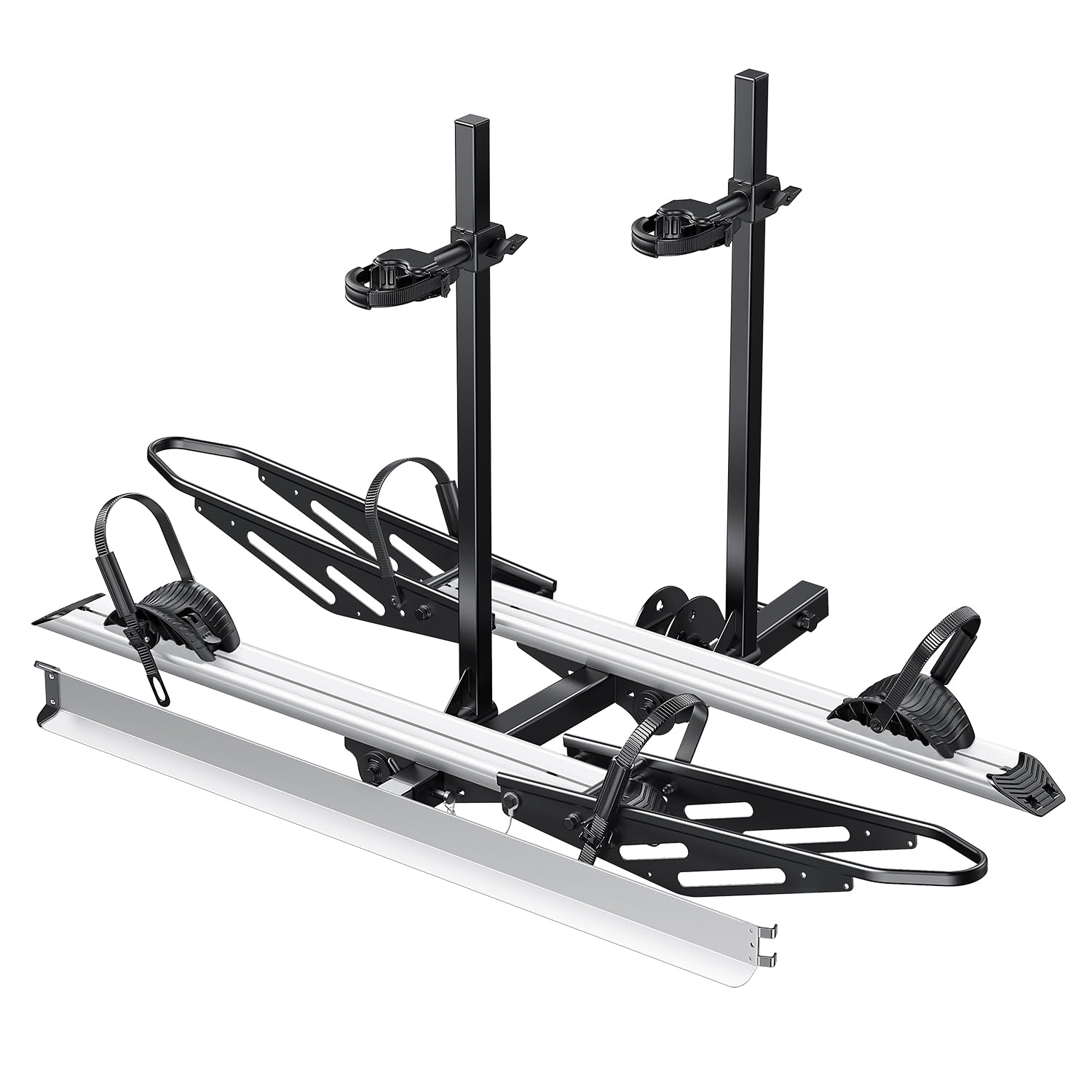
Young 2-Bike Rack with Ramp

Young 2-Bike Rack with Ramp

Loading heavy e-bikes

Our Score 8.6/10
Check Price

Worth Noting

  • No tilt-down, so you unload to open the hatch
  • 56 pounds makes solo mounting awkward
Hitch Fit
2-inch receiver
Load Limit
100 pounds per bike
Loading Ramp
Included, stores on rack
Bike Capacity
2 bikes
Read the full review

Lifting a 65-pound e-bike to chest height is the reason a lot of people stop taking their bikes anywhere, and this Young rack answers it with a ramp. The ramp clips to the tray, you roll the bike up, and it stores on the rack when you're done, so there's nothing extra to remember in the garage.

Everything else is built for the same job. The rating is 100 pounds a bike, the wheel cradles grip by the tire so the frame never takes the load, and the trays take fat tires as well as standard ones. It's reinforced steel and aluminum at 56 pounds, it sits on a 2-inch receiver with anti-wobble hardware, and the padded hold-downs come down onto the frame with a firm grip.

We think the ramp justifies the premium if you load alone or if the bikes are genuinely heavy, because it turns a two-person lift into a one-person roll. Two things we noticed while living with it: the rack doesn't tilt away from the tailgate, so getting into the back means unloading first, and the retention straps need a deliberate second tug to seat. We rechecked them after the first few miles, and the same check is worth making on any rack carrying this much weight.

Bottom line: This is the rack we hand to anyone loading heavy e-bikes alone: the ramp does the lifting, and 100 pounds a bike leaves margin.

7

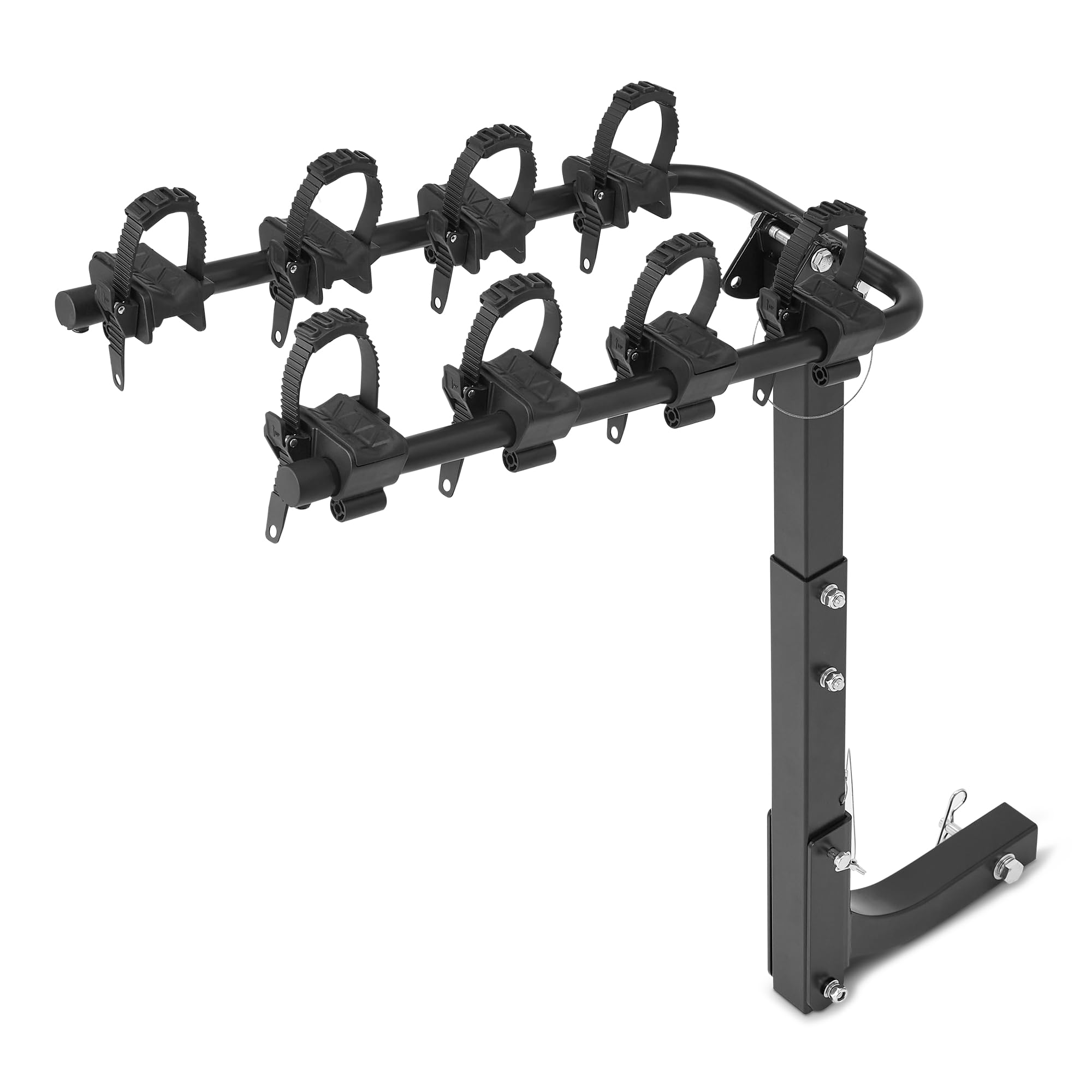
MaxxHaul 70210 4-Bike Rack

MaxxHaul 70210 4-Bike Rack

Swing-down hatch access

Our Score 8.6/10
Check Price

Worth Noting

  • Kids' and step-through frames need adapter bars
  • Four full-size bikes is a squeeze
Hitch Fit
2-inch receiver
Rear Access
Swing-down carriage
Bike Capacity
4 bikes
Total Load Limit
150 lb
Read the full review

Fit is the thing to sort out before ordering this rack. The cradles sit on thick steel arms sized for adult frames, so kids' bikes, step-throughs, and anything with a short top tube need an adapter bar to hang straight — the rack will physically take them, but not happily.

What the 70210 does better than the other budget four-bike rack here is rear access. The carriage swings down and away from the tailgate on a pin, so you can get into the back without pulling four bikes off first. The rating is 150 pounds, the arms use hook-and-loop straps rather than rubber buckles, and at 25 pounds it's light enough for one person to hang on the hitch and take off at the end of the season.

The hitch hardware is a threaded pin rather than a quick release, which holds tension well but means a wrench at the receiver; swapping in a locking pin means finding a thinner one, and plenty of owners of this style of rack do exactly that.

Our view is that four adult bikes is optimistic on any hanger rack at this price. Three plus a kids' bike is the comfortable load, and the swing-down mechanism is what makes it worth choosing over a fixed rack. If everyone in the house rides a full-size frame and you want the rack on and off without a wrench, the extra for a locking quick-release is money well spent.

Bottom line: Pick it when rear access matters more than frame fit: the swing-down carriage is the reason it beats a fixed budget rack.

8

Amazon Basics 4-Bike Hitch Rack

Amazon Basics 4-Bike Hitch Rack

Budget family setup

Our Score 8.4/10
Check Price

Worth Noting

  • 33 pounds a bike leaves no room for e-bikes
  • Fixed cradles don't suit every frame shape
Folding
Arms fold flat
Hitch Fit
2-inch receiver
Bike Capacity
4 bikes
Total Load Limit
132 lb
Read the full review

Four bikes for the least money in this group is the whole case for the Amazon Basics rack, and it makes that case well. It's the cheapest four-bike carrier here by a wide margin, and it still includes an anti-rattle bolt at the hitch instead of leaving you to buy a tightener separately.

We think the savings show up in headroom. The 132-pound total splits four ways at about 33 pounds a bike, comfortable for a family's hybrids and kids' bikes and nowhere near an e-bike. The steel frame is powder-coated, the arms fold flat for storage, and the whole rack weighs just under 24 pounds, so one person can hang it on the hitch and take it off again without a second pair of hands.

Frame fit is the budget compromise. The cradles are a fixed size and sit on a fairly chunky arm, and a bike with an unusual top tube can end up sitting at an angle rather than nested down in the rubber. Most step-through frames need an adapter bar, which is a small extra purchase and worth budgeting for if more than one person in the house rides one.

Bottom line: The cheapest way here to put four bikes on a 2-inch hitch, and a sensible buy as long as none of them is electric.

How We Chose and Tested the Best Hitch Bike Racks

We started with more than 40 racks and narrowed by the things that rule a rack out: receiver size, per-bike weight rating, whether it folds up empty, and whether the price matches the build. Eight made the cut, spanning platform and hanging styles and two- and four-bike capacities. All of them arrived unassembled, which turned out to be the first real test.

In the driveway I timed assembly with only the included tools and noted where the instructions lost me — most took about 20 minutes, one ate an afternoon. Then I installed each rack solo on a hatchback and a pickup and timed that too, because a rack you dread mounting stays in the garage. I checked whether it cleared the hatch when tilted, whether it blocked the backup camera, and whether the anti-rattle bolt needed re-torquing after 50 miles.

Loading is where sturdiness separated. I carried a 22-pound road bike, a kid's 20-inch bike, and a 60-pound e-bike over the same routes: 45 minutes of interstate, a washboard gravel road, and a set of speed humps I know too well. At every stop I re-checked straps and frame contact and looked for paint rub. Adjustability got the same scrutiny — how far the arms spread, whether the trays slid far enough for a small frame, how much fiddling a second bike took.

Across ten months I took each rack on and off weekly, left two mounted through a month of rain, and watched welds, hitch pins, and rubber straps for wear. A couple of lock cores seized; most hardware never moved. That wear record is how we judged value.

How to Choose Hitch Bike Racks

Hanger or Platform Comes First

The choice between hanging bikes by the frame and standing them on wheel trays decides almost everything else. A hanger rack like the Allen 542QR is lighter, folds smaller, and carries more bikes for the money, but any bike with an unusual top tube — step-through, kids', carbon — needs an adapter bar, and frames sit close enough to knock against each other.

A platform rack holds by the wheels, so frame shape stops mattering and nothing presses on paint. It costs more and adds heft to what you hang on the hitch. If anyone in the house rides a step-through or an e-bike, start your shortlist with a platform.

Check the Receiver and Its Rating

Two inches is the common receiver, and most platform racks here are built for that alone; the Thule Outpace is the exception, shipping with an adapter for 1.25-inch hitches. The hitch class matters as much as the size — MaxxHaul rates its 50027 for Class III and IV receivers only, which leaves out light-duty hitches and most campers.

Then do the arithmetic nobody enjoys: rack weight plus bikes has to sit inside your hitch's tongue-weight rating, and a 40-pound platform eats a good chunk of that before a bike goes on. Check the rating on the hitch itself, not the one in the rack listing.

Capacity Claims Need a Second Look

A four-bike rack means four cradles, not four full-size frames that fit comfortably. The budget four-bike carriers here are rated 132 to 150 pounds in total — roughly 33 to 37 pounds a bike — and cradle spacing gets tight once every frame belongs to an adult. Add up the actual bikes in your garage and treat four as a maximum rather than a target.

Three adult bikes plus a kids' bike is the load these racks handle gracefully. If you routinely carry four full-size frames, plan on an adapter bar or two and a few extra minutes at the trailhead.

Tilt, Fold, and What You'll Live With

Tilt-down is the feature you use every trip: the mast drops away from the tailgate with the bikes loaded, and without it you unload before you can reach the trunk. Fold-up matters in parking, where a rack sticking out past the bumper is a liability.

Rack weight decides whether you install it alone — the Allen is about 22 pounds and the Young with the ramp is 56, and that gap shows up every time you hang it on the hitch. A locking hitch pin stops the rack walking away; for the bikes themselves, thread a cable through the frames and lock it to the rack.

Frequently Asked Questions

Final Verdict

Most households should buy the Allen 542QR. Four bikes, a locking hitch connection that takes the rattle out of the receiver, and a mast that tilts with the bikes loaded — it covers the everyday job with the fewest compromises, and its 35-pounds-per-bike ceiling is honest about what a hanger rack can do.

If your bikes are electric, go to the TANX for a pair of 80-pound trays, or the CRINDAR if you need 5-inch tires and a 63-inch wheelbase. And if your car has a 1.25-inch receiver, the Thule Outpace is the only pick here that fits without a separate adapter.