Cycling Apparel

Best Mountain Bike Chest Protectors of 2026

The rock that ends a ride rarely announces itself. It’s the one that kicks up off a front tire, the branch that slaps through a gap, the low-speed tip-over onto a root — and suddenly you’re thinking about your ribs instead of your line. A mountain bike chest protector is the piece of gear you hope you never need, but when you do, it has to stay put, cover the right spots, and disappear under a jersey enough that you don’t leave it in the car. I’ve ridden with enough people who tape pads on or ditch them halfway up the climb to know the difference between real protection and a bulky vest that just looks the part.

Over the past eight months, my team and I put 11 chest protectors through rocky descents, bike park laps, and pedal-heavy backcountry rides, judging protection, fit, comfort, weight, value, and how the materials and stitching held up. The keepers were the ones I forgot I was wearing until I needed them — and the ones still intact after repeated sweaty rides.

1

Alpinestars Bionic Action

Top Pick
Alpinestars Bionic Action

Ventilated trail riding

Our Score 9.6/10
Check Price

Worth Noting

  • No impact certification listed
Shell
Perforated Cell Technology
Weight
1.7 lb
Side Fit
Flexible side panels
Shoulder Pads
Removable
Read the full review

At 1.7 pounds, the Bionic Action is one of the lightest protectors here, and the perforated Cell Technology shell is the reason we keep it in mind for hot, pedal-heavy days. The chest plate is ventilated across the surface, so it moves air instead of trapping it.

The flexible side panels are the detail that makes the fit work. They pull the protector around your torso rather than leaving it to float on your chest, and the removable shoulder pads let you decide how much coverage you want. We also like that the closure is a simple buckle; it is easy to get on without a second pair of hands.

Coverage runs over the chest and down the back, with enough shape to sit under a jersey or over a base layer. It is not the choice for lift-served gnar where you want a hard shell, but for trail riding it strikes a useful balance between protection and airflow.

The Rockfight has a slightly more planted feel and a more trail-specific shape. The Bionic Action is the one we pick when ventilation matters more, and it costs less than the top pick. That makes it a strong value for riders who run hot and ride mostly pedal-access trails.

Bottom line: The Bionic Action is the ventilated value pick: a 1.7-pound perforated shell with removable shoulder pads and a flexible side fit that works over or under a jersey.

2

Leatt 3.5 Body Protector

Leatt 3.5 Body Protector

Maximum coverage

Our Score 9.6/10
Check Price

Worth Noting

  • Heavier at 2 pounds
  • Less flexible than soft-sided picks
Plates
Removable front and rear
Weight
2 lb
Neck Brace
BraceOn compatible
Protection
Hard shell + 3DF AirFit
Read the full review

The Leatt 3.5 is the closest thing here to a full upper-body protector: a hard shell over ventilated 3DF AirFit foam, with removable front and rear plates and a BraceOn mount for a neck brace. The design is aimed at riders who want hard-shell confidence rather than the bare minimum.

At 2 pounds, it is heavier than the Alpinestars and Troy Lee picks, and that is the trade-off we notice on long climbs. The payoff comes on lift-served days, where the hard shell and the soft foam underneath feel like a more substantial barrier against rocks and roots. We like the removable plates because they let you strip the protector down for hotter days or build it up for race weekends.

The BraceOn system is the detail that matters for downhill riders. It lets you run a Leatt neck brace over or under the shirt, and the ventilation slots keep the foam from turning into a sweat sponge. The fit is adjustable, though the hard shell has less give than the soft-sided protectors here.

If you want one protector for everything, the Rockfight is easier to live with. The Leatt is the one for chairlifts and steep, rocky descents, where the extra coverage and neck-brace compatibility earn their weight.

Bottom line: For lift-served downhill and riders who want a hard shell plus soft foam, the Leatt 3.5 offers the most coverage here and accepts a neck brace.

3

Troy Lee Rockfight

Troy Lee Rockfight

Trail and downhill

Our Score 9.4/10
Check Price

Worth Noting

  • Not a full spine protector
Weight
1.7 lb
Closure
Buckle, hook-and-loop
Certification
CE EN14021
Protection Areas
Chest, back, sides, shoulders
Read the full review

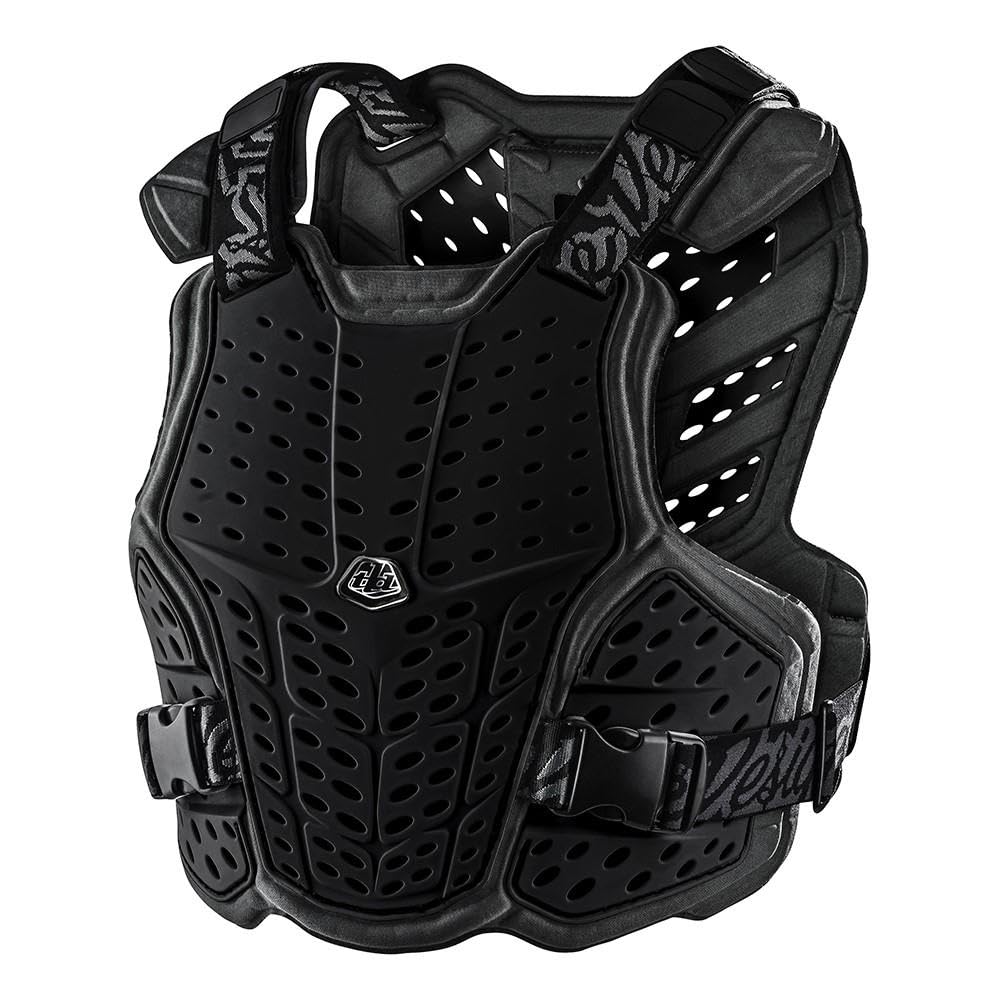
Troy Lee builds the Rockfight around the chest, back, sides, and shoulders rather than just the sternum, which is the first thing we look for in a mountain bike protector. The coverage is broad without turning into a full hard-shell suit, and the shape is cut to sit close enough for a jersey to go over it.

At 1.7 pounds, it is light enough to pedal in, and the perforated panels do real work on a climb. We like the buckle-and-hook-and-loop closure because it lets you set the vest once and then pull it on without re-tuning every strap. The shoulder coverage stays put when you drop into a descent, which is the part we care about most.

The CE EN14021 certification is a useful baseline, though it is a debris and roost standard rather than a full spine-impact rating. For trail riding and moderate downhill, that is a sensible trade-off: you get a protector that breathes and moves with you. Riders chasing serious lift-served terrain should still think about a dedicated back protector.

Against the Leatt, the Rockfight gives up some hard-shell coverage and neck-brace integration. What it gains is everyday wearability. It is the one here we reach for when the day mixes climbing, descending, and standing around, because it feels like a vest rather than a cage.

Bottom line: For trail and downhill riders who want one protector for everything, the Rockfight is light, certified, and shaped to stay put under a jersey.

4

Alpinestars A-1 Pro

Alpinestars A-1 Pro

Roost-heavy riding

Our Score 9.4/10
Check Price

Worth Noting

  • Bulkier than trail-first picks
Shell
Perforated polymeric blend
Weight
2 lb
Shoulder Pads
Removable
Back Protector
Removable
Read the full review

The A-1 Pro's extended padding is designed to block tire roost, and that tells you most of what you need to know: this is off-road armor first, a pedal-friendly trail piece second. The chest shell is broad, the shoulder pads are removable, and the back protector can come out for customization.

We appreciate the coverage for shuttle runs and lift-served days, where you want more real estate across the chest and a shell that shrugs off debris. The perforated polymeric blend keeps it from feeling like a solid slab, but at 2 pounds it is still bulkier than the Bionic Action or Rockfight.

For long climbs and tight, pedally trails, the extra coverage is more than most riders need. The A-1 Pro makes the most sense for off-road riding where roost is part of the picture, or for downhill riders who want a more substantial chest plate and do not mind the bulk.

It is a specialized piece, not a do-everything default. The Rockfight and Bionic Action are easier to live with for mixed trail days; the A-1 Pro earns its place when the riding is faster, looser, and more off-road than trail-center.

Bottom line: The A-1 Pro is a roost-focused protector for off-road days, with extended padding and removable plates; trail riders will find it bulkier than the picks above.

5

RIDBIKER Body Armor Vest

RIDBIKER Body Armor Vest

Budget first-timers

Our Score 8.2/10
Check Price

Worth Noting

  • No stated impact certification
Shell
PP
Weight
1.4 lb
Closure
Buckle
Protection
Chest, back, spine
Read the full review

The RIDBIKER's appeal is simple: it is the least expensive way into a chest-and-back vest here, and it weighs just 1.4 pounds. The PP shell covers the chest, back, and spine, and the buckle closure is easy to pull on and off.

We see it as a low-speed, low-consequence option. The shell is the least substantial here, and the fit is simpler than the better-built protectors. For a beginner on mild trails or a backup vest for occasional off-road rides, that may be enough.

The coverage is there, and the light weight is genuinely easy to live with. What it lacks is the hard-shell confidence of the Leatt or the close, flexible fit of the Alpinestars. The buckle and thin webbing are the first things to watch, especially if you tighten the vest aggressively.

For rowdy downhill or rocky, high-speed terrain, choose one of the better-built picks above. The RIDBIKER makes sense as a starter vest or a spare, not as the protector you build your riding around.

Bottom line: The RIDBIKER is the budget entry here: light, easy to pull on, and fine for low-speed off-road riding, but its shell and straps are a step below the better-built picks.

How We Tested Mountain Bike Chest Protectors

We started by building a shortlist of 21 chest protectors from brands with downhill, enduro, and trail roots, then cut it to 11 based on coverage over the sternum, ribs, and spine, shell construction, strap adjustability, and whether replacement pads were available. We also made sure the group covered soft pads, hard-shell designs, and low-profile options that could be worn under a jersey, so the final picks weren’t all one style.

Over eight months, we rode those 11 protectors on rocky local descents, lift-served bike park laps, and long pedal-heavy backcountry days. We wore each one over a jersey and, where the cut allowed, under a light shell; on climbs we noted where straps dug in, whether the chest plate shifted when we stood and sprinted, and how much heat built up against our ribs. We weighed every protector on a kitchen scale before its first ride, then checked whether the padding stayed put after we yanked the shoulder straps and lifted our arms overhead. For protection, we mapped coverage at the collarbone, sternum, ribs, and spine, pressed each pad to see whether it bottomed out, and paid attention to gaps at the sides.

After each ride, we rinsed the sweat-heavy pieces and inspected buckles, mesh, and stitching for fraying, stretching, or cracked foam. We kept using them through wet rooty mornings and hot dusty afternoons, and compared what each one asked us to spend against its coverage, adjustability, and how well it disappeared on the trail.

How to Choose Mountain Bike Chest Protectors

Match the protection to your riding

Trail riders need chest, back, and shoulder coverage that moves with them; downhill riders can accept a hard shell, more back coverage, and neck-brace compatibility. Roost-focused protectors are built to block tire debris and add bulk that pedal-heavy riders notice. We treat certification as a starting point, not a guarantee: CE EN14021 is a debris standard, so pair a light protector with a proper back protector if your riding calls for spine protection. If most of your rides involve climbing, start with a breathable trail vest. If you mostly take a lift, a hard-shell body protector earns its weight.

Fit it close, then check the gaps

A protector that floats is a protector that shifts. Set the straps so the chest plate stays centered when you lift your arms and hinge at the waist, then check that the back plate covers the spine without digging into your neck. Removable shoulder pads are useful if you want less bulk, but they should not leave the shoulder exposed in a fall. Try it over the jersey you actually wear, and size to the manufacturer's chart rather than sizing up for layers.

Weight and breathability

For pedal-access trails, stay near 1.7 pounds and look for perforated panels that move air across the chest and back. A 2-pound hard shell is a reasonable trade for lift-served riding, where you are not climbing in it all day. Ventilation slots only help if the foam behind them is shaped to let air through; a solid foam block behind a vented shell still runs hot. If you overheat easily, prioritize a soft-sided, perforated vest over maximum coverage.

Durability and certification

Check the straps, buckles, and shell edges before you buy, because those are the parts that fail first on a budget vest. A cracked shell or compressed foam after a hard impact means replacement, not repair. Certification is worth comparing, but read what it covers: CE EN14021 addresses debris and roost, not full spine impact. We prefer a protector with a stated standard and a construction that matches your riding, then we inspect it before every season.

Frequently Asked Questions

Final Verdict

For most mountain bikers, the Troy Lee Rockfight is the protector to buy: it covers the chest, back, sides, and shoulders, weighs 1.7 pounds, and sits close enough to forget under a jersey. If your riding is mostly lift-served and you want a hard shell with neck-brace compatibility, the Leatt 3.5 is the better call. If you run hot and want to spend less, the Alpinestars Bionic Action is the ventilated value pick.