Tires & Tubes

Best Puncture-Resistant Bike Tires of 2026

There's a particular sound a tire makes when it swallows glass — that soft tick-tick-tick that means twenty minutes on the shoulder with cold hands and a stubborn bead. A puncture-resistant tire won't make your bike faster or prettier, but it buys you a ride that ends at your destination instead of at the roadside. Over eight months, my team and I rode 12 sets of them across commutes, gravel, and wet winter roads to find the ones that hold up without turning the ride to stone.

What first-time buyers miss is that protection always costs something: a dense belt under the tread adds weight and rolling resistance, and the best tires hide that tradeoff so well you forget it's there. We judged each set on how it rolled on familiar roads, how it felt over chip seal, whether it seated without a fight, and what it cost per mile of tread life. Some picks lean toward speed, others toward surviving a winter of glass.

1

Continental Gatorskin

Top Pick
Continental Gatorskin

Road commuting

Our Score 9.4/10
Check Price

Worth Noting

  • Only one 700x25 width here
Bead
Folding
Pack
2 tires
Size
700x25
Puncture Protection
PolyX Breaker + DuraSkin
Read the full review

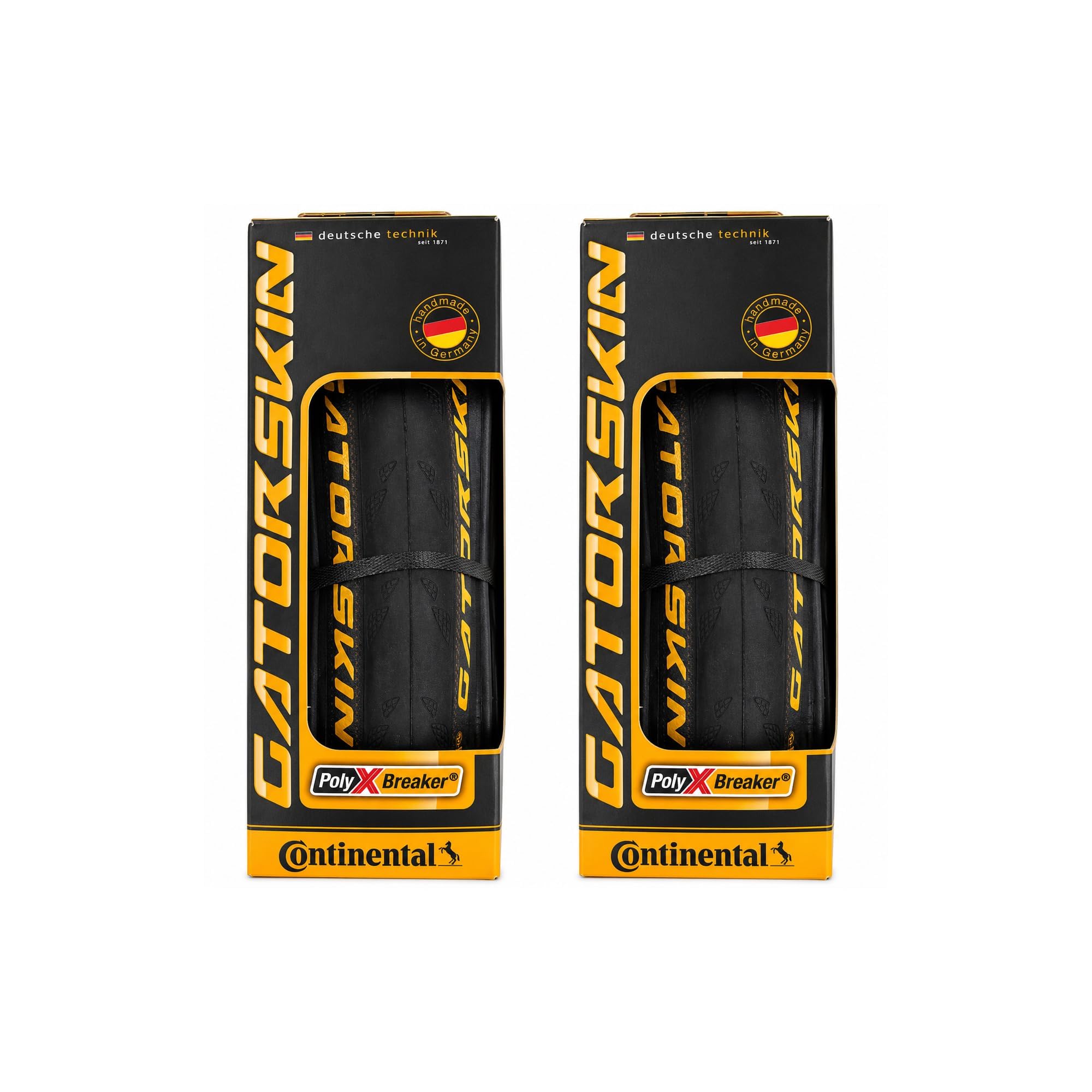
For a 700x25 road bike that doubles as a commuter, the Gatorskin is the tire we reach for first. The PolyX Breaker sits under the tread as a dense polyester shield, and DuraSkin adds a polyamide layer to the sidewall, which is the part that takes the worst of curb scuffs and chip-seal grit. The two-pack is practical, too: replacing both tires at once keeps the handling balanced, and a spare means a ruined rear does not end your week.

That sidewall layer is the detail that separates it from a tire with only a tread belt. Glass and thorns are one problem; a cut sidewall is another, and the Gatorskin is built with both in mind. It is still a clincher, so it needs a tube, and the folding bead can take some patience to seat. We do not mind that trade for a commuter that spends more time on pavement than in a race.

Where it stops is a deep sidewall slash or a sharp piece of metal that finds the gap between tread and rim. No tire in this group is immune, and the Gatorskin is not a magic carpet for glass-strewn bike lanes. What it does is stack the odds in your favor without turning the bike into a sluggish city tank. For riders who want one less flat to fix on the way to work, that is the right bargain.

Bottom line: For 700x25 road and commute duty, the Gatorskin is our first pick: PolyX tread protection, DuraSkin sidewalls, and a two-tire pack that keeps both ends matched.

2

Blackburn Mountain Tire

Blackburn Mountain Tire

Budget trail

Our Score 9.4/10
Check Price

Worth Noting

  • 26-inch fit only
Bead
Carbon steel
Size
26 x 1.75–2.25
Pressure
35–65 psi
Puncture Protection
30% stronger layer
Read the full review

The Blackburn Mountain tire is a budget replacement for a 26-inch mountain bike, and the 1.75 to 2.25-inch fit covers a useful range of older hardtails and kids' MTBs. A protective layer under the tread adds strength without turning it into a dedicated downhill casing, and the tall knobs are shaped for dirt, roots, and loose-over-hard trail.

The carbon steel bead is a detail worth knowing: the design is listed as foldable and unfoldable without damage, which makes shipping and storage easier. That does not make it a folding trail-side spare, though; this is still a wire-bead tire. We like the broad size coverage for a garage bike that sees mixed use, and the 35 to 65 psi range gives you room to soften the ride on roots.

We think this is the right choice when the trail is more important than the commute. The knobby tread is slow and noisy on pavement, so a rider who mostly rides bike paths should choose the Bell or a semi-slick instead. For dirt duty on a tight budget, the Blackburn gives you traction and a protective layer without asking you to baby the bike.

Bottom line: If you keep a 26-inch mountain bike going on a tight budget and ride dirt more than pavement, the Blackburn is our value pick.

3

Fincci 700x32 City Tire

Fincci 700x32 City Tire

City and path

Our Score 9.2/10
Check Price

Worth Noting

  • Sold only as a pair
Bead
Kevlar folding
Size
700x32c
Weight
450 g each
Puncture Protection
1 mm nylon belt
Read the full review

The 700x32c size is the reason this Fincci pair earns a place. That width has enough air volume to take the edge off potholes and curb transitions without feeling like a balloon tire on a city bike. The tread is grooved rather than slick, so it handles pavement and light path duty, and the 1 mm nylon belt sits under the tread to take the sting out of glass and grit.

We like this pair for a commuter that sees broken asphalt, bike-path debris, and the occasional unpaved cut-through. The Kevlar folding bead makes storage and roadside swapping easier, and two tires in one box means you can refresh the rear and keep the front matched. The 30 TPI casing is the number to notice: it is built for toughness and price, not a supple, race-day feel, and that is the right call for a tire in this role.

Installation should be straightforward on most 700c rims, but 32c is wider than a 25, so check frame and fender clearance before ordering. The anti-puncture layer is a single belt, so a deep sidewall cut is still a risk. For city miles, though, this is a sensible balance of protection, width, and cost per tire.

Bottom line: If your bike takes 700x32 and your riding is mostly pavement and light path, this Fincci pair is the practical city choice.

4

Schwinn Knobby 20-Inch

Schwinn Knobby 20-Inch

Kids and BMX

Our Score 9.2/10
Check Price

Worth Noting

  • Tread-only guard leaves sidewalls exposed
  • Sold as a single tire
Bead
Steel
Size
20 x 2.125
Pressure
30–40 psi
Puncture Protection
Puncture guard
Read the full review

A 20-inch wheel usually means a kids' bike or a BMX, and that is exactly where this Schwinn knobby makes sense. The 20 x 2.125 size gives a small wheel a useful cushion, and the puncture guard adds a layer under the tread where glass, goatheads, and curb debris do their damage. The low-profile knobs give it enough bite for dry dirt without turning it into a park-only tire.

The steel bead and 30 to 40 psi range tell you this is a sturdy, lower-pressure tire rather than a race-day flyweight. On a neighborhood bike, that is fine: the wider footprint gives a kid confidence on pavement and dry trail, and the tire is easy to check at a glance. We also like that it keeps the BMX look without asking for a specialist mechanic.

We think this is the right replacement when the goal is fewer flat repairs on a bike that gets ridden hard and put away wet. The 2.125 width is generous, so check frame and fender clearance before ordering; a 20-inch wheel can still have a narrow frame. For the job, it is a sturdy, sensible refresh for a kids' bike or BMX.

Bottom line: For a 20-inch kids' bike or BMX that keeps collecting glass and goatheads, this Schwinn is the sturdy, simple replacement.

5

Bell Flat Defense Comfort

Bell Flat Defense Comfort

Comfort hybrids

Our Score 9.2/10
Check Price

Worth Noting

  • Sidewalls can wear before the tread
  • Sold as a single tire
Bead
Carbon steel
Size
26 x 1.75–2.25
Tread
Smooth
Puncture Protection
Flat Defense layer
Read the full review

The Bell Flat Defense is the tire we point to for a 26-inch comfort or hybrid bike that spends nearly all its time on pavement. The smooth, rolling tread is quiet and efficient, and the Flat Defense layer adds a barrier inside the casing where road debris is most likely to reach the tube. It is a practical replacement rather than a performance upgrade, and that is exactly the job for an around-town bike.

The 1.75 to 2.25-inch size range is broad, which is convenient, but it is also the part to check carefully. A 26 x 1.75 bike sits at the narrow end of that range, and the tire can look or sit wider than the original; if your frame and fenders are tight, measure before ordering. We like the smooth tread for asphalt and packed paths, and the carbon steel bead keeps the tire seated without fuss.

This is a tire for cracked pavement, rail trails, and the ride to the store, not for mud or loose gravel. The payoff is a comfortable, stable ride and a tread that rolls without a knobby hum. We think it is a smart buy for a cruiser, comfort bike, or hybrid that needs a durable replacement and a little extra insurance against flats.

Bottom line: For a 26-inch comfort or hybrid bike that stays on pavement, Bell's Flat Defense tire is an easy, smooth-rolling replacement.

6

Schwalbe Green Marathon

Schwalbe Green Marathon

Small-wheel bikes

Our Score 9.2/10
Check Price

Worth Noting

  • Wired bead adds weight
  • Sold as a single tire
Bead
Wired
Size
16 x 1.35
Weight
13.4 oz
Puncture Protection
GreenGuard
Read the full review

Small wheels are their own tire problem: a 16-inch folder, trailer, or trike can be just as vulnerable to glass as a full-size bike, but the tire choices are thinner. The Green Marathon brings Schwalbe's GreenGuard puncture protection to that size, with a wired bead and a tread that works on asphalt, gravel paths, and grass.

We like this one for the rider who wants a durable small-wheel tire and cares about materials. The Green Marathon is listed as made from 100% Fair Rubber and 80% recycled and renewable materials, which is a more concrete sustainability story than a green sidewall graphic. The 16 x 1.35 size is narrow, though, so it is not a substitute for the 26-inch version of the same name.

The wired bead and protective casing can make mounting fiddly on a tight rim, and the narrow profile is best for pavement and smooth paths rather than loose dirt. For a folder or a cargo trailer that lives in the city, those are reasonable trade-offs. The tire's real appeal is that it treats a small wheel like a real tire instead of an afterthought.

Bottom line: For a folder, trike, or trailer running 16-inch wheels, the Green Marathon brings real flat protection and a lighter environmental footprint.

7

WTB ThickSlick

WTB ThickSlick

Paved city miles

Our Score 9.2/10
Check Price

Worth Noting

  • 705 g is heavy
  • Only 29 x 2.1 in this listing
Bead
Wire
Size
29 x 2.1
Weight
1.55 lb
Puncture Protection
2x rubber casing
Read the full review

The ThickSlick is a different answer to city flats: instead of a thin breaker belt, WTB builds the casing with twice the rubber of a standard tire. That thick layer is designed to shrug off glass, pins, and staples, and the slick tread rolls quietly on concrete and asphalt. This exact variant is the no-Flat-Guard version, so the double rubber is the protection you get, not an extra casing layer.

On a 29-inch urban bike or a trainer, that thick casing feels planted and quiet. The slick profile is happiest on smooth pavement and packed paths, and the wire bead sits firmly on the rim. We like it most for steady street duty rather than a bike that changes surfaces every mile.

For indoor trainer use, the slick tread runs smoothly and avoids the rumble of a knobby tread. The wire bead also means this is a fit-and-forget tire, not one to fold into a saddlebag for a remote repair. It is a straightforward urban choice, not a multi-surface adventure tire.

We think the ThickSlick makes the most sense for a city bike, commuter, or indoor trainer that lives on pavement. If you want the extra Flat Guard layer, check the variant before ordering; this listing is the standard casing. For the right rider, the thick rubber is a simple, durable kind of flat insurance.

Bottom line: For paved city miles and indoor trainer duty on a 29-inch bike, the ThickSlick's double rubber casing is a quiet, tough choice.

8

Fincci 700x25 Road Tire

Fincci 700x25 Road Tire

Light road riding

Our Score 9.0/10
Check Price

Worth Noting

  • Sold only as a pair
Bead
Kevlar folding
Size
700x25c
Weight
280 g each
Puncture Protection
1 mm nylon belt
Read the full review

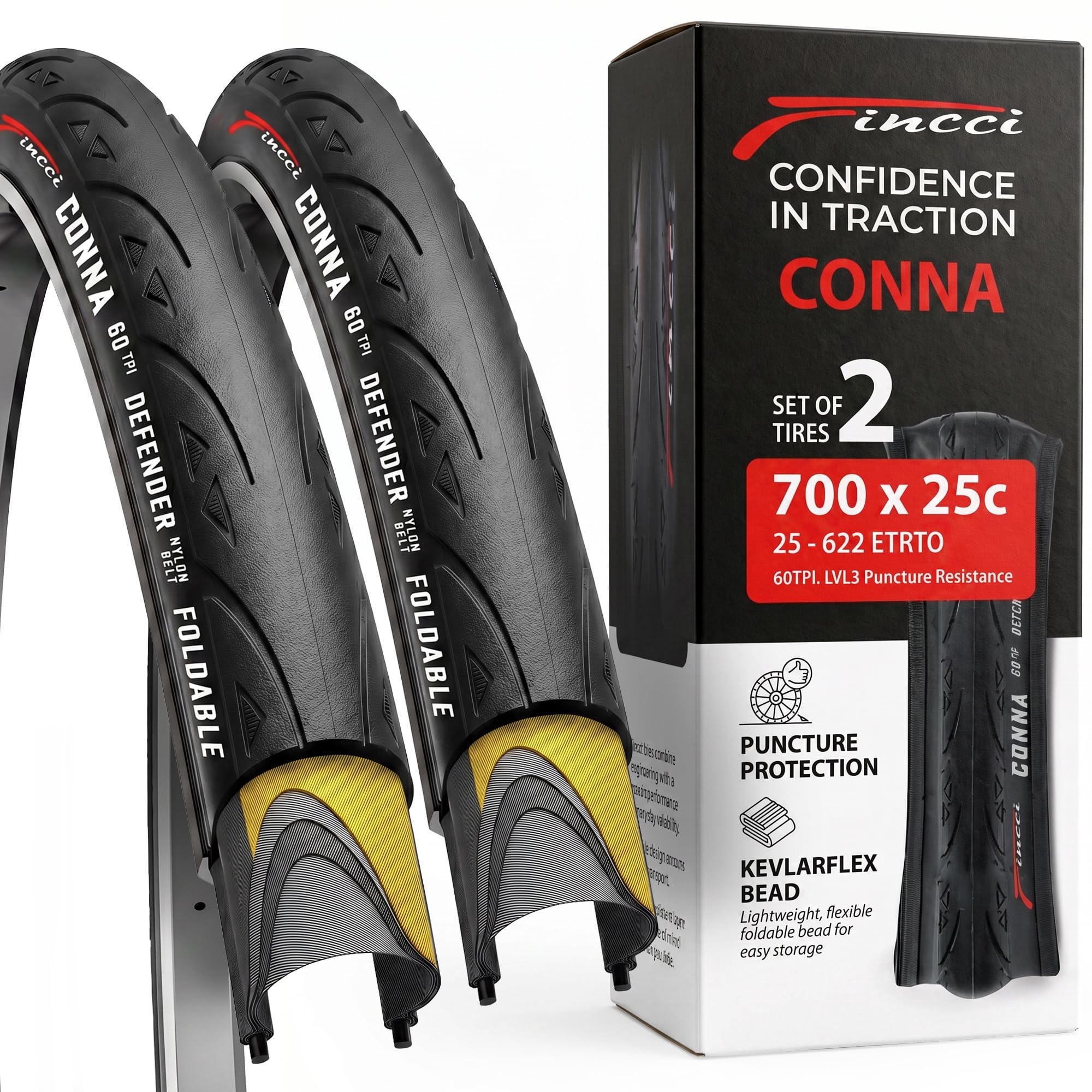
The Fincci 700x25c pair is the lighter, folding option in this group. Each tire is listed at 280 grams, with a 60 TPI casing and a Kevlar bead, so it packs down for storage or a spare. The 1 mm nylon anti-puncture layer is the flat protection, and the slick tread is aimed at asphalt rather than gravel.

On a road bike, that combination makes sense for a rider who wants a spare set without paying for race-day rubber. The tires are easy to fold and carry, and the slick profile rolls smoothly on good pavement. The 60 TPI casing is a middle-ground choice: it is not as supple as a high-thread-count race tire, but it is built for daily road miles rather than race-day snap.

The protection is a single tread belt, not a sidewall shield, so a sharp edge that catches the side of the tire can still end the ride. That is the main reason this is an also-consider rather than our top road pick. If your roads are reasonably clean and you want a light pair for a second wheelset or a commuter, it is a fair choice.

We think the Fincci is best for a road rider who values low weight and packability over maximum flat insurance. For a daily commute through glass-strewn streets, the Gatorskin's sidewall protection is worth the extra cost. For a fair-weather road bike, the Fincci pair is a useful, lighter alternative.

Bottom line: For a road rider who wants a light folding pair and accepts a simpler tread belt, the Fincci 700x25 is a fair-weather alternative.

How We Tested a Dozen Sets of Puncture-Resistant Tires

We started with roughly 40 models from brands known for commuter, touring, and gravel rubber, then filtered by what was actually available in common widths for 700c and 650b wheels, what each casing claimed for protection, and price. That left 12 sets, which went onto the same two bikes — a daily commuter and a loaded touring rig — for eight months.

Each set covered about 500 miles of the same loops: a commute along a shoulder littered with glass and truck debris, weekend gravel, and wet morning rides. Every flat got logged along with its cause. Every couple of weeks we walked each tire under a shop light, dug embedded glass and flint out with an awl, and noted how deep the cuts had traveled, then measured tread depth at the start and end to see how fast each one wore.

Mounting got its own session. We fitted each set by hand first, timed the job, and recorded whether we had to reach for levers and whether the bead seated with a floor pump or needed a compressor. Mounted width went under calipers too, since a tire that runs narrow can rub a frame or change how the bike corners.

On the road, we ran a coast-down test down the same half-mile hill with 25 pounds in the panniers, then compared that against how hard a familiar loop felt at the end of a long week. Ride quality we judged over chip seal and bridge expansion joints; stability by cornering and braking on wet painted lines at lower pressures. Value came last — what each set cost per mile before the tread gave out.

How to Choose Puncture-Resistant Bike Tires

Fit the Wheel and the Frame First

A 700c tire is not universal, and even a 26-inch label needs the ETRTO number and width checked against the rim. Read the sidewall or the rim, then look at frame and fender clearance: a 700x32 can feel plusher than a 700x25, but it can also rub where a narrower tire ran clean. The Fincci 700x32 and Continental Gatorskin show the two ends of that decision in this set.

Buy the exact variant, not the model family. Listings often gather several sizes under one title, and a 16-inch Green Marathon is not a substitute for a 26-inch one. If the size is not printed clearly, ask before ordering.

Match the Tread to Your Regular Ride

Slicks roll fastest on pavement; file treads and semi-slicks handle paths and light dirt; knobby tires trade speed for traction. A city commuter who never leaves asphalt gives up little with the WTB ThickSlick or Bell Flat Defense. A rider who cuts through gravel or roots should look at the Blackburn mountain tread or a semi-slick with shoulder knobs.

Tread is not the same as puncture protection. A slick can have a thick casing, and a knobby can have a thin one. Decide on the surface first, then check the protective layer.

Look at Where the Protection Sits

A breaker belt under the tread stops thorns and glass at the contact patch. A sidewall shield protects against curb scuffs and cuts, which is where many urban flats begin. The Gatorskin's DuraSkin layer is the clearest example in this group; the Fincci tires use a 1 mm nylon belt without the same sidewall coverage.

More protection usually means more weight and a stiffer ride. That is not a reason to avoid it; it is a reason to match the tire to the job. A commuter who rides through glass should accept some weight, while a fair-weather road rider can choose a lighter casing and watch the sidewalls.

Respect the Bead and the Pressure Range

Folding and wire beads both work; folding beads are easier to store and carry, while steel or wire beads can feel more planted at the rim. A stiff protective casing can make mounting harder, so give yourself time and use tire levers carefully. Inflate gradually and check that the bead line sits evenly above the rim before you ride.

Stay inside the pressure range on the sidewall. The Schwinn 20-inch tire runs 30 to 40 psi, the Blackburn 26-inch runs 35 to 65 psi, and a road tire will want more. Higher is not automatically safer; too much pressure can make a tire skittish and harsh.

Frequently Asked Questions

Final Verdict

Buy the Continental Gatorskin if your bike takes 700x25 and you want the strongest all-around flat insurance for road commuting. Its PolyX tread shield and DuraSkin sidewalls are the most complete protection package here, and the two-pack makes a front-and-rear refresh simple.

If your bike takes 700x32, the Fincci city pair gives you more volume and a city tread. For 26-inch dirt, the Blackburn is the budget trail choice; for a 29-inch pavement bike, the WTB ThickSlick is the quiet, thick-casing alternative.