Bike Racks & Transport

Best Roof Bike Racks of 2026

A bike on the roof at 70 mph is a promise you're making to every driver behind you, and the rearview check gets old fast. That low-grade dread — the wobble, the strap you meant to re-tighten, the clearance bar at the parking garage — is why so many roof racks get bought, used twice, and then left hanging in the garage. A good one holds a bike without marring the frame, loads in under a minute without a step stool rocking under your feet, and frees up the back of the car for everything else.

Over the past eight months I've lived with 12 roof racks bolted to the crossbars of three different cars, and driven them to trailheads, lumber yards, and one memorably tight parking structure. The pattern is clear: the rack matters less than the crossbars it clamps onto, and the mount that fits an old quick-release skewer usually won't take a thru-axle without a separate adapter. Keep that in mind before you fall for a sleek-looking tray. Below are the ones that earned a permanent spot up top.

1

Rhino Rack RBC050

Top Pick
Rhino Rack RBC050

All-around roof carrying

Our Score 9.2/10
Check Price

Worth Noting

  • Premium price for a single-bike rack
Locking
Three locking systems
Axle Fit
5mm, 9mm, 15mm, 20mm
Mounting
Universal roof bars
Load Capacity
45 lb
Read the full review

Three separate locking points and a 45-pound capacity are why the Rhino Rack RBC050 is our top pick. The rack locks to the crossbars, the bike locks to the rack, and a cable adds another layer, so the security comes with the rack instead of arriving as an extra purchase. We also like that the mounting hardware works with factory, round, square, elliptical, and Rhino aero bars; that breadth matters more than a long feature list when you are standing in the driveway with a bike over your head.

The ratcheting arm is the detail we kept coming back to. Its handle gives you something substantial to pull against while the front wheel settles into the tray, and the arm folds flat when the rack is empty. Loading a bike this way takes a little practice, but the hold feels direct: the front wheel is clamped, the tray supports the bike, and you are not balancing the whole load while you fiddle with a strap. The 45-pound rating also leaves room for a heavier mountain or commuter bike than many upright racks allow.

The trade-off is that this is still a roof rack: you lift the bike to roof height every time, and the rack is a serious piece of hardware to install. Neither is a flaw in the design, but both shape who should buy it. If you want one rack that covers a wide range of bikes, bars, and locking needs, the Rhino is the least compromised choice here. If your bike has a 9mm quick-release fork and you prefer a lower, simpler mount, the Yakima Forklift is the alternative.

Bottom line: The Rhino Rack RBC050 is our best overall roof rack because it combines a 45-pound capacity, three locking systems, and broad crossbar fit in one secure package.
2

Yakima Forklift

Yakima Forklift

Quick-release fork bikes

Our Score 9.0/10
Check Price

Worth Noting

  • Front wheel must be removed and stored
  • Thru-axle bikes need an adapter
Mounting
Fork mount
Front Hub
100mm x 9mm quick release
Load Capacity
35 lb
Crossbar Range
16 to 42 inches
Read the full review

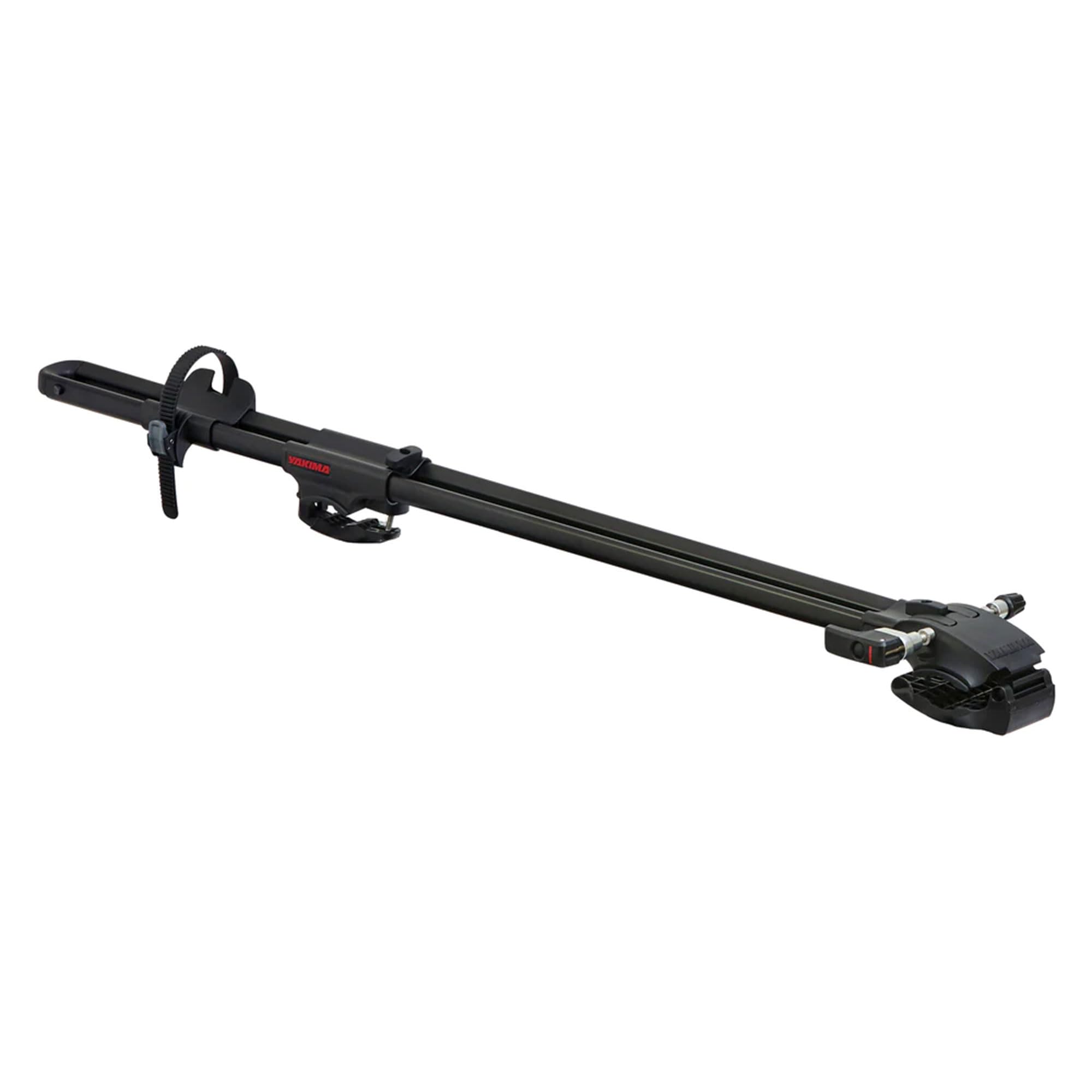
The Forklift is a fork mount, which means the front wheel comes off and the bike's fork bolts directly to the rack. A sliding wheel tray then supports the rear wheel, and the tray adjusts to fit a wide range of bike lengths. The rack clamps to Yakima round, square, factory, and aerodynamic bars, and it installs and removes without tools.

We recommend the Forklift for riders with a standard 100mm x 9mm quick-release front hub who do not mind stowing the front wheel. The hold is direct and easy to read: the fork skewer anchors the bike, the tray keeps the rear wheel straight, and there is no frame clamp to tighten or pad. We appreciated the no-tools mounting because it makes moving the rack between cars less of a project. Thru-axle bikes need an adapter, so check your hub before you commit.

The direct hold is what makes the Forklift worth considering. The fork skewer anchors the bike, the tray keeps the rear wheel straight, and there is no frame clamp to pad or tighten. If you want to keep both wheels on, look at the Rhino or the Thule UpRide instead; if you have a quick-release fork and want a proven fork mount, this is the one we point to.

Bottom line: If your bike has a 9mm quick-release front hub, the Yakima Forklift is a secure, simple fork mount with a sliding tray and tool-free bar mounting.

3

Thule UpRide

Thule UpRide

Carbon frames

Our Score 8.8/10
Check Price

Worth Noting

  • Locks sold separately
Wheel Fit
20 to 29 inches
Tire Width
Up to 3 inches
Frame Contact
None
Load Capacity
40 lb
Read the full review

The UpRide is the rack we choose when the bike is the valuable part. It holds the front wheel in a ratcheting strap and a secure hook, so the frame never touches the rack, and it fits most 20- to 29-inch wheels with tires up to 3 inches wide. That is the combination we want for a carbon frame or a painted finish we are trying to keep intact.

The loading routine is quick once you get the front wheel seated: drop the wheel into the tray, pull the ratcheting strap, and set the hook. We liked that the rack gives you a clear visual target instead of asking you to thread a frame clamp around a downtube. The 5-inch fat-bike adapter is sold separately, so fat-bike riders need to factor that in before ordering.

The catch is the price. This is a premium way to carry one bike, and the rack does not hide that. What you get for the money is a clean, frame-free hold that is easy to trust and easy to explain to someone who has never loaded a roof rack. If your bike has a standard frame and you want to spend less, the Thule ProRide XT or the Rhino Rack are the alternatives we point to.

Bottom line: The Thule UpRide is the no-frame-contact rack we recommend for carbon frames and painted bikes, with a secure wheel hold and wide tire clearance.

4

Subaru OEM Roof Rack

Subaru OEM Roof Rack

Subaru factory crossbars

Our Score 8.8/10
Check Price

Worth Noting

  • 2.6-inch tire limit
Locking
One lock included
Wheel Fit
20 to 29 inches
Tire Width
Up to 2.6 inches
Load Capacity
45 lb
Read the full review

The Subaru carrier is built around the crossbars already on the car. Its clamps are shaped for Subaru's factory roof setup, and the rack is listed for models from the Forester and Outback to the Crosstrek, Ascent, WRX, and Solterra. That factory fit is the reason to start here if you drive one of those cars; it takes the guesswork out of the bar interface.

The rack holds the bike by the downtube with self-adjusting jaws, and ratcheting straps secure the front and rear wheels. It fits 20- to 29-inch wheels with tires up to 2.6 inches wide, carries up to 45 pounds, and includes one lock for the bike. The adjustable clamps let you move it between compatible vehicles, which is useful if your household has two Subarus.

We recommend it for Subaru owners who want a clean factory look and a 45-pound capacity without paying the top premium. The factory fit and included lock make it feel like part of the car rather than an accessory. For everyone else, the Rhino Rack and Yakima Forklift are more universal starting points.

Bottom line: For a Subaru with factory crossbars, this is the cleanest-fitting roof rack here, with a 45-pound capacity and one lock included.

5

Thule ProRide XT

Thule ProRide XT

Standard metal frames

Our Score 8.6/10
Check Price

Worth Noting

  • Locks sold separately
Frame Hold
Soft claw pads
Wheel Tray
Automatic positioning
Rack Weight
11 lb
Wheel Straps
Diagonal quick-release
Read the full review

The ProRide XT is a frame-clamp rack with a softer touch than most. The claw pads are designed to grip the downtube without scratching paint, and the frame holder and wheel tray move into position as you tighten the mounting dial. That automatic positioning is the detail that makes it feel more finished than a basic clamp-on rack.

The wheel straps are diagonal quick-release straps, so you can tension the front and rear wheels without threading a loose strap through a buckle. We liked that the dial gives you a sense of how much force is going into the frame; it is easy to over-tighten a frame clamp, and this one asks you to pay attention. The rack weighs 11 pounds, which is manageable when you are moving it on and off the roof.

The limitation is the frame contact. The soft pads reduce the risk of marring, but a carbon frame still gives up the no-contact advantage of the UpRide. If you have a metal frame and want fast, padded clamping, that is an acceptable trade-off; if you have carbon, look at the UpRide first.

What it does well is make the clamp-and-load routine feel deliberate. The dial and pads give you a clear sense of where the force is going, and the automatic wheel tray keeps the bike straight while you work. That is a small pleasure, but it is the difference between a rack you tolerate and one you do not mind using every weekend.

Bottom line: The ProRide XT suits standard metal frames and riders who want padded, fast frame clamping, though carbon owners should choose the no-contact Thule UpRide.

6

Swagman Standard

Swagman Standard

Budget fork mounts

Our Score 8.4/10
Check Price

Worth Noting

  • Thru-axle bikes need an adapter
  • Instructions are hard to follow
Bar Fit
Square, round, oval up to 3 inches
Mounting
Fork mount
Front Hub
9mm quick release
Load Capacity
35 lb
Read the full review

The Swagman Standard is the least expensive way into a fork mount here. It clamps to square, round, or oval crossbars up to 3 inches wide, uses a 9mm quick-release skewer to hold the fork, and carries one bike up to 35 pounds. Assembly is tool-free, which is a genuine convenience if you are setting it up in a driveway rather than a workshop.

The rack is basic by design. There is no frame clamp and no wheel-tray ratchet, so you are buying the fork hold and not much else. We found the fork clamp to be the part that matters, and it does its job without drama. The lower profile is another advantage: there is less rack to catch wind or crowd the roof when the bike is off.

We recommend it for a 9mm quick-release bike and occasional local trips, where the lower profile and simple hold make sense. The fork clamp is the part that matters, and it gives you a clear, direct connection without a frame clamp in the way. If you want a budget rack that keeps both wheels on, the GATHERSKY is the better fit.

Bottom line: The Swagman Standard is the budget fork mount we recommend for 9mm quick-release bikes and simple local transport, as long as you do not mind stowing the front wheel.

7

GATHERSKY Roof Rack

GATHERSKY Roof Rack

Budget heavy bikes

Our Score 8.0/10
Check Price

Worth Noting

  • U-bolt mount limits crossbar fit
  • Heavy to lift into place
Wheel Fit
Up to 29 inches
Wheelbase
Up to 48 inches
Tire Width
Up to 3.1 inches
Load Capacity
50 lb
Read the full review

The GATHERSKY makes its case with two numbers: a 50-pound per-bike limit and a price that sits at the budget end of this group. It holds the bike by the wheels with two pivoting arms, so there is no frame clamp to tighten, and it fits 29-inch wheels with tires up to 3.1 inches wide. The wheelbase limit is 48 inches, which covers most mountain, hybrid, and commuter bikes.

We recommend it for heavier bikes and for riders who want no-frame contact without paying premium money. The ratchet arm releases with one hand, which makes unloading less of a reach-and-fumble exercise, and the arms fold down when the rack is empty. The 50-pound rating is the real advantage: it leaves more margin for a heavy mountain bike than the 35- and 40-pound racks here.

The reward is a no-frame hold at a budget price, and the dual arms hold the wheels without asking you to clamp a painted frame. It is a lot of rack for the money, as long as your bike and bars are within its stated limits. If you need the lightest possible roof rack or the most adaptable mounting hardware, the premium picks are easier to live with.

Bottom line: The GATHERSKY is the budget pick for heavier bikes, combining a 50-pound limit with a no-frame wheel hold that protects the frame.

How We Chose and Tested Roof Bike Racks

We started with a shortlist of roughly 30 racks pulled from manufacturer spec sheets and retailer listings, then cut anything that couldn't mount to factory crossbars without a separate adapter, anything that couldn't handle a 3-inch tire or a 12mm thru-axle, and anything whose stated weight limit ruled out a modest e-bike. That left 12 racks, which we installed on three vehicles and ran for eight months.

Installation got timed with a stopwatch in a driveway, solo, instructions only — no tutorial videos. We noted whether the diagrams in the manual matched the hardware in the box, whether a second pair of hands turned out to be necessary after all, and how many times we had to flip a bracket after realizing it was on backwards.

On the road, we did 200-mile round trips at highway speed and checked the mirrors more than we'd like to admit, then ran the same racks down a washboard gravel road and through a drive-through with a clearance bar we'd rather forget. Each one was loaded and unloaded ten times in a single weekend to see how quickly "easy" stopped being easy, we hoisted a 45-pound bike onto the roof to watch the trays flex, and we re-checked bolt torque after the first 500 miles. Value got judged on what the extra money bought — metal ratchets instead of plastic, a tray that stayed rigid under load, a lock that felt like it would actually hold.

Locking was tested the way a thief would test it: a bike left in a trailhead lot for an hour, our own yanking and twisting, and a pair of bolt cutters taken to a spare cable to see how much noise and time it would really cost someone. Everything stayed mounted through eight months of sun, rain, and road grit, and at the end we pulled the straps and pawls apart to look for UV cracking, rust, and the grit that seizes a ratchet.

How to Choose Roof Bike Racks

Start With How the Rack Holds the Bike

Fork mounts take the front wheel off and bolt the fork to the rack. They are compact, secure, and the easiest to check at a glance, but they require a compatible quick-release or thru-axle hub and a place to store the wheel. Frame clamps leave both wheels on and grab the downtube; they are fast, but they put force into the frame. Wheel-tray racks like the Rhino and Thule UpRide hold the front wheel instead, which is the better choice for carbon frames and painted finishes. Decide by the bike you carry most, not by which rack looks simplest in a photo.

Measure the Roof Before You Shop

Crossbar shape and spread decide whether a rack mounts cleanly. A clamp that fits a 3-inch square bar may not grip an aero bar, and a tray that needs 16 to 42 inches of spread will not work on every factory roof. The trap is the word universal: it means the rack has adaptable hardware, not that it fits every car. Measure the bar width, the distance between bars, and the clearance above the roof, then compare those numbers with the rack's stated fit. The Yakima Forklift, for example, requires a crossbar range of 16 to 42 inches.

Match the Bike, Not Just the Car

Start with the front hub: a 9mm quick-release fork mount will not take a thru-axle bike without an adapter. Then check wheel size, tire width, wheelbase, and the rack's per-bike weight limit. A 50-pound rack like the GATHERSKY gives heavier bikes more margin, while the Subaru carrier stops at 2.6-inch tires. If you ride a fat bike, the Thule UpRide needs its sold-separately adapter for 5-inch tires. Weigh your bike and measure the tires before you assume a rack will fit; the frame shape matters too, because some clamps run into cables or unusually shaped tubes.

Decide What Security Is Worth

Locks are where roof racks quietly separate. The Rhino includes three locking systems, and the Subaru carrier includes one lock, while the Thule racks ask you to buy locks separately. If the bike stays on the roof while you stop for food or coffee, included locks and a cable are worth paying for. If the rack only travels between home and the trailhead, you can save money and add a cable later. Check that the lock secures both the bike and the rack; a lock that only ties the bike to the carrier leaves the whole assembly vulnerable.

Plan for the Lift

Every roof rack here asks you to lift a bike overhead, and that is the part buyers underestimate. A 45- or 50-pound bike is not the same as a 25-pound road bike when you are reaching above a tall SUV. Practice the loading routine before you need it, and use a step or a stable platform if the roof is high. The empty rack matters too: folding arms reduce wind noise and garage risk, but they do not make the rack weightless. If you move the rack between cars, favor tool-free mounting like the Yakima Forklift.

Frequently Asked Questions

Final Verdict

We recommend the Rhino Rack RBC050 as the best all-around roof bike rack here. It carries 45 pounds, includes three locking systems, and fits a broad range of factory and aftermarket bars, so it covers the most buyers with the fewest compromises. If your bike has a 9mm quick-release fork and you prefer a lower-profile mount, choose the Yakima Forklift. If you ride carbon and want no frame contact, the Thule UpRide is the better splurge.