Bikes

Best Single-Speed Bikes of 2026

A single-speed bike is exactly what it sounds like: one chainring, one cog, and no derailleur hanging off the dropout to adjust or skip. Strip away the shifters and everything left has to do the work — the frame, the welds, the wheels, the brakes — which is why two bikes that look alike in a product photo can ride like they came from different planets. You trade the bail-out gear on hills for fewer parts to maintain, a quieter ride, and a drivetrain that doesn't need a tune-up every season.

I've ridden a fixed-gear conversion around town for years, and the first thing I check on any single speed isn't the frame material — it's whether the chain line runs straight and the rear wheel holds true after a few curbs. Our team spent seven months on nine single-speed bikes, from budget steel commuters to lighter chromoly builds, riding them to work, up the one honest hill in town, and home with groceries strapped to the bars. Assembly was the great divider: a few arrived nearly dialed, others needed a shop trip before the first ride. Here's where each one lands.

1

sixthreezero Around The Block

Top Pick
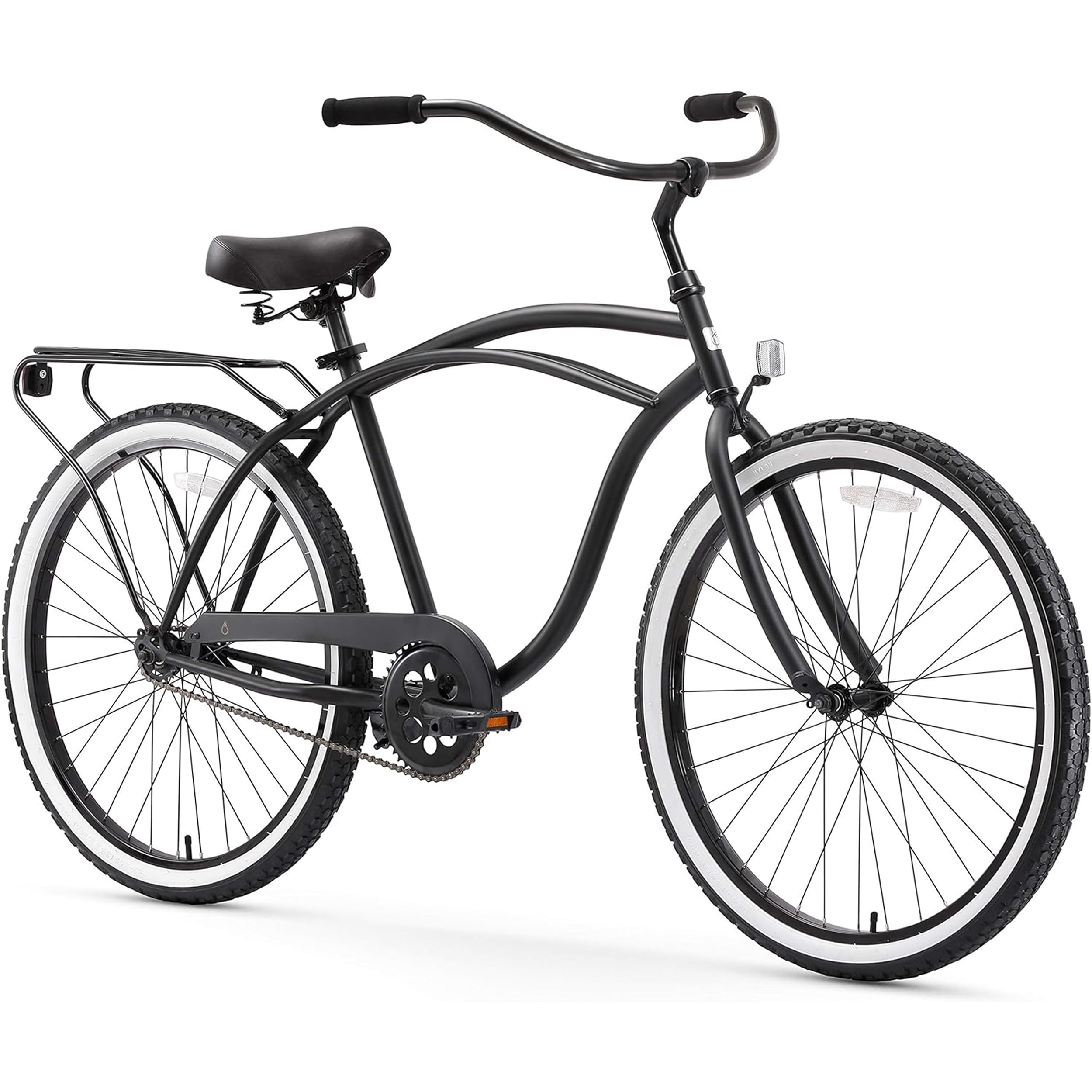
sixthreezero Around The Block

Flat commutes

Our Score 8.8/10
Check Price

Worth Noting

  • Coaster brake is the only brake
  • Heavy 40-pound steel frame to lift
Frame
19-inch steel
Tires
26 x 2-inch whitewall
Brakes
Rear coaster
Weight Limit
300 lb
Read the full review

The Around The Block asks you to sit up and take your time, and after a few miles that stops feeling like a compromise. The bars sweep back toward you, the saddle is wide and padded, and the pedals sit forward of the seat so your legs reach the bottom of the stroke without your back rounding. Of the bikes we tested, this is the most comfortable over distance, and it's the one we kept choosing for slow errands and long, flat paths.

The simplicity is the selling point. One gear, one coaster brake, no cables running to the rear wheel, and nothing to index or adjust. What you give up for that is the brake itself: pedal-back stopping is intuitive and works well at cruiser speeds, but it is the only brake on the bike, and on a real descent or in heavy traffic you'll miss the lever you don't have. If your route includes grades, start with one of the bikes that has front and rear hand brakes.

The 26 x 2-inch whitewall tires do a lot of the comfort work, rolling over cracked pavement and curb cuts without passing much of it up to your hands, and the steel frame is rated for riders up to 300 pounds, which is generous for a cruiser. The rear rack comes with it, which is rarer than it should be and turns a Sunday bike into one you can shop with. Assembly is genuinely quick: the chain is already on the sprockets, the tools are in the box, and the front wheel, bars, and pedals are the whole job. The printed instructions are the weakest thing in the box.

Two things to plan around. The gear is a flat-ground gear, so on a long climb you'll be out of the saddle and pushing, and that's the trade for never thinking about shifting again. And keep an eye on the rear wheel, which carries the load here: check spoke tension after the first week. Neither is a reason to walk away. They're the terms of the deal.

Bottom line: Our overall pick: the most comfortable single-speed we tested, with a rear rack and a 300-pound limit, and the best choice for flat commutes and easy neighborhood miles.

2

AVASTA Loop Single-Speed

AVASTA Loop Single-Speed

Smooth city streets

Our Score 8.4/10
Check Price

Worth Noting

  • Narrow 28C tires ride firm on rough pavement
Hub
Flip-flop, fixed or freewheel
Tires
700 x 28C
Brakes
Dual caliper
Frame Sizes
50, 54, and 58 cm
Read the full review

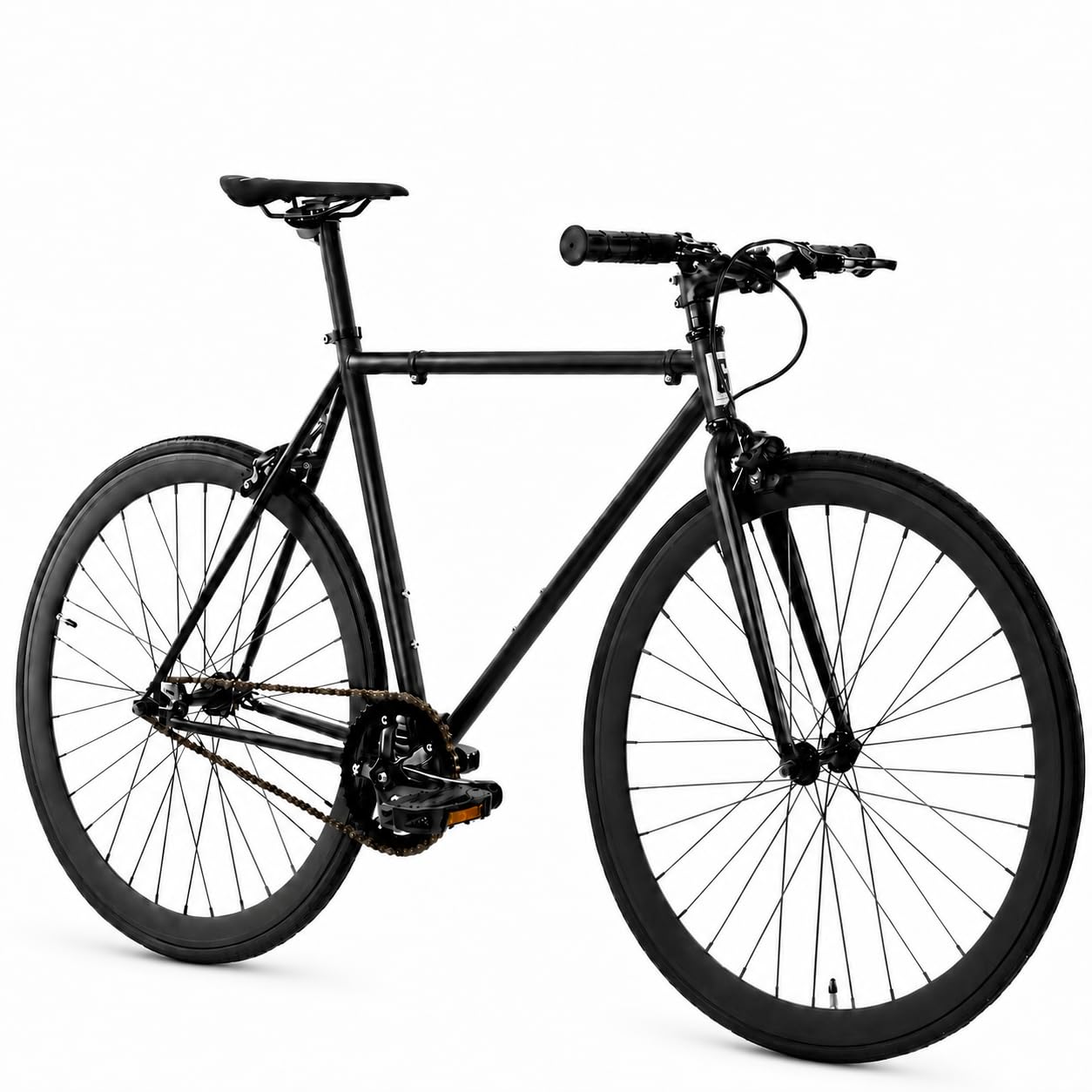
The AVASTA is the other fixie in this group, and it makes its case on looks. Deep-V rims, a flat olive or bright paint option, and a stance that reads quick standing still — if you want a single-speed that looks faster than it costs, this is the one we point at.

Mechanically it's close to the Golden Cycles: flip-flop hub, dual caliper brakes, 700 x 28C tires on those deep rims, and a high-strength carbon steel frame. Where it gives ground is choice. Three frames, 50cm, 54cm, and 58cm, cover riders from about 5 feet 1 inch to 6 feet 3 inches, against seven on the Golden, and it costs a little less for the privilege.

Setup is quick. It arrives 90% assembled with tools included, and about 15 minutes gets the front wheel, bars, and pedals on. The parts worth going over before you ride are the ones that move: pedals, cranks, and tires. Check that the pedals are seated properly and go around every fastener with a wrench before the first ride, then again after a week, because a crank that is slightly loose on day one will not tighten itself.

Ride-wise, the deep rims and narrow 28C tires make this the firmest-riding bike here. That is the point of the design, and on smooth asphalt it feels quick and connected, but on chip-seal or a crushed-limestone path you'll feel every seam, and the balloon tires on the cruiser are far kinder. In a city, though, it's a genuinely fun bike for the money, and the fixed side of the hub gives you a second personality out of the same wheels.

Bottom line: Pick this fixie for its looks and its price: deep-V rims, a flip-flop hub, and dual brakes, as long as you can live with a firm ride.

3

Golden Cycles Fixed Gear

Golden Cycles Fixed Gear

City fixie riding

Our Score 8.2/10
Check Price

Worth Noting

  • Paint chips easily at dropouts and top tube
  • Rear hub and rear brake may need adjustment
Hub
Flip-flop, fixed or freewheel
Brakes
Front and rear
Wheels
700C
Frame Sizes
41 to 63 cm
Read the full review

Seven frame sizes is the reason to start here if you're hard to fit. The range runs from 41cm to 63cm, and each size lists a standover height between 27 and 34 inches, so you can measure your inseam against a real number instead of guessing from a wheel size. That spread covers a young teenager and a tall adult in the same model, which is more than the other fixie here offers.

The rest of the spec is what a city fixie should be: a flip-flop hub so the same rear wheel gives you a freewheel on one side and a fixed gear on the other, 700C wheels that hold speed on pavement, and front and rear brakes rather than a coaster. The brakes are the part we care about most. A fixie with a single brake is a bike you have to think about, and two levers are what make the fixed side of that hub usable in traffic.

On the road it feels quicker than the cruisers here. The 700C wheels roll with less effort, the position is forward enough to put your weight over the pedals without folding you in half, and it steers fast enough for bike-lane traffic. Assembly is easy: front wheel, bars, front brake, and pedals, with directions clear enough to follow without a video.

The weak spots are paint and the rear end. Paint chips at the dropouts and along the top tube faster than you'd hope on a bike you'll lock to a rack, and the rear hub and rear brake are the parts that can arrive needing adjustment. Check both before the first real ride, then check the brake again after a week. For a first fixie none of that changes our recommendation, but plan on a short session with a wrench before you trust it.

Bottom line: The fixie we recommend: seven frame sizes, a flip-flop hub, and two hand brakes make it the most adaptable single-speed here for city riding.

4

VIRIBUS Step-Through Cruiser

VIRIBUS Step-Through Cruiser

Short riders

Our Score 8.2/10
Check Price

Worth Noting

  • 26-inch size suits riders up to about 5 feet 10 inches
Frame
Step-through carbon steel
Brakes
Front and rear V-brakes
Wheels
26 inches
Included
Basket, rear rack, and bell
Read the full review

The VIRIBUS is the least expensive bike here, and it's the only one that shows up with somewhere to put your shopping. There's a front basket, a reinforced rear rack, and a step-through frame low enough to get a leg over in a skirt or with a stiff hip. For errands a mile or two from home, that combination does more for daily usefulness than any number on the other spec sheets.

The rest of the build is sensible at the price. Front and rear V-brakes instead of a coaster give you real stopping power on a downhill, which is the setup we prefer on any bike that will see traffic. The saddle and swept bars are cushioned, fenders and a bell come in the box, and the 26-inch wheels with 2-inch rubber ride soft over bad pavement.

One number needs sorting before you order. The listing states the frame's maximum rider weight as 242 pounds in the frame description and 330 pounds in the specifications, so if you're anywhere near either figure, get it confirmed with the seller before the box ships. That's the sort of ambiguity worth five minutes of email on a bike bought online.

What you're buying is a bike that's easy to live with: easy to pedal away from a stop, easy to park, and inexpensive enough that leaving it locked outside doesn't keep you up at night. The detail that surprised us most is how much difference the low step-through makes on a route with a lot of lights, where getting on and off happens constantly and a top tube is just something to catch your foot.

Bottom line: The pick for shorter riders and quick errands: a step-through frame, basket, rack, and V-brakes at the lowest price in this group.

How We Tested the Best Single-Speed Bikes

We started with spec sheets and owner reviews, narrowing a field of roughly forty bikes by frame material, brake type, gearing, and price band so that every model in the test was a realistic alternative to the others. Nine arrived in boxes, and we built each one in a garage using only the tools included, timing the job and following the printed instructions page by page to see where they got vague or skipped torque values entirely. Every bolt got checked with a torque wrench afterward, then re-checked after the first week of riding, since that's when a stem or crank tends to settle.

Miles happened where these bikes actually live: a five-mile commute over cracked pavement, a weekend loop with a real climb in it, wet mornings, and grocery runs with a rack loaded down. We noted whether the frame felt stiff or flexy under hard pedaling, whether the saddle and bars were still comfortable past the three-mile mark, and whether the gear ratio left us spinning out on flats or grinding on the way up. Chain tension and wheel trueness got checked every couple of weeks, because a soft rim or a cheap rear hub shows up there first.

Build quality we judged by welds, paint, and how the components held up after a wet ride or two; appearance got a fair hearing as well, since a bike you don't like looking at doesn't get ridden. At the end we weighed each one, checked the dropouts and chain for rust, and set what each build cost against what came in the box. In this category, value usually comes down to whether a bike needs a shop visit in month one or not.

How to Choose Single-Speed Bikes

Start With Your Route

Before you compare bikes, count the climbs on the ride you'll really do. A single gear is a flat-ground gear: on rolling pavement you settle into a cadence and stay there, but on a long or steep grade you'll be standing on the pedals and arriving at the top out of breath. If your commute includes one hill you can't coast down, a single speed is still workable. If it includes three, it isn't.

Ride the route once on any bike and notice how often you reach for a shifter. A short, level trip is what these bikes were drawn for, and treating the single gear as a deliberate simplification rather than a missing feature is the whole point.

Cruiser or Fixie: Pick the Posture First

The bikes here fall into two shapes. Cruisers such as the sixthreezero and the VIRIBUS put the bars up and back, the saddle wide, and the pedals ahead of the seat, so you sit upright and see over parked cars. Fixies such as the Golden Cycles and the AVASTA lean you forward over 700C wheels for quicker steering and less wind. Neither is better: the upright bike is kinder on your back and hands, the forward one feels faster and more connected to the road.

One thing a flip-flop hub does not do is give you gears. It swaps a freewheel for a fixed cog on the same wheel, so you still have a single ratio either way, and you only stop pedaling on one side of it.

Get the Frame Size Right

Fit decides whether you ride the bike at all. The Golden Cycles sizes run 41cm to 63cm with standover heights from 27 to 34 inches, the AVASTA comes in 50cm, 54cm, and 58cm for riders from roughly 5 feet 1 inch to 6 feet 3 inches, and the VIRIBUS 26-inch version is aimed at 5 feet 1 inch to 5 feet 10 inches.

Measure your inseam and compare it to standover rather than to wheel size, and leave an inch or two of clearance when you're flat-footed over the top tube. If swinging a leg over is the obstacle, a step-through frame solves it outright.

Wheels, Tires, and Weight

Wheel and tire size change the feel of the same street more than anything else on the spec sheet. The 700C wheels and 28C tires on the two fixies roll fast and firm; the 26-inch wheels with 2-inch rubber on the cruisers soak up broken pavement and curb ramps but take more effort to keep moving.

Weight follows the same split. The sixthreezero is 40 pounds of steel, which is lovely on a flat path and tiresome up a flight of stairs. Choose by the surface you ride and by where the bike sleeps, not by a number that looks better on paper.

Assembly and the First Week

Most of these arrive nearly built: the AVASTA ships 90% assembled, the sixthreezero's chain is already on the sprockets, and tools come in the box. What the box can't do is check its own work. Go over every fastener, set the saddle height before you tighten anything, and have a shop confirm brake adjustment and spoke tension if you're not confident.

The first week is when a loose crank or a cable that's still settling makes itself known, so plan one more pass with a wrench after a few rides. Then add what the bike doesn't come with: a lock, lights, and fenders if you ride year-round.

Frequently Asked Questions

Final Verdict

The Around The Block is our recommendation for most people shopping a single-speed. It's the most comfortable bike we tested, it comes with a rear rack, and it carries a 300-pound rider, which is a lot of forgiveness for the money. Accept the coaster brake and the flat-ground gear and there is nothing else to think about.

If your route has hills, or you want the fixed side of a flip-flop hub, the Golden Cycles bike does that job with two hand brakes and a size for almost any rider.