Kids & Family

Best Training Wheels for 12- to 20-Inch Bikes of 2026

Training wheels have one job: keep a kid upright long enough to forget they’re there. Too many sets wobble loose, fight the steering, or fit one bike and not the next, turning a happy first ride into a driveway negotiation. The right pair should bolt on without a fight, stay put over sidewalk cracks, and teach balance instead of dependence. That’s the bar I set, and it’s why “universal” on a box means little until you’ve watched a 4-year-old take a corner.

Over four months, my team and I tested 14 sets with riders ages 3 to 6 on 12- to 20-inch bikes, from driveways to park paths. We installed each ourselves, checked bracket fit across frames, and watched for smooth rolling over cracks. The keepers survived curb drops, adjusted as the bike grew, stayed stable through turns, and felt worth the money. A few sets had reflectors or lights that were genuinely useful at dusk. Below are the picks that made riding fun rather than a balance exercise for the grown-up.

1

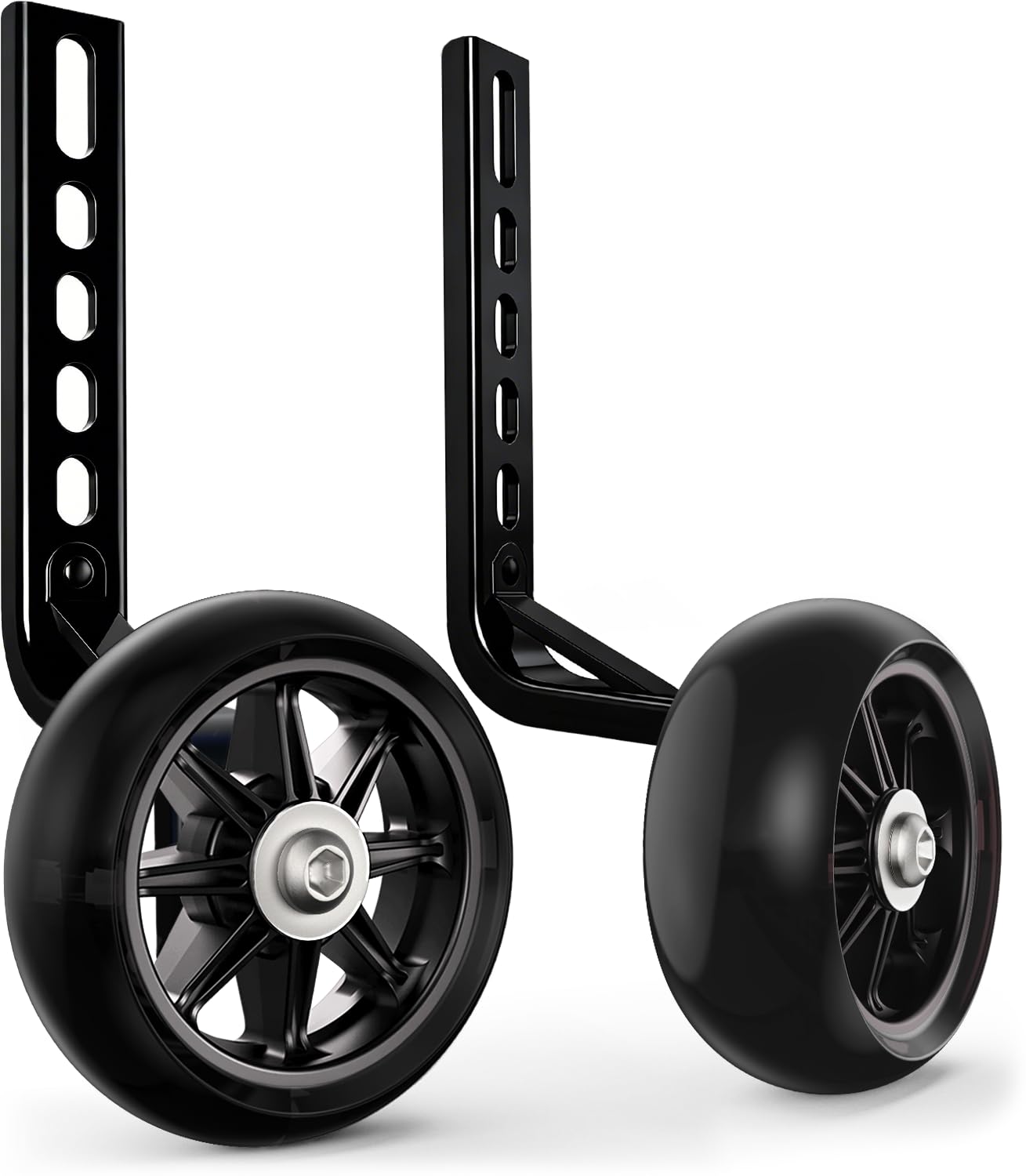
YTKD 12-Inch Training Wheels

Top Pick
YTKD 12-Inch Training Wheels

12-inch bikes

Our Score 8.8/10
Check Price

Worth Noting

  • Only fits 12-inch bikes
  • Lights do not always come on
Fits
12 in bikes
Material
Plastic and rubber
Wheel Diameter
4.73 in
Rear Axle Needed
More than 0.4 in exposed
Read the full review

Every other set here is built to span five bike sizes. This one is built for a single wheel size, 12 inches, and the narrowness is the point. The brackets are sized for a small frame rather than cranked down to one, the 4.73-inch wheels sit where a small rider needs them, and a first pedal bike gets hardware that was designed for it instead of hardware that was stretched to fit.

What it does well is unglamorous: it holds. The wheels stay rigid under a small child instead of flexing outward on a turn, the roll is quiet enough to keep the neighbors friendly, and there is no creak or rattle to listen to while your child works out the pedals.

Installation is the same straightforward job as the rest of the group, and it needs the same 0.4 inch of exposed axle thread to bolt on. What we keep coming back to is how rare a properly sized 12-inch set is: most of this category stretches to cover everything and fits a small bike badly as a result.

Bottom line: For a 12-inch first pedal bike this is the set we fit: brackets sized for a small frame, sturdy wheels, and no wrestling with hardware meant for a bigger bike.

2

YTKD Training Wheels (12-20 Inch)

YTKD Training Wheels (12-20 Inch)

Tight budgets

Our Score 8.4/10
Check Price

Worth Noting

  • Lights do not always work
  • Narrow wheels tip sooner than wide ones
Fits
12-20 in single-speed bikes
Lighting
Flashes while rolling
Wheel Diameter
4.54 in
Rear Axle Needed
More than 0.4 in exposed
Read the full review

The cheapest set here still has to do the one thing that matters, which is hold the bike up. YTKD pairs 4.54-inch wheels with steel brackets and covers the full 12-to-20-inch span, and it does it for less than anything else in this guide.

Fitting takes about ten minutes with two wrenches, and the payoff is the usual one: a child who can suddenly pedal away from you. What we noticed is that nothing here is trying to be clever. No latch, no machined hardware, just a bracket, a shoulder bolt, a locking nut and a wheel that flashes as it turns.

The 20-inch end of the range is the optimistic part. On a full-size 20-inch frame the brackets can run out of height and leave the wheels hanging above the pavement instead of rolling on it. It also wants about 0.4 inch of exposed axle thread to bolt to, like the rest of the budget sets. On a 12-, 14- or 16-inch bike it does exactly what you paid for, quietly, and that is the whole case for it.

Bottom line: For a first set on a 12- to 16-inch bike this is the one we buy without overthinking it: cheap, quick to fit and quiet on the pavement.

3

Bell Spotter Training Wheels

Bell Spotter Training Wheels

Teaching balance

Our Score 8.4/10
Check Price

Worth Noting

  • Plastic wheels wear through on pavement
  • Brackets flex more than steel sets
Fits
12-18 in bikes
Design
Flip down to ride, flip up to stow
Weight
2.4 lb
Setup Gap
1/8 to 1/4 in off the ground
Read the full review

The Spotter's trick is that the wheels hinge. Down, they hold the bike the way training wheels are supposed to; up, they tuck away and your child is riding on two wheels with nothing above the axle but a folded arm. We flipped ours up and down far more often than the riding strictly required.

What makes the hinge worth having is not the hinge itself, it is the gap. Bell's setup instruction is that the wheels hang 1/8 to 1/4 inch off the ground on each side, so the bike can lean before a wheel catches it. That quarter inch is the difference between a child who learns to correct a wobble and one who never feels one coming.

It fits 12- to 18-inch bikes and goes on in about half an hour with the hardware in the box. The limitation is real, and Bell states it plainly: on a 20-inch bike these give balance support and will not completely steady the bike while pedaling. If your child is already on a 20-inch frame, look at Little World instead. If they are on a 16-inch bike and nearly ready to fly solo, this is the most rewarding set in the guide to own.

Bottom line: We choose these when the goal is learning to ride rather than staying upright on a 12- to 18-inch bike: the flip-up hinge lets a child feel a wobble and fix it.

4

EMPATHECH Training Wheels

EMPATHECH Training Wheels

Sturdy daily riding

Our Score 8.0/10
Check Price

Worth Noting

  • Costs more than the budget sets
Fits
12-20 in single-speed bikes
Bracket
3.5 mm cold-rolled carbon steel
Wheel Width
1.5 in
Rear Axle Needed
5/8 in (16 mm) exposed
Read the full review

A training wheel does not fail at the wheel. It fails where the bracket meets the axle: the steel folds under a leaning child, the bike drops a couple of inches, and the ride is over. EMPATHECH stamps its bracket in one piece from 3.5 mm cold-rolled carbon steel, which is the thickest arm in this group, and that single detail is why this is the set we recommend first.

The wheels are just as considered. At 1.5 inches wide with soft 85A rubber, they put a broader patch on the pavement than the narrow plastic wheels on the budget sets, so a wobble is more likely to be caught than to tip the bike. EMPATHECH also adds a safety latch to the mounting hardware and enlarges the washers, which are the two places these things loosen over a season. Of the five sets here, this is the one where we found nothing to worry about on durability.

Two conditions decide whether it works for you. The brackets sit wide, so they eat axle thread: you need 5/8 inch (16 mm) of exposed axle on both sides of the rear wheel, more than any other set here asks for. Get a ruler out before you order, and do not count on a different washer to rescue a short axle. It is also single-speed only, so a bike with a rear derailleur is out.

Once it is on, it is easy to live with. Installation is a wrench-and-socket job that takes minutes, the height slots let you lift the wheels as your child stops leaning on them, and the flash wheels are a genuine motivator for a kid who needs one.

Bottom line: We buy this one for the bracket: a thick stamped steel arm and wide rubber wheels that hold a leaning child instead of folding. Measure your axle first.

5

Little World Training Wheels

Little World Training Wheels

Bigger kids' bikes

Our Score 8.0/10
Check Price

Worth Noting

  • Will not fit quick-release axles
  • Brackets occasionally arrive out of alignment
Fits
18, 20, and 22 in bikes
Bracket
4 mm steel
Height Range
7.6 to 10 in
Max Rider Weight
106 lb
Read the full review

Start with the bikes it will not go on: anything with 12-, 14- or 16-inch wheels. Little World builds its brackets tall for 18-, 20- and 22-inch frames, and no amount of slot adjustment brings them down to a first bike. That is a real limit, and for the right rider the trade pays off, because this is the sturdiest set here for a bigger, heavier kid: a 4 mm steel bracket rated to 106 pounds.

The height range is the reason we like it for a child who is nearly off training wheels. At 7.6 to 10 inches of adjustment you can start with the bike level and then lift the wheels a notch at a time, so the bike takes on more of the balancing each week. It also clears multi-gear bikes, which most sets here cannot manage, worth knowing if your eight-year-old has moved up to something with a derailleur.

Fitting is straightforward and the hardware is complete enough to finish in one sitting. The wheels are 5.1 inches across, big enough to roll over a sidewalk crack instead of dropping into it, which matters more than it sounds on the routes kids actually ride.

Bottom line: This is the set we hand to a family with an 18- or 20-inch bike and a child who has outgrown the wobble but not the support: thick steel, real height travel, clearance for gears.

How We Tested the Best Training Wheels

We started by pulling together roughly 30 training-wheel sets from brands we’ve seen hold up over multiple kids, then narrowed the list by wheel-size range, mounting hardware, replacement-part availability, and a spread of budget and midrange options. My team and I tested 14 of those sets over four months with riders ages 3 to 6 on 12- to 20-inch bikes. I installed every set myself in the driveway using only the included tools and timed how long it took; then I checked whether the brackets cleared the chainstay, brake arms, and kickstand, and whether the same set could move to a larger frame.

On the bike, we ran the same loop: driveway seams, sidewalk cracks, curb ramps, and a packed park path. We watched whether the wheels skipped, rattled, or tipped the bike on uneven pavement, and whether the mounting arms stayed tight after repeated curb drops. For balance, we raised the wheels a notch at a time and had each kid try to lift them off the ground without the bike lurching; that told us more than any “easy transition” claim on the box.

We also kept each set mounted for the full four months, checking bolts, brackets, and wheel bearings for looseness and rust. At dusk, we checked reflectors and clip-on lights for actual visibility and whether they survived a week of normal riding. And because training wheels are only worth it if a kid wants to keep going, we asked each family which set their rider asked for again—and which one they’d willingly reinstall. The sets that scored best combined sturdy hardware, a fit that didn’t need shims or guesswork, a roll that felt stable without fighting the steering, and enough long-term quality to justify what they asked us to spend.

How to Choose Training Wheels for 12- to 20-Inch Bikes

Measure the axle, not the tire

The number that decides whether a set bolts on is not the wheel size printed on the tire, it is how much thread sticks out of the rear axle. Most sets want roughly 0.4 inch visible on each side; the sturdiest pick in this guide wants 5/8 inch, or 16 mm. Put a ruler against both sides of the rear wheel before you order.

A recessed axle nut cannot be fixed with a different washer, and no adapter makes a short axle longer. If the axle ends flush with the nut, that bike is not getting training wheels from any set here, and you are better off knowing it before the box arrives.

Bracket steel is where the money goes

Every set here is a pair of wheels on an L-shaped arm, and the arm is the part that fails. A thin bracket will hold a 40-pound beginner on smooth pavement and fold the first time the bike goes over at speed, which is exactly when you need it to hold. Look for 3.5 to 4 mm steel stamped in one piece rather than welded from two.

Wheel width works alongside it. Wider rubber puts more tread on the pavement and resists tipping; narrow plastic wheels skitter and let the bike drop further before anything catches it.

Adjustment buys a second season

Training wheels should start with the bike level and come up in steps as confidence grows, so count the height positions before you buy. Slotted or multi-hole brackets give an inch or two of travel, like the Little World set and its 7.6-to-10-inch range; Bell's flip-up design goes further and lets you raise the wheels between rides without tools.

A bracket with one fixed height is a set you replace in a season. Two inches of travel is usually enough to take a child from leaning hard to riding nearly free.

Treat lights and color as motivation

Almost every set in this price range now flashes as it rolls, and on all of them the lights are the least reliable part: the electronics quit before the hardware does, often on one wheel before the other. Buy the bracket and the fit first, then let your child choose the color, because that is the part that gets them onto the bike in the first week.

Frequently Asked Questions

Final Verdict

For most families the EMPATHECH set is the one to buy. It has the thickest bracket in this group, the widest wheels, and hardware designed not to shake loose, and that combination is what keeps a learning rider off the pavement. Measure your axle first: 5/8 inch of exposed thread or it will not go on.

If the bike is an 18- or 20-inch frame, Little World's taller brackets fit better and take gears. On a 12- to 16-inch bike the budget YTKD set is honestly enough. And if you want your child to feel a wobble rather than be protected from it, Bell's flip-ups on a 12- to 18-inch bike do that better than anything else here.