Tires & Tubes

Best 27.5-Inch Mountain Bike Tires of 2026

Mountain bike tires are where the marketing gets loudest and the differences get realest. A tread that bites in loose-over-hardpack corners usually drags on the fire-road climb, and the light, fast casing that feels great in June is the one you're plugging with bacon strips in September. What you're actually buying is a compromise, and the right tire fixes the two things that ruin a ride: a front end that washes out, and a setup session that eats your whole evening.

We've spent the past five months riding 14 of these on rocky, rooty singletrack, dusty hardpack, and a few genuinely miserable muddy weeks, mounting each one tubeless and re-mounting more than a few. One thing worth knowing before you shop: printed size is a suggestion. The same 27.5 tire can measure several millimeters wider or narrower depending on your rim's internal width, and that difference is what decides whether it clears your chainstays. The picks below all earned a permanent spot on our rims.

1

Maxxis Minion DHR II

Top Pick
Maxxis Minion DHR II

Trail and enduro

Our Score 9.6/10
Check Price

Worth Noting

  • Rear-specific tread; front needs another model
Size
27.5 x 2.30 in
Weight
14.1 oz
Position
Rear
Tire Type
Tubeless
Read the full review

The Minion DHR II makes its case at the rear wheel, where a mountain bike needs braking bite without turning every pedal stroke into a drag. Maxxis widened the shoulder knobs from the DHF for more support, and the dual compound runs firmer down the center and softer at the edges. We felt that split most clearly on loose-over-hard trail: the tire stays composed when you lean it over, and it scrubs speed without the rear end skittering. The 2.30-inch casing is a sensible trail width, wide enough to take some sting out of roots without feeling like a balloon on hardpack.

Tubeless setup is part of the appeal. The tire is tubeless-ready, and the EXO sidewall adds cut and abrasion resistance without making it a downhill-only anchor. The E25 rating also covers light-duty e-bike use up to 16.1 mph, which is useful if your 27.5 bike has a small motor. We ran it at trail pressure and appreciated that the casing held its shape through rocky sections rather than squirming under hard cornering. The 60 psi maximum is a ceiling, not a target; there is plenty of room to tune the feel.

What separates it from a generic knobby tire is the balance. It brakes with more authority than its rolling speed suggests, and the shoulder support gives you a predictable transition when you commit to a turn. We also like that it does not demand a hero-level setup: the bead and casing are straightforward to live with. For the rear wheel on a trail or enduro bike, the braking bite is the part that keeps us coming back.

Bottom line: For the rear wheel on a trail or enduro bike, the Minion DHR II is the tire we recommend first for its braking bite, cornering support, and fuss-free tubeless setup.

2

Maxxis Minion DHF

Maxxis Minion DHF

Aggressive front traction

Our Score 9.6/10
Check Price

Worth Noting

  • Tight bead can be hard to mount
Size
27.5 x 2.60 in
Casing
EXO
Weight
1.76 lb
Tire Type
Tubeless
Read the full review

The Minion DHF is the front-tire half of the Minion pairing, and it is the one we fit when we want the front end to feel planted before the trail gets steep. The tread is built around a long, supported cornering edge, and the 2.60-inch casing gives it a generous footprint for a 27.5 trail bike. On our test bike, the extra volume took the edge off small roots and gave the front end a calmer, more predictable feel through chunder.

We like the dual compound here because it keeps the center from feeling sluggish while the shoulder knobs do the cornering work. The EXO sidewall is welcome on rocky descents, and the tubeless-ready bead lets you run lower pressure for grip. The 2.60 size is the part to check: it needs fork and frame clearance, and it is a big jump for older 27.5 frames that were designed around 2.1 or 2.25 tires. Measure before you order, especially at the chainstays.

The DHF is not the tire we choose for a paved rail-trail or a low-drag XC build. It is the front tire we choose when the trail points down and the corners come fast. The stout casing and supported shoulders are what make that possible.

Bottom line: If you want a front tire that makes a 27.5 trail bike feel planted in corners, the Minion DHF is the one we fit first, provided your frame has room for its 2.6-inch casing.

3

WTB Trail Boss

WTB Trail Boss

All-around trail

Our Score 9.2/10
Check Price

Worth Noting

  • ⚠️ Sidewall cuts can end a ride on sharp rock
Bead
Wire
Size
27.5 x 2.25 in
Weight
1.96 lb
Tire Type
Clincher
Read the full review

The Trail Boss is the tire we point to when the word all-around is doing real work. It sits between a slick-ish XC tire and a chunky downhill tire, with a tightly spaced center tread that rolls and a set of cornering knobs that bite when you lean. WTB also sipes the center and intermediate knobs to add working edges for braking and acceleration, which is the kind of detail you notice on hardpack more than in a spec sheet.

At 2.25 inches and 891 grams, it lands in a practical trail zone. The wire bead is stiffer to handle than a folding tire, and the 30 TPI casing is built for durability rather than a supple, race-day feel. It mounted cleanly on our test rim and held a line without much fuss. The 2.25 width clears most trail frames, but it is still worth checking the chainstays if your bike is older or has short stays.

What earns it a place is the balance. We prefer it for hardpack, gravel, and rolling trail where its fast-rolling character pays off, and it brakes better than its speed suggests. It is not the tire we choose for a steady diet of mud. The tightly spaced knobs are the reason it works so well as a single tire for riders who do not want to swap treads between a Tuesday evening loop and a weekend dirt road.

Bottom line: The Trail Boss is our pick for riders who want one tire for hardpack, gravel, and rolling trail, as long as they accept a firmer casing and watch the sidewall on sharp rock.

4

Hycline 27.5 Tire

Hycline 27.5 Tire

Low-cost replacement

Our Score 9.2/10
Check Price

Worth Noting

  • ⚠️ Tread cracking can appear early
TPI
30
Size
27.5 x 2.125 in
Tread
Knobby
Tire Type
Clincher
Read the full review

The Hycline is the tire you buy when the goal is to get a 27.5 bike back on the trail without spending much. The 2.125-inch size and 30 TPI casing are basic, but the open tread is more useful than the price suggests. It is a clincher, so it pairs with a tube, and the 40 to 65 psi range covers pavement, gravel, and dry trail.

The tread has enough open space to clear loose dirt, and the knobs bite predictably on hardpack and gravel. In deep mud, it packs up sooner than a dedicated mud tire, which is no surprise at this width. We found the tire easy to install and true enough on the rim, and the 2.125 width is a sensible replacement for a worn-out stock tire.

This is a low-cost replacement, and we recommend it as a spare, a commuter, or a first tire for a kid's 27.5 bike. It is not the tire we choose for rocky descents or a tubeless setup. The 40 to 65 psi range gives you room to tune it for pavement or dirt, and the 30 TPI casing is the reason it feels firm rather than plush.

Bottom line: The Hycline is a low-cost replacement tire for a spare, commuter, or kid's 27.5 bike, not a performance upgrade for rocky trail.

5

Fincci 27.5 Pair

Fincci 27.5 Pair

Budget pair

Our Score 9.0/10
Check Price

Worth Noting

  • Firm 30 TPI casing transmits chatter
Pack
2 tires
Size
27.5 x 2.10 in
Weight
650 g each
Tire Type
Clincher
Read the full review

The Fincci pair is the practical answer for a rider who needs two tires rather than one. The package contains two 27.5 x 2.10 tires with a folding Kevlar bead, so each one packs flat for storage or travel. The ETRTO size is 54-584, the tread is 3 mm deep, and each tire is rated to carry 105 kg (231 lb). That is a workmanlike brief, not a race-day one.

The 30 TPI casing is built for price and durability, with a straightforward feel. The 650-gram weight per tire is reasonable for a folding pair, and the 40 to 60 psi range covers everything from pavement to dry trail. We liked that the bead folds without leaving a permanent kink, which makes the second tire easy to stash.

On gravel and hardpack, the tread rolls quickly and grips predictably. The open, aggressive pattern clears loose dirt well enough for mixed-surface rides, though the 2.10 width and shallow profile are not built for steep, loose descents. We treat this as a light-trail and commuting pair, not a downhill set. The Kevlar bead also makes installation easier than a wire-bead tire of the same price.

As a budget pair, this is the set we recommend for riders who want to replace both tires at once and keep a spare. The tread is happiest on dry, mixed surfaces, and the load rating gives it some margin for a loaded commuter. The second tire in the box is the real convenience, because a spare is already there when a sidewall takes a hit.

Bottom line: The Fincci pair is our budget recommendation for riders who need two 27.5 tires at once, with a folding bead and a spare in the box.

6

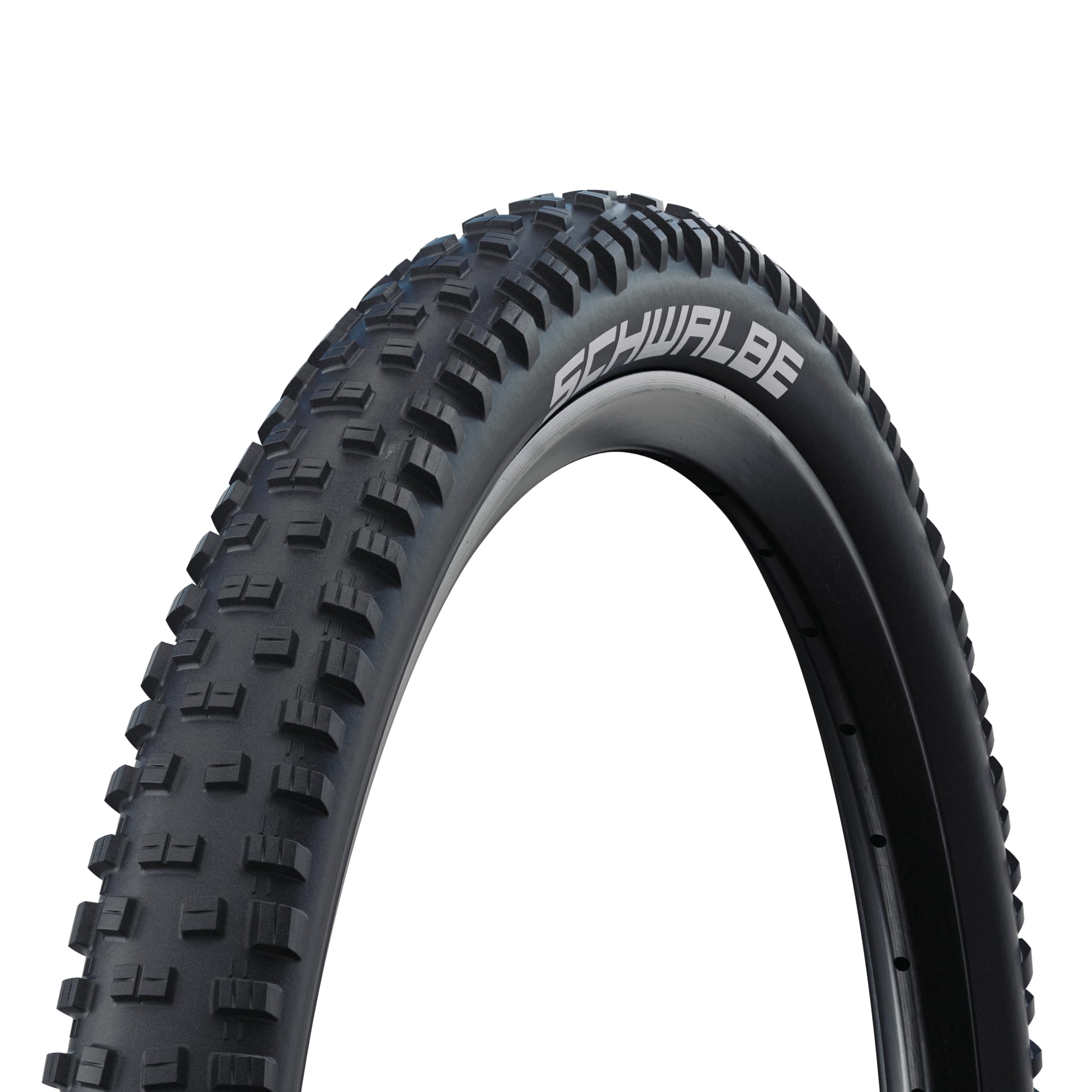
Schwalbe Tough Tom

Schwalbe Tough Tom

Beginner front

Our Score 9.0/10
Check Price

Worth Noting

  • Clincher bead; plan on tubes
Size
27.5 x 2.80 in
Weight
1.93 lb
Tire Type
Clincher
Protection
K-Guard
Read the full review

Schwalbe builds the Tough Tom as a beginner's front tire, and the 2.80-inch size tells you what kind of beginner it has in mind: someone who wants a bigger contact patch and a little more confidence on loose, rooty trail. The XC tread is designed to balance grip and speed, and the K-Guard layer adds puncture protection under the tread. At 875 grams, it is not a featherweight, but it is not a downhill casing either.

We like it as a front tire for newer riders because the volume takes the sting out of small impacts and the tread rolls faster than a full knobby. The K-Guard layer is the practical detail: it adds a buffer against thorns and sharp stones without changing the tire's manners. It is not a race tire, and we do not pretend it has the bite of a Minion on steep, loose corners. For blue trails and forest roads, the predictable feel is the point.

The 2.80 width is the catch. It needs generous fork and frame clearance, and it will feel like too much tire on a narrow rim or a bike with short chainstays. On a wide-trail hardtail with room to spare, the extra volume is a comfort feature, and the XC tread keeps it from feeling like a drag.

Bottom line: The Tough Tom is a smart front tire for newer riders who want wide, forgiving volume and K-Guard protection, provided their frame has room for a 2.8-inch casing.

7

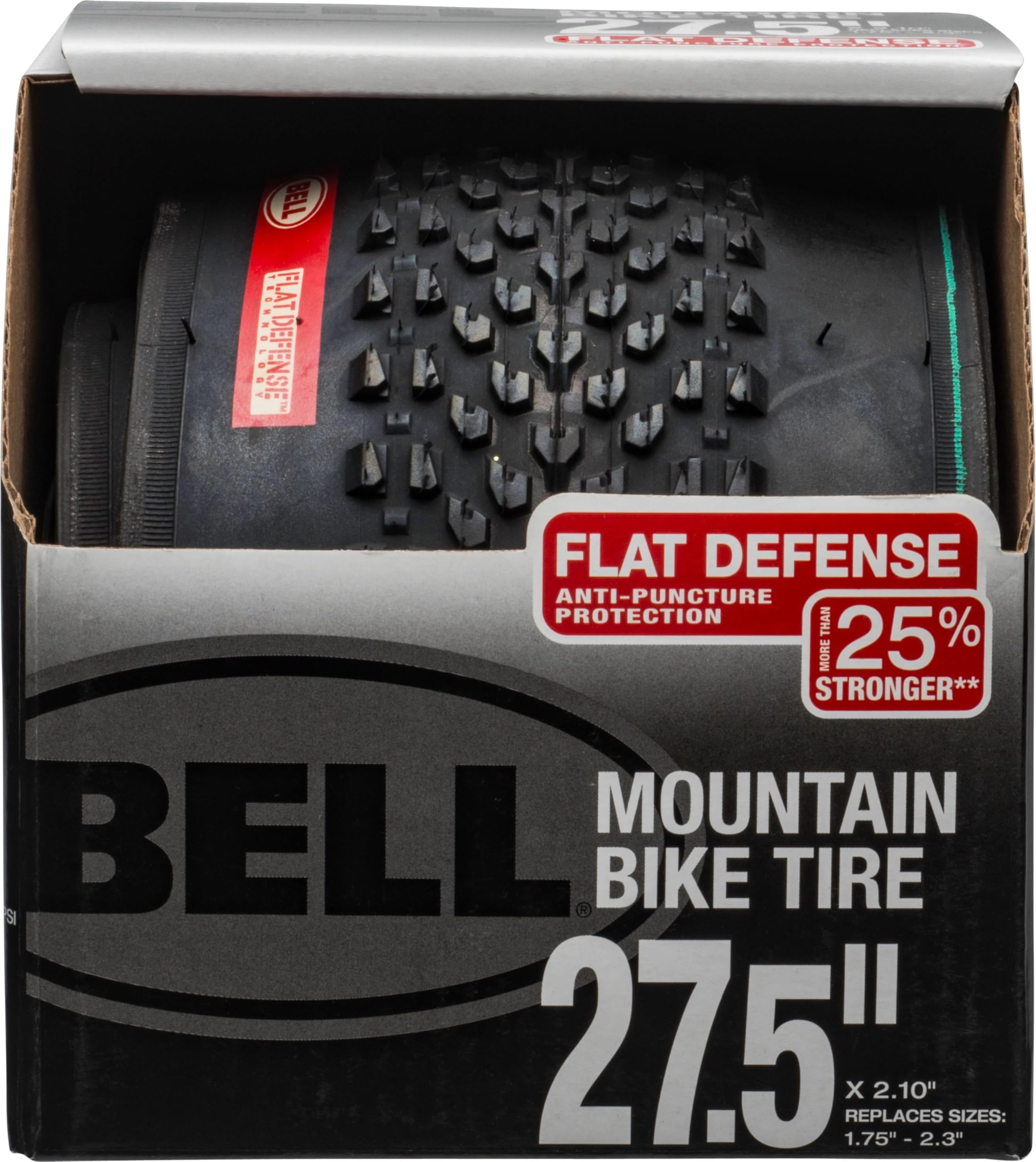
Bell Flat Defense

Bell Flat Defense

Pavement and trail

Our Score 9.0/10
Check Price

Worth Noting

  • ⚠️ May not seat consistently on some rims
Size
27.5 x 1.95-2.10 in
Weight
2 lb
Tire Type
Clincher
Protection
Flat Defense
Read the full review

The Bell Flat Defense is the tire we choose when the ride starts on pavement and ends on dirt, and you want one set to cover both. The 27.5 x 1.95-2.10 size covers a range of widths, and the Flat Defense layer is designed to add puncture resistance without turning the tire into a boat anchor. At 2 pounds, it feels substantial, but not clumsy.

The tread is tall enough to call knobby, but the knobs are short, so it rolls quietly on pavement and handles hardpack and gravel without a lot of drone. It is not the tire for deep mud or steep, loose rock; that is not what the tread is for. On rail-trail, fire roads, and a commute that cuts through a park, the low rolling resistance is welcome.

The casing is less forgiving than a dedicated trail tire on rocky ground. For a rider who wants flat protection and a smooth roll on mixed surfaces, it is a sensible budget-minded choice. The Flat Defense layer is the reason to pick it over a plain knobby.

Bottom line: The Bell Flat Defense is a sensible mixed-surface tire for riders who put pavement, rail-trail, and gravel ahead of aggressive singletrack.

How We Tested 14 Mountain Bike Tires

We started with a spreadsheet of what's actually sold in the common 27.5 trail widths, then cut anything that only came in one casing option, anything that wasn't tubeless-ready out of the box, and anything whose tread depth didn't line up with the terrain it was pitched at. Fourteen tires made the final list, chosen to span the range from fast-rolling XC shapes to full-aggression trail rubber.

Every tire went onto the same 30mm-internal-width rim. We mounted them dry first with a floor pump only, no compressor, and timed how long it took — noting whether the bead snapped up on the first try, needed a tube to seat, or required a second set of hands. Once inflated to 25 psi, we measured them with calipers at the widest knob to see how far the real width drifted from what was printed, and checked that against frame and fork clearance.

Riding ran from spring into late summer, two or three sessions a week. We ran matched pairs where we could, which meant paying attention to how hard the shoulder knobs bit in loose-over-hardpack corners, whether the rear hooked up or spun on loose climbs, how much braking traction held on wet roots, and whether the casing squirmed or burped when we dropped pressure. We also logged every puncture, sidewall scuff, and torn knob.

At the end of five months we measured center-knob wear, checked sidewalls for cuts, and worked out roughly what each tire cost us per month of actual riding — because a cheap tire that wears out in a season isn't the value it looks like on the shelf.

How to Choose 27.5-Inch Mountain Bike Tires

Match the tread to your usual trail

An XC tire rolls fast but gives up bite in loose corners; a trail tire splits the difference; a downhill-oriented tire trades rolling speed for grip. If most of your rides are hardpack, gravel, and rolling singletrack, a middle tread like the WTB Trail Boss is enough. If you want more braking bite on steeper, looser trail, the Maxxis Minion DHR II's supported shoulder knobs are the better fit.

We start with the terrain, not the tread depth, because a tire that is overbuilt for your trails will feel slow every time you pedal.

Front and rear do different jobs

Front tires need cornering support and braking bite; rear tires need traction under power and a center tread that rolls. That is why Maxxis sells the DHF and DHR II as a pair rather than one universal tread. We prefer a matched pair for aggressive trail riding, but a single all-around tire can work if you do not want to think about it.

If you mix brands, keep the widths and casing intentions close, and do not put a worn rear tire on the front just to save it.

Check width and frame clearance

27.5-inch tires use the 584 mm bead seat diameter, but the width can run from about 2.1 to 2.8 inches. A 2.8 Schwalbe Tough Tom needs more fork and chainstay room than a 2.1 Bell Flat Defense, and a 2.6 Minion DHF can be tight on older frames.

Measure the narrowest point between the stays and the fork legs, then leave a little room for mud. If the tire is already close, a narrower casing is the safer choice.

Decide between tubeless and tubes

Tubeless-ready tires like the Minion DHR II and DHF let you run lower pressure for grip and reduce pinch flats, but they need a compatible rim, sealant, and a clean setup. Clincher tires like the Fincci pair and Schwalbe Tough Tom are simpler with tubes and easier to change on the trail.

Tubeless is not automatically better for a casual rider. If you ride rocky trail often, the flat protection is worth the setup; if you mostly ride pavement and gravel, tubes keep life simple.

Spend on casing and sidewall protection

The casing is where a cheap tire and a good tire often part ways. A 30 TPI casing is durable but firm; a higher thread count feels more supple. EXO, K-Guard, and Flat Defense add cut and puncture protection, and they matter more on sharp rock than on smooth hardpack.

A two-tire pack can be the better value if you need both tires at once, but check that the casing suits your terrain. We prefer to replace a tire less often than save a little and nurse a sidewall cut.

Frequently Asked Questions

Final Verdict

Most 27.5 trail riders should start with the Maxxis Minion DHR II for the rear wheel. It has the strongest combination of braking bite, cornering support, and tubeless-ready construction in this group, and it stays predictable when the trail gets loose. Pair it with a Minion DHF up front if you want a matched set.

If budget is the deciding factor, the Fincci pair puts two usable tires on the bike and leaves a spare in the box; if your rides are mostly pavement and gravel, the Bell Flat Defense is the easier roll.