Components

Best Bike Bottom Brackets of 2026

The worst sound in cycling isn’t a crash—it’s the dry click that starts somewhere under your cranks and follows you home. A bottom bracket is the bearing assembly that lets your cranks spin, and when it’s right, you never think about it; when it’s wrong, every pedal stroke feels like a small argument. The trick is that “right” depends on your frame’s shell size, your crank’s spindle, and how much grit and rain you’re willing to subject it to.

Over the past eight months, I’ve installed 12 bottom brackets across a commuter, a road bike, a gravel rig, and a trainer setup, and the differences showed up fastest at the work stand and on wet morning rides. A cheap one can feel fine for a week; the good ones stayed smooth after repeated soakings and never developed that dreaded creak. I paid attention to fit, adapter compatibility, installation fuss, and whether the bearings still felt like bearings after the grit arrived. The picks below are the ones I’d happily run again.

1

Shimano BBR60

Top Pick
Shimano BBR60

Road and gravel

Our Score 9.6/10
Check Price

Worth Noting

  • Bearing life can fall short in wet, gritty use
Series
Ultegra/105
Bearings
Steel ball bearings
Shell Standard
BSA threaded
Weight Vs. SM-BB6700
14 g lighter
Read the full review

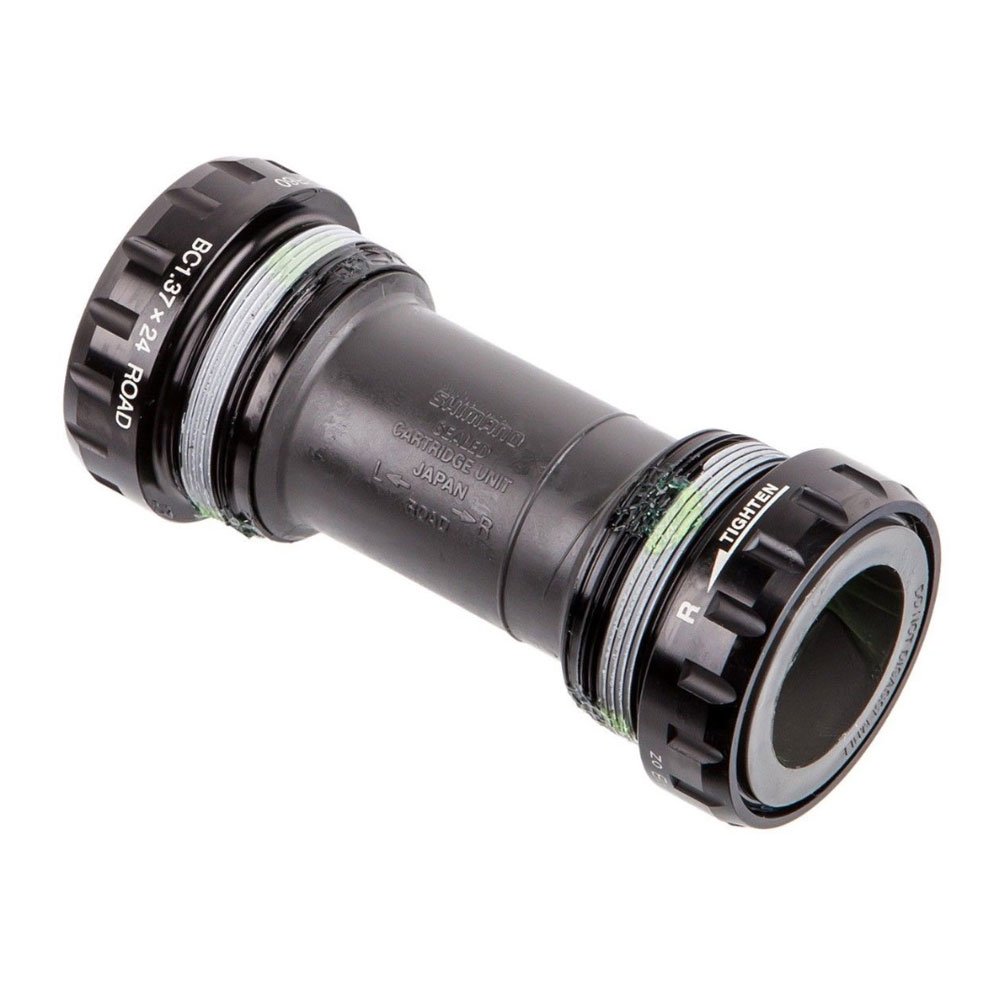
The BBR60 is Shimano's Ultegra/105-level threaded bracket, and it's where we start almost every conversation about a worn-out bottom bracket. Two steel ball bearings pressed into black cups, listed 14 grams lighter than the SM-BB6700 it replaced in the range and, by Shimano's own numbers, half the friction. Treat the friction figure as marketing and the feel still holds: with the chain off, a crank on a healthy BBR60 turns with almost nothing in the way.

Installation is the easy part as long as the shell is clean. The cups wind in by hand, and the plastic fitting tucked into the box will get you through one install. Buy the proper 41 mm, 16-notch socket with the bracket instead — it's the tool that keeps the splines intact when the unit comes back out in a couple of years, and one fitting is all the plastic one is good for.

What you don't get is choice. One shell standard, one bearing option, no cups to swap when the bearings go rough — the whole unit comes out and a new one goes in. That's the trade for the price and the quiet: the small bearings spin beautifully, the seal keeps road spray where it belongs, and the whole thing costs little enough that you won't agonize over it.

If your frame is press-fit, or your cranks are square taper or DUB, this isn't your part. For the threaded road, gravel and hybrid frames most of us ride, it's the bracket that gets out of the way.

Bottom line: We fit the BBR60 to threaded road and gravel frames without a second thought: it's light, silent, and cheap enough that replacing it never feels like a decision.

2

SRAM DUB BSA

SRAM DUB BSA

DUB crank upgrades

Our Score 9.4/10
Check Price

Worth Noting

  • Only fits DUB cranksets
Sealing
Gutter Seal Technology
Bearings
Sealed cartridge
Shell Standard
English threaded (BSA)
Spindle Standard
SRAM DUB
Read the full review

DUB is SRAM's own spindle standard, and it's the one part of the decision no bottom bracket can work around. A 24 mm crank won't go into a DUB bracket and a DUB crank won't go into anything else, so if the arms on your bike carry that marking, the shortlist is one name long and this is it.

We like this one for what comes in the box as much as for the bearings. The sealed cartridge sits behind SRAM's Gutter Seal lips, and the kit ships with 2, 3 and 4.5 mm spacers plus the chart that tells you which combination your crank and shell width want. Get that combination wrong and you'll spend a season chasing a chainline complaint you can't diagnose from the saddle.

Threaded installation is as straightforward as it gets — clean the shell, grease the threads, wind it in. The catch is money: you pay more here than for the Shimano, and the extra buys the correct interface rather than a smoother bearing. Worth it when DUB is what you own, wasted when it isn't.

Bottom line: If your crank arms say DUB, this is the bracket that ends the search — we just wish the standard didn't charge a premium for existing.

3

Shimano BB-MT501

Shimano BB-MT501

Budget trail builds

Our Score 9.2/10
Check Price

Worth Noting

  • Only fits threaded BSA shells
Cups
Aluminum threaded
Bearings
Steel ball bearings
Part Number
EBBMT501B
Shell Standard
English threaded (BSA)
Read the full review

Before anything else: the title on this listing calls it an 86.5 mm press-fit bracket. The bullets, the aluminum threaded cups and the part number — EBBMT501B — all describe an English-threaded mountain bike bracket, which is what an MT501 with that number is. Check the part number on the page you order from, because a press-fit frame is the one thing this bracket can't help with.

For a threaded trail bike, it's the value pick of this group. Aluminum cups take the abuse a plastic-cupped bargain bracket won't, the bearings are steel, and it threads in with the same splined socket as the rest of Shimano's outboard range, so there's no new tool to buy. For the money, we haven't found a reason to fit anything else on a bike that sees mud.

What you aren't buying is permanent silence. Outboard cups sit directly in the path of every puddle, and the seal is what decides how long the bearings survive. Fit it, ride it, replace it when it grumbles — at this price that's the honest expectation, and it's an easy calculation to live with.

Bottom line: We recommend this for threaded trail bikes where value matters more than grams — just confirm the part number before you order.

4

Race Face X-Type

Race Face X-Type

24 mm cranksets

Our Score 9.2/10
Check Price

Worth Noting

  • 24 mm spindle cranks only
Weight
3.39 oz
Crank Fit
Most 24 mm spindle cranks
Shell Width
68/73 mm
Spindle Interface
24 mm X-Type
Read the full review

The BBR60 is the right answer for Shimano cranks and no help at all if yours are Race Face, or another brand's 24 mm spindle that isn't Shimano's. That narrow question is exactly what the X-Type answers: Race Face builds it for its own X-Type cranks and states that it also fits most other 24 mm external mountain systems, which covers the common aftermarket options.

The kit is unusually complete — spacers for both 68 and 73 mm shells and instructions that actually explain the combination, which is rarer than it should be. Cranks spin freely before the chain goes on, the test we run on every bracket here, and this one passes it cleanly.

Where it loses ground is the price. You're paying for fitment, not for a bearing that outlasts the Shimano, and the sealed cups are no more serviceable than anyone else's. For a rider whose cranks leave no other option that's the cost of getting the bike right; for everyone on Shimano or SRAM, it's money spent on a problem you don't have.

Bottom line: Worth the money only if your cranks demand 24 mm X-Type fitment, though you pay a premium for a fit rather than a better bearing.

5

Mimoke Square Taper

Mimoke Square Taper

Cheap square taper

Our Score 9.0/10
Check Price

Worth Noting

  • 68 mm BSA shells only
Bearings
Sealed cartridge
Shell Width
68 mm
Spindle Lengths
113, 116, 118, 122.5, 124, 126 mm
Spindle Interface
Square taper
Read the full review

Square taper is where a bottom bracket stops being a decision and starts being a measurement. The Mimoke comes in 113, 116, 118, 122.5, 124 and 126 mm spindles on a 68 mm shell, and that length is what sets your chainline — get it wrong and the cranks sit off-center, the front derailleur stops trimming cleanly, and you're paying return postage. Measure the old unit before ordering and this is the simplest, cheapest fix here.

The rest is undemanding. It's a sealed cartridge, so it goes in with a splined tool, needs no preload adjustment and keeps grit away from the balls in a way the open cup-and-cone it replaces never could. We fitted ours with no drama and nothing to tweak afterward, which is one of the quiet pleasures of a cartridge unit. Wet weather is where cheap bearings age first, so plan on this being a wear item rather than a lifetime part. Square taper's own trap is the crank arm: grease the taper, torque the bolt, and check it again after the first few rides, because a loose arm will chew the taper and cost you a crank.

Bottom line: Our pick for old square-taper commuters: six spindle lengths, sealed bearings, and the lowest price in the roundup.

6

Sunlite Bottom Bracket Set

Sunlite Bottom Bracket Set

One-piece crank bikes

Our Score 9.0/10
Check Price

Worth Noting

  • Only fits one-piece (Ashtabula) cranks
Type
One-piece cup-and-cone set
Includes
Cups and ball bearings
Material
Steel
Read the full review

This isn't a cartridge bracket and it never pretended to be. It's a cup-and-cone set for one-piece — Ashtabula-style — cranks: the hardware on kids' bikes, BMX cruisers and the American-built clunkers at the back of the garage.

You get the cups, the cone and locknut, and a set of loose ball bearings. Installation is old-fashioned in the best way: grease everything, seat the bearings, thread the assembly together, then adjust the cone until the crank turns free with no side play and lock it down. There's no press involved, no splined socket to hunt for, and nothing sealed to fail quietly.

For a bike that's worth fixing and not worth upgrading, that's exactly the right trade, and we rate it for the repairability alone — next winter you can repack it with fresh grease instead of binning it. Match the cup size and thread to the old set before ordering; this is the one place in the roundup where the size on the page matters as much as the type.

Bottom line: Our pick for one-piece cranks: it gets a kids' bike or an old cruiser turning again, and you can repack it instead of replacing it.

How We Tested the Best Bike Bottom Brackets

We began with a shortlist of roughly 30 bottom brackets, then narrowed it by shell standard, spindle diameter, bearing type, and the tools each one required. That filtering matters more than it sounds: a well-machined cup is useless if it doesn’t match your frame or the included adapters wobble on your press. We ended up with 12 units and installed them on four bikes—a commuter, a road bike, a gravel rig, and a trainer-bound frame—over eight months.

On the work stand, I cleaned and faced each shell, checked the stated width and diameter against the frame, and pressed or threaded each cup into place. I noted whether the cups went in square, whether spacers and spindle adapters fit without slop, and whether the crank preload could be set without binding. Then I spun the cranks, listened for roughness, and rode each setup on commutes, weekend gravel loops, and indoor trainer sessions, including several wet rides.

After the first month and again at the end, I checked for play, grit, and creaking, and listened for noise during hard standing efforts and steady tempo. Smoothness was easy to judge by hand; durability took the full eight months, especially on the bikes that saw rain and dust. The bottom brackets that impressed us kept their adjustment, stayed quiet, and didn’t need an adapter workaround to fit properly.

How to Choose Bike Bottom Brackets

Start With the Frame, Not the Bracket

A threaded English (BSA) shell is the easy case: the cups screw straight in, the drive side is reverse-threaded, and it covers most steel and aluminum road, gravel and trail bikes. Press-fit shells have no threads at all and need a bracket in the frame's own press-fit standard. Measure the shell width too, since 68 and 73 mm are the common sizes and 83 or 100 mm turn up on downhill and fat bikes. The title on a listing is the least reliable part of the purchase; the part number and the shell measurement are what you check.

Match the Spindle to the Cranks

The bracket is the cheap half of a pair, and the cranks pick it. Shimano's two-piece cranks run a 24 mm spindle and take Shimano's own outboard cups; SRAM's DUB cranks need a DUB bracket and nothing else; Race Face and other 24 mm brands need a compatible external unit such as the X-Type. Older and cheaper bikes run square taper, and one-piece Ashtabula cranks use a cup-and-cone set. Buying the wrong interface is the expensive mistake here, because the bracket is worthless the moment the crank won't slide onto it.

Square Taper: Length Is the Whole Decision

On a square-taper bike the number that matters isn't the brand, it's the spindle length, because that sets your chainline. Lengths run from roughly 110 to 127 mm in small steps, and a couple of millimeters either way moves the chainrings in or out enough to spoil front shifting. Measure the old unit end to end before ordering, or take the figure from the crank's own specification. The taper isn't universal either — JIS and ISO look alike and don't interchange — so match the crank as well as the length.

Sealed Cartridge or Cup-and-Cone

Nearly every bracket here is a sealed cartridge: bearings inside a unit that bolts in, needs no adjustment, and gets thrown away rather than serviced when it grinds. That is the right trade for most riders, and it is why a bracket counts as a wear item on a wet-weather bike rather than a lifetime purchase. Cup-and-cone sets, like the Sunlite, are the exception — loose bearings, preload set by feel, and the option of repacking with fresh grease. They reward a rider who enjoys the maintenance; a sealed cartridge rewards everyone else.

Frequently Asked Questions

Final Verdict

For most people reading this, the answer is the Shimano BBR60. Threaded frames and 24 mm cranks are what the majority of road, gravel and hybrid bikes run, and it does that job quietly, smoothly and cheaply.

Change one requirement and the pick changes with it: DUB cranks take the SRAM bracket, a threaded trail bike on a budget takes the BB-MT501, and an old square-taper commuter takes the Mimoke in whatever length the old unit measured. Everything after that is fitment detail.