Components

Best Mountain Bike Cassettes of 2026

A cassette is one of the quietest upgrades on a mountain bike — until you buy the wrong one. The right block of cogs can smooth out climbing, sharpen shifting, and stretch the life of your chain and chainring; the wrong one adds rotating weight, runs noisy, or wears out before the season does. The real trick is balancing weight against durability and price against shift quality, because the lightest cassette is almost never the one that survives a muddy spring.

Over the past six months, my team and I have ridden 12 cassettes across rocky singletrack, steep fire-road climbs, and a few unusually wet weekends. We weighed them, shifted them under load, and kept notes on value, not just sticker price. One thing first-time buyers miss: a cassette is only as good as its match to the rest of the drivetrain — cog spacing, derailleur capacity, and chain wear matter as much as the number of speeds. The picks below are the ones that shifted cleanly, held up, and felt worth the money.

1

SRAM NX Eagle PG-1230

Top Pick
SRAM NX Eagle PG-1230

1x trail bikes

Our Score 9.6/10
Check Price

Worth Noting

  • Needs an Eagle 12-speed shifter, derailleur, and chain
Speeds
12
Weight
1.36 lb
Freehub
Shimano HG splined
Gear Range
11-50T
Read the full review

Fifty teeth on the biggest cog, twelve speeds, and a cassette body your bike probably already has: the NX Eagle PG-1230 is the part we point most trail riders toward when they want modern range without rebuilding the rear wheel. The 11-50T spread runs from a genuine bailout to a gear you can still pedal downhill, which is what makes a single chainring up front work.

What settled it for us is the mounting standard. This cassette is built for a Shimano HG splined driver body, the type that has been on the back of mountain bikes for decades, so gaining all that range doesn't also mean tracking down a new driver. SRAM rates it for e-MTB duty, and at 615 grams it comes in lighter than the 51-tooth Shimano in this guide, a difference we stopped registering after the first climb.

The one thing to check is your freehub material. The splines on this cassette are stamped rather than cut into a broad base, and on an aluminum freehub body they can dig in under load, leaving notches that make the next cassette a fight to slide on. On a steel driver it's a non-issue. If yours is aluminum, expect it to pick up marks and look the body over for burrs when you next swap cogs. That's worth knowing before you torque the lockring, not a reason to pass on the cassette.

Twelve speeds also keeps the jumps between cogs small, and on rolling ground that's the part you feel. You shift one gear at a time instead of hunting between two that are both nearly right, and the chain stays where you put it under load. For a 1x trail bike that sees real climbing, this is the cassette the rest of the list gets measured against.

Bottom line: We recommend it for modern 1x trail bikes: 11-50T of range and e-MTB-rated construction on the HG hub body most bikes already have.

2

Shimano HG50 11-36T

Shimano HG50 11-36T

All-steel 10-speed

Our Score 9.6/10
Check Price

Worth Noting

  • 36-tooth low gear trails the 42- and 51-tooth picks
Finish
Nickel-plated
Speeds
10
Weight
16 oz
Gear Range
11-36T
Read the full review

Nickel-plated steel cogs, a steel lockring, and sprockets that have been cut away and drilled to save grams without losing stiffness: the HG50 is the least clever cassette here, and that's the pitch. Nothing about it depends on a new standard, a special tool or a particular frame.

The 11-36T spread is the sweet spot for a 2x10 or a strong rider on 1x10. Thirty-six teeth paired with a 30- or 32-tooth ring will get you up most rolling trail climbs, and the gaps stay close enough that you're shifting one gear at a time on undulating ground rather than jumping two. That fine spacing is also why it suits a cadence-sensitive rider more than a pure hill hunter.

It isn't light, and it isn't meant to be. Sixteen ounces of nickel-plated steel is what buys the wear resistance, and the plating is what stops the cluster rusting through a wet winter of commuting. On a bike that does double duty, trails at the weekend and errands all week, that's the combination we keep coming back to.

Bottom line: The 10-speed we recommend for riders who put down miles in wet grit: all-steel cogs, nickel plating, and drilled sprockets that keep it at 16 ounces.

3

Shimano HG400 11-32T

Shimano HG400 11-32T

9-speed repairs

Our Score 9.4/10
Check Price

Worth Noting

  • Too little range for a 1x9 on steep ground
Speeds
9
Weight
14.1 oz
Gear Range
11-32T
Read the full review

At the budget end of this guide sits the HG400, an 11-32T nine-speed cassette in alloy steel, 400 grams, with a plain silver finish. It's the direct replacement for whatever cluster came on the bike, and it doesn't pretend to be anything more.

The 32-tooth low gear is the part that earns its place. On a 2x9 or 3x9 bike it's the difference between spinning up a loose climb and stalling halfway, and it's a step up from the 28-tooth low gears that were common on 9-speed mountain bikes. You get that without changing chain length, derailleur or shifters.

What we like is that it asks nothing of the rest of the bike. Same lockring, same splines, same derailleur adjustment you already know. If you're chasing range rather than repair, though, this isn't your cassette, because a 32-tooth low gear on a 1x9 leaves you short on genuinely steep ground, and the wide-range picks here go to 42 and 51 for exactly that reason.

Bottom line: The straightforward 9-speed replacement: 11-32T, steel cogs, and a low gear that finally makes the climbs on an older bike reasonable.

4

Shimano Deore CS-M5100 11-51T

Shimano Deore CS-M5100 11-51T

Wide-range 11-speed

Our Score 9.2/10
Check Price

Worth Noting

  • 1.5 lb is the heaviest here
Speeds
11
Weight
1.5 lb
Gear Range
11-51T
Cog Material
Steel
Read the full review

The number on the box is 51 teeth, but the interesting part of the CS-M5100 is what happens between the cogs. The spread runs 11, 13, 15, 18, 21, 24, 28, 33, 39, 45, 51, which keeps the top three tightly spaced for flat and rolling ground and saves the big leaps for the bottom of the range, where you're already standing and grinding.

That's the same low gear as the 12-speed SRAM here, and it matters most if your bike is 11-speed: you get the bailout without changing shifters, chain or frame. Check your derailleur's maximum cog rating first, because 51 teeth is past what most road and older trail derailleurs will clear, and a cage that's too short will rub no matter how carefully you set the b-gap.

Weight is where you pay for it. Steel cogs on an aluminum carrier is the right material choice for something that spends its life in grit, but at 1.5 pounds this is the heaviest cassette in this guide. You feel it when you lift the wheel, not when you ride it, and the cogs are the reason to accept that.

Paired with a 32- or 34-tooth chainring, the 51-tooth cog changes what an 11-speed bike is willing to climb. Pitches that used to be a hike-a-bike become a slow seated grind, and the chain stays put through the shift under power. It's the simplest way we've found to modernize an older 1x11 trail bike without touching the rest of the drivetrain.

Bottom line: If your bike is already 11-speed and the climbs are getting away from you, this buys 12-speed-style range for the price of a cassette and a derailleur check.

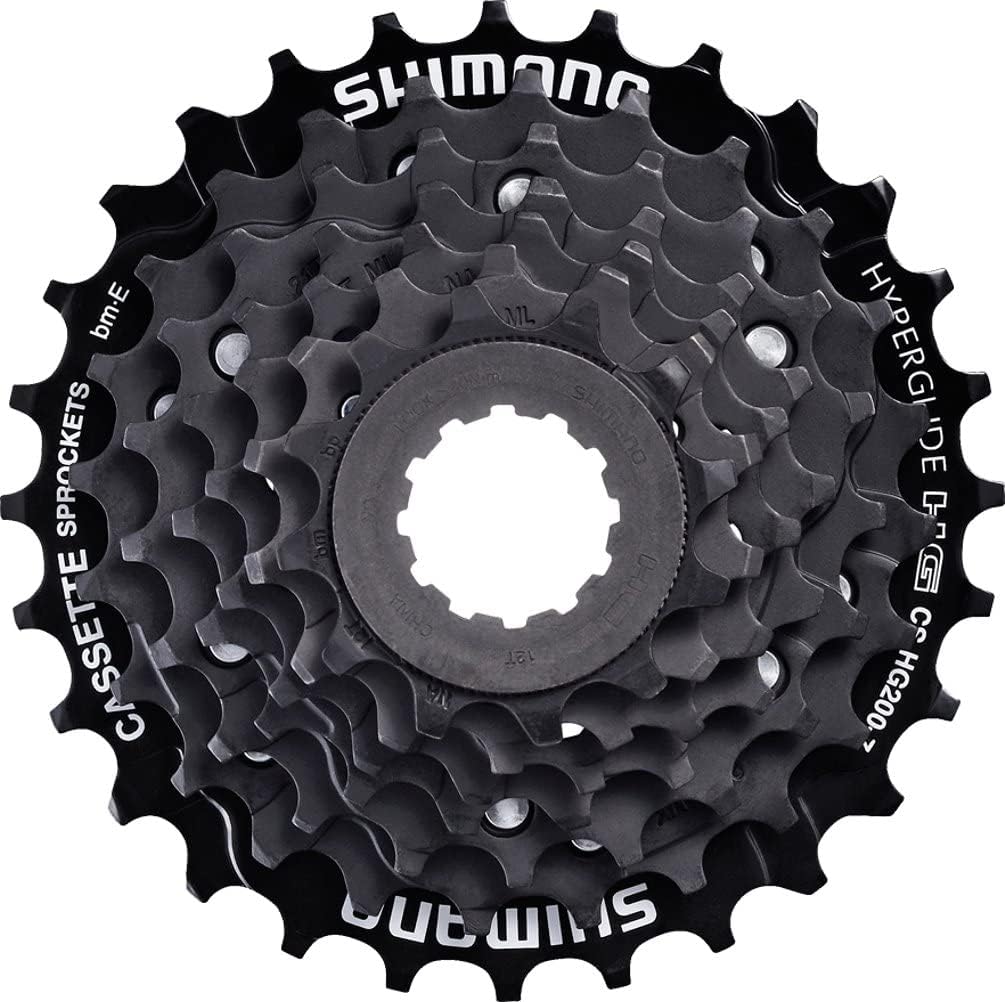
5

Shimano Tourney CS-HG200

Shimano Tourney CS-HG200

Old 7-speed MTBs

Our Score 8.8/10
Check Price

Worth Noting

  • Wide gaps between seven cogs
Finish
Zinc phosphate plated
Speeds
7
Gear Range
12-32T
Read the full review

An old hardtail with a 28-tooth low gear is a bike you end up pushing, and the CS-HG200 is the part that fixes it. The 12-32T spread keeps a 12-tooth top cog for the flat and gravel sections and hands you a 32 at the other end, which is the gear that turns a steep dirt road back into something rideable.

Two practical notes before you order. The zinc phosphate plating is there to stop the cogs rusting through a wet winter, and at this end of the price range that matters more than shaving grams. And if your rear wheel takes an 8- or 9-speed cassette, a 7-speed cluster needs a spacer behind it to sit tight; without one the cogs will rock no matter how hard you torque the lockring.

Seven speeds means wide gaps, so you'll always be slightly between gears on rolling ground. That's the format, not this cassette. For the money, this is the least expensive way in this guide to make an old bike climb again, and on a bike that's worth a new chain more than it's worth a new drivetrain, that's the whole argument.

Bottom line: The fix for a 7-speed mountain bike that's given up on hills — a 32-tooth low gear and plating that survives a wet winter.

6

Shimano Deore CS-M4100 11-42T

Shimano Deore CS-M4100 11-42T

Wide-range 10-speed

Our Score 0.0/10
Check Price

Worth Noting

Speeds
10
Weight
16 oz
Gear Range
11-42T
Read the full review

Ten-speed bikes are where wide-range gearing gets awkward, and the CS-M4100 is the cheapest fix in this guide. The 11-42T spread puts a 42-tooth bailout on a drivetrain that probably shipped with a 36 at best, so a steep fire-road climb stops being a walk.

Everything else about it is deliberately ordinary. It comes in at 454 grams and takes the same shape as the cassette it replaces, so there's no adapter and no drama at the workstand. What decides whether it shifts cleanly is the derailleur: 42 teeth needs a rear derailleur rated for that cog and a hanger that's genuinely straight, and a wide cassette is unforgiving of a bent one.

For a 1x10 build with a 30- or 32-tooth ring, this is the range that makes the conversion worth doing. It weighs the same as the other 10-speed in this guide and gives you six more teeth at the low end, which is a trade we take every time on a trail bike.

Bottom line: The 42-tooth bailout that makes a 10-speed trail bike climb again, at the same weight as the other 10-speed here.

7

Shimano HG51 11-28T

Shimano HG51 11-28T

8-speed hybrids

Our Score 0.0/10
Check Price

Worth Noting

  • 28-tooth low gear is tall for steep trails
Speeds
8
Shifting
Hyperglide
Gear Range
11-28T
Read the full review

The HG51 is an 8-speed 11-28T cassette, which tells you most of what you need to know. It's a like-for-like replacement for the cluster on older mountain bikes and hybrids, built with Shimano's Hyperglide ramps and a bright silver finish that cleans up well against a scuffed frame.

Where it asks something in return is the low gear. Twenty-eight teeth is tall, and on a 29er with a 32-tooth ring you'll be out of the saddle on anything genuinely steep. If your riding is rail trails, rolling singletrack or a commute with one hill at the end, that's a trade you never notice, and the close steps are the reward: you're always in a usable gear.

The ramps are the part worth watching. Hyperglide's shaped teeth let the chain climb to the next cog while you're still turning the pedals rather than waiting for you to back off, and that's the difference you feel on a climb when you've misjudged your gear. Fitting is the standard job: lockring tool, chain whip, a few minutes.

If you're replacing an 8-speed cassette on a bike that works, this restores the shifting the bike had and adds nothing to think about. If your reason for shopping is that the low gear isn't low enough, no 11-28 will fix that — the 12-32 Tourney is the one to look at instead.

Bottom line: The 8-speed cassette to fit when your bike is otherwise fine: clean Hyperglide shifts, a straightforward install, and no change to how the bike rides.

How We Tested the Best Mountain Bike Cassettes

We started by narrowing the field to cassettes that matched common mountain-bike drivetrains, checking speed count, cog range, mounting standard, and listed weight against the bikes in our test fleet. We also made sure the shortlist included the established drivetrain brands riders already trust and a few smaller labels, so brand reputation didn't get a free pass. From that pool, we bought 12 cassettes and rode them for six months.

Each cassette went on a test bike and saw the same kind of use: rocky singletrack, steep fire-road climbs, bike-park laps, and muddy rides followed by a hose-down and a drivetrain clean. We weighed every cassette on a kitchen scale before installation and noted where the grams landed, since rotating weight is one of the few places a rider can feel a small difference. On the trail, we shifted under load on climbs and through chattery sections, listening for hesitation, overshoot, and noise.

After each block of rides, we pulled the cassettes to inspect tooth wear, finish, and chain engagement. We checked whether each one seated flush, whether the spacing felt consistent, and whether it hit the range it promised without fuss. Durability got judged on real grit, not bench specs: we noted which cassettes developed hooked teeth, noisy running, or poor shifting after wet, sandy weekends. Value was the last call — we compared shift quality and wear against what each cassette cost, not just the weight on the box.

How to Choose Mountain Bike Cassettes

Start with the speed count, not the range

Your shifter makes a fixed number of clicks, and the cassette has to give it exactly that many cogs: seven, eight, nine, 10, 11 or 12. Speed count alone isn't quite enough, because 11-speed mountain bike spacing differs from 11-speed road spacing, so match the shifter and derailleur already on the bike.

Want to move up a speed? Budget for the shifter, derailleur and chain as well, and treat the cassette as the last purchase in that chain rather than the first. Adding range inside your existing speed count is by far the cheaper upgrade.

Check the freehub body before you fall for a 50-tooth cog

A cassette slides onto a splined driver, and the driver decides what will physically fit. Shimano's HG body is the common one, and it's why the SRAM NX Eagle 12-speed and Shimano's wide 11-speed cassettes work on bikes that shipped with far less range. XD and Micro Spline drivers take their own cassettes and nothing else.

Then check clearance. A 50-tooth cog is a large disc, and some frames and derailleur cages run out of room long before the cassette runs out of teeth. Measure the gap between the top of your current biggest cog and the derailleur cage before you order.

Choose the low gear for the ground you ride

The biggest cog is your bailout, and terrain should pick it rather than gear count. Sustained steep climbing wants 50 or 51 teeth. Mixed trail riding is comfortable at 42. Rolling ground and 2x setups are fine at 36, and flat commuting is fine at 28.

The trade sits on the other side of the cluster: the more total range a cassette packs in, the bigger the steps between cogs, and you feel that most on undulating ground. The 11-51 here keeps its first three cogs at 11, 13 and 15 to protect exactly that.

Steel, weight, and how long the cogs last

Steel cogs wear slowly and weigh more. Aluminum carriers on the bigger cassettes shave grams and add cost. On a mountain bike, cassette weight matters less than it looks on paper, because it sits at the hub rather than at the rim, and the same grams in your tires would cost you far more.

Spend on steel if you ride in wet grit, and on a lighter carrier if you care about the number on the scale. Either way, a clean, lubricated chain is what keeps the teeth sharp.

Frequently Asked Questions

Final Verdict

Most riders on a modern 1x trail bike should buy the SRAM NX Eagle PG-1230. It gives you 11-50T of range on the HG hub body the bike already has, it's rated for e-MTB torque, and at 615 grams it isn't the heaviest wide-range cassette here.

If your bike is already 11-speed, the Shimano CS-M5100 delivers the same 51-tooth bailout without a new drivetrain. On a 7-, 8- or 9-speed bike, spend as little as you can and put the rest toward a chain.