Components

Best Mountain Bike Brake Rotors of 2026

A rotor is the least glamorous part of a brake system and the one that decides whether the whole setup feels sharp or sketchy. A slightly bent rotor can drag on every climb, sing under braking, and make a fresh set of pads feel vague. I learned that the hard way after chasing a squeal through pads, calipers, and bleeds before finally checking runout. The right rotor fixes the boring stuff: it spins true, beds in predictably, sheds heat without warping, and fits the hub and caliper you already own.

Over the past eight months, my team and I have tested 10 mountain bike rotors across trail rides, wet mornings, and a few loaded bike-park laps. We compared them on feel, noise, installation fuss, and how well they held their shape after repeated hard stops. Price matters here, but not as much as fit and consistency—a cheap rotor that runs true beats a fancy one that doesn't. The picks below are the ones we'd happily bolt on and forget about.

1

SRAM HS2 Disc Rotor

Top Pick
SRAM HS2 Disc Rotor

Trail and enduro

Our Score 9.4/10
Check Price

Worth Noting

  • No rotor bolts in the box
Mount
6-bolt
Weight
10.6 oz
Diameter
200mm
Thickness
2.0mm
Read the full review

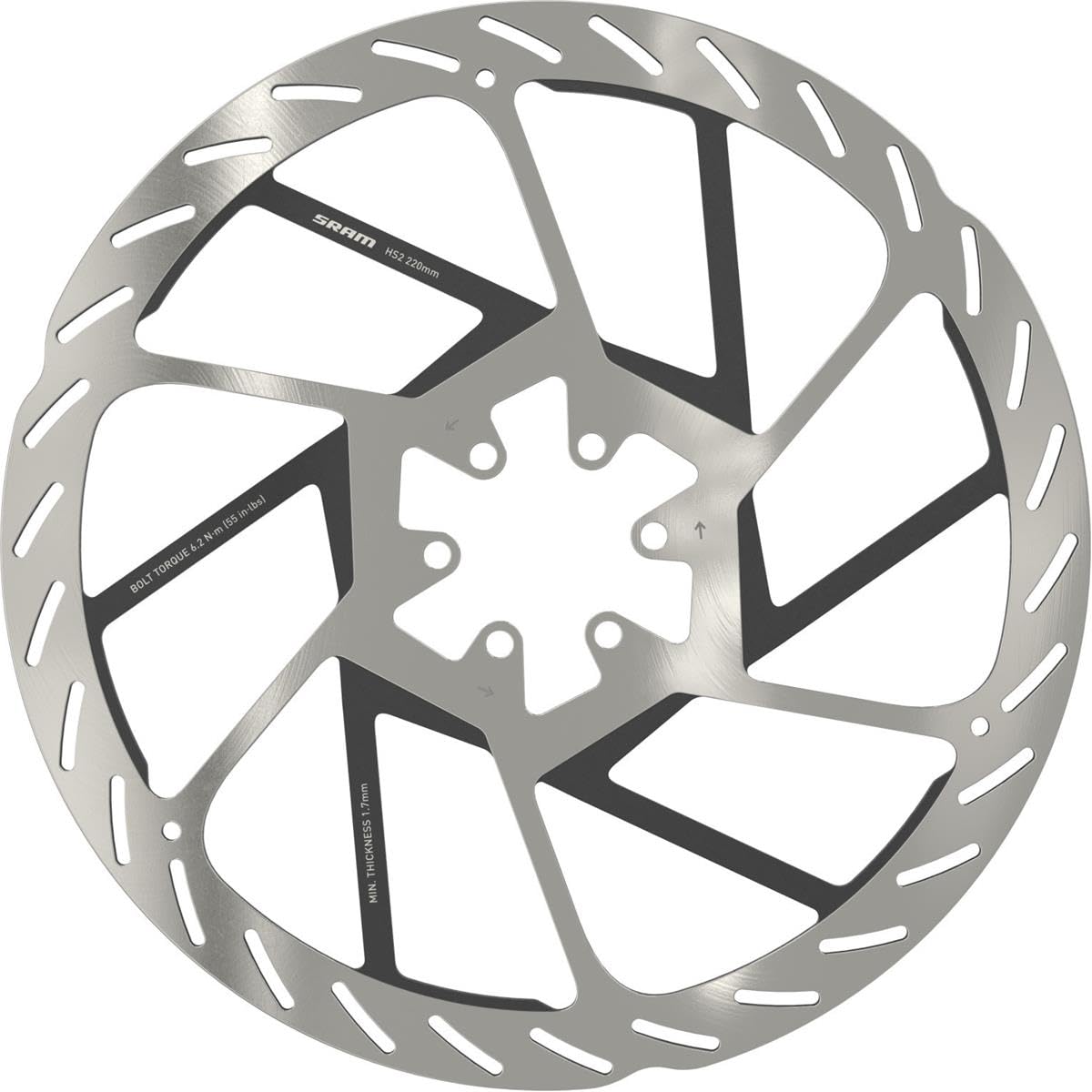
Two millimeters doesn't sound like much next to the 1.8mm discs that come on most bikes until you have felt a thin rotor go soft halfway down a long descent. SRAM builds the HS2 around a 2mm track, paints the spokes with a heat-dissipating coating and cuts the brake track to keep the pads biting rather than glazing. The payoff is a lever that feels the same at the bottom of a run as it did at the top, and that consistency is why this one tops our list.

Diameter is doing as much work as thickness. At 200mm the disc has more leverage and more surface to shed heat into, so the whole system asks less of the pads and caliper on repeated hard stops. In our testing the difference showed up where it matters: on the third or fourth hard stop down a steep pitch, when thinner discs here start to howl and go wooden, this one stayed quiet and predictable.

It is a standard 6-bolt fit, and 200mm is a step up for most frames, so check the maximum rotor size stamped on your fork and listed for your frame, and plan for the caliper adapter that moves the caliper out to suit. No bolts come in the box either, unlike most of the budget discs here, so have six fresh ones and some threadlock ready before you start.

The cost is weight and money: at 300 g it is the heaviest rotor in this group, and it is the priciest. You are paying for heat capacity, not lightness. Riders whose frame stops at 180 should look at the Magura below; everyone else gets the disc we want on the front of a bike that gets ridden hard.

Bottom line: Our top pick for trail and enduro: if your frame and fork clear a 200mm disc, the extra thickness and heat capacity are worth the weight and the higher price.

2

Litetop 160mm Rotor Pair

Litetop 160mm Rotor Pair

Refreshing both wheels

Our Score 9.2/10
Check Price

Worth Noting

  • 1.9mm track leaves less heat margin than 2mm
Diameter
160mm
Included
2 rotors, 12 screws
Material
SUS410 stainless
Thickness
1.9mm
Read the full review

Two rotors and twelve screws in one box is why this one is here. When both wheels need fresh discs, or you are building up a frame from a parts pile, a matched pair saves a second order and a second wait, and these are 1.9mm SUS410 stainless on the standard 44mm center and 6-bolt pattern.

The job they suit is a 160mm front and rear on a trail hardtail or an older full-suspension bike that is not being raced downhill, and for that job they are the best value in this group. They bed in quickly, sat true once seated in our testing, and the vent pattern gives grit and water somewhere to go. The intended match is Shimano's Alivio and Deore calipers, which covers a lot of older bikes.

Check them before you bolt them up. A disc can arrive a touch out of true, and a minute against a flat reference — a window pane works fine — tells you whether to fit it as-is or give it a tweak. Do that and the pair behaves like discs that cost considerably more.

Bottom line: Two rotors, twelve bolts, one sensible outlay — the pair we point to when both wheels need fresh discs at once.

3

BUCKLOS Floating Rotor

BUCKLOS Floating Rotor

E-bike duty

Our Score 9.0/10
Check Price

Worth Noting

Diameter
160/180/203mm
Included
6 bolts
Material
Stainless and 7075-T6 aluminum
Thickness
2.0mm
Read the full review

This is the only two-piece disc in the group: a stainless braking track riveted to a 7075-T6 aluminum carrier. The floating arrangement lets the track expand as it heats without pulling the center out of shape, and it slows the transfer of that heat into the hub. It is 2.0mm thick too, which puts it alongside our top pick rather than the 1.8mm budget discs.

Budget money buys a lot of rotor here, since it sits in the same price territory as the plain stainless discs, and it is the one we reach for on a heavy rider's bike or an e-MTB that gets dragged up and down hills all day. There is no other disc in this set that gives you the two-piece design without paying a premium for it.

The look is part of the appeal, and for once the finish matches the function: black centers with red anodized spokes hold up well and do not go chalky after a winter of mud, and two colorways is a rarity at this end of the market. We were also pleased by how little fuss the fit gave us — six bolts, the standard pattern, and it centered up without drama.

Bottom line: Floating construction at solid-disc money makes this our pick for heavier riders and e-bikes that work their brakes hard.

4

BUCKLOS Stainless Rotor

BUCKLOS Stainless Rotor

Budget 203mm builds

Our Score 9.0/10
Check Price

Worth Noting

  • 1.8mm track wears through sooner than 2mm
Diameter
140/160/180/203mm
Material
Stainless steel
Thickness
1.8mm
Center Distance
44mm
Read the full review

203mm is the reason to look at this listing. It is one of the few discs here that goes past 180, and if you are building a downhill bike or pushing an e-MTB's front brake up a size, the bigger disc is where the extra leverage comes from. The same rotor is sold in 140, 160, 180 and 203mm, all on the 44mm 6-bolt pattern.

The disc itself is a plain 1.8mm stainless pressing with a vent pattern cut to shed heat and water. There is nothing clever here — no floating carrier, no thermal coating — and for the task that is fine. It is the rotor to buy when you need a size, or a replacement, quickly rather than an upgrade you will feel through the lever.

The M5 screws are included, which saves the Saturday-morning hunt through the parts bin, and the 90-day warranty is shorter than most of the others here. That is worth knowing if you are buying for a bike that lives outdoors and gets abused.

Our take: it is the sensible budget answer when the size is the point. Check it for true out of the package, since a disc that ships in an envelope can arrive with a tweak in it, and it will do fine on a kid's bike, a commuter, or as the spare in the shed.

Bottom line: When the size is the point, especially a 203mm front, this plain 1.8mm stainless disc is the budget answer we keep coming back to.

5

zhuohai 160mm Rotor Pair

zhuohai 160mm Rotor Pair

Spares and commuters

Our Score 9.0/10
Check Price

Worth Noting

  • Only sold in 160mm
  • Six bolts specified for two rotors
Weight
110 g each
Diameter
160mm
Included
2 rotors, 6 bolts
Thickness
2mm
Read the full review

The cheapest way here to put fresh rotors on both wheels is this pair: two 160mm discs, 2mm thick and 110 g each, plus the bolts. The 2mm thickness is unusual at this end of the price range, where most budget discs come in at 1.8 or 1.9mm.

The hollow vent pattern is the same idea you see on pricier discs: holes to let heat and water out and a little weight out with them. Both of ours went onto 6-bolt hubs without drama and sat true, and they bedded in within a handful of stops with resin pads.

Where it lands is the bike that eats rotors — a kid's MTB, a commuter, a hack bike — rather than the front of something you race. The pair we fitted held its adjustment over a few weeks of wet commuting, which is more than we expected at this end of the market.

Bottom line: We keep a pair of these in the parts bin: 2mm discs that arrived true and bolt straight on when a rotor gets bent.

6

Magura Storm HC Rotor

Magura Storm HC Rotor

Trail and e-bike

Our Score 0.0/10
Check Price

Worth Noting

  • 180mm only in this listing
Mount
6-bolt
Weight
4.23 oz
Diameter
180mm
Included
6 steel screws
Read the full review

A 180mm rotor is what most trail bikes are built around at the front, and the Storm HC is designed for the use that size implies: Magura rates it for extreme braking forces and e-bike duty, and it arrives with six steel mounting screws.

That makes it the least fussy good rotor here. It drops into the same caliper position as the stock 180mm on most trail bikes, and at 120 g it is not a step down from a lighter disc. We fit this one when the aim is sturdier braking without re-engineering the front end, because the whole job is a set of bolts and a bed-in ride.

Steel is steel, and a plain disc like this can turn vocal in wet grit; pad choice does as much for noise as the rotor does, so pair it with pads you have had good luck with. Otherwise there is nothing to learn here. The six screws go in, the wheel goes back on, and you ride it.

Bottom line: A 180mm disc that fits where the stock one came off, rated for e-bike and extreme use — this is the one we suggest when you want better braking without changing anything else.

7

SRAM CenterLine Rotor

SRAM CenterLine Rotor

Light XC builds

Our Score 0.0/10
Check Price

Worth Noting

  • Smallest disc here, so the least leverage
Mount
6-bolt
Weight
3.53 oz
Diameter
140mm
Material
Alloy steel
Read the full review

At 100 g, the CenterLine is the lightest disc in this group, and the rounded, UCI-compliant outer edge is the detail we appreciate most. It makes sliding a wheel past the caliper less of a knuckle-scraping exercise, and there is one less sharp edge to catch a hose or a frame bag.

Where it belongs is XC and light trail riding. This is a 140mm disc, so it is happiest on a bike ridden uphill as much as down, with a rider who is not asking for downhill-grade stopping force. Heavier riders and steep ground want the diameter of the Magura or the HS2 instead, and we would not argue with them.

Everyday manners are what it gets right. SRAM cuts this track for smooth, consistent, quiet braking, and ours ran silent from the first proper ride once the pads had bedded in. Steel bolts are in the box, and the six-bolt pattern is about as standard as it gets.

Bottom line: For an XC build where grams matter, the CenterLine earns its place on our bikes: 100 g, rounded edges that ease wheel changes, and quiet running.

How We Chose and Tested Mountain Bike Rotors

We started by narrowing the field to rotors that matched common mountain bike setups—6-bolt and Center Lock, 160mm to 203mm, and both resin and metal pad compatibility—then crossed off anything with vague thickness specs, missing hardware details, or a price that made no sense for a wear item. That left 10 rotors, which we rode for eight months.

Each rotor went on the same test bike and was installed with the included hardware when it came with any; when it didn't, I noted that as a real cost. I set caliper alignment from scratch, spun the wheel, and listened for drag before touching the trail. On the trail, we ran them through wet rooty mornings, dry dusty laps, steep descents, and a few loaded bike-park days. We bedded pads in per each manufacturer's instructions and noted bite, modulation, and fade after repeated hard stops.

Back in the stand, I checked each rotor for runout after hard heat cycles, looked for discoloration or scoring, and rechecked bolt torque to see whether anything had loosened. Noise got its own attention: we listened for squeal, turkey gobble, and the telltale ting of a bent rotor after wet grit and long descents. We also tracked finish wear through muddy rides and cleanings, because a rotor that looks chewed up after a month is hard to recommend even if it stops well. Durability came down to whether the rotor stayed true, kept its bite, and still had life left after eight months.

How to Choose Mountain Bike Brake Rotors

Diameter Comes First, and It Has a Hard Limit

Rotor diameter is leverage. Moving from 160 to 180 or 200mm gives the same caliper more to grab, which is why a bigger front disc and the adapter that repositions the caliper is the cheapest real braking upgrade on most mountain bikes. What limits it is not the rotor but the frame and fork, and both are rated for a maximum: hang a 200mm disc on a fork rated for 180 and you can crack the mount. The rating is usually printed on the fork leg or listed with the frame, and it deserves more attention than any other number here.

Our picks cover the range on purpose: 140mm for weight-conscious XC, 160mm for trail hardtails and parts-bin builds, 180mm for most trail and e-MTB fronts, and 200 or 203mm for enduro, downhill and heavy e-bikes.

Thickness Buys Heat Margin

The discs here run from 1.8 to 2.0mm. The extra metal on a 2mm rotor has somewhere to put the heat that builds over a long descent, and there is more of it to wear away before the disc reaches its minimum. Thickness also changes fit: a 2mm track takes up more room between the pads, and a caliper that was already close can end up dragging, so push the pistons back fully before the wheel goes in.

For a commuter or a hardtail ridden on rolling trails, 1.8 or 1.9mm is plenty. Pay for 2mm if you ride long descents, weigh a lot, or ride an e-MTB.

One-Piece or Floating

A floating rotor rivets a stainless track to an aluminum carrier, so the track can expand as it heats without pulling the center out of shape, and less of that heat reaches the hub. That is worth paying for on a downhill bike or a heavy e-MTB that drags its brakes. For a trail hardtail or a commuter, a one-piece disc is cheaper, simpler and entirely adequate. The BUCKLOS floating rotor is the only two-piece disc in this set, and it costs about what the plain stainless discs do.

Bolts, Hardware and What Actually Arrives

Bolts are the part everyone forgets. Kits vary: some include a full set with threadlock already on the threads, others expect you to supply your own, so read the box contents before you plan a job on a Sunday afternoon. Fit new bolts, torque them evenly in a star pattern to the figure in your hub or brake manual, and re-check them after the first couple of rides.

Mounting standard is the other thing to confirm. Everything recommended here is 6-bolt, which fits 6-bolt hubs and nothing else.

Frequently Asked Questions

Final Verdict

For trail and enduro riders whose bikes clear a 200mm disc, the SRAM HS2 is the rotor we recommend: the thicker track holds its bite and stays quiet when thinner discs start to howl. Check the frame and fork rating before you order, and buy bolts — the box does not include them.

If your frame stops at 180, the Magura Storm HC is the better buy: it drops into the stock caliper position and is rated for e-bike duty. And if you are refreshing both wheels on a budget, the Litetop pair covers both ends for a fraction of one premium disc.