Components

Best Mountain Bike Shifters of 2026

A mountain bike shifter is basically a ratchet with a cable attached, yet the gap between a good one and a cheap one shows up on every climb. Lever throw, detent spacing, and the way the cable seats in its channel decide whether a click lands as a clean shift or a chain grinding between gears. I've owned shifters that felt crisp in the workstand and turned vague and sticky the first time grit worked its way under the pod. What you're actually buying is a shift you don't have to think about.

My team and I spent the past eight months installing, adjusting, and riding 12 shifter sets on trail bikes, hardtails, and one stubborn parts-bin build. Some clicked cleanly out of the box and held their indexing for months; others needed a barrel adjuster tweak before they'd stay in gear. One thing I'd tell a first-time buyer: match the shifter to the drivetrain you already have, because speed count and cable pull have to agree, and a mismatched set won't index properly no matter how carefully you install it. Every pick below earned its spot on shift quality, not on spec sheet claims.

1

Shimano Altus SL-M315-7R

Top Pick
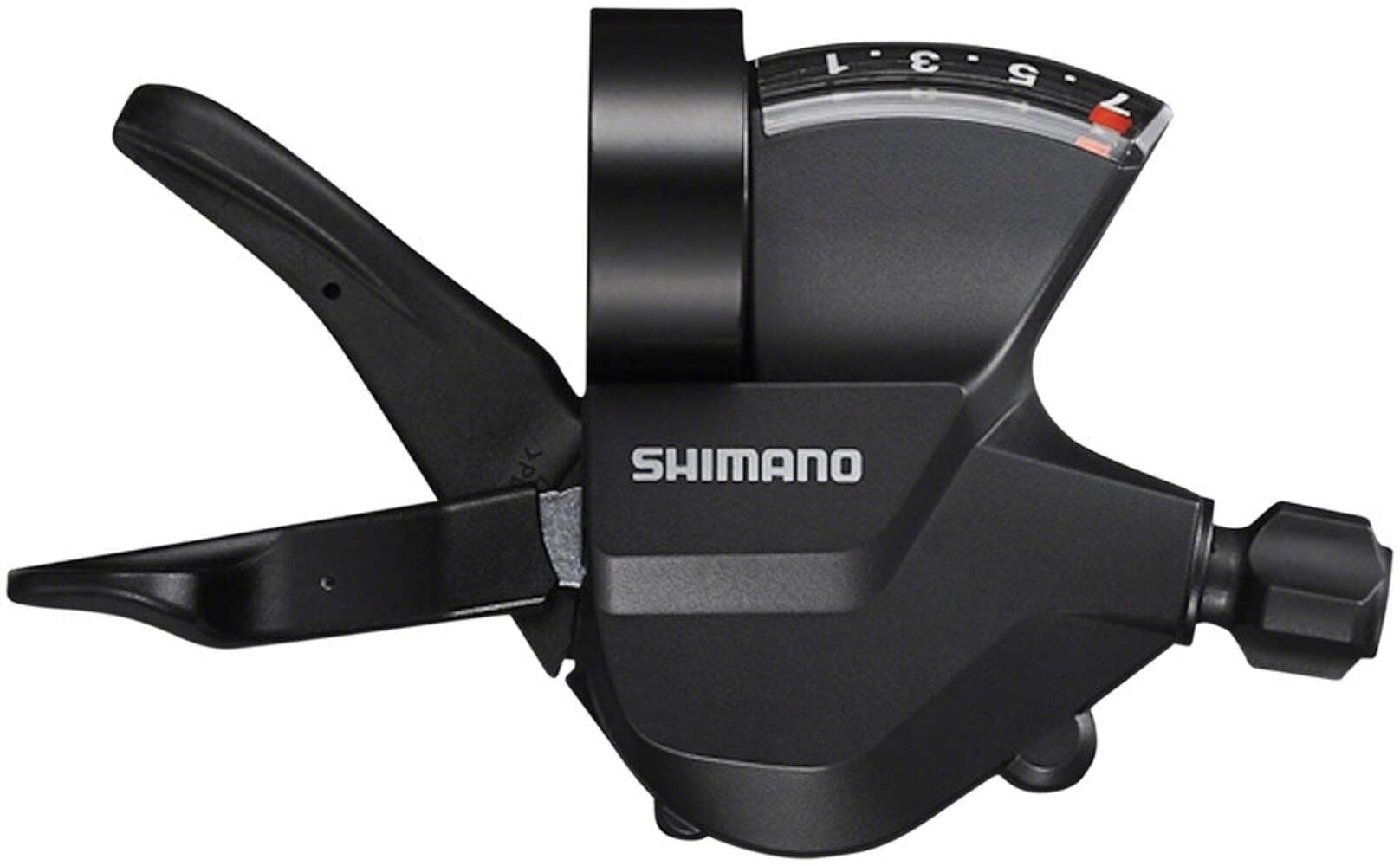
Shimano Altus SL-M315-7R

Budget 7-speed MTBs

Our Score 9.4/10
Check Price

Worth Noting

  • Right-hand lever only
  • No cable housing in the box
Speeds
7-speed, right hand
Gear Display
Numbered window
Shifter Type
RapidFire Plus trigger
Included Cable
OPTISLICK inner cable
Read the full review

A stiff twist grip is why a lot of perfectly sound mountain bikes end up parked in the garage. The Shimano Altus SL-M315-7R is the part that ends that on any 7-speed rear end: one clamp, one cable, and a trigger pair under the bar instead of a grip you have to wrestle through a full wrist turn.

We fitted this lever to a tired hardtail, and what keeps it at the top of this list is how little it asks of you. The inner cable arrives already threaded through the body, so the swap runs: put the old shifter in the gear you want to start from, slide the grip off, clamp the new body on, run the cable back to the derailleur, and index. Nothing in that job needs a shop stand, and the lever's clicks are distinct enough that you know where you are by feel before you look at the window.

Shimano's RAPIDFIRE Plus layout gives two ways to release cable, a thumb push or an index-finger pull, which is the detail that makes this lever work for children and for adults who never got comfortable with a finger pull. The thumb can sweep up to three cogs in one stroke, so you drop into a climbing gear on the approach to a rise rather than one click at a time. The numbered window sits below the bar, readable without tilting your head.

Two things to plan for. It is the right-hand lever only, so a 3x7 bike still needs a front shifter, and the box holds the inner cable but not the housing. If the old outer sleeve is kinked or frayed, order housing in the same basket. Long frames and anything converted to bigger wheels are worth measuring before you cut the cable to length.

Bottom line: The best-value fix in this group for a stubborn 7-speed bike: a light trigger, two ways to release cable, and a gear window you can read without looking down.

2

Shimano Deore SL-M6000

Shimano Deore SL-M6000

1x10 trail bikes

Our Score 9.4/10
Check Price

Worth Noting

  • 10-speed rear derailleurs only
  • Clamp band needs its own bar space
Clamp
Band-on
Speeds
10-speed, right hand
Gear Display
Optical indicator
Shifter Type
RapidFire Plus, 2-Way Release
Read the full review

If your bike runs ten cogs behind a single chainring, there is only one lever to think about, and this is the one we point at. The Deore SL-M6000 is a compact alloy-bodied trigger with a light thumb action and a cable adjuster built into the lever body, so a stretched cable can be taken up at the trailhead instead of in the workshop.

Shifting has the familiar Shimano shape to it: a push to drop a cog, a press or a pull on the release paddle to come back, and an optical window above the bar showing where you are. We minded the single-gear release far less than expected. Shimano lists this lever without instant or multi-release, so each push moves one cog, and on a one-ring bike that turns out to be most of what you need, since there is no front shift to coordinate with it.

What you are paying for is the mechanism. The pivot feels tight rather than wobbly, the clicks stay distinct, and the body sits close under the brake lever where a stray knee is less likely to find it. That combination is what makes a shifter disappear from your attention, which is the highest compliment a part like this can earn.

The little barrel adjuster is the feature we have come to value most. A quarter turn at a red light, or on a fire road halfway up, is the difference between a ride spent listening to the chain rub and one spent riding. Pair it with a fresh inner cable and it behaves like a much more expensive lever.

Bottom line: The lever we point at for a 1x10 mountain bike: alloy body, light thumb action, and a cable adjuster on the lever body for mid-ride tuning.

3

SRAM MRX Comp Twist Set

SRAM MRX Comp Twist Set

Twist-shift rebuilds

Our Score 9.0/10
Check Price

Worth Noting

  • Rear indexing is 7-speed only
  • No cable housing included
Speeds
3 x 7-speed set
Included
Inner cables and grips
Shifter Type
Twist grip
Front Shifting
Friction
Read the full review

The left half of the SRAM MRX Comp does not click. It is a friction shifter, and that is exactly why the set works: with no indexing to match, the front twist grip will drag any major brand of front derailleur across a double or triple chainring, including the mismatched combinations that make old bikes shift badly.

The right side is the indexed one, a 7-speed twist grip with the inner cables already threaded through both units and a pair of stationary grips in the box. We appreciated that completeness. New grips alongside new shifters is the difference between a bike that feels rebuilt and one that feels patched, and the grips here are thicker than the skinny originals on older hybrids.

Twist shifting divides riders, and we can see both sides. Rotating the whole grip through several gears in one motion is quick, works with gloves, and is the format a lot of people learned on. The trade-off sits at the front, where friction means no clicks to guide you: you trim the derailleur by feel and by ear until the chain stops rubbing. Riders who want every shift to announce itself should choose a trigger set instead.

It is a 7-speed rear, full stop, so this is a set for older mountain bikes, hybrids and kids' bikes rather than anything with a wide-range cassette. Within that world it is the least fussy way to put new grips and new cables on the bar in one job.

Bottom line: A complete twist-shift refresh for a 7-speed bike, with cables already threaded and grips in the box, plus a friction front that forgives almost any derailleur.

4

MEGHNA 3x7 Twist Set

MEGHNA 3x7 Twist Set

Kids and older bikes

Our Score 8.8/10
Check Price

Worth Noting

  • Plastic bodies suit light-duty riding
Speeds
3 x 7-speed set
Cable Length
180 cm front and 210 cm rear
Shifter Type
Twist grip
Handlebar Fit
0.87 in (22.2 mm)
Read the full review

Four pieces come out of the bag: a 3-speed left twist shifter, a 7-speed right one, and a pair of grips to slide on behind them. That completeness is the whole pitch, one order covering a 3x7 bike without a separate hunt for grips, and it is why we reach for this set when the bike in question has to be fixed for as little as possible.

Cable length is the detail that makes it more useful than the packaging suggests. The front cable runs 180 cm and the rear 210 cm, both longer than a typical factory fit, so the set works on kids' bikes, long-wheelbase hybrids and anything where the original cable left a tight kink at the head tube. The bodies clamp onto standard 0.87-inch (22.2 mm) bars, and one wrist rotation can cross several gears instead of clicking through them one at a time.

We are not going to pretend this is a trail-grade part. The bodies are plastic, the grips are on the firm side, and the long haul is where a budget set gives up first. Give yourself an hour rather than half of one for fitting, because getting the rear to run quietly through all seven cogs is the part that separates a satisfying install from a frustrating one, and the indexing rewards patience.

Put it on a kids' bike, a commuter or a rebuild you are handing to a neighbor, and those compromises sit where they belong. Put it on a bike that gets ridden hard every weekend and the plastic is the part you will replace first.

Bottom line: One order puts a 3x7 bike back on the road with both shifters, both grips and unusually long cables, which makes it our light-duty pick for kids' bikes.

How We Tested a Dozen Shifter Sets

We started by rounding up every trigger and grip shifter we could get our hands on across 1x11, 1x12, and 2x10 setups, then cut the field to 12 by checking speed compatibility, clamp diameter, what actually comes in the box, and whether replacement cables and housing are easy to source a few years down the road.

Each set went onto a bike in my garage with a stopwatch running. We timed a full install from bare bar to indexed, noted whether the included cable and housing left enough length for a wide bar with internal routing, and flagged the sets that shipped with no cable at all, since that's money you don't see in the listing price. We checked clamp fit on a standard bar without shims, and we adjusted lever reach and cable tension to see whether the barrel adjuster could be turned by hand or needed a tool.

Then we rode them: a wet late-winter stretch on rooted singletrack, weekly gravel climbs where you're shifting under load, and a bike park weekend that hammers everything. We shifted mid-climb under power, dumped several gears at once at the bottom of a descent, and re-tensioned cables trailside to find out how the action held up once mud was involved. Grip mattered more than I expected. With wet gloves, a narrow thumb paddle or a slick grip-shift collar cost us shifts.

At the end, we pulled the cables to look for fraying at the anchor bolt, checked the detents for wear and the lever bodies for play, and re-indexed each set after a fresh cable to see if it held its settings. Value came down to whether the extra spend bought something you could feel on the trail, like crisper detents or a lighter action, rather than a nicer finish.

How to Choose Mountain Bike Shifters

Match the index count first

Shifters are sold by the number of gears they index, and that number has to match the cassette on your rear wheel. A seven-speed lever pulls cable in seven steps; on a ten-speed cassette it will never reach the outer cogs cleanly, however much you turn the barrel adjuster. Count the cogs before you order, then work out whether you need the left lever too, because on trigger and thumb levers the two sides are separate parts. The rear is the side that wears out first, which is why right-hand-only levers are the common replacement.

Trigger, twist, thumb, or integrated

The choice comes down to how much hand you want to use. A trigger shifts with a thumb push and an index pull from a fixed position, and it keeps working when your hands are cold or wet. A twist grip rotates the whole grip and can cross several gears in one motion, but it takes grip strength and it is the format most often blamed when a kid refuses to shift. Integrated shift/brake levers save a clamp and a stretch of bar, and they tie the two jobs together, so when the brake half wears out you replace both. Check which brake type an integrated lever is built for: a linear-pull lever paired with a mechanical disc caliper changes the braking you get.

Room on the bar and grip length

Bar diameter is rarely the problem, since 22.2 mm at the grip end is the mountain bike standard, but space is. A clamp-band shifter needs its own clean stretch of bar between the grip and the brake lever, and swapping a twist grip for a trigger leaves a gap where the twist body used to sit. Plan on a fresh grip on that side; a lock-on grip lets you slide it to wherever the gap ends up. Direct-mount levers that bolt to the brake lever body avoid the squeeze, but both halves have to be designed for each other.

Cables, housing, and getting the indexing right

Most levers arrive with the inner cable already threaded through the body, and almost none include the housing. If the old outer sleeve is kinked or cracked, replace it at the same time: a new lever pulling against a draggy housing will index badly and feel heavy, and no amount of adjustment fixes that. Fit the new lever while the old one is still sitting in a known gear, so the cable lands in the same position, then tune with the barrel adjuster a quarter turn at a time until the chain runs quietly through the whole cassette.

Where the money actually goes

Two levers that look alike can differ inside. Metal ratchets and tight pivots hold their indexing; plastic bodies and thin cables stretch and wear. For a kids' bike, a commuter or anything that lives outdoors, a cheap set with long cables is the sensible spend. For a bike you ride hard, pay for the mechanism. The difference between the Deore lever's alloy body and the plastic on the budget twist sets is that decision in miniature.

Frequently Asked Questions

Final Verdict

Start with the Altus SL-M315-7R. On the 7-speed bikes most people are actually repairing, it is the best-value part here: a light trigger, a three-cog sweep and an install that needs one cable and one clamp. If your bike runs ten cogs behind a single ring, the Deore SL-M6000 is the better match and worth the step up.

And if you prefer rotating a grip to pushing a lever, or you want new grips in the same box, the SRAM MRX Comp set does both sides at once.