Accessories

Best Bike Cargo Trailers of 2026

The first time I tried to bring home a 40-pound bag of potting soil on a rear rack, I learned what bike commuters already know: panniers have a ceiling, and it's low. A cargo trailer turns any bike into a small pickup — groceries, lumber, camping gear, even a dog crate — but only if it tows well behind you. A loaded trailer that shimmies at speed, rattles over cracks, or wanders toward the next lane makes every errand feel reckless. I've spent the past six months towing nine different trailers around town to see which ones actually behave.

The differences come down to things the spec sheets don't emphasize. Wheel size, hitch design, and where the load sits matter more than the claimed weight limit, and a trailer rated for 100 pounds that tracks straight beats one rated for 150 that fights you. Assembly varies wildly too — some went together in twenty minutes with the included wrench, others took an afternoon and a second set of hands. What the good ones share is that they feel like part of the bike, not a shopping cart lashed to the seatpost. The picks below run from stripped-down folders you can stash in a closet to heavy-duty haulers built for mulch runs.

1

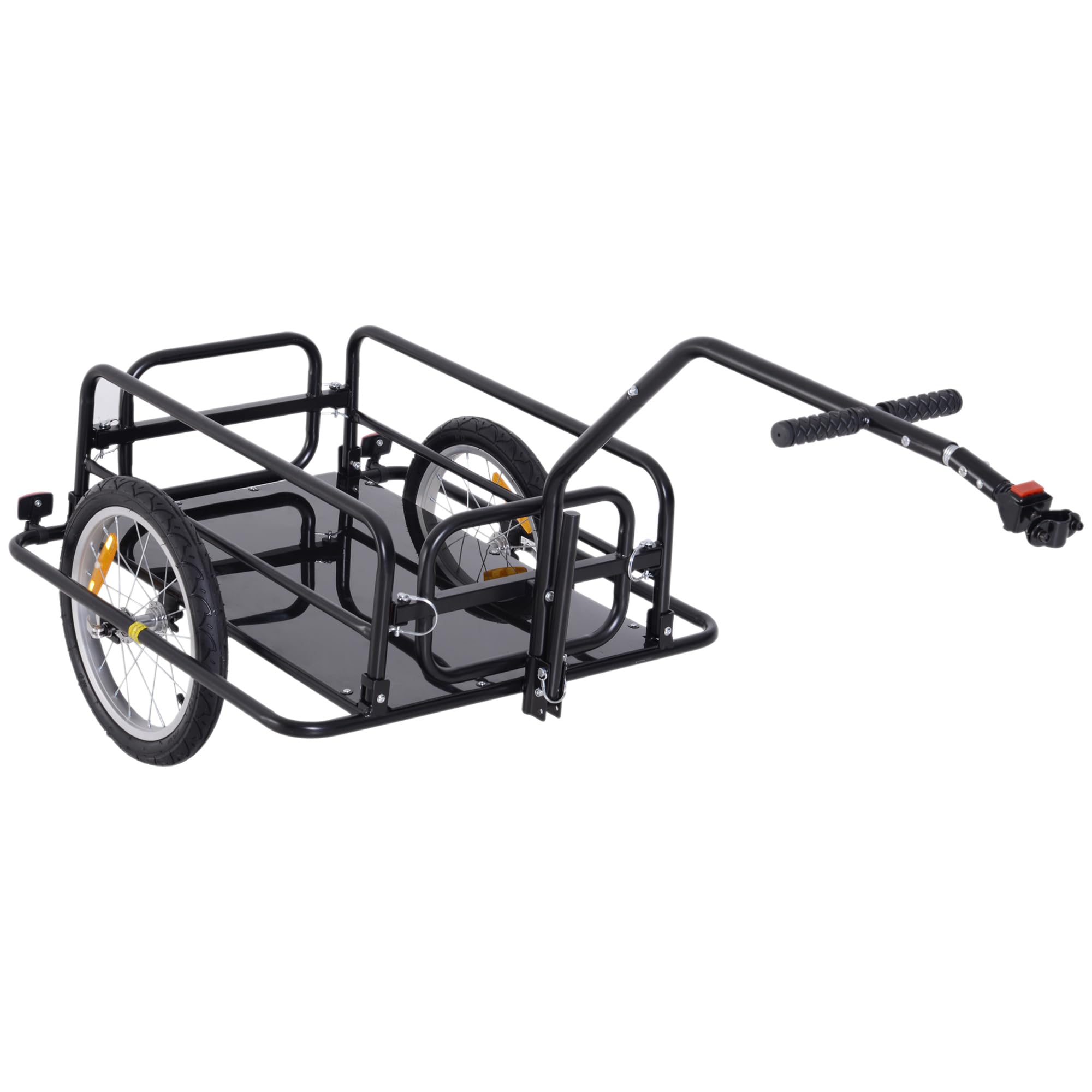
Xspec 2-in-1 Trailer

Top Pick
Xspec 2-in-1 Trailer

Cart conversions

Our Score 9.6/10
Check Price

Worth Noting

  • Not designed for quick-release bikes
  • Cargo box limits oversized loads
Cargo Box
22"L x 15"W x 12"H approx.
Load Capacity
88 lb
Trailer Weight
28 lb
Pushcart Dimensions
35"L x 23"W x 35"H
Read the full review

The Xspec solves the last-fifty-yards problem: we towed it to the store, unhitched it, flipped the front wheel down, and pushed the loaded box through the parking lot instead of carrying bags. The conversion is quick enough that we used it more than we expected. The waterproof cover fits snugly and kept a grocery run dry in a drizzle, and the removable box means you can lift the whole load off the frame when you get home.

With an 88-pound capacity and a cargo box around 22 by 15 by 12 inches, it is an errand trailer rather than a moving van. A case of water and a bag of groceries fill it quickly, and tall boxes need a strap. The trailer felt stable behind a commuter bike, with no wobble we could detect, and the six reflectors are a sensible touch for evening trips.

The catch is the coupler: Xspec's design is not for quick-release bikes, so check your rear axle before you order. We also found the box less useful for long lumber than an open flatbed. For park trips, beach gear, pet supplies, or grocery runs where you want a covered box and a pushcart mode, it is a clever choice; for heavy or oversized cargo, the VEVOR and PEXMOR are more capable.

Bottom line: We like the Xspec for errands that end in a parking lot: the box cover, pushcart conversion, and stable ride make it a clever second set of wheels.

2

Burley Flatbed

Burley Flatbed

Long flat loads

Our Score 9.4/10
Check Price

Worth Noting

  • 100-pound load limit
  • Premium price
Load Capacity
100 lb
Frame Material
Aluminum
Trailer Weight
15.1 lb
Unfolded Dimensions
33"L x 30.9"W x 16.1"H
Read the full review

There is no box, no cover, and no sides on the Burley Flatbed, and that is the point. We strapped a long flat box across the deck that no wagon-style trailer here could swallow, and the two-wheel chassis tracked so calmly that we forgot it was back there on a straight paved path. The aluminum frame is the other half of the appeal: this is a 15.1-pound trailer that does not fight you when you lift it out of the car.

The 100-pound rating is lower than the VEVOR's, so this is not the pick for a load of wet firewood or a stack of bricks. What it does better is carry awkward shapes: lumber, a folded table, a paddleboard bag, or a cooler that needs to sit flat. The open deck means you supply the straps, and there is no weather protection unless you add a tarp or a cargo bag. We found the push-button wheels and compact fold genuinely useful at the end of a trip.

The Burley hitch is the detail that sells it for touring and mixed-surface riding. It felt secure on a crushed-limestone path, and the trailer stayed planted when we shifted weight around. If you want a premium flatbed for long gear and do not need a box, this is the one we point to; if you need weather cover or a higher load rating, look elsewhere in this group.

Bottom line: We choose the Burley Flatbed when the load is long and awkward; its light aluminum deck tracks beautifully, though the open tray and 100-pound limit are the trade-offs.

3

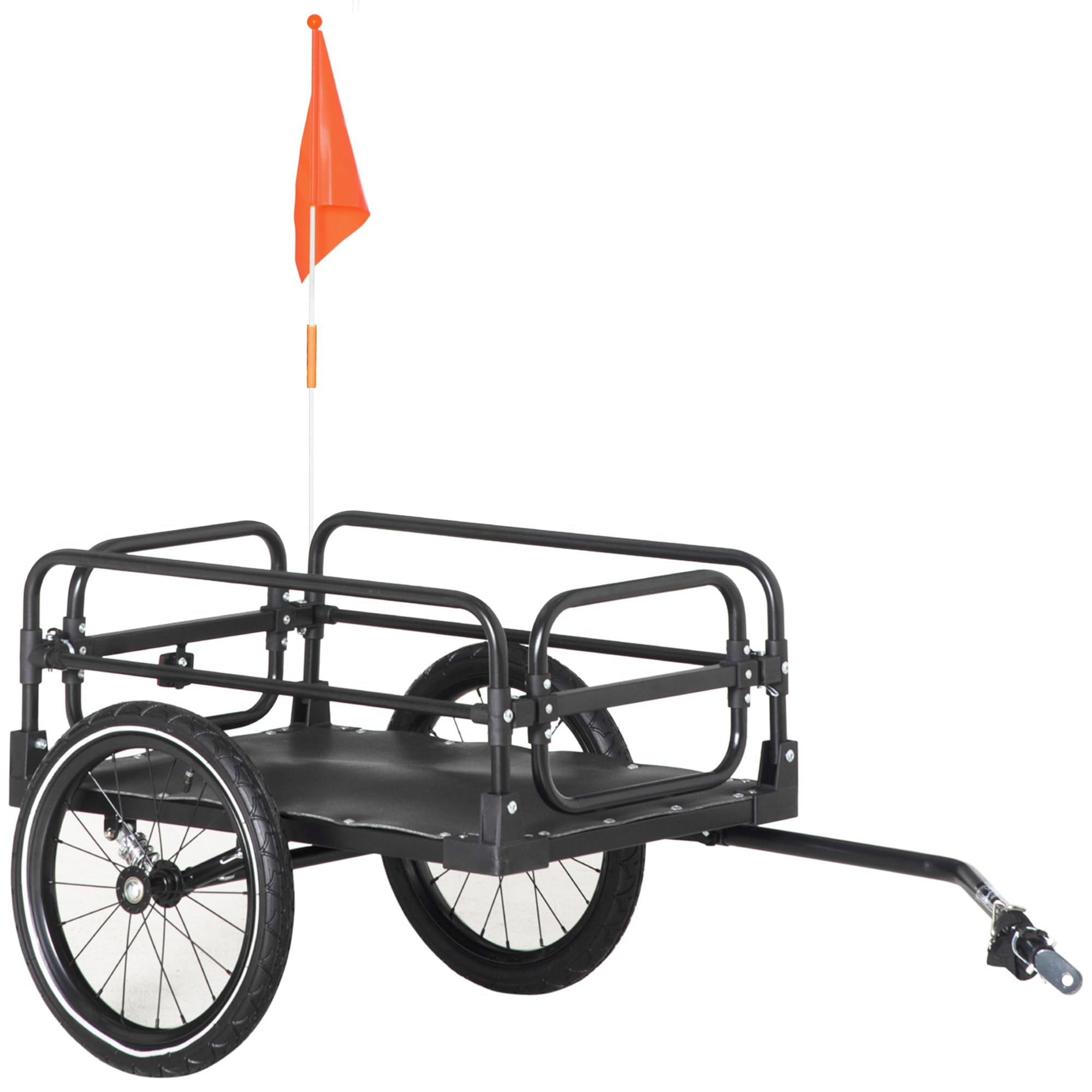
Aosom Suspension Trailer

Aosom Suspension Trailer

Rough paths

Our Score 9.0/10
Check Price

Worth Noting

  • 88-pound load limit
Suspension
Yes
Load Capacity
88 lb
Trailer Weight
27.3 lb
Trailer Dimensions
49.25"L x 25.25"W x 21"H
Read the full review

Suspension is the reason to look at this Aosom. We took it over a crushed-stone path with a load of camping gear, and the trailer took the chatter out of the ride that a rigid-frame wagon sends straight up through the hitch. The 16-inch wheels and the two-wheel chassis keep it planted, and the red flag and reflective strips are useful when an evening errand runs long.

The 88-pound rating is the limit to respect: this is a grocery-and-gear trailer, not a furniture mover. We also found the 49.25-inch length easy to store against a garage wall, and the fold-down frame saves space when the trailer is not in use. For rough pavement, gravel paths, and riders who feel every bump, it is the most comfortable trailer in this group.

The suspension does not change the load rating, and the trailer still needs a low, centered load to feel settled. We kept the heavy gear over the axle and the lighter items toward the rear, and it tracked without the side-to-side wag we have felt from shorter, taller trailers. The 88-pound ceiling is the number that decides whether this one belongs in your stable; for light cargo on bad surfaces, it is an easy recommendation.

Bottom line: We pick the suspension Aosom for rough paths and light cargo; it smooths the ride and folds away, but the 88-pound rating keeps it out of heavy-haul duty.

4

VEVOR Bike Cargo Trailer

VEVOR Bike Cargo Trailer

Heavy cargo

Our Score 8.8/10
Check Price

Worth Noting

  • Heavy 28.7-pound frame
Bike Fit
22 to 28 inches
Load Capacity
160 lb
Trailer Weight
28.7 lb
Trailer Dimensions
55.51"L x 28.74"W x 21.65"H
Read the full review

A 160-pound load rating is the reason the VEVOR leads this group. We filled it with a week of groceries, a case of water, and a bag of tools, and the 16-inch tires rolled over pavement joints without the nervous shimmy we expected from a loaded wagon. The steel frame feels planted, and the folding sides make it easy to drop a duffel or cooler into the bed. It is the trailer we recommend first for errands that are too heavy for panniers.

The hitch is a universal design that fits 22- to 28-inch bikes, and we appreciated being able to swap it between a commuter and a mountain bike without a new bracket. Setup is straightforward, though the deck edge is sharp enough that we kept a glove on while fitting the panels. The folded package lives in the garage without complaint, but this is not a trailer you lift onto a roof rack one-handed.

The practical limit is the axle and tires when you push toward the top of the rating. We kept heavy items centered over the axle and checked pressure before each loaded ride, and it behaved well. If you routinely carry more than 160 pounds, choose a different design; for grocery runs, camping gear, and small tools, the VEVOR is the default.

Bottom line: We recommend the VEVOR for heavy grocery runs and gear hauls: it carries 160 pounds, folds for storage, and fits most bikes without a new hitch.

5

Burley Travoy

Burley Travoy

Compact commuting

Our Score 8.8/10
Check Price

Worth Noting

  • 60-pound load limit
  • Premium price
Hitch
Quick Hitch
Dimensions
11.5"L x 15.5"W x 37"H
Load Capacity
60 lb
Trailer Weight
11.2 lb
Read the full review

The Travoy is less a wagon than a rolling bag you can tow. It folds down to roughly briefcase size with twist handles and push-button wheels, and at 11.2 pounds it is the trailer here we can carry in one hand. The upright tow design keeps it close behind the bike, and the quick hitch moves it from one bike to another without tools.

We used it as a hand cart for a grocery run and liked that the tow arm and wide kickstand let it stand upright while we loaded it. The 60-pound rating is the catch: this is for a laptop bag, a small shop, or a week of light groceries, not a sheet of plywood or a case of paint. It also costs as much as the Burley Flatbed, so you are paying for the fold and the hand-cart mode rather than capacity.

For a folding-bike commute, a train-to-office trip, or a market run where storage is tight, the Travoy is the easiest trailer here to store and carry. For heavy hauls, it is the wrong tool. We like it best as a second trailer for the days when a full-size wagon is overkill.

Bottom line: We reach for the Travoy when storage and stairs matter most; it folds small, rolls as a hand cart, and tops out at 60 pounds.

6

Aosom Foldable Trailer

Aosom Foldable Trailer

Flexible flatbed

Our Score 8.8/10
Check Price

Worth Noting

  • Parts can need force to align
  • Seat-post hitch may not suit every bike
Hitch
Seat post hitch
Load Capacity
88 lb
Trailer Weight
26.5 lb
Trailer Dimensions
61.5"L x 28.5"W x 30.25"H
Read the full review

The Aosom's removable walls are what make it useful: we dropped the sides to carry a cooler and a bag of soil, then put them back to keep smaller groceries from sliding around. The 61.5-inch deck is long enough for awkward boxes, and the 16-inch air tires roll smoothly on pavement. It is a simple, flexible flatbed for occasional errands.

At 88 pounds, the load rating is lower than the VEVOR and PEXMOR, and the trailer itself weighs 26.5 pounds. It is not the pick for a weekly warehouse run or a load of tools, but it is fine for groceries, camping gear, and a beach chair or two.

Assembly is the part to budget time for. The parts can need some force to line up, and the seat-post hitch is worth checking against your bike before you order. Once together, it folds down reasonably compactly and the quick-release wheels help with storage.

This is an also-consider rather than a top pick because capacity and frame alignment sit below the leaders. If you want a low-cost flatbed with removable walls and do not need to haul heavy loads, it is a sensible choice; if you need a trailer that feels locked together from the first ride, spend more.

Bottom line: We see the Aosom as a flexible occasional-use flatbed: removable walls and a long deck make errands easier, if you can live with an 88-pound limit.

7

PEXMOR BT105

PEXMOR BT105

Budget hauling

Our Score 8.4/10
Check Price

Worth Noting

  • Assembly directions can confuse
  • Shallow bed limits tall loads
Wheels
16 inches
Load Capacity
198 lb
Trailer Weight
27 lb
Trailer Dimensions
51.18"L x 26.77"W x 17.7"H
Read the full review

The PEXMOR BT105 wins the capacity argument on paper: 198 pounds is the highest load rating in this group, and it sits in the budget tier. We loaded it with bagged soil and a cooler, and the 16-inch air tires softened the ride on broken pavement. The frame folds down for storage, and the universal coupler lets you switch it between bikes with a pin and a clip.

The bed is shallow, so tall loads need a strap or a cargo net. We also spent more time with the assembly directions than with the frame itself; the coupler and support arm are the parts that need a careful read. Once together, the trailer felt solid enough for occasional heavy errands, though we kept the load low and checked the hitch after the first few miles.

This is the budget pick for someone who needs the highest weight rating here and does not want to pay premium prices for a covered box or a Burley hitch. The assembly is the weak point, not the load rating, but for moving gear, tools, or a big grocery run, it earns its place.

Bottom line: We recommend the PEXMOR BT105 when load rating matters more than refinement; it hauls the most weight here at the budget tier, with assembly as the caveat.

How We Tested Bike Cargo Trailers

We started by pulling every cargo trailer we could find from major bike brands and online retailers — about thirty in all — then cut the ones with vague or inflated weight capacities, no replacement parts available, or wheels so small they'd rattle apart on a curb. Nine made the final list, spanning folding budget models to heavy-duty haulers, and we towed each one for six months.

Assembly got timed first, solo, with only the tools in the box. We noted where the instructions and the hardware disagreed and which steps genuinely needed a second set of hands. Each trailer then went onto a hybrid bike and a cargo e-bike to see how the coupler fit different axle and seatpost setups, and whether it left the bike feeling twitchy.

Day to day, they hauled groceries, bags of mulch, lumber, and a week's camping gear. We loaded each to its stated limit with water jugs, ran figure eights in an empty parking lot, and briefly let go of the bars to see whether it tracked straight or pulled to one side — the quickest read on wheel alignment we found. We also bumped them up and down curbs, folded and unfolded them, carried them up a stairwell, and checked whether they'd fit in a hall closet.

After six months we looked at rusted bolts, frayed fabric, worn tires, and whether the folding joints had worked loose, then weighed all of that against price. The trailers that held up weren't always the priciest; the ones that disappointed usually cut corners on the hitch or the wheels.

How to Choose Bike Cargo Trailers

Start with load rating and cargo shape

Load ratings here run from 60 pounds to 198 pounds, but that number only tells you what the frame is rated to pull. We look at the bed shape next: an open flatbed swallows a long box that a covered cargo box cannot, while a deep box keeps groceries from sliding. If your weekly load is a case of water and a bag of tools, a 100- to 160-pound trailer is plenty; if you routinely move soil or firewood, the VEVOR and PEXMOR make more sense. Do not use the rating as a target; use it as a ceiling.

Match the hitch to your bike

Hitches are not universal in practice. Some trailers clamp to the rear axle, some to the seat post, and some use a proprietary coupler. The Xspec coupler is not designed for quick-release bikes, while the Burley trailers use their own hitch and the VEVOR fits 22- to 28-inch bikes. Before you order, look at your rear axle, your seat post, and whether you have disc brakes or a through-axle. If you swap bikes often, a tool-free quick hitch is worth prioritizing; if one bike does all the work, a bolted mount is fine.

Look for stable tracking and serviceable tires

A two-wheel trailer tracks better than a single-wheel design when loaded, and 16-inch air tires are the common sweet spot here for pavement and crushed gravel. The Aosom suspension model adds a smoother ride on rough paths, but suspension does not fix a top-heavy load. We load heavy items over the axle and low in the bed, then check tire pressure before a long ride. A flat is the simplest problem to fix at the roadside, so plan for it before you leave.

Measure the folded footprint and lifting weight

Folded size is only half the storage question. The Burley Travoy folds to briefcase size and weighs 11.2 pounds, while the VEVOR folds into a much larger package at 28.7 pounds. If you lift the trailer into a car trunk or up stairs, weight matters as much as folded dimensions. If it lives in a garage, measure the floor space and the path to it. A trailer that is awkward to store is a trailer you stop using.

Decide whether you need a cover or a second mode

A cover or a second mode changes how often you use the trailer. The Xspec's waterproof cover and pushcart conversion make it useful for groceries and park trips, while the Burley Travoy doubles as a hand cart for the last block. An open flatbed like the Burley Flatbed is better for lumber and long boxes but needs straps and a weather plan. Decide whether your cargo is mostly boxes and bags or mostly long, dirty stuff; that choice matters more than a long feature list.

Frequently Asked Questions

Final Verdict

For most riders, the VEVOR is the cargo trailer to buy first. It has the capacity for a real grocery run, a hitch that fits a wide range of bikes, and a folding frame that keeps it out of the way. It is heavy to lift, but the trade-off buys stability and load space.

If your cargo is long and awkward, choose the Burley Flatbed; if you need a covered box that converts to a pushcart, the Xspec is the more useful errand tool. The PEXMOR is the budget capacity play, and the Travoy is the one for tight storage and light loads.