Components

Best Bike Chainrings of 2026

Ordering a chainring online is a small act of faith. The photo shows a ring of teeth that looks like the one already on your bike, but the details that decide whether it works — bolt circle diameter, tooth count, offset, and whether it's built for a single ring or a double — are buried in a spec line you have to know to look for. Get one wrong and you've bought a handsome paperweight; get them right and a drivetrain that had started to grind and skip quietly goes back to shifting the way it did when the bike was new.

Chainrings are the part everyone replaces last and notices most, and they wear out slowly enough that most riders don't realize how sloppy their shifting had become until a fresh ring goes on. Over the past eight months my team and I have mounted 12 of them on our own bikes, from stamped steel budget rings to machined aluminum narrow-wide models, and ridden them through commutes, gravel loops, and one memorably muddy cyclocross season. Accurate fit, teeth that hold their shape, and a price that makes sense for a wear item were what separated the good ones — the picks below span singlespeed, 1x, and 2x setups, so start with your bolt pattern and work down.

1

YBEKI SRAM Direct Mount Chainring

Top Pick
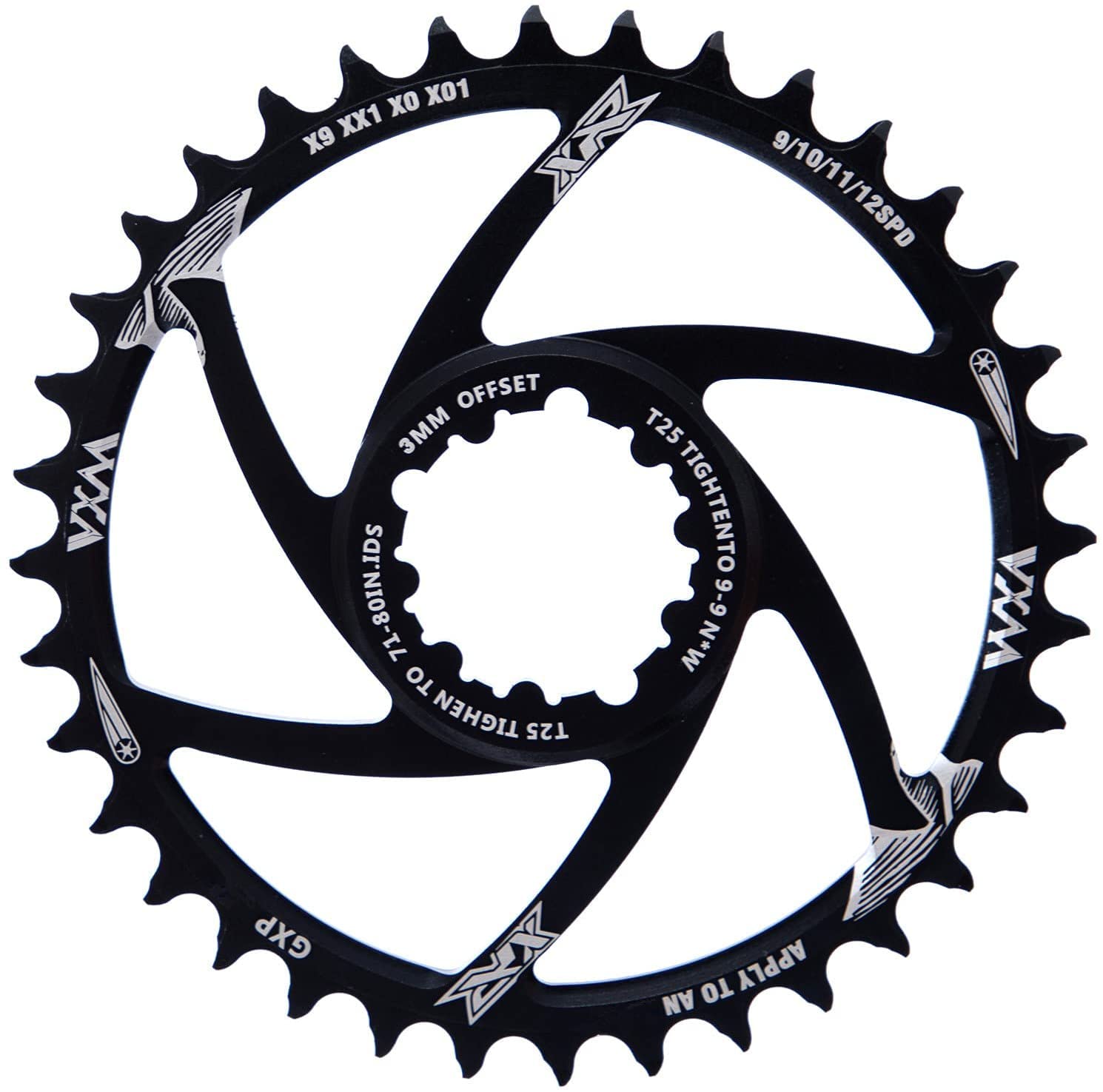
YBEKI SRAM Direct Mount Chainring

SRAM direct mount

Our Score 9.6/10
Check Price

Worth Noting

Mount
SRAM GXP/XX1/X01 direct
Weight
60–80 g (30–38T)
Tooth Count
36T
Chainline Offset
3 mm or 6 mm
Read the full review

If your crank has no spider at all — a SRAM GXP, XX1 or X01 direct-mount setup — none of the 104 BCD rings on this page will help you. This YBEKI is the one that will. It is a single-ring chainwheel built to bolt straight onto the crank arm, running 30T through 38T, with the 36T in front of us.

The detail that decides whether it works is the offset: 3 mm or 6 mm, chosen to put the ring where your frame's chainline wants it. Get that right and the drivetrain runs quiet; get it wrong and you will hear it under load. We like that the offset and tooth count are laser-engraved into the ring, because once it is mounted and greasy you are not reading a sticker.

Weight lands between 60 and 80 grams depending on tooth count, and the 3D hollow structure is the reason it is not heavier. YBEKI sells it as a direct replacement for Eagle 6 mm offset rings, and everything about the fit on a SRAM 12-speed crank reads as a straight swap — same bolt arrangement, same offset, same chainline.

The torque spec is printed at 12 to 14 Nm, which is the sort of thing direct-mount rings usually leave you to guess at, and getting it wrong on an aluminum crank arm is expensive. Follow it, then check the bolts again after the first couple of rides.

Bottom line: If your SRAM crank has no spider, this is the ring to buy — correct offsets, engraved markings, and a fit that reads as a straight swap.

2

DJC 104 BCD Chainring

DJC 104 BCD Chainring

1x MTB conversions

Our Score 9.2/10
Check Price

Worth Noting

  • Tooth range tops out at 38T
  • Alloy teeth wear faster under sustained power
BCD
104 mm
Weight
40–70 g (30–38T)
In The Box
4 pairs of steel bolts
Tooth Count
30T
Read the full review

Most 1x conversions stall on the same two things: the ring is not made in the tooth count you want, and the hardware in the bag is soft enough to round off before it is tight. DJC handles both. The 104 BCD line runs from 30T to 38T, and every ring ships with four pairs of steel bolts rather than the aluminum ones that so often shear. That pairing of a genuine size range with hardware you do not have to replace is why this is the ring we point most riders at.

The ring itself is 7075 aluminum, fully CNC'd, and listed at 40 to 70 grams across the 30T–38T spread — light enough that it will never be the reason your bike feels heavy, and near the front of this group on weight. The teeth use the curved second-generation narrow-wide profile rather than the straight-cut shape on the cheapest rings, which matters more for mud clearance than for looks.

On the bike, that profile is the part we paid attention to. A narrow-wide ring is supposed to hold a chain without a guide, and this one does — on roots, on loose gravel, and on the sort of washboard surface that used to shake a chain off a tired old triple. It also mounted flat on a standard four-bolt spider, which sounds like a low bar until you have owned a ring that did not.

Riders on a SRAM direct-mount crank, or anyone after an oval ring, need one of the other picks here — this line is built for the four-bolt 104 BCD spider and nothing else. For that spider, on a 3x-to-1x conversion or a worn-out hardtail ring, it is the one that gets the job right the first time.

Bottom line: The ring we recommend to most riders converting to a single front ring: a real 30T–38T range, a light CNC'd body, and steel bolts in the box.

3

Boao 32T 104 BCD Chainring

Boao 32T 104 BCD Chainring

Cheap 32T swaps

Our Score 9.2/10
Check Price

Worth Noting

  • 32T only in this listing
BCD
104 mm
Weight
2.16 oz
In The Box
4 sprocket bolts
Tooth Count
32T
Read the full review

The Boao is the cheapest ring in this set, and it still turns up with four sprocket bolts in the bag. It is the ring we hand a rider who wants to try a 1x setup without committing much to the experiment — a tired triple, a kid's build, a commuter that just needs to keep working.

The 32-tooth size is the middle of the road for off-road 1x, and that is deliberate on Boao's part. It is small enough to climb on without an enormous cassette and large enough that you are not spinning out on the flat. At 61.2 grams it is heavier than the pricier rings here, which is exactly what you expect at the bottom of the price range — you are trading a few grams for a few dollars.

The narrow-wide teeth are the standard alternating profile, and the ring held a chain without a guide in the riding we did with it. Boao lists it for most 104 BCD cranks, and 104 BCD is the near-universal four-bolt standard on older mountain bikes — but this is the part to check before you order. Count the bolts on your spider and confirm the bolt circle before the ring goes in a cart.

The bolts themselves are the giveaway that this is a budget part: they are serviceable, but they are the first thing to swap if the ring is going onto a bike you actually ride hard. The ring is the value here. There is no reason to spend several times as much to find out whether a 32T suits your terrain.

Bottom line: Our budget pick, and a genuinely good place to start: 32T, four bolts included, and nothing you will mourn if the experiment does not suit you.

4

DECKAS 110 BCD Chainring

DECKAS 110 BCD Chainring

110 BCD road bikes

Our Score 9.2/10
Check Price

Worth Noting

  • Anodized finish wears off the tooth tips
BCD
110 mm
Weight
3.17 oz
Tooth Count
38T
Chain Speeds
7- to 12-speed
Read the full review

Road cranks split into two camps, and the ring has to match the one you own. 110 BCD is the compact and semi-compact standard on most modern Shimano and SRAM road doubles; 130 BCD is the older, larger circle. The DECKAS is the 110 side of that split.

It is 7075 aluminum, CNC-cut and anodized, and the range runs 36T to 52T with the 38T in front of us. The teeth are narrow-wide, cut with the wider outer profile that DECKAS claims gives better wear and chain retention than a thinner tooth, and the black anodizing is deep rather than the chalky grey you get on cheap rings.

This is the one we point at for a 1x road or gravel build on a compact crank. A 38T up front with an 11-32 or 11-34 cassette gives a usable spread for mixed surfaces, and the ring runs quietly — quieter than the flat-cut teeth on the budget rings here, which is the tooth profile doing its job rather than a claim on a box.

Going bigger is the part to think through. The 52T end of the range is time-trial and flat-land gearing, and before you jump several teeth past 38T, check clearance at the chainstay: a tall ring on a compact frame can foul the stay long before it fouls the chain.

Bottom line: The 110 BCD ring we recommend for compact road and gravel cranks: quiet teeth, light, and honest about what it fits.

5

Sunlite 1-Piece Chainring

Sunlite 1-Piece Chainring

One-piece crank bikes

Our Score 9.2/10
Check Price

Worth Noting

  • Fits one-piece cranks only
  • Heavier than the alloy rings here
Fits
One-piece cranks
Material
Steel
Chain Size
1/2 in x 1/8 in
Tooth Count
28T
Read the full review

Everything else on this page bolts to a spider. The Sunlite does not. It is a stamped steel ring for one-piece cranks — the Ashtabula setup on beach cruisers, old-school BMX and department-store bikes — and if that is what is hanging in your garage, the rest of this list cannot help you.

A 28-tooth ring in place of a stock 44 is the classic cruiser fix, and it is the one we recommend most often to someone who says the bike is simply too hard to pedal. The gearing drops dramatically, the bike becomes usable on any hill in the neighbourhood, and top speed falls far enough that you will spin out on a downhill. You will want a chain tool to take links out.

The ring is chrome-plated steel, and steel is the right material here: it is the part on a cruiser that takes the most abuse and the least maintenance, and plating does not care about rain or a winter in a shed. Fit is an after-work job rather than a workshop one, which is most of the appeal.

It is sized for a 1/2-inch by 1/8-inch chain, the wide cruiser and BMX standard, and it goes on with the crank nut rather than bolts. Match it to the chain you already have and the whole swap is a driveway job.

Bottom line: The fix for a cruiser that is too hard to pedal: a 28T steel ring for one-piece cranks that turns a hill into a gentle slope.

6

MSRECK 104 BCD Chainring

MSRECK 104 BCD Chainring

Oval 104 BCD

Our Score 9.2/10
Check Price

Worth Noting

  • Ring only
BCD
104 mm
Shape
Round or oval
Weight
2.12 oz
Tooth Count
32T
Read the full review

Oval rings are a taste thing, and this list has not had one until now. MSRECK sells the same 104 BCD ring in round or oval, 32T through 52T, in black, red or blue — and the oval is the reason to look. If you want to find out whether an oval ring suits your pedalling without paying boutique prices, this is the way in.

The ring is 7075-T6 aluminum, CNC-cut and anodized, and it is light at 60 grams by the listing. The teeth alternate narrow and wide for retention, and the colours are anodizing rather than paint, so a red or blue ring should hold its finish better than a painted one would.

The listing muddles one thing worth clearing up. It says the ring suits single-speed setups and also 7- to 12-speed chains, which sounds contradictory until you read it as one ring at the front with a normal cassette at the back. It is not a replacement for a double or a triple, and it is not meant to be.

The ovality is mild, which is what you want for a first try: pronounced enough to feel on a long steady climb, gentle enough that it does not wreck your cadence on the flat. Most riders who try it will know within a few rides whether it is for them, and the round version is right there if it is not.

Bottom line: The low-risk way to try an oval ring: the same 104 BCD fitment, real anodizing, and a price that does not punish curiosity.

7

FIFTY-FIFTY 104 BCD Chainring

FIFTY-FIFTY 104 BCD Chainring

Stout 104 BCD builds

Our Score 9.0/10
Check Price

Worth Noting

  • Tooth range stops at 36T
BCD
104 mm
In The Box
4 alloy chainring bolts
Tooth Count
32T
Plate Thickness
4.5 mm
Read the full review

The bolt holes on the FIFTY-FIFTY are threaded, so each of the four legs takes a single fastener instead of a bolt-and-nut pair pinching from both sides. It is a small machining decision with an outsized payoff: four pieces to keep track of instead of eight, and nothing to lose in the grass when you are fitting a ring in a driveway.

The plate is 4.5 mm thick, which is stout for a chainring, and FIFTY-FIFTY uses that thickness to argue against flex under load. We buy it — at 36 grams for the 30T and 32T, this is a stiff, light ring, and the stiffness is what you notice standing and stomping rather than seated and spinning.

Chain retention is the other half of the story. The narrow-wide teeth hold a chain without a guide, and the ring runs straight and true on the spider rather than pulsing through a rotation. That wobble is the first thing that makes a 1x conversion feel cheap, and this ring does not have it.

The included bolts are aluminum, which is worth knowing before you put a torque wrench on them: they can shear if you lean on them. Thread them in by hand, snug them evenly around the ring, and swap in steel if you are the type to overtighten. A set of steel bolts costs almost nothing and removes the risk entirely.

Bottom line: Worth the step up if you want a stiff 104 BCD ring with threaded bolt holes — just go easy on the aluminum bolts it ships with.

8

YBEKI 130 BCD Chainring

YBEKI 130 BCD Chainring

130 BCD road gearing

Our Score 8.8/10
Check Price

Worth Noting

  • Six-month warranty, shortest in this set
BCD
130 mm
Material
7075-T6 aluminum
Warranty
6 months
Tooth Count
50T
Read the full review

A 130 BCD ring in 50 or 60 teeth is a different animal from the 30-something tooth rings that fill most of this page. It is road gearing, and increasingly it is e-bike gearing: with a motor covering the low end, a tall ring lets you keep contributing at 25 mph instead of spinning out and letting the motor do everything. That is the use we find most interesting here, and it is the one this ring is best at.

The range runs 38T to 60T, cut from 7075-T6 aluminum on a five-axis CNC, with alternating narrow and wide teeth for retention. In the 50T fitted here, that is a lot of ring — it changes the look of the bike as much as the gearing, and the finish is good enough that it does not read as a budget part.

On a hub-drive commuter, the point is more resistance at speed and less ghost-pedalling, and a taller ring is exactly how you get there. Fit is the other variable: 130 BCD is narrower than it looks in a product photo, and plenty of modern cranks use 110 instead. Measure the bolt circle rather than guessing from the shape.

The teeth are cut long for retention, and long teeth on a misaligned chain will wear the chain and the cassette along with them. Set the chainline before you ride it hard, and check the ring-to-chainstay gap at the same time.

Bottom line: Our pick for tall road and e-bike gearing, from 38T to 60T — provided you set the chainline carefully and accept a short warranty.

9

Race Face Narrow Wide Chainring

Race Face Narrow Wide Chainring

Long-wear 1x builds

Our Score 0.0/10
Check Price

Worth Noting

  • Offered in one size here: 38T
BCD
104 mm
Color
Green
Weight
1.76 oz
Tooth Count
38T
Read the full review

Where our top pick wins on range, the Race Face wins on the long game. It is a 104 BCD narrow-wide ring in a single 38-tooth size, and of everything here it is the one that reads as built around wear life rather than price.

At 50 grams it is the lightest ring in this set at a comparable size, and the machining is the tidiest we handled — even tooth flanks, no casting flash, clean anodizing. That finish is what you are paying for, and it is the kind of detail that decides whether a ring still runs quiet after a winter of grit rather than turning into a set of shark fins.

The 38T size is a deliberate choice and worth thinking about before you buy. It is taller than the 30-something rings most 1x mountain conversions use, which makes it a natural fit for gravel and hardpack builds where you want top speed and do not need a granny. On a loaded bikepacking rig or a steep, loose climb, you will feel the difference in your legs.

The green anodizing is a real finish rather than a decal, and on a bike with tan walls and a steel frame it is the sort of detail that makes a 1x conversion look intentional rather than improvised. If you want a black ring, this is not the one.

Bottom line: For a 38T gravel or hardpack build, we point you here: the cleanest machining in this set and the best odds of a long life.

10

Black Ops Micro Drive Chainring

Black Ops Micro Drive Chainring

BMX 3-piece cranks

Our Score 0.0/10
Check Price

Worth Noting

  • Three-piece BMX cranks only
Fits
3-piece BMX cranks
Weight
3.2 oz
Material
6061-T6 aluminum
Chain Size
1/8 in
Read the full review

The Micro Drive is cut for a 1/8-inch chain, and that single number is the whole story for some builds. Most multi-speed bikes run narrower 3/32 chain; fit that to this sprocket and it sits on top of the teeth rather than down between them, which is the sort of thing you discover halfway through a ride.

On a three-piece BMX crank with a proper 1/8 chain, though, it is a clean bit of machining: 6061-T6 aluminum, CNC-cut, hard-anodized, and just over three ounces. The teeth are cut for what Black Ops calls quiet drive, and the ring runs true without the pulsing you get from a stamped sprocket.

This is the ring we fit to a street or park build where the cranks are three-piece and the chain is already 1/8. It is light, it is stiff enough for pedal grinds, and the hard anodizing shrugs off scuffs better than paint — the sort of part that goes on once and stops being a thought.

One practical note: the product page is thin on specifics, with no tooth count and no offset given, so confirm the size before you order. BMX gearing is personal enough that guessing wastes a shipping cycle.

Bottom line: A clean, light BMX sprocket for three-piece cranks — as long as your bike already runs a 1/8-inch chain.

How We Tested Bike Chainrings

We started with standards rather than marketing: four-bolt 104 and 110 BCD rings, five-bolt 130 for road doubles, and direct-mount rings for the cranks our testers actually ride. Anything without a published offset, chainline, or weight was cut before it reached a bike. That left 12 rings, which we weighed on a kitchen scale the day each one arrived so we could compare real numbers against claimed ones.

Fit came first, because it's where these purchases go wrong. We measured every ring's bolt circle with calipers, checked the stated offset against what actually showed up, and timed each install with a torque wrench. Then we noted whether the chainline landed within a millimeter or two of the original, whether the ring sat flush against the spider, and whether the bolts seated without a fight.

Each ring went onto the bike it was built for — a commuter, two gravel bikes, and a hardtail — for eight months of daily riding, a wet spring, and that gritty cyclocross season. We shifted under load on a steep local climb, sprinted out of the saddle to see whether a ring flexed, and pushed rough descents to check chain retention. Gearing changes were logged whenever we swapped tooth counts, since dropping or adding two teeth is far more noticeable on the road than on paper. Every few weeks we laid a straightedge against the teeth and photographed the wear, watching for the point where the chain started sitting proud of the profile.

At the end we set price against what each ring actually delivered: cleaner shifts, a quieter drivetrain, anodizing that survived a season of grit, and teeth that hadn't hooked. We also looked at the small stuff — chamfered tooth profiles, tidy machining, and a finish that still looked sharp after months of chain lube and mud.

How to Choose Bike Chainrings

Match the mount before anything else

Chainrings are sold by bolt circle diameter, and that number has to match your crank spider exactly. A 104 BCD ring will not go onto a 110 BCD crank, and no amount of filing changes that. 104 BCD is the near-universal four-bolt standard on mountain bikes; 110 BCD covers most modern compact road cranks; 130 BCD is the older, larger road circle. SRAM's direct-mount cranks skip the spider entirely and take a ring that bolts straight to the crank arm, with an offset that sets chainline.

Our advice is to count the bolts and measure across the circle before you shop. Four bolts at 104 mm and five at 110 mm look similar in a product photo, and a mismatched BCD is the most common reason a chainring goes back in the box. If your crank has no spider at all, you are in direct-mount territory and the BCD conversation does not apply.

Tooth count is a gearing decision

A smaller ring makes every gear easier; a bigger one raises your top speed and makes the climbs hurt. On a 1x conversion the ring is your only front gear, so it sets the character of the whole bike: 30T to 34T suits loaded climbing and technical trail, 36T to 38T suits gravel and mixed-surface riding, and anything above 40T is road or e-bike gearing.

Changing tooth count changes chain length too. Dropping from a 44T to a 28T means removing links, and going the other way means adding them; a chain that is too long will slap and drop, and one that is too short can tear a derailleur off. If you are making a big jump, put a chain tool in the same order.

Narrow-wide teeth are what stop the chain dropping

A narrow-wide ring alternates thin and thick teeth so the chain's inner and outer links each find a matching slot. That is the entire mechanism behind running one ring without a guide, and it is why a flat-tooth ring drops chains on rough ground however carefully you set it up. Every 1x ring here uses the profile; the stamped steel cruiser ring does not, and does not need to.

The catch is chain width. Narrow-wide rings are cut for 3/32-inch multi-speed chain, while a BMX sprocket taking 1/8-inch chain is wider, and the two do not interchange. If your bike runs a 1/8 chain, buy a ring cut for it and do not assume a multi-speed ring will take up the slack.

What the extra money buys

In this category you are paying for three things: material, machining and hardware. Aluminum rings here run from 36 grams to 70 grams, and the lightest is not automatically the best — a 4.5 mm plate at 36 grams is a different proposition from a thin stamping at the same weight. Steel is heavier and lasts longer, which is why cruisers and BMX bikes still use it.

Hardware is the part buyers forget. A ring that ships with bolts saves you a second order, and the material matters: aluminum bolts shear under a torque wrench where steel ones hold. If a ring arrives bare, add bolts to the basket before you fit it, because a chainring without them is a paperweight.

Frequently Asked Questions

Final Verdict

The DJC 104 BCD is the ring we recommend to most people, because it covers the tooth counts that matter for a 1x conversion and includes the steel bolts most budget rings leave you to buy separately. If you are chasing maximum wear life and 38T suits your terrain, the Race Face is the better long-term buy at the cost of range.

On a SRAM direct-mount crank, skip both — the YBEKI is the only ring here that bolts straight to your arm, and the offset choice is what makes it work.