Accessories

Best Bike Fenders of 2026

The first time I rode to work in a proper rainstorm, I arrived with a brown stripe up my back and grit in my teeth. Fenders are the unglamorous fix: they catch the rooster tail before it reaches your jacket, drivetrain, and the person drafting behind you. Over the past eight months, our team has ridden a dozen sets through rainy commutes, weekend gravel loops, and quick errands, and the differences come down to coverage, hardware, and stability. A good set disappears under you; a bad one rattles or leaves your shins soaked.

Installation can make or break the experience. Some fenders clip on in minutes, while others need zip ties, bracket bending, and a second pair of hands. Once mounted, the best ones stayed quiet over potholes and curb hops, shed water instead of pooling it, and still looked presentable after months of grit. Fit is the other wild card—clearance, wheel size, and rack mounts vary—so the picks below span commuter bikes, hybrids, and drop-bar builds. The right fender is the one you forget is there until it rains.

1

SKS Mudrocker Rear

Top Pick
SKS Mudrocker Rear

Full rear coverage

Our Score 9.2/10
Check Price

Worth Noting

  • Needs 3.5 inches of space between seat stays
Wheel Sizes
27.5, 28 and 29 inch
Blade Length
840 mm
Profile Width
3.5 inches (9 cm)
Tire Clearance
Up to 3.0 inches
Read the full review

At 840 mm, the MUDROCKER's blade is the longest in this group, and the length is the whole argument: it's the difference between a guard that catches the rooster tail and one that catches the spray soaking your shorts and the back of your jacket. It's also the one that sits closest to the tire, which is where a rear fender earns or loses its keep.

We like how close it sits. The glass-fibre-reinforced plastic is stiff enough to hold a tight arc without flapping, so it can be set low and still behave. The trade-off is that you have to watch the gap under load — on a hard landing the tire can come up into the blade with an audible slap, so set it with a little room and check it again once you've ridden it properly.

It attaches with its own mounting kit rather than a fistful of ties, and at 172 g the weight is a fair price for that much coverage. The bike it suits is a trail or enduro machine running up to 3.0-inch tires, ideally with Vario seatpost hardware on the frame.

This is the most expensive fender here, and what you're buying is blade length and stiffness rather than branding. If you're only chasing grit out of your eyes, spend less; if your goal is arriving dry from the waist down, the extra is doing real work.

Bottom line: The rear guard for mountain bikers who want to finish a wet ride with a dry back — long, stiff, and set close to the tire.

2

Ass Savers Win Wing 2

Ass Savers Win Wing 2

Road and gravel

Our Score 9.2/10
Check Price

Worth Noting

  • Road version tops out at 35 mm tires
  • Soft blade can take a set if bent hard
Mount
Seat stays, three settings
Weight
1.06 oz
Blade Material
80% recycled PP
Tire Clearance
Up to 35 mm
Read the full review

Thirty grams is roughly a slice of bread, and the first time you hold the Win Wing 2 you'll wonder how something this flexible can do anything at all. It can: the blade mounts on the seat stays and catches the plume off the rear tire before it reaches your back, and it does it without a single tie around your paint.

The mounting is the clever part. Four components and a wishbone clamp onto the seat stays with three angle settings, so you can match the blade to your frame's angle rather than accepting whatever one fixed position gives you. Ours went on in about the time it takes to fill a bottle, and it comes off just as quickly on a dry week.

The design also flexes on purpose. If something catches the blade it gives rather than jamming, which is the behaviour you want from a guard sitting inches from a spinning wheel, and the blade itself is made from 80% recycled polypropylene with every component sold separately if you break one.

What stays with us is how little it changes the bike — nothing bolted on, nothing strapped to a stanchion. The same softness that lets it fold means a hard, prolonged bend can leave it set slightly out of shape, so store it flat rather than stuffed in a bag.

Bottom line: Thirty grams of recycled plastic that keeps road and gravel spray off your back, and folds out of the way when the weather clears.

3

Fox Mud Guard MY21 36-38

Fox Mud Guard MY21 36-38

Fox 36/38 forks

Our Score 9.2/10
Check Price

Worth Noting

  • Fits only Fox 36 and 38 forks
Mount
Bolt-on direct mount
Fork Fit
Fox 36 and 38
Material
Plastic
Read the full review

If you own a Fox 36 or 38, this is the front fender that looks like the fork grew it. It bolts to the fork's own mounts, so there's no tie wrapped around a stanchion, nothing to trim, and no strap to re-tension. We rate it the neatest installation in this group, and the stiffness that comes with a bolted mount is most of the reason.

The blade is short — it's a guard, not a touring mudguard — but it takes the water, grit and small stones that would otherwise come up into your face and the fork seals. The plastic is firmer than the zip-tie guards here and it doesn't flutter at speed, which is what you want from something bolted to a moving fork leg.

On the bike it nearly disappears: black on black, tucked under the arch, and it doesn't shift when you knock it in the shed. It also does the unglamorous work of keeping grit out of the wiper seals, which is the argument for leaving it on all winter rather than fitting it only when the trails turn to soup.

Bottom line: The cleanest front guard you can put on a Fox 36 or 38 — no ties, no trimming, and nothing to re-tension after a wet ride.

4

Mucky Nutz MugGuard Short

Mucky Nutz MugGuard Short

Wide MTB tires

Our Score 9.0/10
Check Price

Worth Noting

  • Front wheel only
  • Strap fit varies between forks
Mount
Velcro roll
Material
Polypropylene
Wheel Sizes
26, 27.5 and 29 inch
Tire Clearance
Up to 3 inches
Read the full review

Wide tires are where short guards usually give up, and the MugGuard doesn't: the short version is rated for 26, 27.5 and 29-inch wheels and tires up to 3 inches, with a shape that clears a fat casing without rubbing. Our reservation is the mount, because the velcro roll has to pull the blade tight against a fork shape it wasn't moulded for, and on some forks it can shift far enough to graze the tire on a hard hit. Check the gap with the fork compressed before you commit.

The release is the part we appreciate most. A velcro roll rather than zip ties means the guard comes off in seconds for a bike rack or an uplift and goes back on without a fresh packet of ties. The slots take a zip tie as well, which is how we'd—which is how we mount it when we want it permanent.

Coverage is short by design: this is face-and-fork protection, not a dry back, and the arch is shaped to shed sticky mud instead of packing it into the crown. The matte black finish looks better than most plastic blades, and a gloss version exists if you prefer a shinier match to your frame.

Bottom line: The front guard we put on wide rubber: it clears 3-inch tires and comes off in seconds, though the velcro fit varies from fork to fork.

5

SKS X-Tra Dry Rear

SKS X-Tra Dry Rear

Tool-free commuting

Our Score 8.8/10
Check Price

Worth Noting

  • Won't clamp to aero or triangular seatposts
Mount
Tool-free seatpost clamp
Weight
4.8 oz
Material
Plastic
Warranty
5 years
Read the full review

No tools, no ties, no scrabbling around in the dark: the X-Tra Dry clamps onto the seatpost, and it comes off again when you lock up. That's the entire case for it, and it's a strong one if your bike does double duty between a commute and a weekend ride.

What you give up is length and hold. The blade is short enough that proper rain still peppers your back and your backpack, and the clamp is the part to watch — it can creep down the post over rough ground and wants a re-tighten. For the first twenty minutes of a wet commute it does exactly what it promises; for a two-hour soaking you want a longer rear blade.

We keep coming back to it for the five-year warranty and the fact that it fits any bike in the garage in the time it takes to open the gate. Tool-free cuts both ways, though: the same release that makes it convenient makes it easy for someone else to walk off with. A zip tie through the clamp settles that if the bike lives outside.

Bottom line: For a commuter who wants a dry backside without bolting anything on: it clips to the seatpost in seconds and lifts off just as fast.

6

Zefal Deflector FM30

Zefal Deflector FM30

Front trail riding

Our Score 8.8/10
Check Price

Worth Noting

  • Tire width tops out at 2.6 inches
Mount
Six sleeved zip ties
Weight
4.76 oz
Dimensions
475 x 88 x 170 mm
Tire Clearance
Up to 2.6 inches
Read the full review

Most zip-tie fenders ask you to run bare plastic ties around a painted fork leg and hope for the best. The Deflector FM30 ships six reinforced ties with soft sleeves, a small detail that decides whether your fork comes out of a season with rubbed paint or not.

The blade is 475 mm long and 88 mm wide, rated to 2.6-inch tires, and weighs 135 g — light enough to forget and long enough to keep gravel and road spray out of your face. The polypropylene is stiff for its weight and the finish is understated, which is about all you can ask of a black plastic mudguard.

What we don't love is where the coverage stops. In standing water you'll still catch some on the shins, and the blade is a front-only solution, so a wet rear wheel is somebody else's problem. As a quiet, paint-friendly guard for a trail bike on 2.4s or 2.5s, it does its job without asking for attention.

Bottom line: A front guard for riders who care what their fork looks like afterwards: the sleeved ties hold it tight without chewing the paint.

7

NICEDACK 3-Piece Fender Set

NICEDACK 3-Piece Fender Set

Budget two-bike kit

Our Score 8.8/10
Check Price

Worth Noting

  • Rear blade can tear where it's cinched
  • Partial protection in heavy rain
Mount
Zip tie
Included
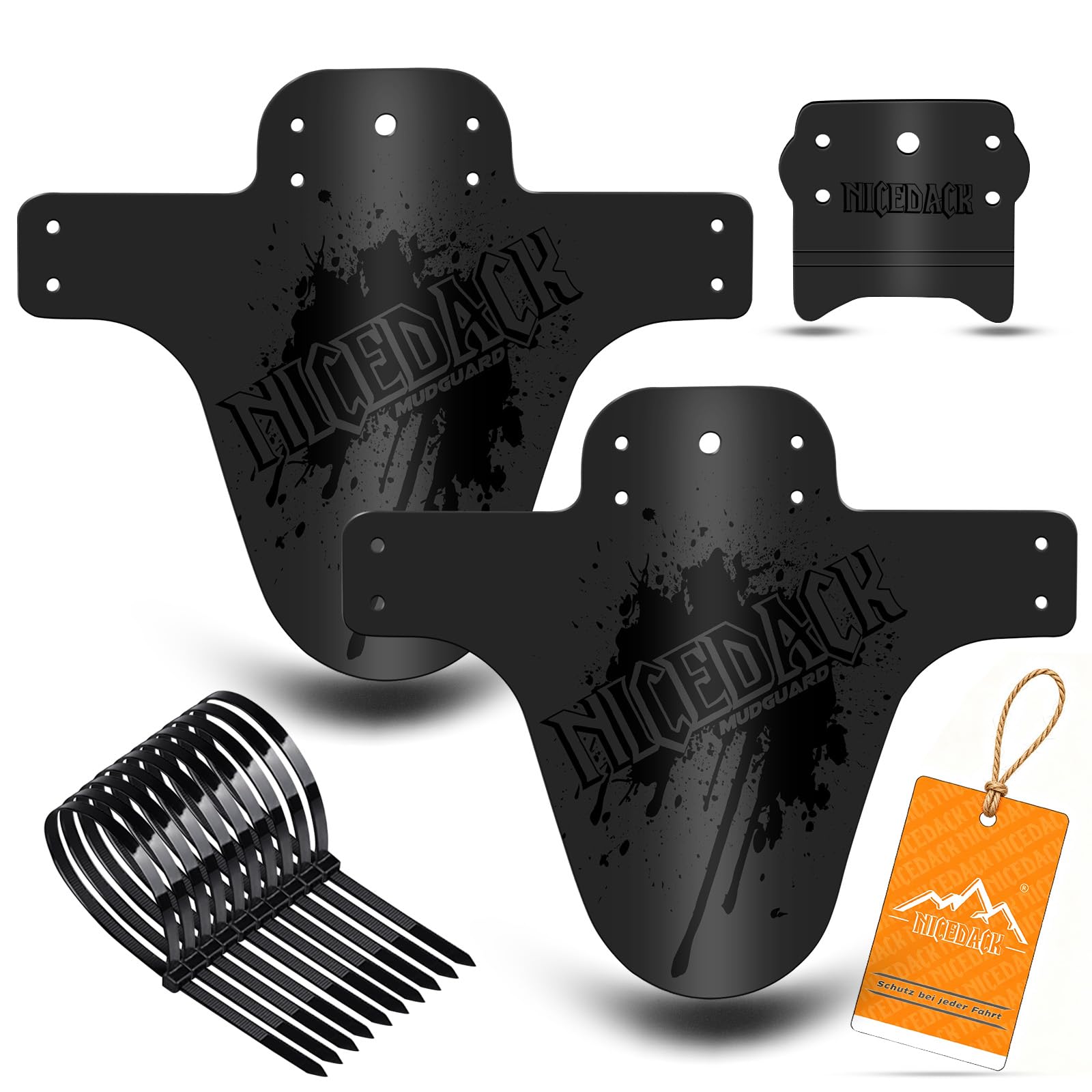
2 large, 1 small fender, 10 ties
Thickness
1 mm
Wheel Sizes
26, 27.5 and 29 inch
Read the full review

Three blades in one box is the pitch, and it's a real one: two large fenders, a small one, ten zip ties, and 1 mm polypropylene that folds far enough to wrap a 26, 27.5 or 29-inch wheel. It's the lowest-cost multi-bike option here, and the small blade is the piece we didn't expect to use as much as we did.

The ties are where it comes apart. They're thin and they snap under load well before the blade does, so buy a decent pack and fit those instead — with proper ties the fenders sit still and the whole thing behaves. Cinch them gently at the mounting holes, because a heavy hand is what damages the blade rather than the road.

Where the small blade earns its place is the down tube, a rear stay, or a kid's bike where a full guard looks ridiculous. The two large blades do the conventional fork and rear-seat jobs, and the flexibility that makes them easy to fit is the same flexibility that lets them flutter at speed.

For a second bike, a commuter, or a kid's bike that lives outside, this is the set we hand over: you're not out much if one walks off, and with better ties it does the job it's sold for.

Bottom line: The cheapest way to fender two bikes: three blades in one box, provided you replace the ties before you fit them.

8

FIFTY-FIFTY Mountain Bike Fender

FIFTY-FIFTY Mountain Bike Fender

Everyday trail riding

Our Score 0.0/10
Check Price

Worth Noting

  • One fender and six ties per pack
  • Colours run off the product photos
Mount
Four-point zip-tie fixing
Weight
1 oz
Material
Polypropylene
Position
Front fork or rear seat
Read the full review

Two zip ties are how most short fenders attach, and two zip ties are why most of them wander: the blade pivots around the pair until one edge is rubbing the tire. FIFTY-FIFTY uses four anchors spread across the blade instead, and that single change is the reason it holds the line you set. The polypropylene is thick enough to take a curve and keep it, which matters more on a fork leg than it does on a workbench.

We ran ours up front for most of the test and then moved it to the rear, and what we kept noticing was how little attention it asked for — no re-tightening, no chatter at speed, and once the tails are trimmed the ties all but vanish against a black fork. It's listed for disc-brake bikes only, so if you're still on rim brakes this isn't your fender.

What it isn't is a full mudguard. It stops the rooster tail that hits your face and eyes and keeps crud off the fork bridge and down tube, but a wet rear wheel still finds your back and legs. Each pack holds one blade and six ties, so front and rear coverage, or fenders for two bikes, means two packs — which is how we set up a trail bike anyway.

Colour is the detail to buy carefully. The yellow and the red don't land where the product photos put them, so order expecting close rather than exact if you're matching a frame.

Bottom line: Our default for most riders: four anchor points keep it from wandering, it mounts front or rear, and one blade covers a whole trail season.

How We Chose and Tested the Best Bike Fenders

We started by pulling together fenders that fit common wheel sizes and mounting setups—bolt-on, quick-release, and zip-tie models—then narrowed the list by coverage, hardware quality, replacement-part availability, and whether the build justified the price. Twelve sets made the cut. We mounted each on at least two bikes: a commuter with a rear rack, a flat-bar hybrid, and a drop-bar gravel bike. Testing ran for eight months, through wet winter commutes, spring gravel loops, and everyday errands.

Installation was timed solo with a basic multitool, and we noted every bracket that needed bending, every trip to the hardware store, and whether the included zip ties felt reusable or one-time-only. Once mounted, we checked clearance at the fork crown, brake bridge, and chainstays, then rode through puddles and hit the fenders with a garden hose to see where spray actually landed—on our back, the drivetrain, or both. We also bounced over curbs and potholes to judge rattle, sway, and stability.

Over the months, we watched for cracks, loose bolts, and zip ties that stretched or snapped, plus how easily each fender could be nudged back into alignment after a knock. Moisture resistance got a separate check: after wet rides, we looked for water pooling inside the fender, grit trapped against the tire, and any spray reaching the bottom bracket. We also noted finish scuffs and how each set looked on the bike. The fenders that held up shared tight hardware, generous coverage, and a mounting system that didn't rely on hope.

How to Choose Bike Fenders

Start With Where the Water Lands

Front and rear spray are two different problems. The front wheel throws water forward and up into your face, shins and fork seals; the rear wheel throws a rooster tail up your back, your seatpost and the rider behind you. A short fork guard solves the first. Only a long rear blade solves the second.

So decide what you actually want to stay dry. If you're riding trails and the annoyance is grit in your eyes and mud on your stanchions, a compact front guard is enough. If you commute or ride in genuine rain and arrive with a wet stripe up your jacket, budget for a rear guard that runs well down the wheel rather than a stub.

Match the Mount to Your Bike

There are four ways a fender attaches: zip ties around the fork or seat stays, a velcro roll, bolts into mounts the fork already has, or a clamp on the seatpost. Each one trades permanence for convenience. Ties are cheap and secure but need cutting to remove; velcro and clamps come off in seconds and are the parts that wear; bolt-on is the neatest and only exists if your fork has the holes.

Direct-mount is the trap here. A Fox-specific guard or a RockShox ZEB fender is worthless on a fork without those threaded mounts, and there is no adapter worth trusting. Look at the back of your fork arch before you order. Equally, a seatpost clamp has nothing to grip on an aero or triangular post.

Check Clearance, Not Just Wheel Size

A fender rated for 29-inch wheels is not automatically rated for your 29-inch wheels. Wheel diameter, tire width and frame gap are three separate numbers, and the third is the one that ruins purchases. The MUDROCKER, for instance, needs its 3.5-inch profile to fit between the seat stays — plenty of frames won't give it that.

Set the blade up with a visible gap all the way round, then compress the fork and look again, because a guard that clears while the bike is standing still can meet the tire under load. If you're within a couple of millimetres at rest, it's too close.

Decide How Much Fiddling You'll Tolerate

Zip-tied guards are fit-once-and-forget, which suits a bike that stays in your garage. If you swap between bikes, put the bike on a rack, or park it on a street, a tool-free mount earns its keep — but the same release that makes it convenient makes it easy for someone else to lift.

Our rule: convenience for you, plus a zip tie through the clamp if the bike lives outside. That keeps the quick release for your own use and takes the fender off a thief's shopping list.

Spend on the Hardware, Not the Logo

Blades are simple molded plastic, and most of them are good enough. What separates the picks here is the hardware and the shape. Glass-fibre-reinforced plastic holds a tighter arc without flapping; sleeved ties protect fork paint; velcro eventually gives up; thin ties snap before the blade does.

We'd rather see a plain blade with quality ties than a branded one held on with hardware that fails in your hand — so factor a pack of decent zip ties into any budget fender purchase and carry two spares.

Frequently Asked Questions

Final Verdict

Most riders should start with the FIFTY-FIFTY. Four anchor points hold a short blade exactly where you set it, the same fender moves from the fork to the rear seat, and it clears 2.6-inch tires without fouling. It's the least fussy way to stop eating trail grit.

Two requirements change the answer. If your fork is a Fox 36 or 38, skip the ties and take the MY21 — it bolts on and looks factory. And if the wet is coming up your back rather than into your face, the MUDROCKER's 840 mm blade is the one that ends the argument, provided your seat stays give it 3.5 inches.