Accessories

Best Mountain Bike Fenders of 2026

There's a particular stripe of grit a rear tire paints up your back on a wet trail — usually the moment you remember you never mounted a fender. A good one keeps that spray out of your eyes and off your drivetrain, which matters more than most riders expect once the trails stay damp. The trouble is the category itself: clip-on plastic, bolt-on aluminum, and zip-tie kits that fit one wheel size and not yours. A fender that sits crooked or rattles loose is worse than riding bare.

We've spent the past six months riding 14 fenders through mud, gravel, and everyday commuting, and the keepers share a few traits. One lesson I learned: coverage beats looks — a longer rear fender keeps more off your back than a stubby one, even if the stubby one photographs better. Install ranges from a two-minute snap-on to a wrestling match with zip ties that, annoyingly often, aren't even in the box. Below, the picks are sorted by where each makes sense — full coverage for wet climates, minimal clip-ons for fair-weather riders.

1

All Mountain Style MTB Mud Guard

Top Pick
All Mountain Style MTB Mud Guard

Styled trail guard

Our Score 9.4/10
Check Price

Worth Noting

  • No zip ties in the box
Mount
Zip ties, not included
Weight
1.41 oz
Position
Front fork
Panel Thickness
1.2 mm
Read the full review

At 1.2 mm this is the thickest plastic in the group, half again what the folding two-pack uses, and flexing it against the fork tells you so. Thickness is not vanity here: a stiffer panel holds its curve under spray and shrugs off the stone that flicks up off a front tire in the wet.

What actually sells it is the finish. The camo and graphic options are the reason to choose this over a plain black blade, and we don't think that is a shallow reason, because the front of your bike is the part you look at all ride. The long single panel and four mounting slots also wrap a chunky fork lower neatly, set high for a big dual-crown or tight to the tire on a trail fork.

Weight is a non-issue at 40 g, and the universal fit spans 26 to 29-inch wheels on most trail forks. Set the blade close to the tire for the most coverage, and leave a finger's width of gap if you ride clay that packs, since that gap is the difference between a guard that works and one that drags.

Bottom line: Our pick for looks and thickness: a 1.2 mm panel with graphics worth paying for, though you'll need to add zip ties to your order.

2

SKS Mudrocker Rear Fender

SKS Mudrocker Rear Fender

Maximum rear coverage

Our Score 9.2/10
Check Price

Worth Noting

  • Rear guard only, despite the front-and-rear title
  • Premium price for one blade
Position
Rear, seat stays
Wheel Sizes
27.5, 28, 29 in
Blade Length
840 mm
Max Tire Width
3.0 in
Read the full review

Measure before anything else. The Mudrocker needs a 9 cm profile to sit between your seat stays, and on plenty of frames that one number decides the purchase. We appreciate that SKS states it plainly, because a rear guard that fouls the stays is worse than no guard at all.

Where it fits, nothing else here covers as much. The rear blade runs 840 mm, long enough to catch spray that would otherwise paint your back, your dropper and the shock, and it clears 27.5, 28 and 29-inch wheels with tires up to 3.0 inches, so plus bikes are in. The glass-fibre reinforced plastic is a step up from the plain polypropylene guards here, and the fitting kit clamps it to the stays rather than strapping it on.

It is not subtle. A blade this long and wide looks like a lot of fender on a small frame, and on a short-travel bike it can look out of proportion. For a winter commuter or a bike that lives on wet trails, that is the right trade to make.

Bottom line: The most coverage in this group, and our choice if your seat stays have the room: 840 mm of blade and clearance for 3.0-inch tires.

3

Fox Mud Guard MY21 36-38

Fox Mud Guard MY21 36-38

Fox 36/38 forks

Our Score 9.2/10
Check Price

Worth Noting

  • Fits Fox 36 and 38 forks only
Mount
Bolt-on direct mount
Fork Fit
Fox 36 and 38
Position
Front fork
Read the full review

There is no zip tie anywhere in the mounting kit. This guard bolts to the fork's own fender mounts, and because it is held at fixed points rather than tensioned against the lowers, it stays where you set it instead of creeping toward the tire over a ride. Fit it once and forget it.

The payoff is integration. The blade follows the arch line, there are no tie tails to trim or replace, and it is noticeably more rigid than the flat panels in this group. On a fork with the mounting holes already there, it reads as a factory part rather than something bolted on as an afterthought, and it comes off in a minute when you want a bare front end.

Coverage is the short-blade kind: arch, stanchions and goggles are covered, your down tube is not. On a trail or enduro bike that is the right compromise, because the fork is the part worth protecting and a longer blade starts crowding the tire as the suspension works.

Bottom line: Our pick for Fox 36 and 38 owners: it bolts to the fork's own mounts, holds its position, and looks factory-fitted.

4

Mucky Nutz MugGuard Short

Mucky Nutz MugGuard Short

Quick on/off

Our Score 9.0/10
Check Price

Worth Noting

  • Velcro is the first part to wear out
Mount
Velcro strap
Position
Front fork
Wheel Sizes
26, 27.5, 29 in
Max Tire Width
3.0 in
Read the full review

The strap is velcro rather than a zip tie, and that is the whole point. The MugGuard comes off in seconds for a bike rack, a shuttle run or a wash, and goes back on without a trip to the shed for new ties.

Where it earns its place is width. The Short covers 26, 27.5 and 29-inch wheels and clears casings up to 3.0 inches, which makes it one of two guards here that will sit over a plus tire without rubbing. It is a single curved panel in a matte finish, and the strap runs through two slots so you can set the height where the fork gives you room.

Fit is the thing to check. On some fork lowers the Short can shift and kiss the tire under a hard hit, so mount it high, leave a gap at the arch, and look at it again after a rough descent. If it moves, rethread the strap or add a zip tie through the same slots, which takes two minutes and settles the question.

Bottom line: The one we take off in seconds for a rack or an uplift: velcro rather than zip ties, and clearance for 3.0-inch tires.

5

RockShox ZEB Fender

RockShox ZEB Fender

ZEB fork owners

Our Score 9.0/10
Check Price

Worth Noting

  • Fits RockShox ZEB forks only
Mount
Bolt-on direct mount
Fork Fit
RockShox ZEB A1 and later
Position
Front fork
Read the full review

It bolts to the fork's own fender mounts, so from a few feet away it doesn't read as an add-on: no tie tails, no strap, just a blade that follows the arch of a ZEB. The black finish matches the lowers closely enough that most people won't spot it as a separate part.

That integration is the appeal. There is nothing to re-tension after a ride and nothing to lose in a toolbox, and the guard sits where the fork was designed to take one. If you have ever cut a zip tie off at the trailhead because it had started chafing a lower, this is the alternative you were looking for.

Two checks before you order. Count the mounting holes on your fork, because ZEB generation changes have brought a two-hole pattern on some newer Zeb Ultimate forks rather than the three this guard expects. And open the box before you start: the tiny Allen screws have been missing from some packages, and threading them in is fiddly even in a warm workshop, never mind a cold parking lot.

Bottom line: For ZEB owners who want the guard to look like part of the fork, this is the neatest answer in our group; check the box for screws first.

6

Zefal Deflector FM30

Zefal Deflector FM30

Wide-tire front

Our Score 8.8/10
Check Price

Worth Noting

  • Rated only to 2.6-inch tires
  • Zip-tied on, so it stays on the bike
Weight
4.76 oz
Position
Front fork
Wheel Sizes
26, 27.5, 29 in
Max Tire Width
2.6 in
Read the full review

Six zip ties come with soft sleeves that sit between the plastic and your fork lowers, and that small piece of thought is what sold us on the Zefal. A bare tie cinched onto a painted or anodised lower will wear a line into the finish over a winter of muddy rides; these sleeves take the wear instead. It is the kind of detail you only notice when it is missing.

Coverage is generous for a fork guard: 475 mm long with side wings that catch spray a flat panel lets through, and it fits 26, 27.5, 27.5+ and 29-inch wheels. For a trail bike on 2.4s it leaves nothing to think about. At 135 g it is light enough to forget, and the polypropylene holds its shape when you pull the ties down hard.

Take the setup slowly. Set the blade close to the tire, pull the ties snug without dishing the panel, and trim the tails so they don't catch a knee pad. Then check the ties once after the first wet ride, because new plastic settles.

Bottom line: The front guard we reach for on 2.4 and 2.6-inch trail tires, mostly because of six small sleeves that save your fork's paint.

7

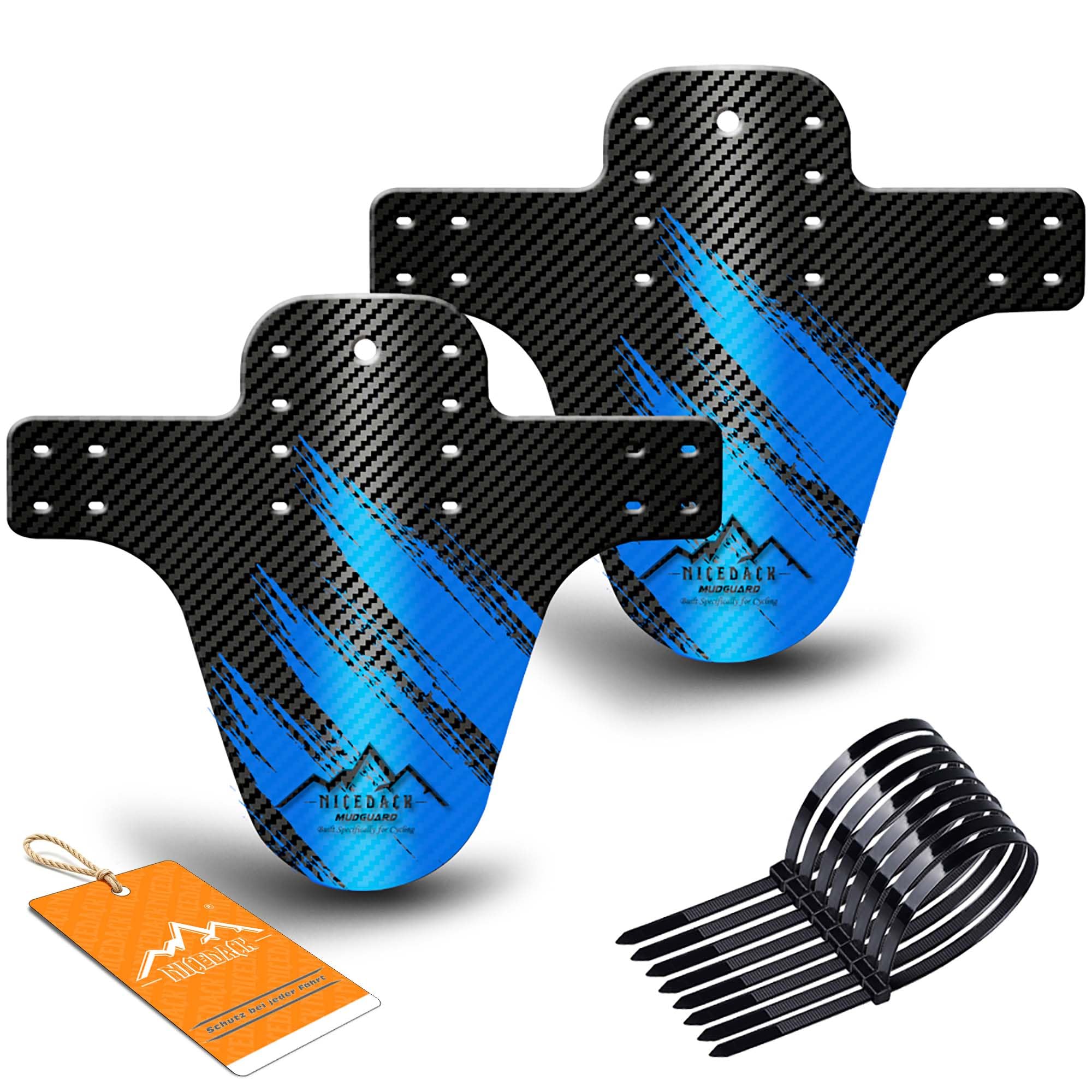
NICEDACK 2-Piece Fender Set

NICEDACK 2-Piece Fender Set

Budget pair

Our Score 8.8/10
Check Price

Worth Noting

  • Included zip ties are flimsy
Mount
Zip ties
Pieces
2
Wheel Sizes
20 to 29 in
Panel Thickness
0.8 mm
Read the full review

Two guards in the pack, one for each end, and both fold. Each one folds small enough to sit in a hip pack or under a saddle until the day the trail turns to soup, which is more than most single guards here will do for you.

The adjustability is the real strength. There are more zip-tie holes than on most guards, so you can set the blade where your frame actually gives you room, and the set is rated from 20 to 29-inch wheels, which is broad enough to cover a kids' bike as well as yours. Fitting both ends takes one pack of ties and a steady hand.

It is a splash guard, though. At 0.8 mm the plastic is the thinnest here and the blades are short, so expect the worst of the spray off your face and back rather than a clean jersey at the end of a boggy ride. Folded into a pack in July, though, either one is there when the weather turns in October, and that is what a cheap second set is for.

Bottom line: Our budget pick: two folding guards that cover both ends, with zip ties worth replacing before you fit them.

8

SKS X-Tra Dry Rear Fender

SKS X-Tra Dry Rear Fender

Hardtail rear

Our Score 8.8/10
Check Price

Worth Noting

  • Short blade sprays over the top on wide 26-inch tires
Mount
Quick-release clamp
Weight
4.8 oz
Position
Rear, seatpost
Read the full review

It clips to the seatpost and comes off again without a tool, which is the reason to own one: fit it for a wet week, pull it when the weather breaks, and there is nothing left on the bike to rattle or date the build. For a hardtail or a commuter with no seat-stay mounts, that is genuinely useful, because it needs nothing from the frame. The wide blade keeps spray off your back, shorts and saddle.

The clamp is the part to watch. On rough ground it can creep and let the guard swing down until it slaps the tire, so check it after a few miles and thread a zip tie through the mount if it moves. Being able to lift the whole thing off in a second is lovely when you are loading the car, and less lovely when the bike is parked downtown.

Bottom line: Our pick for a hardtail or a commuter: tool-free on and off, wide enough to keep your back dry, with a clamp that needs watching.

9

FIFTY-FIFTY Mountain Bike Fender

FIFTY-FIFTY Mountain Bike Fender

Front or rear

Our Score 0.0/10
Check Price

Worth Noting

  • Rear-seat mounting is disc-brake only
  • Zip-tied on, so removal means new ties
Mount
Four-point zip ties
Material
Polypropylene
Position
Front fork or rear seat
In The Box
Fender, six zip ties
Read the full review

Six heavy-duty zip ties and a set of instructions come in the bag, and that completeness is a big part of why this is the guard we point most riders toward first. Zip ties are the thing fender boxes forget, and a bare panel of plastic the night before a ride is a nuisance you remember. There is no shopping trip in the middle of this one.

The fixing is a four-hole pattern rather than two slots, and that does more than the spec suggests. With four anchors you can shape the guard around the fork arch, pull the slack out of it, and stop it creeping into the tire over a ride. A guard that stays centred is a guard you stop thinking about.

Coverage is what a fork-arch guard should be and no more. It takes the rooster tail that would otherwise land on your goggles and the fork stanchions, which is the part that costs money, since grit under a wiper seal wears the fork. The polypropylene is thick enough to be durable and flexible enough to form onto most lowers, and at an ounce you won't notice it on a climb. The listing also allows rear-seat mounting, so a spare can cover either end of the bike.

It is a short blade, though, so your down tube, shins and back are still on their own. That is the honest limit of the design: this protects the front end and the seals, and covering the rest of you is a separate purchase.

Bottom line: Our default pick: it mounts front or rear, ships with six heavy-duty zip ties, and the four-point fixing keeps it exactly where you put it.

How We Tested Mountain Bike Fenders

We started by pulling every fender we could find that listed an actual wheel-size and tire-width range, then cut anything that topped out below a 2.4-inch tire or had no stated clearance. About 40 models went in; 14 came out. Over six months, those 14 lived on three bikes — a 29er trail hardtail, a 27.5 full-suspension, and a commuter. They saw muddy singletrack the morning after rain, loose gravel, wet pavement on the way to work, and lift-served days at the bike park.

Every fender got a timed first install, solo, with whatever came in the box. We counted hardware — several arrived with no zip ties and no note saying so — and logged whether the instructions matched the actual mounting points. Fit was checked at the fork crown and seatstays with the wheel dropped out and back in, and we watched for rubbing under hard braking and full suspension travel. We also noted whether the straps or clamps could be re-positioned without drilling new holes, since a fender that only fits one way is a fender you fight every time you swap bikes.

On the trail, the question was simple: after a two-hour ride through puddles and mud, was there a wet stripe up the back of a light-colored jacket or grit on the downtube? We hosed each bike down afterward and checked whether water ran off or sat in the mounting hardware. Durability testing meant leaving fenders mounted for weeks at a time, pulling them on and off, inspecting zip-tie holes and hinge points for cracks, and checking whether they sagged or rattled loose over washboard. We also looked at whether a fender scuffed the fork or frame, and compared what each one cost against its coverage and included hardware — the cheapest often needed a trip to the hardware store first.

How to Choose Mountain Bike Fenders

Front, Rear, or Both

Front guards do the work you notice. They stop the rooster tail off the front wheel before it reaches your goggles and the fork stanchions, and grit under a wiper seal is what wears fork bushes, so a fork-arch guard is cheap insurance for the suspension you already paid for. A rear blade is about your back, your shorts and the seat stays, and it is the one to add if you ride wet ground through winter. Sets cover both ends; singles make sense when you only fight one kind of mud.

Check Tire Width and Fork Clearance First

Wheel diameter is rarely the limiter, since most guards here span 26 to 29-inch wheels. What separates them is the casing they clear, from 2.6 inches on the Zefal up to 3.0 inches on the Mucky Nutz and the Mudrocker. Then look at the fork: a zip-tie guard needs room around the arch and the lowers, a direct-mount guard needs the right holes, and a rear blade needs about 9 cm of profile between the seat stays.

The trap is the word universal. It means the guard can be coaxed onto a lot of forks, not that it fits yours. Compress the fork with the guard fitted and watch the gap at full travel.

Zip Ties, Bolts, or Velcro

Zip ties are the default because they grip almost anything: six ties pulled snug, tails trimmed, and the guard stays put for a season. Bolts are neater and quieter, and they only work if your fork has the matching mounts. Velcro suits riders who take the guard off for a rack or a wash. Whatever the mount, the guard should be snug enough not to slide and not so tight that the plastic dishes, and it is worth checking again after the first ride. Sleeved ties, like the ones on the Zefal, protect painted lowers.

Length, Thickness, and How Wet You Ride

A short fork guard and a long rear blade do different jobs, and the difference is length rather than price. Thin 0.8 mm panels fold into a pack and handle splash; 1.2 mm panels and glass-fibre reinforced plastic hold their shape when a rock flicks up. If you ride clay and roots all winter, pay for coverage and accept the extra bulk. If you want something in the pack for the one boggy section on your local loop, a folding pair is the smarter buy.

Frequently Asked Questions

Final Verdict

Start with the FIFTY-FIFTY. Six zip ties in the bag, four fixing points, and a shape that wraps a fork arch without fuss — it solves the most common problems with the least trouble, front or rear. If your fork has direct-mount holes, the Fox guard for 36 and 38 forks is the neater answer and it never creeps. And if your winters are properly wet, the Mudrocker's 840 mm blade is worth measuring your seat stays for.