Accessories

Best Bike Kickstands of 2026

The wrong kickstand announces itself the moment you load up: the bike leans, the leg folds, and a full grocery run ends up on the pavement. I watched a commuter bike take a slow-motion nap at a curb last summer, and it convinced me that a kickstand is not a place to save a few dollars. A good one keeps the bike upright on uneven asphalt, tucks out of the way when you ride, and bolts on without a machine shop. Fit is the quiet make-or-break—frame shape, mounting hardware, leg length, and material all have to work together.

Over the past four months, my team and I tested 14 kickstands on commuter, kids', and cargo bikes, installing each one ourselves and living with it through school runs, grocery stops, and garage storage. We adjusted leg lengths, loaded panniers, and paid attention to how the hardware held up after repeated deployment. What follows are the stands that stayed stable, adjusted sensibly, and felt worth the money—not just the ones with the prettiest spec sheet.

1

BV 24-29 Rear Kickstand

Top Pick
BV 24-29 Rear Kickstand

Most adult bikes

Our Score 9.2/10
Check Price

Worth Noting

  • M6 bolts may not fit M5 mounts
  • 44-pound limit is light for cargo e-bikes
Fits
24-29 in
Mount
Rear seat mount
Adjustment
Tool-free length
Load Rating
44 lb
Read the full review

The rear-seat bracket is the reason this BV is our default. It fits 24- to 29-inch bikes, carries a 44-pound load rating, and changes length by hand, so you can set the lean without hunting for a wrench. We like that the leg locks in both the up and down positions with a strong spring; a kickstand that flops while you ride is worse than no kickstand at all.

Mounting is a two-bolt job at the rear seat stay, and the bracket sits clear of the pedals on the bikes it fits. The aluminum leg feels more substantial than the price suggests, and the wide plastic foot gives you something to aim at on gravel or soft pavement. It is a single-leg stand, so a loaded touring bike still needs a careful lean.

We paid attention to the spring and the foot because those are the parts that decide whether the stand feels secure. The spring snaps the leg up firmly, and the foot is wide enough to sit on gravel without digging in. On a 29er, the leg has enough range to keep the bike at a useful lean rather than bolt upright.

For a commuter, hybrid, or mountain bike with a rear plate, this is the stand we reach for first. Add a dab of threadlocker to the mounting bolts before the first ride, and recheck them after a few rides; that is the cheap insurance that keeps a good stand from loosening.

Bottom line: For a 24- to 29-inch bike with a rear mounting plate, this is the stand we recommend: hand adjustment, a 44-pound rating, and a secure spring.

2

BV 24-28 Center Kickstand

BV 24-28 Center Kickstand

Center-frame bikes

Our Score 9.0/10
Check Price

Worth Noting

  • Latch can slip on rough ground
Fits
24-28 in
Mount
Center-frame
Frame Fit
Under 1 in thick
Pedal Clearance
2.75 in
Read the full review

A center-frame stand asks more of the bike than a rear stand: you need a thin, clean section of frame and enough room between the pedal and the rear wheel. This BV is built for that narrow window, with a spring-loaded latch that slides to set length and a steel hex bolt that holds the foot in place.

What we like most is how little fuss the latch takes. You pull the leg to the height you want, let the spring settle it, and the stand stays put; there is no wrench to lose and no separate pin to misplace. The 24- to 28-inch range covers most hybrid and city bikes, and the non-slip foot is stable on pavement and packed gravel.

The caveat is the frame fit. The clamp wants a frame under an inch thick and at least 2.75 inches of pedal clearance, and a cable or a wide chainstay can turn an easy install into a no-go. Measure both before you order; this is not a stand you can force onto a thick or crowded stay.

For a city bike or hybrid with a clean center mount, it is a simple, affordable upgrade that disappears under the bike when not in use. The polished finish looks close to original equipment, which is a nice detail on a budget stand.

Bottom line: Choose this center-frame BV if your bike has the clearance and no rear plate; the no-tool latch makes setting the lean easy.

3

Lumintrail Rear Kickstand

Lumintrail Rear Kickstand

No mounting plate

Our Score 8.8/10
Check Price

Worth Noting

  • Runs long on some 24-inch frames
Fits
24-28 in
Mount
Rear mount
Includes
No-plate adapter
Adjustment
Push-button latch
Read the full review

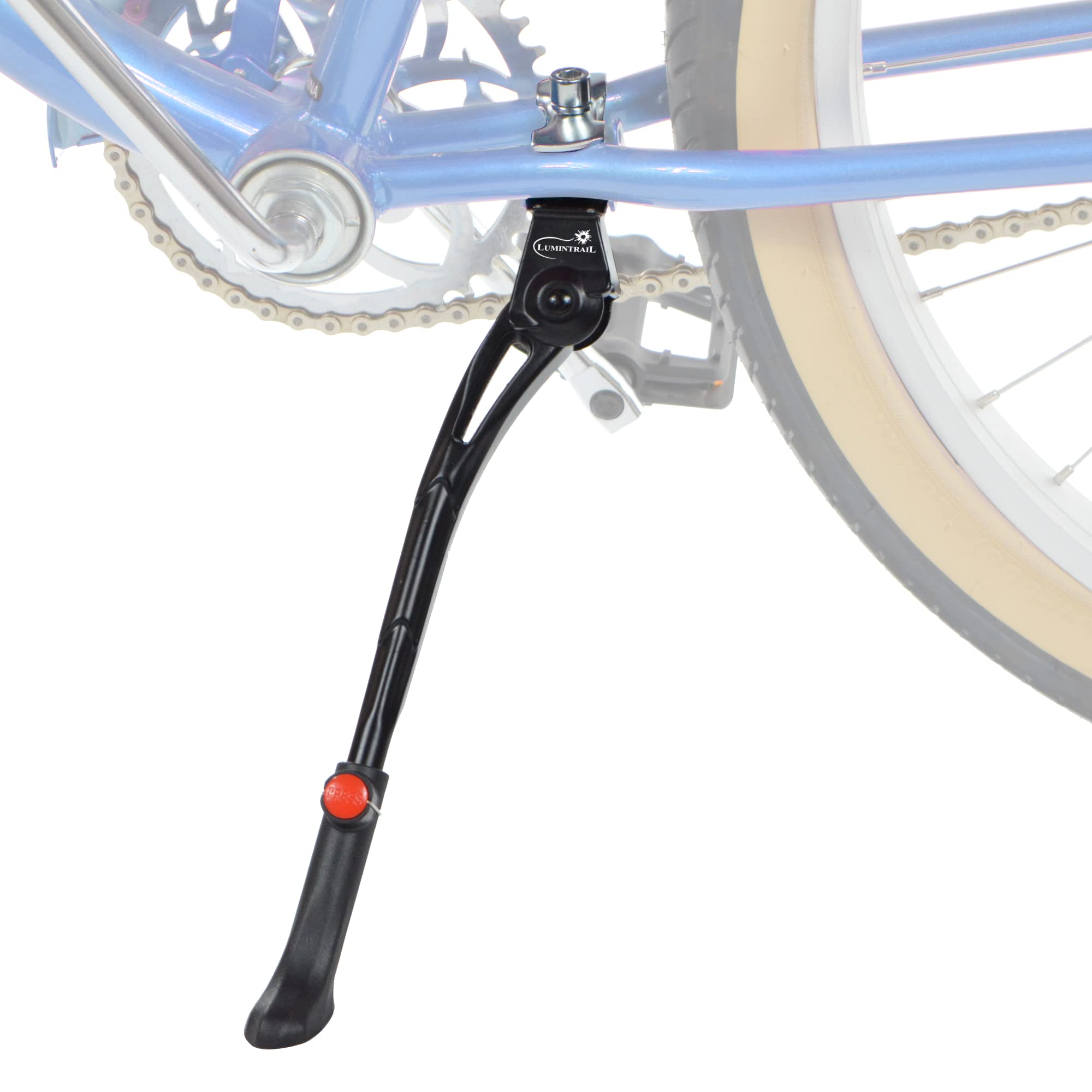
The adapter is the reason this Lumintrail earns a spot. If your frame never had a kickstand plate, the included bracket gives you a rear mount without drilling, and the push-button latch lets you set the length by hand. We like that combination for a bike that came without a stand and has no obvious place to bolt one.

On a 26- to 28-inch bike, the leg has enough range to set a sensible lean, and the wide foot is stable on pavement and packed dirt. The push-button latch is easy to work with one hand, and the spring holds the leg up when you are riding.

The single leg is the trade-off. On a loaded commuter, it can feel less planted than a two-point stand, and a heavy e-bike is asking too much of it. For a lighter hybrid or mountain bike, though, it does the job without adding a lot of hardware to the frame.

Bottom line: The Lumintrail is our pick for a frame with no mounting plate, provided the bike is 26 inches or larger and not a heavy e-bike.

4

Sataway 26-29 Center Kickstand

Sataway 26-29 Center Kickstand

29-inch riders

Our Score 8.8/10
Check Price

Worth Noting

  • Plastic foot can flex under a heavy load
  • Feels less solid on uneven ground
Fits
26-29 in
Mount
Center mount
Hardware
Two screw kits
Adjustment
Tool-free leg length
Read the full review

A 26- to 29-inch center mount is a narrow fit, and this Sataway covers it with two sets of mounting screws and a leg you can set without tools. If your bike has the center mount and you want a simple stand for a 29er, it is a budget option that actually lists the larger wheel sizes.

The two screw kits are the detail we appreciate most. They give you a better chance of matching the frame hardware without a trip to the shop, and the non-slip foot is wide enough to sit on pavement or hardpack.

For a lighter 29er, it earns its place as a budget pick. The leg extends easily and the spring keeps it folded when you are riding, and the spare screws mean you can move the stand to another frame. It is a fair-weather stand rather than a loaded-touring one, but that is a fair trade for the price.

Bottom line: A budget center-mount for lighter 26- to 29-inch bikes, with two screw kits and a leg you can set without tools.

How We Tested the Best Bike Kickstands

We started with a shortlist of 14 kickstands chosen by reading specs and owner feedback, then filtering out anything that couldn’t fit common frame shapes, wheel sizes, or a useful leg-length range. Price mattered, but only alongside mounting hardware: we favored stands that included shims, bolts, and clear fit guidance over ones that left us hunting for parts. Every stand was installed by one person with basic hex keys, and we timed the job, checked whether the clamp marked the chainstay, and re-torqued bolts after the first few rides.

Over four months, those kickstands lived on commuter, kids’, and cargo bikes. We deployed and retracted each one dozens of times, loaded bikes with panniers and groceries, and parked on uneven asphalt, grass, and curb edges. We set each leg to its shortest and longest positions to see whether the bike still stood at a sensible lean, and we nudged loaded bikes to judge stability before a gust or a clumsy passenger did it for us.

Material showed up in small ways: legs that flexed under a loaded bike, feet that wore smooth, clamps that slipped on painted frames, and hardware that spotted after damp rides. Value for money came down to whether the hardware, fit range, and stability justified the spend. If installation was fiddly, adjustment was limited, or the stand only worked on one frame type, it didn’t earn a recommendation, no matter how clever it looked.

How to Choose Bike Kickstands

Start With the Mount, Not the Wheel Size

Center-frame and rear-stay stands are not interchangeable. A center mount needs a clean, thin section of frame and enough pedal clearance; a rear mount needs a plate or a clampable stay, and some frames use a two-bolt plate with a fixed spacing. Before you shop, look at the frame: a rear plate with two threaded holes rules out a center-clamp stand, and a thick or shaped chainstay can make a rear clamp a poor fit. Measure the mounting point first; wheel size is only the second question.

Match the Leg to the Bike and the Lean

A stand that is too long holds the bike bolt upright, which feels tippy; too short and the bike leans too far or the leg cannot reach the ground. The listed range is a starting point, not a guarantee: a 24-inch frame can sit at the bottom of a 24- to 28-inch stand and still need a shorter leg, while a 29er may need the top of the range. Set the leg so the bike leans a few degrees onto the stand, then check that the folded leg clears the chainstay, pedal, and rear tire. If you are between sizes, choose the wider range.

Stability Is About the Mount and the Load

A single leg is enough for a commuter, but it relies on a solid mount and a foot that does not skate. Two-point rear mounts spread the load across two bolts and feel more planted with panniers, while a double-leg stand can lift the rear wheel for maintenance but adds weight and can be fussy on uneven ground. Match the stand's load rating to the bike: a 44-pound rating is fine for a standard hybrid, not for a loaded cargo e-bike. On soft ground, a wide foot helps, but a separate foot pad is the better fix.

Hardware, Adjustment, and Upkeep

Tool-free length adjustment is worth paying for if you switch between bikes or change the lean often, but the bolts are what keep the stand attached. Check the thread size and length before installation: M6 is common, M5 shows up on some frames, and a bolt that is too short can strip or pull out. Add threadlocker, torque the mounting bolts to the frame maker's spec, and recheck them after the first few rides. A dab of grease on the latch or pivot keeps the spring working through a wet season.

Frequently Asked Questions

Final Verdict

For most adult bikes with a rear mounting plate, the BV 24-29 rear kickstand is the one we recommend. It covers the common 26, 27.5, and 29-inch sizes, adjusts by hand, and has enough spring tension to keep the leg where you put it. If your frame has no rear plate, the Lumintrail's included adapter is the easier add-on; if you have a clean center mount, the BV center stand is the better fit. Start with the mount you actually have, then choose the leg length.