Lights & Electronics

Best Bike Lights of 2026

The best part of an evening ride is the moment the streets empty out and the air cools — right up until the sun drops and every parked car starts looking like it might pull out. A bike light buys you the margin: it makes you visible to drivers and shows you the potholes before your front wheel finds them. I've ridden home on a fading light, and I don't recommend it. My team and I have spent the past seven months with 14 lights, and the gap between one that holds its charge and one that sags at mile four is wider than the spec sheet — or the price tag — suggests.

Brightness numbers are the easiest thing to compare on a box and the least useful on a road — a focused 400 lumens can read better than a washed-out 800. What really decides whether a light stays with you is the mount and the charge. The picks below held their brightness, their bracket, and their battery.

1

Cuvccn Q4 Bike Light Set

Top Pick
Cuvccn Q4 Bike Light Set

Year-round commuting

Our Score 9.2/10
Check Price

Worth Noting

  • Straps fit standard bars only
Weight
2.72 oz
Battery
1100 mAh front, 350 mAh rear
Max Output
400 lumens
Water Resistance
IPX6
Read the full review

Most of the sets here claim some level of water resistance; the Cuvccn is the only one rated IPX6, which is the difference between shrugging off a shower and surviving the road spray that comes off a wet commute at speed. The charge port sits under a rubber flap, the spot where water actually gets into lights like these, and one split cable charges both units at once, so the second cord never disappears into a drawer.

That sealing is why it tops our list, but it is not the only reason. The headlight puts out 400 lumens from two main LEDs ringed by smaller ones, and the spread is what makes it useful: a bright center with enough spill at the edges to catch a curb or a pothole before you are on top of it. On lit streets we ran it on a lower steady setting and still had brightness in reserve for the dark stretch at the end of the ride. The two switches work independently, so the front can sit on steady while the rear flashes, instead of one button forcing you through every combination.

Battery figures are 1100 mAh up front and 350 mAh at the back, and both lights pop off their straps in seconds when it is time to charge. Twelve modes sounds like a gimmick until you want a flash behind a bus in daylight and a steady beam on a towpath after dark, and that flexibility is why this is the set we hand to someone who commutes all year. The price lands in the middle of this group, which makes the sealed port and the beam easy to justify.

Bottom line: Our pick for a year of commuting: 400 lumens of front light, the only IPX6 rating here, and both halves charging from one cable.

2

Zewdov Bike Light Set

Zewdov Bike Light Set

Budget city riding

Our Score 9.2/10
Check Price

Worth Noting

  • Front light can cut out mid-ride
  • Elastic straps only, no bolt-on option
Weight
0.95 oz
Max Output
250 lumens
Charge Time
1-1.5 hours
Water Resistance
IP65
Read the full review

Twenty-seven grams and 1.7 cm thick: these are the smallest lights in this guide, small enough that the front one nearly disappears between the brake lever and the shifter, and small enough to leave on a bike at the rack without it looking worth taking. Two pairs of elastic straps come in the box, so the same light moves between bars, seatpost and a child's bike without any hardware.

The listed output is 250 lumens, the low end of this group, and that is the honest way to read it: this is a set for being seen on lit streets and for seeing the next few metres of path, not for unlit descents at speed. Both lights charge together from a 2-in-1 cable in about an hour and a half, quick enough to top up over lunch, and the IP65 rating covers dust as well as water jets. The port covers press down firmly, which is more than we can say for every light here.

What puts it in the guide is the cost against what you get: two lights, two strap pairs and a shared cable for less than any other set here. Nothing else is this easy to leave on a parked bike, and we kept reaching for it as the set to throw in a bag for a borrowed bike. For a streetlit commute, a spare pair, or a child's bike, that is the whole argument; if your route is a dark towpath in January, the Cuvccn or the Lsan are the ones to look at instead.

Bottom line: If your riding is streetlit and the budget is tight, nothing here beats this pair on weight, charge time, or outright cost.

3

BLITZU 120T Tail Light 2-Pack

BLITZU 120T Tail Light 2-Pack

Rear visibility

Our Score 9.2/10
Check Price

Worth Noting

  • Elastic strap can split before the light fails
Pack
2 lights
Weight
1 oz
Max Output
120 lumens
Water Resistance
IPX5
Read the full review

The 120T pair is the most flexible thing here in the literal sense: the same light goes on a seatpost, a seatstay, a saddle bag, a backpack strap or a helmet, and you get two of them. Each weighs about an ounce, is barely bigger than a matchbox, and comes with its own charging cable.

Brightness is 120 lumens of red behind a diffuser, so it reads as a light rather than a hot dot of glare, visible from a long way back without dazzling anyone behind you. USB-C charging matters more than it sounds on a light this small, because the cable already in your bag for your phone is the cable it wants. We found charges quick enough that topping up before a ride stopped being a chore.

Two taillights is the underrated part of the package. One on the bike and one on a helmet or bag covers the angle a seatpost light misses when a driver approaches from the side, and the second light costs very little on top of the first. That is why it is the rear light we point most riders to; the Cygolite below is brighter and better mounted, but it is a single light at several times the money.

Bottom line: We recommend the 120T to most riders buying a rear light: two USB-C taillights, with mounts for the bike, a bag, or a helmet.

4

Cygolite Hypershot 350

Cygolite Hypershot 350

Daytime visibility

Our Score 9.2/10
Check Price

Worth Noting

  • Micro-USB port, not USB-C
  • Most expensive light here
Weight
2.65 oz
Runtime
2 to 200 hours
Max Output
350 lumens
Water Resistance
IP64
Read the full review

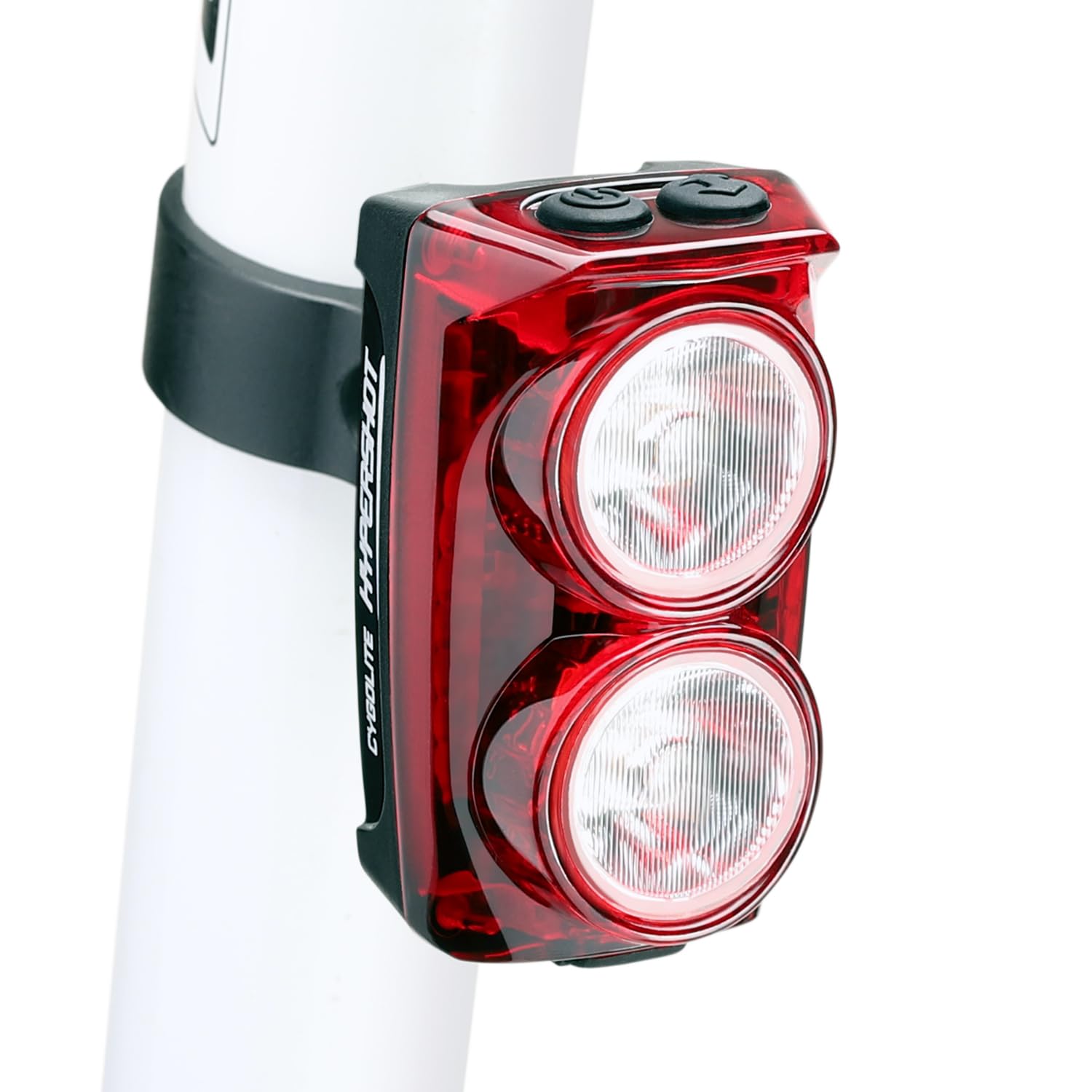
Adjustable flash speed is the Hypershot's trick, and it is more practical than it sounds: a pattern drivers have already tuned out is not doing anything, and being able to change the rate is how you get noticed again. Seven modes include steady, a steady pulse that helps drivers judge distance, and several flash patterns running from triple flash to a random setting.

Output is 350 lumens of red, the highest rear output here by a wide margin, and it is pitched at daylight as much as darkness. Listed runtime runs from 2 to 200 hours depending on mode, so at the flashing end it is a week or more of commuting between charges. The body is 75 grams and IP64, which is a sensible spec for something bolted to a bike that lives outside.

The mount is a hard seatpost or seatstay bracket rather than an elastic band, and that changes how the light behaves. Over broken pavement what we noticed is that it holds its aim and does not walk around the post, and it does not come off unless you take it off, which matters for a light that stays on the bike.

What you are paying for is a taillight good enough to run in daylight, and in traffic that is money well spent, because noon is the condition most rear lights never solve. Two things to accept: the charging port is micro-USB rather than USB-C, so it is an extra cable in the bag, and it is the most expensive light in this guide by a distance. Neither matters much for a light that stays on one bike and charges once a week.

Bottom line: Spend the extra if you ride in traffic, because this is the only taillight here that still registers in full daylight.

5

GearLight S400 Pro

GearLight S400 Pro

Quick bike swaps

Our Score 9.2/10
Check Price

Worth Noting

  • IPX4 is the weakest water rating here
  • Plastic strap is the weak point
Mount
Tool-free quick mount
Max Output
400 lumens
Front Modes
5
Water Resistance
IPX4
Read the full review

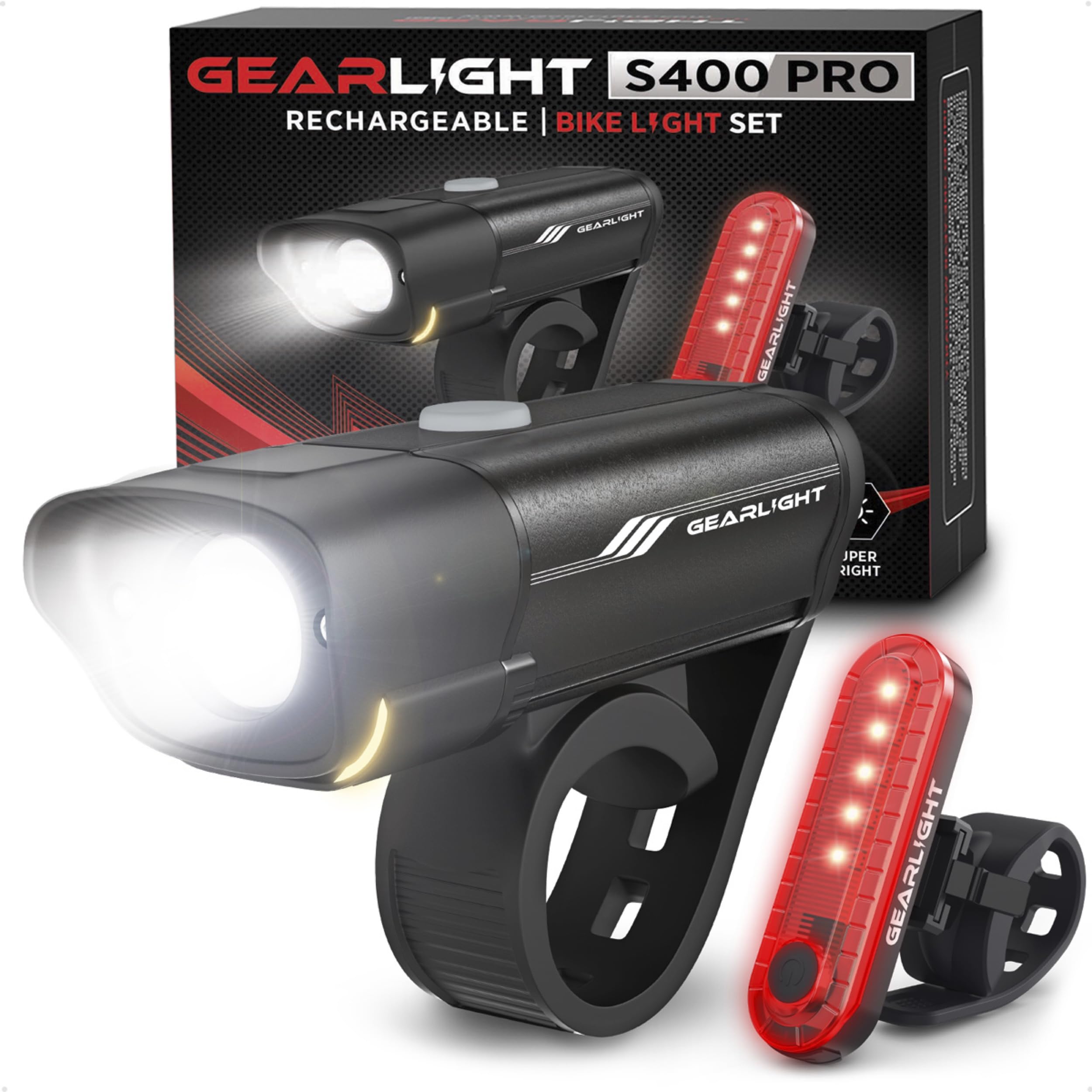
The mount is why this set is here: a tool-free quick bracket that goes on and comes off in a couple of seconds, which is what you want if your bike lives in a hallway or on a rack and you would rather not leave a light on it. Between two bikes in one household, this is the set that gets swapped rather than duplicated, and we rate that convenience highly enough to overlook the specification it gives up.

The front light is a 400-lumen aluminum-and-plastic unit with five modes, the rear matches it, and both charge over USB. On the road the beam is strong enough for an unlit park path at commuting speed, and the rear has enough pattern choice to be useful in traffic. Set against the Cuvccn it is a close call on output and a clear loss on sealing, which is the trade: easier to move, less suited to a wet winter.

Bottom line: Best for a two-bike household: the tool-free bracket swaps in seconds, though this is the least water-resistant set here.

6

Lsan P12 Bike Light

Lsan P12 Bike Light

Unlit roads

Our Score 9.0/10
Check Price

Worth Noting

  • Mount can shift or release on rough ground
  • Bulkiest headlight here
Housing
Aluminum alloy
Runtime
Up to 12 hours
Max Output
1200 lumens
Water Resistance
IPX5
Read the full review

Twelve hundred lumens is the biggest claimed number in this guide, and it exists for one specific rider: the one whose regular route has a stretch with no streetlights at all. We think that is the entire case for the Lsan, because on lit roads it is more light than you need, and on a dark path it is the difference between reading the surface ahead and guessing at it.

The headlight is a three-LED unit in an aluminum shell, and the metal does two jobs: it takes knocks and it pulls heat away from the emitters, which is how a bright light stays bright instead of fading after ten minutes. Listed runtime reaches 12 hours at the low end of its modes. The odd extra is a USB output, so the same battery will top up a phone or a bike computer, which makes this the only light here with a second job.

What we keep coming back to is the pairing of output and that power-bank function, because it is the combination that matters on a long ride rather than either feature on its own. The taillight is a conventional red unit and the headlight is the bulkiest front light in this group, so it is not the set for a folder or a bike you carry upstairs. Buy it for the ride where the streetlights run out.

Bottom line: The one to buy when your route goes properly dark: brightest headlight here, and the only one that doubles as a phone charger.

7

BLITZU Gator 320

BLITZU Gator 320

First commuter kit

Our Score 9.0/10
Check Price

Worth Noting

  • Mount can work loose on rough roads
Mount
Tool-free handlebar mount
Weight
3.2 oz
In The Box
Front light, rear light, bell
Water Resistance
IPX5
Read the full review

A bell comes in the box, which no other set here offers, and it is the detail that turns the Gator 320 into a starter kit rather than a pair of lights: front light, rear light, bell, one purchase. The mounts are tool-free, the headlight body is aluminum rather than plastic, and the whole set goes on or comes off in seconds.

What we appreciate most is the completeness. For someone building up a first commuter, this covers the light and the thing you notice missing on a shared path, and the buttons are easy to find with winter gloves on. The headlight is the heaviest front unit among the sets here at 3.2 ounces, but that weight buys a metal body that takes a knock. A one-year warranty comes with it, as it does with most of the sets in this guide.

Where it earns its place is the bundle rather than the beam: buying lights, a bell and a spare strap separately costs more and arrives in three boxes. The front light is decent for lit streets and the rear is quick to switch on behind the saddle, but if beam quality is what you are chasing, the Cuvccn and the Lsan are the ones to compare.

Bottom line: A tidy first purchase: front light, rear light, and a bell from one box, with a metal-bodied headlight that shrugs off knocks.

What Seven Months of Night Riding Taught Us About Bike Lights

We started by gathering every bike light we could find from brands we'd trust on a dark road, then narrowed the field by claimed output, runtime, mount style, charging setup, and price until we had 14 models worth riding. Testing ran seven months, and every light went on the same routes: a 25-minute pre-dawn commute, evening grocery runs, and a few unlit trail sections on weekend rides. Where I could, I ran two lights at once so the comparisons were side by side rather than from memory.

Brightness and battery life got tested together, because they're really the same question. I rode each light on its highest steady setting until it dimmed or cut out, timing the run, and noted whether the output stepped down gradually or fell off a cliff without warning. Lights that claimed eight hours and delivered three at full power didn't make the cut. Each one was fully drained and recharged from a wall outlet with the clock running, and I checked the charging port after a five-minute run under the faucet — the rubber covers on some of these are decorative.

Mounting is where the field thinned out fastest. I installed and removed each light 20 times, counting how many needed a tool, then rode a stretch of patched asphalt and speed bumps to see whether the head shifted, with a strip of tape on the bar marking the starting angle. Every light got dropped from handlebar height onto pavement and left out in the rain. Value came down to what was in the box — a spare mount and a USB-C cable go a long way — and whether the thing still worked in month seven.

How to Choose Bike Lights

Decide Whether You Need to See or Be Seen

The job splits in two. On lit streets your light mostly has to announce you to drivers; on an unlit path it has to show you the surface ahead, which takes more output and a beam with spill at the edges rather than a tight hot spot in the middle.

Claimed lumens are not measured to one shared standard, so use them to rank a shortlist rather than to compare brands. Here the Zewdov's 250 lumens is a lit-street light, the Cuvccn's 400 covers both jobs, and the Lsan's 1200 is for routes that go properly dark. Buy for your darkest regular stretch, then run a lower steady mode where there is ambient light.

Match the Charging to Your Routine

Battery complaints outnumber every other kind in this category, and most start with the cable. Two questions settle it: does the light charge over USB-C, the lead you already carry for a phone, and can both halves charge from one of them? The Cuvccn's split cable and the Zewdov's 2-in-1 both mean one charger on the desk instead of two.

Check charge time as well. The Zewdov pair fills in about an hour and a half, which is the difference between topping up over lunch and planning the day around it, and whatever you buy, press the port cover home after every charge.

Choose Between a Strap and a Hard Bracket

There are two mounting families here, and they trade off against each other. An elastic strap goes on without tools, swaps between bikes in seconds and comes off when you lock up, but it holds aim less firmly over rough ground and the strap itself is the part that fails first.

A hard bracket, like the Cygolite's seatpost mount, keeps the light pointed where you set it and does not walk around the post. If the light lives on one bike, take the bracket; if it moves between bikes or the bike parks outside, take the strap and check its tension weekly.

Read the Water Rating

Ratings here run from IPX4 to IPX6 and IP65, and the X means the maker has not rated dust protection. IPX4 handles rain and splashes, IPX5 and IPX6 add resistance to water jets with IPX6 the stronger of the two, and IP65 pairs dust-tightness with jet resistance.

What no rating tells you is how well the rubber flap over the charge port seals after a season of use, and that flap is where water actually gets in. A splash-rated light is fine for commuting; it is not fine for a hose-down at the car wash.

Do Not Skip the Rear Light

A rear light is what drivers approaching from behind see first, so it is worth buying separately if you already own a front light. Around 100 lumens is plenty after dark, while a daylight-visible unit like the 350-lumen Cygolite is about being noticed at noon, which is the condition most taillights fail.

Pattern choice matters too: an irregular flash resists being tuned out, and a steady or pulse mode lets a driver judge distance. If you ride in traffic, mount a second light high on a bag or helmet, since that is the angle a seatpost light misses.

Frequently Asked Questions

Final Verdict

For most riders the Cuvccn Q4 is the set to buy. It is the only pair here rated IPX6, the 400-lumen front light has enough spread for a genuinely dark path, and both halves charge from one cable, which is the sort of small convenience that keeps a commuter lit through a winter.

If your route has a long unlit stretch, the Lsan's 1200-lumen headlight and power-bank output justify the bulkier bars. Buying a rear light on its own, the BLITZU 120T is the value pick, and the Cygolite is the one to choose when being seen at noon matters more than the price.