Lights & Electronics

Best Mountain Bike Lights of 2026

The moment I knew my bike light was the weak link came midway down a rooty descent, when the beam washed out and every shadow looked like a rock. A good mountain bike light fixes that: it puts a usable pool of light where you’re actually looking, holds its brightness long enough for a real ride, and stays aimed at the trail instead of your stem. Over eight months, I rode with 12 different lights, and the pattern was clear—raw brightness numbers tell you far less than beam shape and visibility.

Battery life, durability, and mounting are the quieter make-or-break details. A light that dims an hour into a two-hour ride, rattles loose on rocky descents, or has a mount that shifts after a clumsy remount is a liability, no matter how bright it is. Functionality matters too—switching modes with cold, muddy gloves should be simple—and value for money comes down to what a light reliably delivers night after night, not just its spec sheet. The picks below are the ones I’d trust on a dark trail.

1

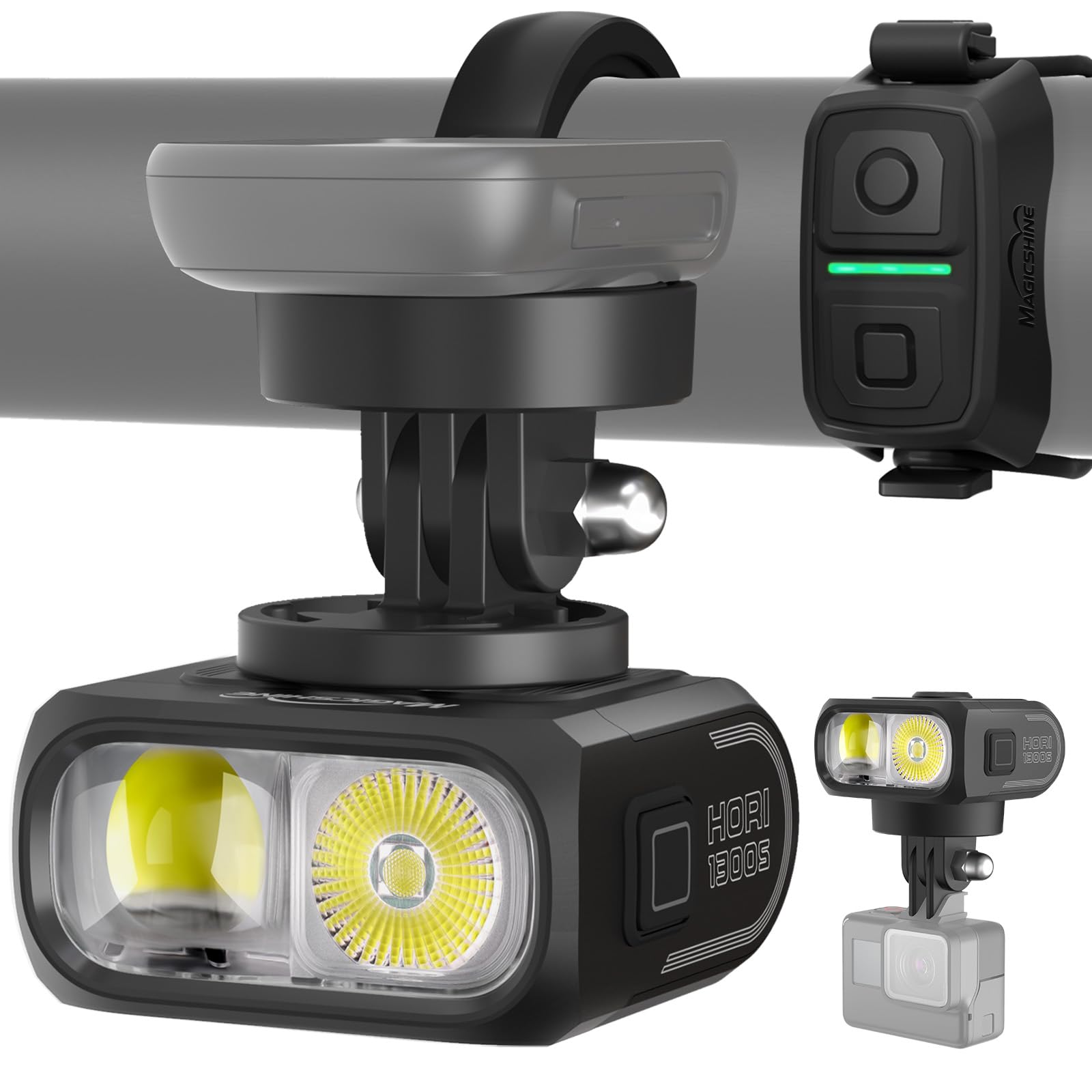
Magicshine Hori 1300S

Top Pick
Magicshine Hori 1300S

Trail riding

Our Score 9.2/10
Check Price

Worth Noting

  • High beam runs the battery down fast; charge after most rides
  • Mount bolt is awkward to reach with the light fitted
Beam
High beam with cut-off low beam
Battery
3200 mAh, USB-C
Max Output
1300 lumens
Water Resistance
IPX6
Read the full review

Almost every light here throws the same round hotspot wherever you point it. The Hori 1300S splits the job: a 1,300-lumen high beam for unlit trail and a low beam with a genuine cut-off that puts light on the road instead of in the eyes of whoever is coming the other way. That single decision is why it's our top pick — it's the only light in this group with a shaped beam rather than a second, dimmer circle.

The rest is built for the same rider. The aluminum body is IPX6 rated, the dual clamp carries the light and a Garmin or Wahoo computer on one mount, and the 3,200 mAh cell charges over USB-C. The vibration sensor worried us — a light that wakes up in a hallway is a light with a flat battery — but the useful half is the auto-off, which stops a mid-climb snack break from eating your runtime.

There's a remote that pairs with the light so you can drop from high to low without leaving the grip; check that the bundle you're buying includes one, because it's the difference between using both beams and leaving it on high all night. Two-year warranty, and shims for 28, 32 and 35 mm bars mean it moves to the next bike without a parts order.

Bottom line: Our pick if you ride unlit trail regularly: the shaped low beam keeps you courteous and visible on the road, and the high beam is bright enough to ride fast by.

2

APECYC 1200 Lumen Set

APECYC 1200 Lumen Set

Budget commuting

Our Score 9.2/10
Check Price

Worth Noting

  • Clamp rotates on rough ground
  • Charge doesn't last on the brightest setting
In The Box
Headlight, taillight, bracket, cable
Max Output
1200 lumens
Battery Display
LCD screen
Water Resistance
IPX6
Read the full review

A two-year warranty on a light at the budget end of this group is the detail that made us look twice, and the specification backs it up: IPX6, USB-C, an LCD screen that reads out the charge, and a taillight in the same box. That is most of what matters on a light that costs a fraction of our top pick.

On the bike it does the basics well. The beam is a focused spot rather than a wide flood, which suits the way most people actually use a light like this — a road link, a rail trail, a commute that ends after dark. Both mounts are tool-free and come off in seconds for charging, the front light disappears on the bar at 7.04 ounces, and the rear has enough patterns to hold a driver's attention without turning into a disco.

The warranty does quiet work here too. A budget light that dies in month fourteen is a write-off; one that's covered for two years isn't, and that changes how willing you are to leave it on a locked bike outside a cafe or hand it to a kid heading to practice.

Bottom line: The set we suggest when money is tight: USB-C, a battery screen, a taillight and two years of coverage for a budget outlay.

3

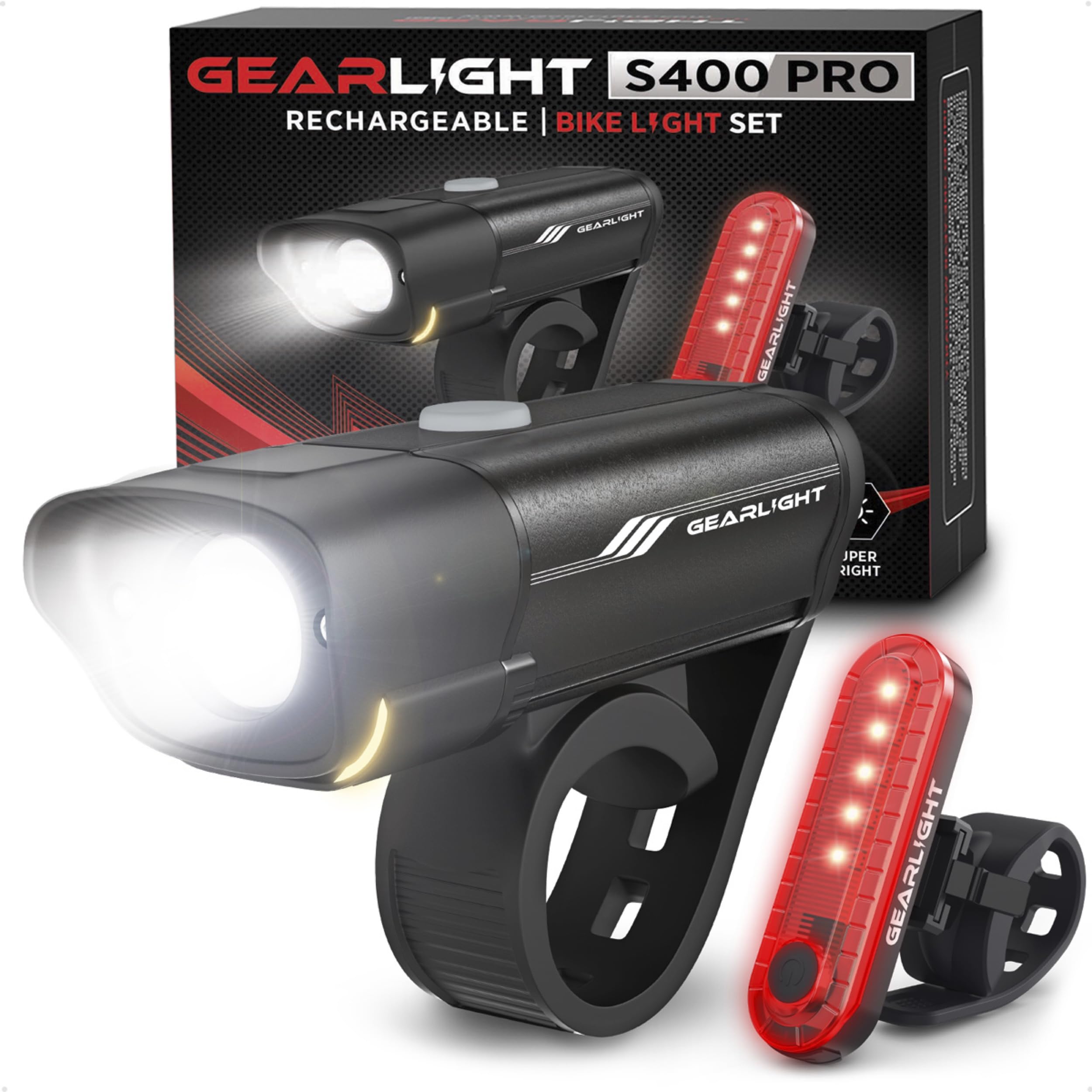
GearLight S400 Pro

GearLight S400 Pro

Pavement riding

Our Score 9.2/10
Check Price

Worth Noting

  • Plastic mount straps split at the bend
  • High setting reaches only a few feet
Modes
5
In The Box
Front and rear lights
Max Output
400 lumens
Water Resistance
IPX4
Read the full review

If your mountain bike mostly commutes — the ride to work, the bike path, the gravel road out to the trailhead — this is one of the easiest sets here to live with: five modes on the front, a stretch-and-hook mount, and a taillight you can leave on the seatpost.

The beam is a round hotspot with a soft edge rather than a shaped trail beam, and the five modes cover steady, flash and everything between. On a dark bike path it's plenty, and in traffic the flashing patterns do more for you than the steady beam does — which is the honest way to think about a light this size.

The rear light deserves its own mention. It clips on in seconds, has more patterns than the front, and is bright enough to run in daylight on a road commute. That's the half of a set people underestimate, and it's also the half where most near-misses happen.

There's one more thing in its favour: because the front is small and light, it's the easiest light here to carry as a spare. Toss it in a jersey pocket on a ride where a bigger light is the plan, and a flat battery stops being the thing that ends your night.

Bottom line: The set we suggest for commuting and bike-path miles: quick to fit, easy to live with, and honest about what 400 lumens can do.

4

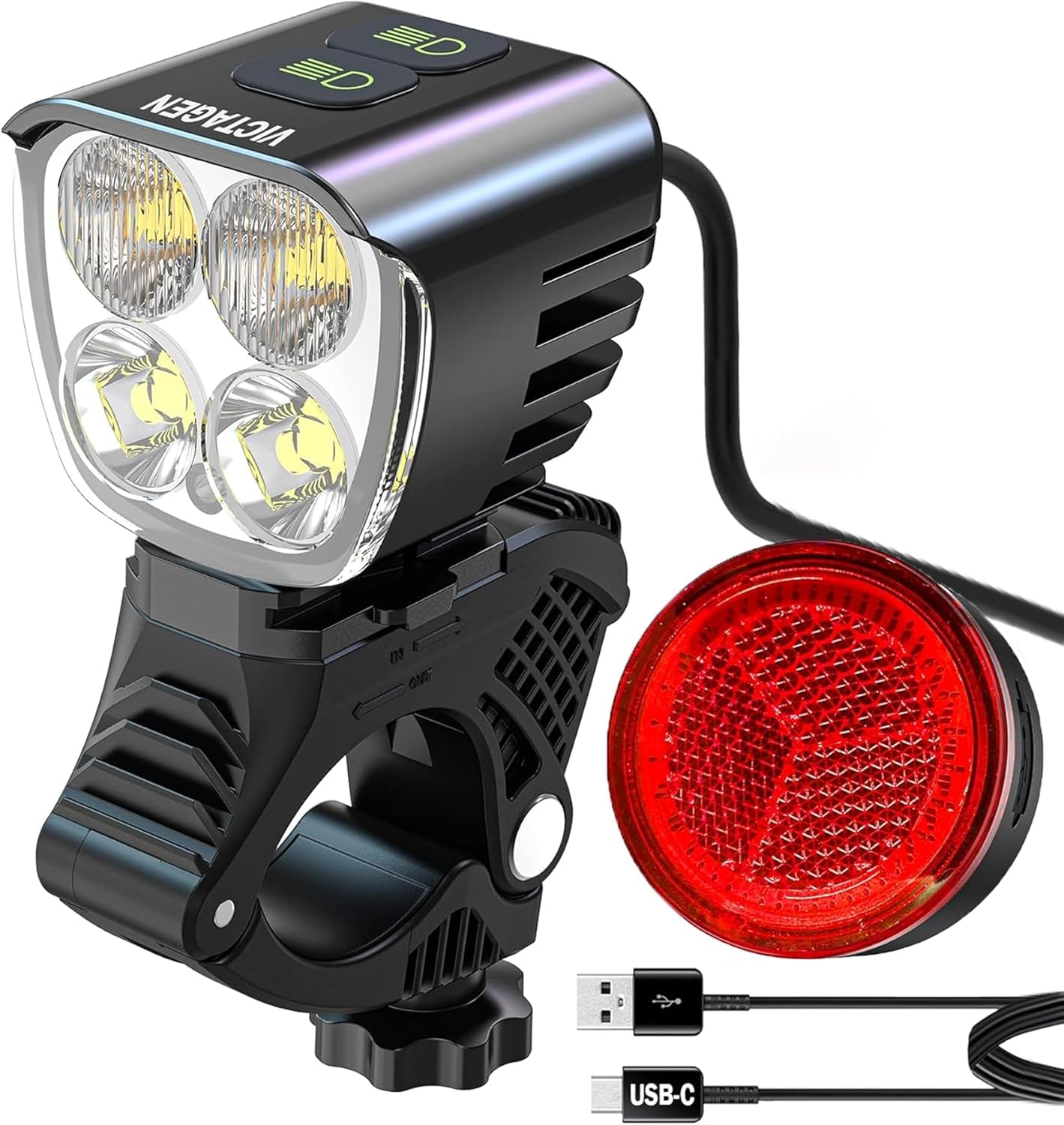
Victagen 12000lm Headlight

Victagen 12000lm Headlight

All-night rides

Our Score 9.0/10
Check Price

Worth Noting

  • 11.2 ounces sitting on the handlebar
  • Quick-release clamp works loose on rough ground
Max Output
12000 lumens
Claimed Runtime
6-15 hours
Battery Capacity
10000 mAh
Water Resistance
IP65
Read the full review

A 10,000 mAh battery is the whole argument. Victagen quotes 6 to 15 hours depending on mode, the four-LED head has separate high and low beams, and there are 13 modes you'll ignore after the first week in favour of one trail setting and one road setting.

Where it earns its place is the ride that starts before dawn and finishes after it. We kept reaching for this one when the plan ran long, partly because the battery indicator sits on top of the body where you can see it at a glance, and partly because the USB output will put charge back into a phone down to its last few percent. The taillight in the box adds a brake-warning flash, which is worth more on a group night ride than any of the extra beam patterns.

On the trail the high beam does what the numbers promise: a long, bright patch far enough ahead that you can ride at a pace you chose rather than a pace the light allows. The clamp takes 22 to 33 mm bars, the head rotates a full turn so you can aim it at the ground in front of the wheel, and the listing includes a free replacement mount within a year — which tells you where the wear happens.

Bottom line: If your night rides run for hours, this is the light we hand people: a huge battery, a real high beam, and a mount the maker replaces free for a year.

5

Siuyiu JW617 4800

Siuyiu JW617 4800

Wide trail beam

Our Score 9.0/10
Check Price

Worth Noting

  • Bracket bolts work loose over time
  • Battery drains quickly at full brightness
Mount
Two aluminum brackets
LED Count
17 LEDs
Max Output
4800 lumens
Water Resistance
IP65
Read the full review

The head is 6.69 inches wide and packed with 17 LEDs, and the difference shows the moment the trail turns. Where a single-emitter light puts a bright circle in the middle of the path, this one lights the edges too, so the line through a rock garden is visible before you commit to it. Four modes split flood, spot and a combination of the two, and the flood setting is the one that earns its keep on a wooded descent.

That beam shape is what puts it near the top of this group for technical riding: it's the light that most changed how willing we were to ride an unfamiliar trail after dark. The rest is sensible rather than exciting — IP65, a digital display showing charge and run time, USB-C, and two aluminum brackets in the box so a second bike is already set up.

Size is the honest trade-off. Six and a half inches of head plus a bracket that sits proud of the bar means checking clearance against your cables at full lock, and the ABS sections of the housing feel less premium than the aluminum front does. None of that matters once it's dark and the beam is doing the work.

Bottom line: A broad, edge-to-edge beam from 17 LEDs, a digital charge readout, and enough housing to survive a knock — our pick for tight, unlit trail.

6

Victagen VTG8 8000

Victagen VTG8 8000

Multi-bike use

Our Score 9.0/10
Check Price

Worth Noting

  • Bracket is the weakest part of the package
Weight
6.74 oz
Charging
USB-C with power output
Max Output
8000 lumens
Battery Display
LCD readout
Read the full review

At 191 grams this is the light that travels: hardtail to commuter to a partner's bike, in and out of a pack, without the front end of the bike feeling like it's carrying a battery. The quick-release shoe means it comes off in a second when you stop for coffee, which is the difference between a light that gets used and one that gets left at home.

The LCD readout is the feature we ended up using most. Instead of guessing whether there's another lap left in the cell, you get a number before you drop in — and because the USB-C port works both ways, the same battery will put charge back into a phone or a GPS that's dying halfway round.

The beam comes from three LEDs with a high and a low setting, and it's biased wide rather than long, which suits wooded trail where the corners arrive close together. Modes are easy to find with gloves on, and the taillight in the box is rechargeable rather than coin-cell, so the whole set goes on the same charger.

For most riders this is the sweet spot of the two Victagens: the same display-and-clamp thinking as the big one, in a package you can actually move around. It won't run all night at full output and doesn't pretend to, but for a two-hour trail ride plus the ride home, it's the one on our bar most often.

Bottom line: At 191 grams with a quick-release shoe and a numeric charge display, this is the light we move between bikes without thinking about it.

7

Lsan P12

Lsan P12

Known routes

Our Score 9.0/10
Check Price

Worth Noting

  • Head shifts in the bracket on rough ground
  • Bulky head takes handlebar space
Charging
USB input and power-bank output
Max Output
1200 lumens
Claimed Runtime
12 hours
Water Resistance
IPX5
Read the full review

Three LEDs, an aluminum shell and a headline figure of 1,200 lumens — on paper this is the bargain of the group. The head also works as a power bank, so a phone or a GPS on its last few percent can be topped up from the same battery that's lighting the trail.

The light itself holds up its end. It's bright enough for a rail trail or a familiar loop, the beam is broad rather than piercing, and the 12-hour runtime is a low-setting number rather than anything you'll see with the light turned up. The body is bulky enough to take a real chunk of handlebar, and both units charge over USB.

The mount is where it loses us. The head slides into a bracket that doesn't grip hard enough once the ground turns rough, and it shifts under braking bumps — the sort of thing you notice every thirty seconds on a descent. For a commute or a route you know by heart it's a lot of light for the money; for mountain biking proper, it isn't the one.

Bottom line: A bright, cheap headlight with a power-bank port and a bracket that lets it shift; fine for known routes, frustrating on rough trail.

8

Suruid 1800 Lumen

Suruid 1800 Lumen

Easy trail

Our Score 8.6/10
Check Price

Worth Noting

  • High beam drains the battery quickly
  • Bracket won't fit very narrow bars
Modes
5
Housing
Anodized aluminum alloy
Max Output
1800 lumens
Water Resistance
IPX4
Read the full review

The Suruid is the best-feeling light in the budget half of this group: an anodized aluminum shell that doesn't flex when you squeeze it, a stout bracket, and a two-source head that combines a low beam and a high beam so you get a near field and a long throw from one unit.

Pointed down a dark lane, the high beam reaches a long way, and the low beam is civil enough for a shared path. Five modes cover the usual ground, IPX4 deals with rain and road spray, and the whole thing feels like it was machined rather than moulded.

Our hesitation is endurance rather than build. Charge life between top-ups is fine on the low settings and short on the high beam, so a couple of hours of hard trail riding is the realistic ceiling; the bracket also won't close on a very narrow bar, which rules out a kid's bike. If your rides fit inside that window, it's the most satisfying light to handle here — and the one whose battery you'll think about most.

Bottom line: An aluminum-bodied light with a long-throwing high beam and a low beam for the road; the battery is the part you end up planning around.

How We Tested Mountain Bike Lights

To build the shortlist, I started with lights recommended by local riders and shop mechanics, then narrowed by claimed output, runtime, mount type, and price so the group covered commuter-friendly beams as well as trail-focused ones. We ended up testing 12 lights over eight months, with every model seeing the same mix of after-work singletrack laps, pre-dawn pavement spins, and wet, rooty days.

On the trail, I ran each light on both handlebar and helmet mounts, timed full charges and runtime in each mode, and noted when output visibly stepped down. I paid attention to beam shape—whether roots and rocks appeared early enough to react, whether side spill lit the edges of turns, and whether the light washed out in fog or rain. To check durability and reliability, lights got mud-spattered, rinsed, dropped onto grass, and left in a hot car between rides; I recorded any flicker, seal failure, or button that became hard to press.

Mounting got its own scrutiny: I installed each light on three different bar diameters, bounced the bike over rock gardens, and checked whether the clamp crept or the beam sagged. Mode changes were done with winter gloves, and I compared what came in the box—spare mounts, cables, good instructions—against how well the light actually worked. Value for money wasn't about the lowest price; it was about how much dependable brightness, runtime, and secure mounting you got for the spend.

How to Choose Mountain Bike Lights

Beam Pattern Beats the Lumen Number

Every light here claims a big figure and none of them agree on how it was measured, so treat output as a rough ranking rather than a specification. What you can compare is the shape of the beam. A single round hotspot is fine for being seen on a road; a wide, even spread is what lets you read a line through rocks at speed.

The most useful feature on a trail light is a separate low beam with a cut-off: it puts light on the ground without dazzling a driver or a rider coming the other way, so you can leave it on through town and go to full brightness only when the trail starts. Our top pick is built around exactly that.

Match Runtime to Your Longest Ride

Runtime figures are quoted for the dimmest setting, and the brightness you actually want on a descent draws several times the current. Work backwards from your longest winter loop: if it takes two hours, you want a usable beam for two hours, not a headline number measured on low.

A charge indicator — a screen, or a simple three-light gauge — is worth paying for, because a light that dies unannounced on a descent is worse than a dimmer one that warns you. Top up after every night ride; lithium cells would rather be charged often than run flat.

The Mount Is What Fails First

Across this category, brackets and straps cause more trouble than the electronics. A stretchy silicone or plastic strap is quick and tool-free, and it is also the part that splits; a bolted aluminum clamp takes longer to fit and doesn't let go. If the light shares the bar with a computer, a dual mount keeps the cockpit sane — the Magicshine carries both.

Whichever you choose, fit it, ride a rough mile, and check it again. A light that rotates on the bar is worse than useless, because you stop trusting it and leave it at home.

Water, Knocks, and What the Rating Means

IPX4 covers rain and spray from any direction; IPX6 survives a jet of water, and IP65 adds dust sealing, which matters on a gravel or dust-covered trail. Beyond the rating, look at the housing: an aluminum body handles a drop onto rock better than plastic, and it also sheds heat from the LED, which is what stops a small light dimming itself on a long descent.

A two-year warranty on a light you're going to use in the wet is worth more than an extra flashing mode you'll never select.

Frequently Asked Questions

Final Verdict

Buy the Magicshine Hori 1300S if you ride unlit trail more than once a month. The shaped low beam is the difference between a light you tolerate on the road and one you can leave switched on, and the high beam is strong enough to let you ride at a pace you choose rather than a pace the light allows.

If the budget won't stretch that far, the APECYC set covers commuting and easy trail with USB-C, a charge screen and a taillight, and the big Victagen is the one for rides that run past midnight.