Components

Best Bike Saddles of 2026

Halfway through a sixty-mile gravel ride, I stopped negotiating with my sit bones and started negotiating with my saddle. A bike saddle is one of the few parts you feel every pedal stroke, and the wrong one turns a good bike into a daily punishment. Shape, width, and how the saddle supports your sit bones matter more than the cushy look. Over the past six months, I’ve logged miles on 12 saddles across road rides, gravel, commutes, and indoor trainer sessions, and the differences showed up fast.

Comfort is the headline, but I also watched the details that decide whether a saddle stays on the bike: whether the cover and finish held up, how straightforward installation was, and whether the price felt fair for the materials. A good saddle should disappear under you—stable on rough pavement, supportive without feeling like a plank, and shaped so you’re not shifting every few minutes. Some firm saddles break in nicely; others never do. The picks below span that range, so you can match one to your riding rather than someone else’s idea of comfort.

1

Brooks England B17

Top Pick
Brooks England B17

Long-distance leather comfort

Our Score 9.4/10
Check Price

Worth Noting

  • Most expensive saddle in this guide
  • Tension bolt can fail and slacken the leather
Rails
Steel
Shell
Full-grain leather
Length
275 mm
Max Weight
330.7 lb
Read the full review

The B17 doesn't feel like much out of the box. It's a hammock of full-grain leather over steel rails, 275 mm long, hard enough under a thumb that you wonder what the fuss is about. At 0.53 kg it's also lighter than every other saddle here that lists a weight, which is not what most people expect from leather and steel.

That trade is worth making, and it's why this is the saddle we reach for on long days. Leather spreads weight across a suspended panel instead of concentrating it in foam, and it doesn't pack down over a five-hour ride the way padding does. There's an aesthetic argument too: black leather and steel rails on a steel frame look like they grew there, and it's the one saddle in this guide that looks better after a season than it did on day one.

The cost is time. Break-in runs to hundreds of miles for some riders and barely a week for others, and you won't know which you are until you've done it. Feed the leather occasionally, keep it out of a soaking overnight, and the 150 kg rating and steel rails suggest it will still be bolted to the bike long after the foam saddles here have been replaced.

Bottom line: Long-distance riders who will put in the break-in miles get a saddle that molds to them and keeps improving; nothing else here rewards the patience the same way.

2

Bikeroo Comfort Saddle

Bikeroo Comfort Saddle

Everyday upright riding

Our Score 9.2/10
Check Price

Worth Noting

  • Wings can chafe on a leaned-forward road bike
Width
7.8 inches
Length
10.2 inches
Padding
Memory foam
Max Weight
350 lb
Read the full review

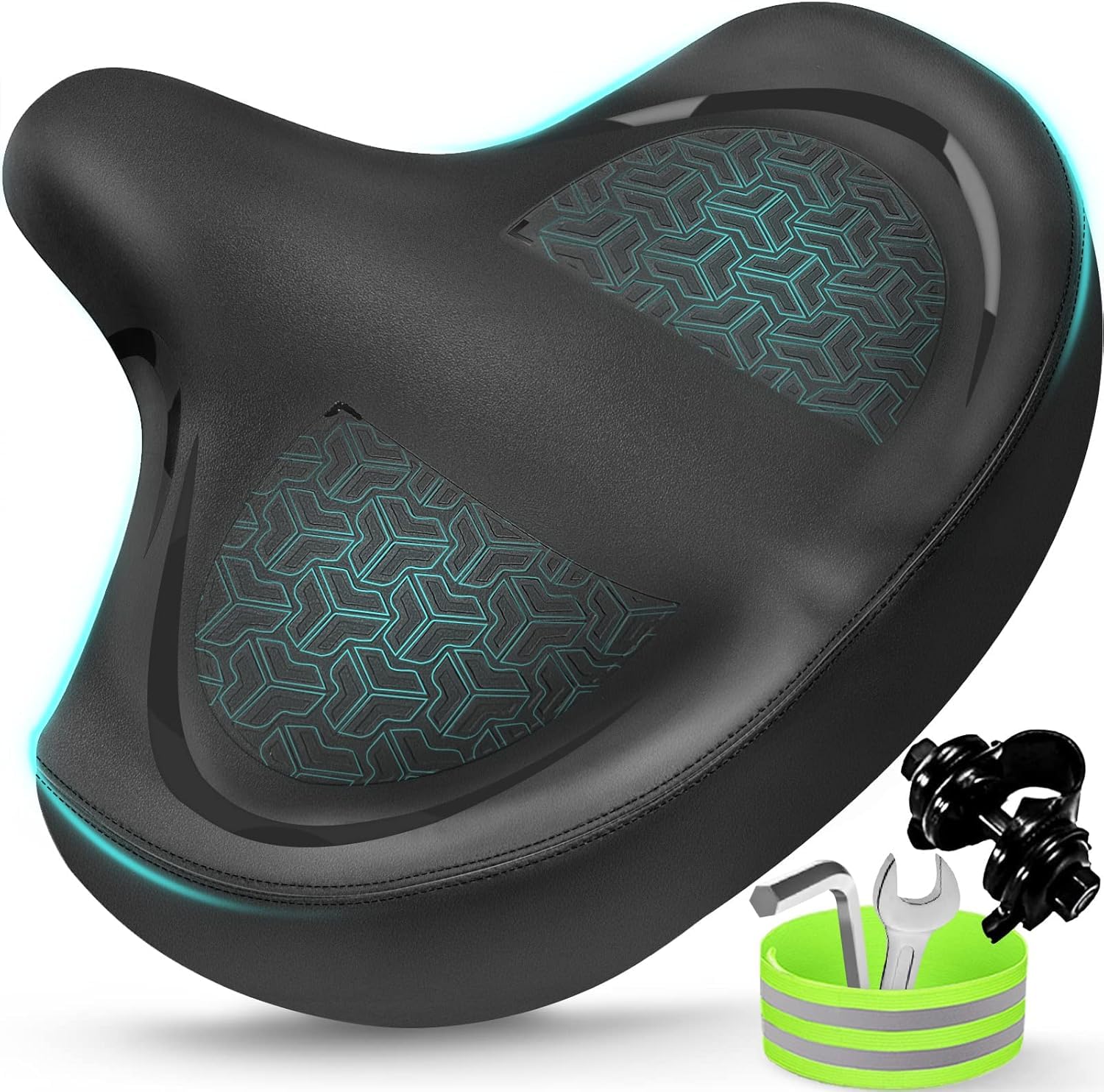
A channel cut clean through the padding is what separates this Bikeroo from most of the saddles here. It isn't a shallow dimple pressed into the top; the opening runs from the nose back through the wide part, so the weight that usually lands on soft tissue gets carried by the sit bones on either side. At 7.8 inches wide and 10.2 inches long, it's sized for someone sitting fairly upright on a hybrid, cruiser, or e-bike.

Everything for the swap comes in the bag: two hex keys, a multi-hole wrench, an adapter, and a waterproof cover for the weeks the bike lives outside. The clamp is the standard two-rail type, so fitting takes minutes on most posts, and the 350-pound rating is the second highest here after the Twomaples — worth knowing if an e-bike or a cargo rack is part of the picture.

What we appreciate most is how little it asks afterward. There's no leather to feed, no tension bolt to check, and the memory foam holds its shape instead of flattening into a hammock. For a rider whose only real complaint is a hard stock saddle, and who wants to be riding again this afternoon, that combination of genuine width, a genuine cutout, and nothing to maintain is the most useful thing in this guide.

The foam is denser than the word soft suggests, which is why it doesn't collapse under a heavier rider and also why the first mile can feel firmer than expected. Give it a few outings before you judge it; the padding settles faster than any leather saddle ever will, and the cover wipes clean after a wet commute.

Bottom line: If you want one saddle that makes an upright hybrid or e-bike comfortable without a break-in period or any upkeep, this is the one we point people to first.

3

RockBros Bike Seat

RockBros Bike Seat

E-bikes and indoor

Our Score 9.2/10
Check Price

Worth Noting

  • Cover can tear with heavy use
Width
8.6 inches
Length
10.2 inches
Padding
Memory foam
Max Weight
220.5 lb
Read the full review

There's a grab handle molded under the nose of this saddle, and once you've used it you notice how strange it is that nothing else here has one. On an e-bike or a spin bike that weighs more than you want to deadlift, the handle gives you somewhere to hold while you drag it out of the garage or shift it across the floor.

The platform itself is 10.2 inches long and 8.6 inches wide, with a three-zone padding layout that removes material from the middle and puts it under the sit bones. The cover has raised anti-slip dots, which do more than a smooth vinyl surface when you're shifting around on a climb.

Small extras add up: a reflective strip across the back for visibility, a mounting wrench in the box, and a waterproof cover for wet commutes. The clamp needs a firmer tighten than most, so recheck it after the first few rides before it works loose mid-route.

Where it earns its place is the pairing of a wide, genuinely padded platform with a handle that solves a problem nothing else here addresses. It's the saddle we fit first on an e-bike, and the one we suggest to anyone who has to carry a bike up a flight of stairs.

Bottom line: E-bike and indoor riders get a comfortable, wide platform and a carry handle that makes a heavy bike easier to move around the garage.

4

LCYMD Bike Seat

LCYMD Bike Seat

Plush budget comfort

Our Score 9.2/10
Check Price

Worth Noting

  • Won't fit every 1.25-inch seat post out of the box
Cover
Faux leather
Width
8 inches
Length
9.7 inches
Padding
High-density foam
Read the full review

If the only thing you want from a new saddle is for the hurting to stop, this is the one we start with. At 3.7 inches tall it carries the deepest padding here, layered as high-density foam over two shock-absorbing balls, and the cover is a non-slip faux leather with a vent down the center. It looks like a small armchair and treats you accordingly.

Fitting is straightforward: the mounting hardware comes in the box, the clamp is the usual two-rail type, and it's backed by a two-year manufacturer warranty, which is longer coverage than most saddles here offer. At 0.81 kg it's heavier than the Bikeroo, and you feel that carrying the bike rather than riding it.

The foam is dense rather than squishy, so it supports instead of bottoming out, and the center vent keeps air moving on warm days. It's the least subtle saddle in this guide, and on a long ride that's the point: nobody notices a wide, soft seat, they just stop thinking about it.

Bottom line: The plushest saddle here, and the one to start with if a hard stock seat is the only thing keeping you off the bike.

5

Wittkop Bike Seat

Wittkop Bike Seat

Trail and road

Our Score 9.0/10
Check Price

Worth Noting

  • Costs more than every other foam saddle here
Width
6.7 inches
Length
10.8 inches
Padding
Memory foam
Read the full review

Narrow is the point. At 6.7 inches across, the Wittkop is more than an inch slimmer than the Bikeroo and the LCYMD, and that's exactly what a mountain or road rider wants: a platform the thighs can move around without clipping an edge on every stroke. The five padded zones put material under the sit bones and thin it out everywhere else, so you sit on support rather than on a cushion.

The 10.8-inch length gives you room to shift forward on a climb and back on a descent, and the memory foam is dense enough to stay supportive well past the first hour rather than squashing flat. The cover is waterproof, which matters on a bike that spends its life on a roof rack or a damp trailhead.

Getting the angle right matters more on this shape than on a wide comfort saddle. The profile can read nose-down once it's clamped, and a saddle tilted forward puts your weight onto your hands and wrists, so set the rails level, tighten, then check again after the first ride. Do that and it disappears under you, which is the highest compliment a trail saddle can earn.

Bottom line: Mountain and road riders who pedal hard get a narrow, supportive platform that stays out of their thighs' way, and it holds up over hours in the saddle.

6

Velmia Bicycle Saddle

Velmia Bicycle Saddle

Mixed-position riding

Our Score 9.0/10
Check Price

Worth Noting

  • Firm padding that won't suit riders wanting plush
Cover
Waterproof
Width
7.3 inches
Padding
Memory foam
Read the full review

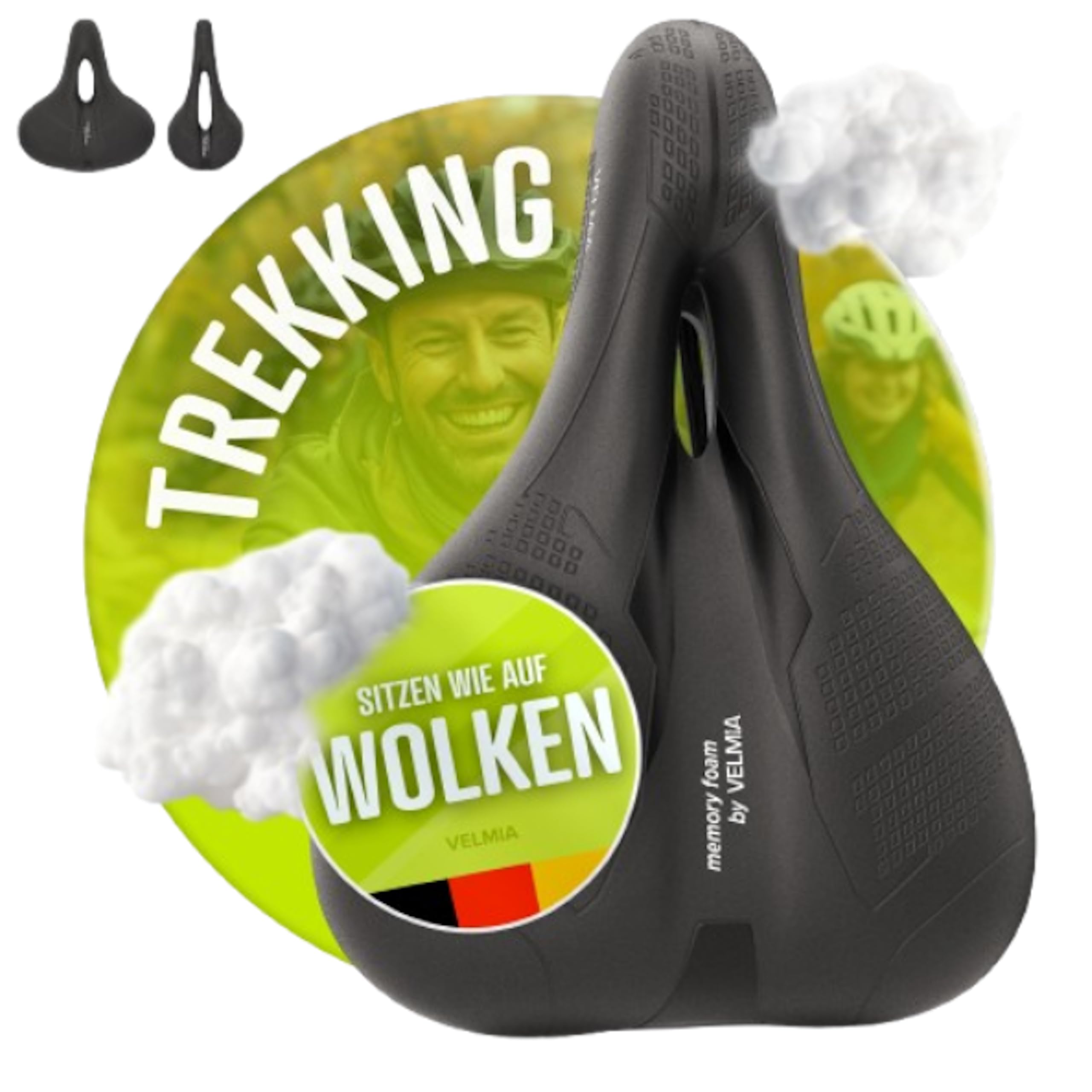
At 7.3 inches wide, the Velmia sits between the cruiser-plush picks and the narrow trail shapes here, and that middle ground is where a lot of casual riders actually live: upright enough for a town bike, tidy enough that your thighs aren't fighting the wings on a longer spin.

Velmia sells three versions keyed to riding position, so the same saddle can be bought for a leaned-forward or upright posture rather than guessed at. The cover is waterproof, the top has a vented slot to move air, and the box includes a saddle clamp and illustrated instructions. Waterproofing matters more than it sounds, because a saddle that soaks through takes days to dry and sours every ride until it does.

The rails are the part to watch, since a snapped rail drops the saddle without warning; check the clamp bolts after the first few rides and don't overtighten them. What we like is that the choice is handled for you — pick the version that matches your position and the width question is largely settled, which is more guidance than most saddles here offer.

Bottom line: A middle-width saddle for riders who split their time between upright cruising and longer efforts, with three versions to match how you sit.

7

Twomaples Oversized Seat

Twomaples Oversized Seat

Larger riders

Our Score 9.0/10
Check Price

Worth Noting

  • Tilt is hard to lock in on some seat posts
Width
12.2 inches
Length
13.39 inches
Padding
Memory foam and gel
Max Weight
650 lb
Read the full review

Twelve inches across the back is not a saddle anyone buys by accident. The Twomaples is built for riders who need the load spread as widely as possible — larger bodies, upright cruisers, e-bikes, trikes — and it delivers with a platform measuring 13.39 by 12.2 inches, the widest here by a clear margin.

The wings are concave rather than domed, and that's the detail we think makes the size work. A flat or convex platform this wide becomes a slide; the dished shape is designed to hold you in the middle instead, and two shock spring balls underneath take the edge off rough pavement. A 650-pound rating makes it the highest-capacity saddle in this guide by a wide margin.

At 2.1 pounds it's heavier than anything else here that lists a weight, which is the honest cost of that much foam, gel, and steel — you feel it lifting the bike onto a rack, not riding it. Installation is standard two-rail with wrenches and an adapter in the box, and the memory foam over cooling gel stays comfortable on long, slow rides where a narrow saddle would have you standing on the pedals.

Bottom line: Fit this one if you need the widest platform here: larger riders and upright e-bikes get the load spread across a genuinely broad, dished seat.

8

Bluewind Noseless Seat

Bluewind Noseless Seat

Front pressure relief

Our Score 8.8/10
Check Price

Worth Noting

  • Cover can separate at the seams
Width
9 inches
Length
13 inches
Padding
2.5-inch foam
Max Weight
300 lb
Read the full review

Take the nose off a saddle and two things happen: the pressure that usually sits at the front disappears, and your thighs stop rubbing against anything when you pedal. That's the whole argument for the Bluewind's noseless shape, and for riders who get numb or chafed on a conventional saddle it's a convincing one.

The platform is 13 inches long and 9 inches wide with 2.5 inches of foam, so there's plenty of surface under you even without a nose to steer with. On an exercise bike or a cruiser, where you're planted and pedaling steadily, the shape makes sense; on a road bike where you shift around constantly, the missing nose leaves you with less to control.

Getting it level takes patience. The tilt range is limited, and a saddle sitting nose-up pushes you backward with every stroke, so spend time with the clamp before your first ride and check the angle again once the bolts have settled.

Where it lands for us: it's the saddle we suggest to anyone whose discomfort is at the front rather than the sit bones, and the extra width makes it a sensible upgrade for an indoor bike. It isn't the saddle for a fast group ride, and it isn't trying to be.

Bottom line: Riders whose discomfort sits at the front of a conventional saddle get real relief here, and the wide rear suits indoor bikes too.

How We Tested the Best Bike Saddles

We started by narrowing a field of more than 60 saddles to 12 based on rail material, shell construction, width options, cover material, and price spread, then bought each one at retail so no brand could tune a sample for us. Each saddle went onto the same steel test bike and, where the rails allowed, a carbon seatpost, with saddle height and fore-aft position measured and reset for every rider. We matched each model’s stated width to sit-bone measurements from three testers before the first ride.

Over six months, those 12 saddles rotated through commutes, weekend road rides, gravel loops, and indoor trainer sessions. We rode them in rain and dust, on smooth tarmac and chip-seal, and on rides from 20 minutes to four hours. After every ride, each tester logged where pressure showed up, whether they slid forward, and how often they stood to relieve discomfort. We timed first mounts and adjustments with a torque wrench, noting whether rails fought the clamp or the saddle slipped.

Every few weeks we checked covers for scuffs and seam separation, rails for bending or creaking, and shells for flex. We rated firmness on the first ride and again at the end, because a saddle that feels hard out of the box may settle in—and one that feels soft may bottom out. Value got a final pass: we compared materials, finish, and how the saddle held up against what it cost.

How to Choose Bike Saddles

Match the Shape to Your Riding Position

Bars level with or above the saddle put most of your weight on the back of the seat, so you want width there and a shorter nose. Drop the bars and you rotate forward onto the front, where a wide, soft platform turns into a chafing point on every stroke. That's how the 12.2-inch Twomaples and the 6.7-inch Wittkop can both be good saddles and still be wrong for each other's rider.

Be honest about the bike you actually ride. A hybrid with swept bars and a cruiser are upright; a gravel or road bike is not, whatever saddle it came with suggests otherwise.

Cutouts, Noses, and What Padding Can't Fix

Pressure relief comes from shape. A channel cut through the padding — the Bikeroo's is the deepest here — or no nose at all, as on the Bluewind, moves load off soft tissue and onto the sit bones. Adding foam past a point just makes the saddle taller and hotter without changing where you sit.

Firm foam that holds its shape usually beats soft foam that bottoms out after an hour, even though the soft one feels better in the shop.

Check the Clamp Before You Order

Nearly every saddle here mounts on two rails with a clamp on the seat post, and most ship with tools and an adapter for older posts. What a listing calls universal fit refers to those rails, not to your post: a 1.25-inch post or a proprietary exercise-bike fitting can need an adapter that isn't in the box.

Look at the clamp on your bike before you buy. If it isn't a standard two-rail clamp, choose a saddle that states it fits your bike rather than assuming.

Springs, Elastomer, and the Noise Trade-off

Suspension under the saddle — steel springs, rubber balls, elastomer blocks — absorbs pavement seams and trail chatter, and it's a big part of why the plush picks feel so different from a racing saddle. The trade is weight, movement, and noise, since springs can rock side to side and start creaking once grit works in.

On smooth roads you'll gain more from the right shape than from suspension; on broken surfaces it earns the extra pound.

Foam, Leather, and How Long a Saddle Lasts

Foam is maintenance-free but compresses over time, and covers wear where your thighs rub. Leather costs more, takes weeks or months to break in, and wants occasional feeding, but it molds to you and can be tensioned as it stretches.

Weight follows the same logic: a leather-and-steel saddle and a wide gel platform both outweigh a slim racing seat, which only matters if you race or carry the bike up stairs. Pick foam for zero upkeep, leather for a fit that keeps improving.

Frequently Asked Questions

Final Verdict

Start with the Bikeroo. A deep cutout, 7.8 inches of width, mounting tools in the box, and a 350-pound rating make it the most useful saddle here for the rider most people actually are: upright, occasional, and tired of a hard stock seat.

If you ride for hours and want a saddle that keeps improving, the Brooks B17 is worth the break-in. If your bike rewards a narrow platform, fit the Wittkop instead.