Bikes

Best Commuter Bikes of 2026

A commuter bike is supposed to make the trip to work the easiest part of your day. The wrong one turns every pothole, hill, and stairwell into a negotiation. What you're really buying is a bike that disappears under you — one that carries your bag, handles wet pavement, and still looks presentable when you lock it outside. I've ridden enough clunkers to know the difference isn't fancy specs; it's the stuff you notice on repeat trips.

We've spent the past eight months with seven commuter bikes, from pedal-only to e-assist, and the ones worth your money get the basics right. Assembly should take an evening, not a weekend, and the frame should feel sturdy when you load a rear rack while the ride stays smooth over cracked asphalt. If you're going electric, battery life matters more than peak speed — a dead battery halfway home is not a commute — and appearance counts too, since this is a bike you'll park in public and look at every morning. Below are the picks that earned a spot by the door.

1

Funhang EB-C1 Electric Bike

Top Pick
Funhang EB-C1 Electric Bike

Daily e-commuting

Our Score 8.8/10
Check Price

Worth Noting

  • 61.5 pounds, so plan on ground-level parking
Motor
500W, 1,000W peak
Weight
61.5 lb
Battery
48V 374.4Wh, removable
Wheel Size
26 inches
Read the full review

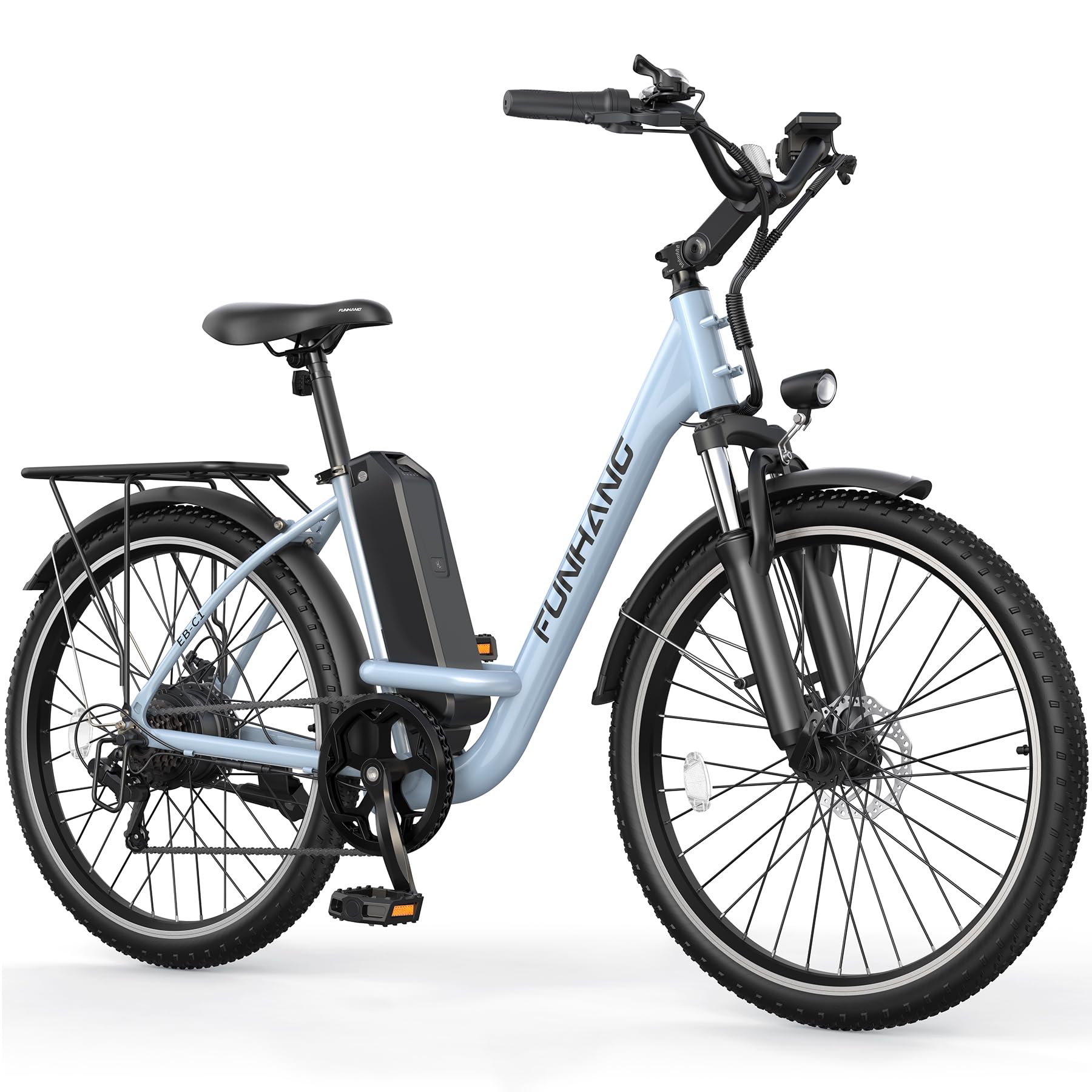
Budget e-bikes usually get you a motor and leave the commuting to you. The Funhang EB-C1 is the exception: the rear rack, front and rear fenders, headlight, and an adjustable stem are all fitted before it ships. That completeness is why it's our top pick — you can ride it to work on day one without a second order for the parts that make a bike useful in traffic.

The motor is modest on purpose. Five hundred watts, a thousand at peak, and a 20 mph cutoff suit bike-lane speeds, and five assist levels plus a seven-speed drivetrain let you decide how much work you do. The 48V, 374.4Wh pack lifts out to charge at a desk or in an apartment, and Funhang claims 25 to 30 miles on electric alone — a best case that throttle-only riding, a heavy load, or cold weather will all cut into.

Weight is the trade. The steel frame and 61.5 pounds buy a planted feel at speed, helped by 26-inch wheels, a front suspension fork, and disc brakes that pull it down from 20 mph with authority. The 300-pound rider limit is the most generous here, which makes this the e-commuter for bigger riders as well as longer routes.

Assembly is a one-person job with the tools in the box. The detail we appreciate most is the adjustable stem and seatpost: together they buy several inches of fit adjustment, which matters if you're between sizes or sharing the bike with someone else. If your commute is five flat miles and you don't mind the effort, the HILAND does the job with nothing to charge — everyone else should start here.

Bottom line: We recommend the EB-C1 to anyone whose commute is long or hilly enough that arriving sweaty is the problem; the rack, fenders, and lights are already on it.
2

Hoverfly Ourea Electric Bike

Hoverfly Ourea Electric Bike

Rough pavement

Our Score 8.4/10
Check Price

Worth Noting

  • 264-pound rider limit is the lowest here
Motor
750W
Battery
374.4Wh, removable
Claimed Range
20-40 miles
Max Rider Weight
264 lb
Read the full review

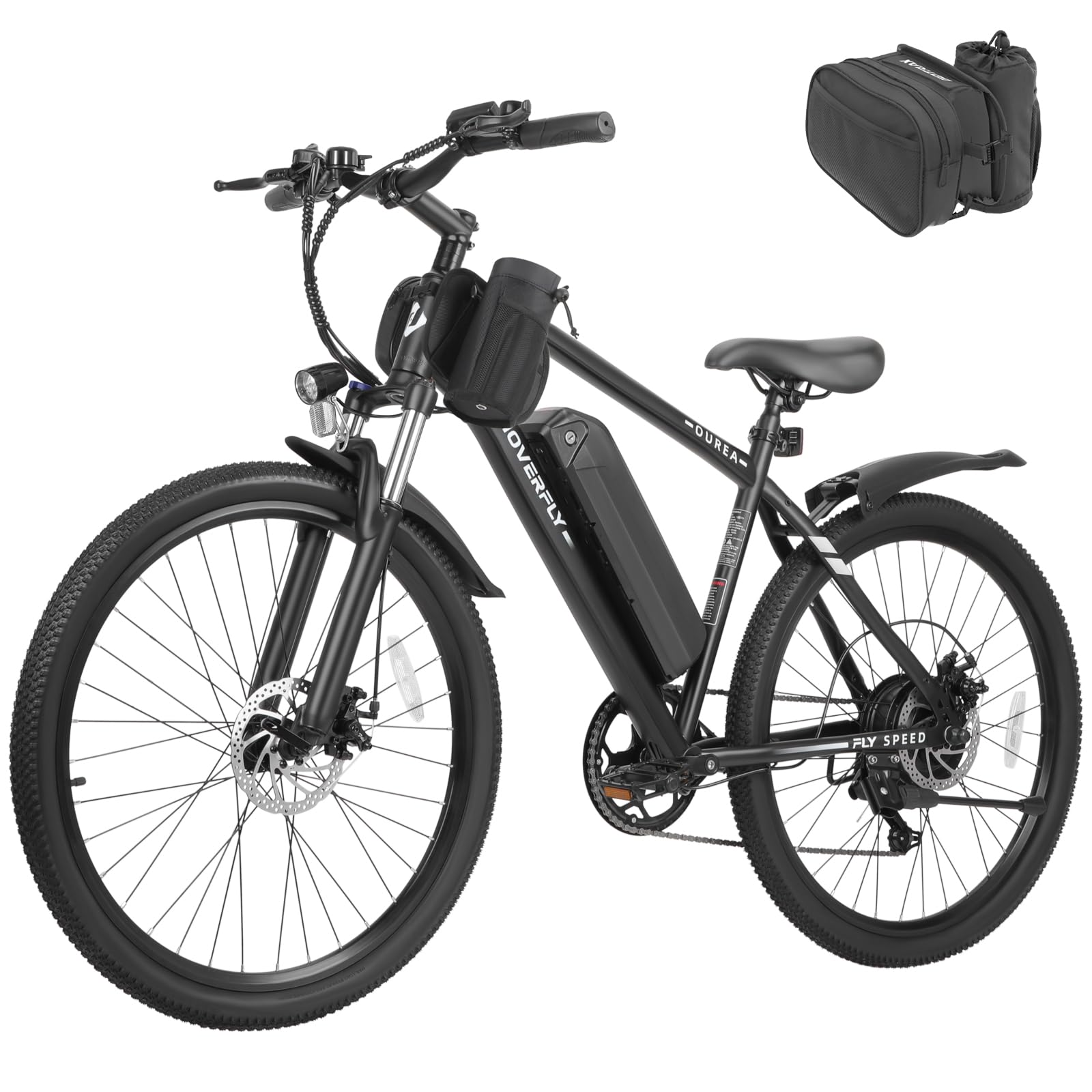
If the Funhang is built for smooth pavement, the Ourea is the one we take when the pavement isn't. A front suspension fork and 26-inch tires with a little more volume take the edge off patched asphalt and curb cuts, and the fenders, headlight, taillight, and bell are already fitted.

The 750W motor tops out at 20 mph, and the 374.4Wh battery is both removable and lockable — the lock matters if the bike sits outside a station all day. Hoverfly quotes 20 miles on electric alone and 40 with pedal assist, with a five-hour charge. Seven gears and a thumb shifter give you something to do with your legs when the assist is off.

Here's the part that surprised us: at 53.4 pounds it's lighter than the top pick despite the bigger motor, and that shows up in the everyday business of getting it out of a hallway and onto the street. The 365-day warranty and UL 2849 certification are the other two things we point first-time e-bike buyers toward.

On gravel and fire roads it's in its element; on a fast group commute the suspension fork and 1.95-inch tires cost you a little effort compared with a rigid hybrid, a trade most riders on broken city streets make happily. If you want a commuter that doubles as a weekend towpath bike, this is the one.

Bottom line: We like the Ourea for commutes over rough, patched roads, where its suspension and fenders do more for you than a rigid frame and a bigger battery.

3

LELEKUAI T1 Folding E-Bike

LELEKUAI T1 Folding E-Bike

Small-space storage

Our Score 8.4/10
Check Price

Worth Noting

  • 60 pounds whether folded or not
Motor
750W peak
Weight
60 lb
Battery
48V 10Ah
Wheel Size
14 inches
Read the full review

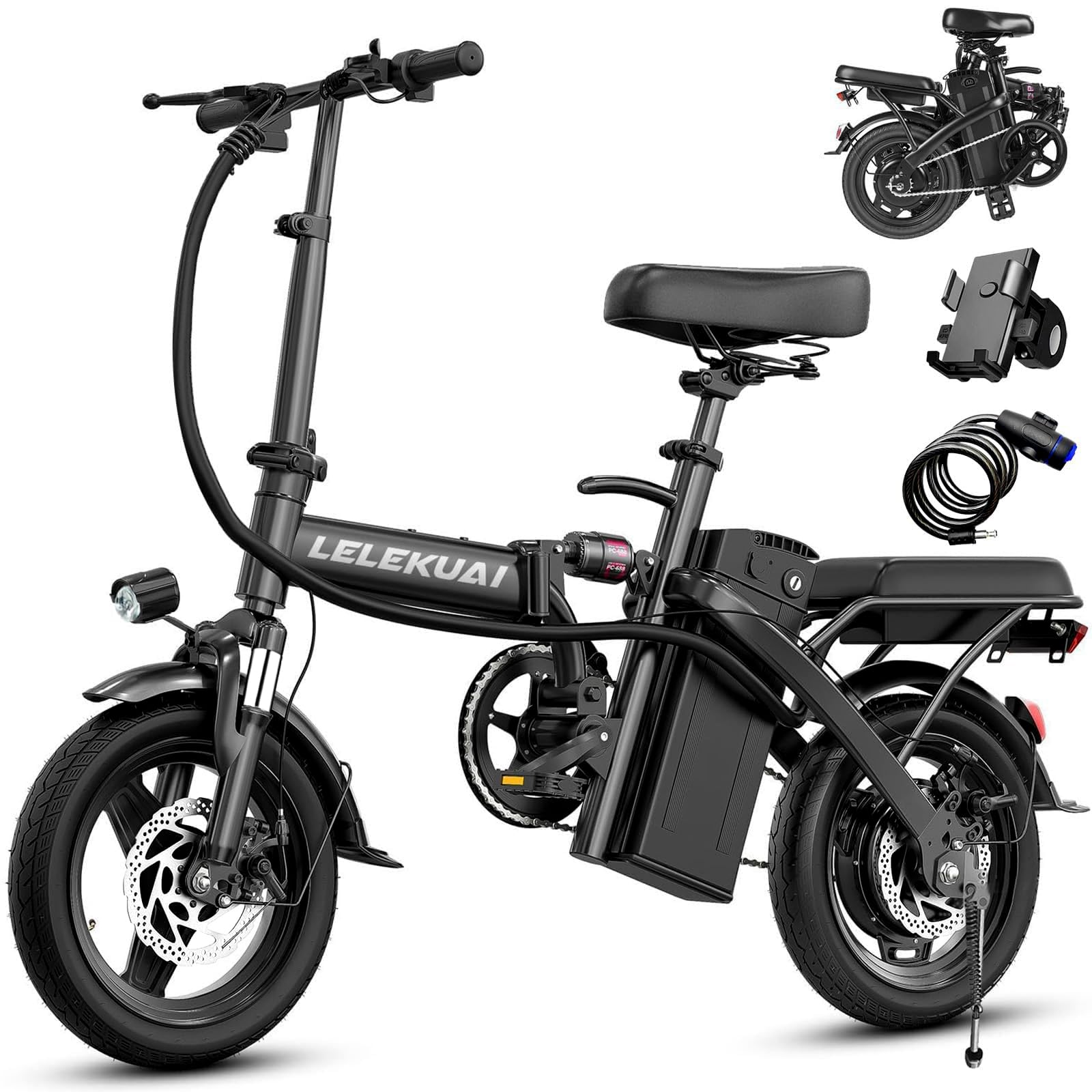
Fold it and the T1 takes up roughly the footprint of a suitcase, which is the whole argument for it: a bike you can keep in a closet, drop in a trunk, or wheel into an office instead of chaining to a rack in the rain. For a studio apartment or a commute that ends at a train, that's not a small thing.

The package is more complete than the price suggests — a 750W peak motor with a 20 mph top speed, a removable 48V 10Ah battery that charges off the bike, dual disc brakes, front suspension, and a stated 32-mile range. That 480Wh pack is the largest of the three e-bikes here on paper, but treat 32 miles as an ideal-day figure.

The trade is ride quality. Fourteen-inch wheels are small enough that cracks, patch repairs, and gravel come up through the bars, and the short wheelbase feels twitchier at speed than the 26-inch bikes here. On smooth bike-lane asphalt it's perfectly pleasant; on a beat-up street at 20 mph it isn't the bike we reach for.

One caveat worth knowing before you order: the label on this build describes it as a bike for teens, so check the seat height against your inseam rather than assuming an adult fit. It's also the only pick here that stows under a desk, which is why it stays on the list.

Bottom line: We see the T1 as a space-saving second bike for short city errands, not a replacement for a full-size commuter.

4

AVASTA Loop Single-Speed

AVASTA Loop Single-Speed

Flat, short rides

Our Score 8.4/10
Check Price

Worth Noting

  • One gear only, so climbs and headwinds are on you
  • Caliper brakes are the least powerful in this group
Tires
700 x 28C
Brakes
Caliper
Drivetrain
Single-speed, flip-flop hub
Frame Sizes
50, 54, 58cm
Read the full review

One gear, two ways to ride it: the Loop's flip-flop hub lets you run it as a freewheel single-speed or flip the rear wheel and ride fixed. For a flat city commute that means less to adjust, less to break, and a quieter ride than any geared bike here — and the olive-and-steel look is the reason people stop and ask about it.

We rate it for exactly that rider. The high-strength carbon steel frame takes the sting out of rough asphalt, the 700 x 28C tires on 40mm deep-V rims roll fast, and there are caliper brakes on both ends. The freestyle pedals and KMC chain are the sort of simple parts you can replace yourself.

Setup is about as easy as it gets: 90 percent assembled, tools in the box, and a quoted 15 minutes of work if nothing needs adjusting. Ride it in freewheel mode first — fixed takes a few rides to stop feeling like the bike is pushing back.

Sizing runs from a 50cm frame for 5'1" to 5'6" up to a 58cm for 5'11" to 6'3", which makes this the pick here for shorter riders — a real gap in this group. The two-year warranty is also the longest of the five, and on a bike this simple there's not much to claim on.

Bottom line: We rate the Loop for flat-city riders who want one gear and almost nothing to maintain; if your route has real climbs, the seven-speed picks here will treat you better.

5

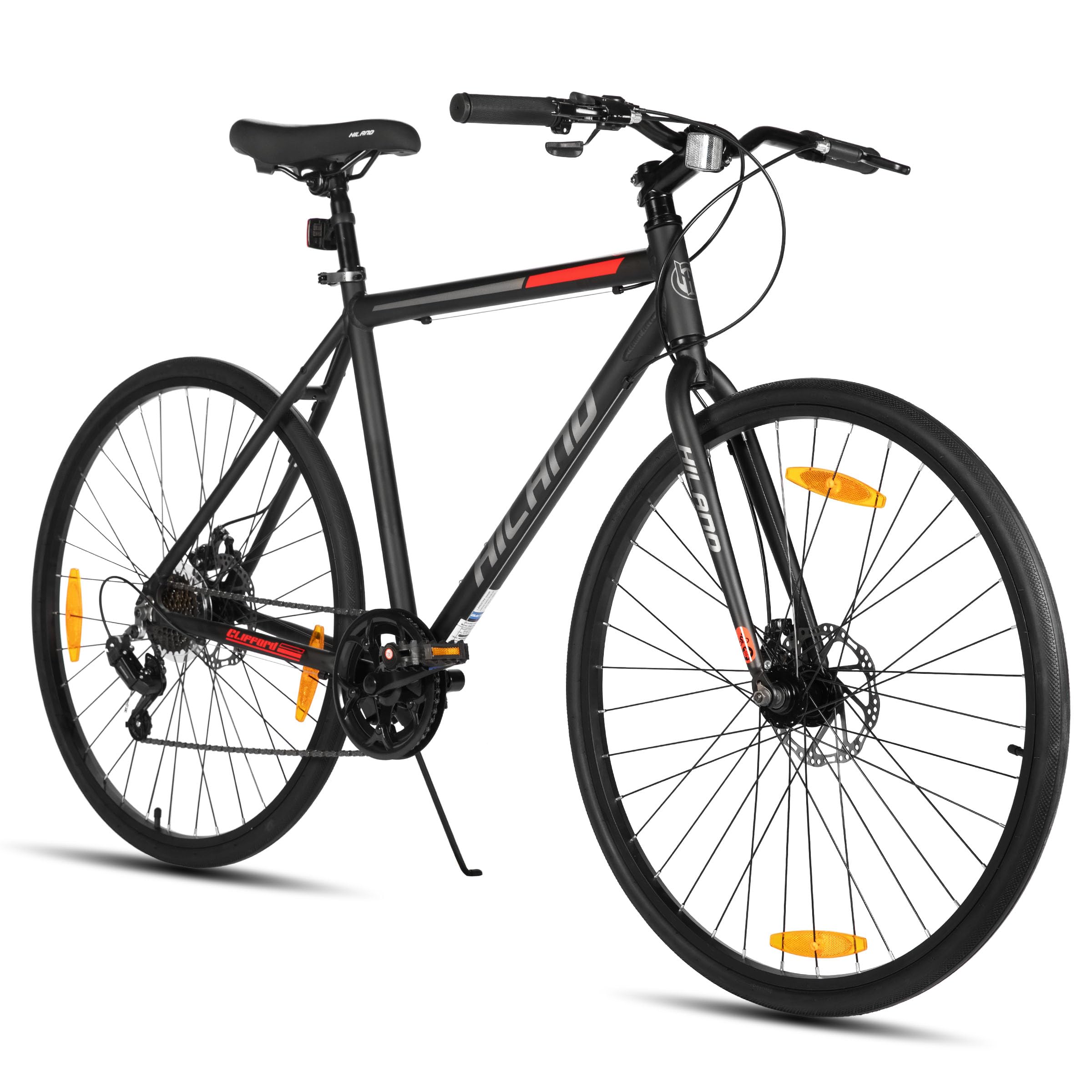
HILAND Clifford Hybrid Bike

HILAND Clifford Hybrid Bike

Taller riders

Our Score 8.0/10
Check Price

Worth Noting

  • Sized for riders 5'9" and taller only
  • Rack, fenders, and lights are extra
Brakes
Dual disc
Speeds
7
Frame Material
Aluminum
Minimum Rider Height
69 inches
Read the full review

HILAND's fit guidance starts at 5'9", and that's the first thing to settle: if you're shorter than that, this isn't your bike however good the rest of it looks. For taller riders it's the value play in this group — an aluminum hybrid with seven speeds and dual disc brakes.

Aluminum is what we noticed first. At this end of the market most commuters are steel, and the lighter frame is the difference between carrying the bike up a flight of stairs and deciding not to. The rest of the spec is sensible rather than exciting: a rigid fork that puts your effort into forward motion, 700c wheels that roll over cracks instead of into them, a thumb shifter, and disc brakes that keep working in the wet.

It arrives 90 percent assembled with pedals and tools in the box, and the final steps are the usual ones: bars, front wheel, seatpost. Give the front disc a minute if it rubs — that's a first-ride annoyance on boxed bikes rather than a fault, and it's the kind of thing a shop sorts in five minutes.

What it doesn't come with is commuter equipment. The box holds the bike, a kickstand, and a tool kit, so a rack, fenders, and lights are yours to add, and that narrows the price advantage once you've bought them. Add them anyway: a light, simple bike that climbs well and costs less than any e-bike here is a good place to start a commute.

Bottom line: Our pick for taller riders who want a light, simple hybrid and don't mind fitting their own rack and fenders.

How We Tested Commuter Bikes

We started by pulling together a shortlist of commuter bikes from brands we trust, filtering by price, frame size, and whether they came with practical touches like rack mounts and fenders. Then we narrowed it to seven models that represent the range of what's actually for sale — pedal-only, e-assist, and a couple of budget picks. Over eight months, each bike became a daily rider: the morning commute, the grocery run, the rainy ride home.

Assembly was timed with a stopwatch and a single set of hands, and we noted whether the instructions made sense without a second cup of coffee. On the road, we rode the same five-mile loop with a loaded rear rack, over cracked asphalt, up a short hill, and through a wet-weather week. We checked whether the frame felt sturdy when loaded, whether the ride stayed smooth over rough patches, and whether the bike still looked decent after a month of locking up outside. For e-assist models, we tracked battery life across a week of commutes, noting how many miles we got per charge and how easy it was to remove the battery for charging at a desk.

Durability got its own test: we left each bike locked outside in the rain, checked for paint chips and rust, and kept an eye on brake pads and drivetrain wear. Functionality came down to the little things — did the fenders actually keep our work clothes clean, did the lights survive a bumpy ride, did the rack hold a pannier without swaying? Finally, we weighed value against what each bike asked us to spend, factoring in the cost of assembly and any immediate upgrades. The bikes that made the list are the ones we kept reaching for after the novelty wore off.

How to Choose Commuter Bikes

Motor or no motor

A 20 mph e-bike turns a ten-mile ride into roughly half an hour without a change of shirt, which is the case for the three electric picks here. The trade is weight: the lightest full-size e-bike in this group is 53.4 pounds, and none of them go up a flight of stairs gladly.

If your commute is under about five flat miles, a hybrid like the HILAND does the same job with nothing to charge and less to maintain. Above that, or with a bridge on the route, the motor earns its keep.

Fit decides more than the spec sheet

Frame size and standover are the only things you can't upgrade later. The HILAND starts at 5'9", the AVASTA's 50cm frame covers 5'1" to 5'6", and that range — not the component list — should decide which bikes you even consider.

Measure your inseam, check the maker's chart, and stand over the frame with both feet flat. A bike you have to lean at a stoplight is a bike that stays in the hallway.

Gearing and brakes for the streets you have

Seven speeds get you over a bridge ramp and into a headwind; a single-speed makes you stronger and the bike simpler, and it's the right call only if your route is genuinely flat. On brakes, discs — even mechanical ones — hold up better in rain and on long descents than the caliper rims on the AVASTA, which is why every other pick here runs them. If it rains where you live, pay for discs.

Carry, park, and store

Two questions settle this: where does the bike sleep, and what are you carrying? The Funhang and Hoverfly arrive with racks and fenders, so check what's in the box on the others before you budget for extras.

If the answer to where it sleeps is a closet or a car trunk, a folder earns its compromises. If it's a stairwell, weight matters more than anything else on this page.

Buying an e-bike: battery, range, and certification

Claimed range assumes a light rider, flat ground, and low assist. Add hills, weight, cold, or a heavy throttle hand and the real number drops, so treat the 25-to-30-mile figure on the Funhang and the 20-mile electric figure on the Hoverfly as best cases rather than commuting figures.

A removable pack is worth insisting on: you can charge it at a desk and carry it inside instead of leaving it in the cold. The Funhang, Hoverfly, and LELEKUAI all state UL 2849 certification — if you charge indoors, make that a requirement.

Frequently Asked Questions

Final Verdict

For most people, the Funhang EB-C1 is the commuter to buy: it arrives with the rack, fenders, and lights that the others leave you to add, and 20 mph of assist covers a longer or hillier route than any unpowered bike here. If you ride five flat miles and want nothing to charge, the HILAND does the same job for less, provided you're 5'9" or taller.

Below that, the AVASTA Loop's 50cm frame fits down to 5'1", lower than anything else here — though you give up gears to get it.