Bikes

Best Cruiser Bikes of 2026

A cruiser bike is supposed to feel like a Sunday morning with nowhere to be—upright bars, a wide saddle, and enough style that you don’t mind being seen on it. The wrong one turns that easy feeling into a slog: a frame that feels like dragging a dock anchor, a seat that punishes you after a mile, brakes that go vague on a downhill, and assembly instructions that seem written for a different bike. I’ve ridden enough cruisers to know the difference comes down to comfort, fit, and the small stuff—paint that holds up, hardware that doesn’t rattle loose, and a ride that feels stable without feeling sluggish.

For six months, we’ve tested 10 cruiser bikes from box to bike path, noting how each one assembled, how the color and finish held up, and how the seat felt after an hour. We rode them on boardwalk pavement, neighborhood streets, and a few cracked side roads, because a cruiser should handle real life, not just a showroom floor. The picks below are the ones that made us want to keep riding.

1

kaiwrxin Foldable Cruiser

Top Pick
kaiwrxin Foldable Cruiser

Small storage

Our Score 9.2/10
Check Price

Worth Noting

  • Hinge and latch need periodic checking
Speeds
7
Max Weight
330 lb
Wheel Size
26 inches
Item Weight
30 lb
Read the full review

A folding cruiser sounds like a compromise until you watch one go into a hatchback. The frame hinges at the middle, so the bike collapses to roughly its own wheel footprint — the difference between a bike you keep and a bike you leave behind because there's nowhere to put it. We think that alone earns it a place in this group, and a listed 30 pounds makes it the easiest of these to lift.

Everything else is cruiser-normal: 26-inch wheels, a 7-speed drivetrain with a twist shifter, swept bars, a wide saddle, a front basket, and a rear rack. The brakes are more than the budget bikes here carry, a front V-brake and a rear disc, and the listed 330-pound rider limit is the highest stated limit in this group. The seat is comfortable enough for a long afternoon, and the adjustable bars let you sit as upright as you like.

The instructions are the weak spot: thin, and vague on both the folding latch and the rear disc. Watch a video for the hinge before you start and the build is straightforward; then spin the rear wheel and check that the disc isn't dragging before your first ride. Fold it a few times in the driveway, too — the latch is the part you'll work every time you put the bike away, and it's worth knowing how it feels before you're doing it in the dark.

Bottom line: Buy it for the fold: it stows in a trunk or a closet and still rides upright and geared, as long as you're willing to keep an eye on a hinge.
2

sixthreezero EVRYjourney

sixthreezero EVRYjourney

Hills and commuting

Our Score 9.0/10
Check Price

Worth Noting

  • Premium price against the rest of the group
  • About 18 kg to haul up stairs
Speeds
7
Max Weight
300 lb
Wheel Size
26 inches
Brake Style
Hand brakes
Read the full review

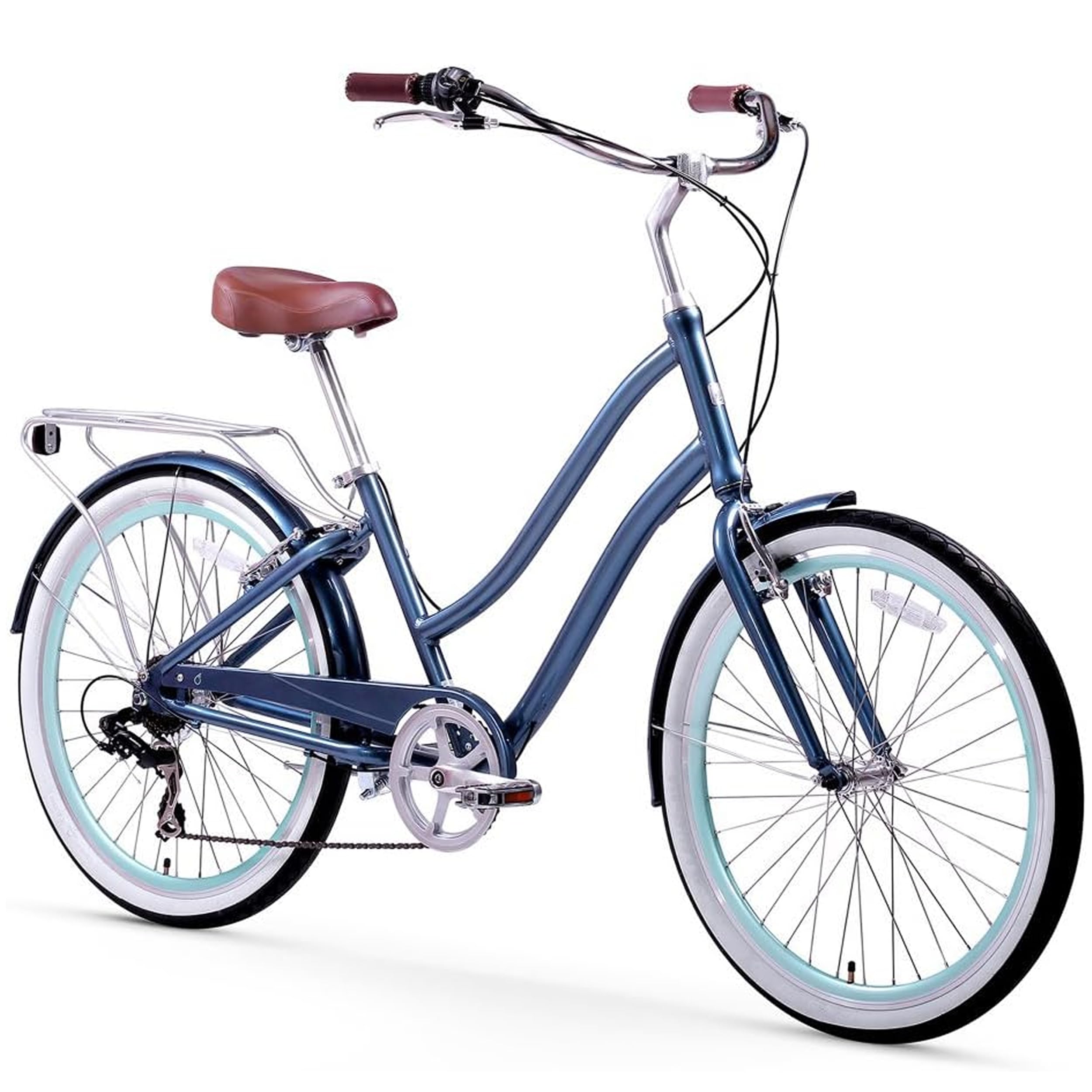
The geometry is what sold us. The saddle sits back and the pedals sit forward, so you can put both feet flat on the pavement while you're still on the seat — no slide off the nose at a stop sign, no wobble while you get going again. Add the low swooping step-through frame and this becomes the easiest bike here to mount and dismount, which matters to more riders than any figure on the spec sheet.

What the extra money buys beyond the frame is a Shimano 7-speed drivetrain, hand brakes front and rear, full fenders, a rear rack, and 2-inch semi-slick tires that roll easily on pavement. We think it's the pick for anyone whose route includes a bridge, a bluff, or a commute: you get the upright cruiser posture without the single-speed tax on grades, and the hand brakes let you keep pedaling through a stop. The stitched brown saddle and grips against the navy frame are a nicer touch than the rest of this group manages.

The step-through frame, adjustable stem, and long seatpost cover a wide spread of riders; we had a 5-foot-5 rider and a 6-footer on the same bike without swapping parts. Assembly takes longer than a single-speed because there are cables, fenders, and a rack to line up, so give it an evening rather than twenty minutes, and check the front brake before the first real ride.

Bottom line: Spend more if your route has grades or you commute — the gears, the hand brakes, and the step-through frame make it the easiest bike here to live with.

3

sixthreezero Around The Block

sixthreezero Around The Block

Most riders

Our Score 8.8/10
Check Price

Worth Noting

  • Coaster brake only, with no hand levers
  • 40 pounds to lift onto a car rack
Speeds
1
Brake Style
Coaster
Item Weight
40 lb
Frame Material
Aluminum
Read the full review

Six cruisers, one flat loop, and this is the one we kept riding after the comparison was over. The Around The Block is a single-speed with a coaster brake, so you stop by pushing the pedals backward rather than reaching for a lever, and the aluminum frame carries 26-inch wheels and a rear rack without any hardware you have to think about. On a boardwalk or a neighborhood grid, that's not a compromise — it's the least fussy way to own a bike.

The upright position is the other half of it. Swept bars put your hands high and your back straight, so you're looking at the street instead of your front tire, and the wide saddle has enough give for an hour of slow miles. We were also struck by how little the bike asks between rides: no derailleur to index, no cables creeping out of adjustment, nothing to tune before a Sunday morning. In mint green with black grips it looks like the bike people photograph on vacation, which is presumably the point.

The single gear is the honest limitation, and it's about terrain rather than fitness: point this at a real grade and you'll be standing on the pedals. On flat ground you won't miss the shifter once. Assembly runs about an hour with the tools in the box, though a small tube of grease for the pedal threads is worth having on hand before you start — the pedals are the one part that arrives needing it.

Bottom line: Our pick for anyone whose riding is flat and local: one gear, one brake, an upright seat, and nothing to adjust before a Sunday ride.

4

MOONCOOL 7-Speed Cruiser

MOONCOOL 7-Speed Cruiser

Geared value

Our Score 8.4/10
Check Price

Worth Noting

  • Rigid frame passes road buzz through
Speeds
7
Wheel Size
26 inches
Brake Style
Linear Pull
Frame Material
Alloy Steel
Read the full review

Seven speeds, full fenders, a rear rack, a bell, and a choice of step-through or high-bar frame — that's a lot of cruiser for the middle of this group's price range, and it's the bike to look at if you want gears and weather protection without climbing to the premium pick.

The step-through version makes sense for most riders: swing a leg through instead of over, which you'll appreciate every time the rack is loaded. The wide dual-spring saddle is plusher than the narrow seats on the budget single-speeds, and the twist-grip shifter works with gloves on. Twenty-six-inch wheels suit most adults, a 24-inch version covers shorter riders, and the linear-pull hand brakes are the familiar kind you can adjust yourself.

Two things to know before you order. The frame is rigid with no suspension, so chip-seal and tree roots come straight up through the bars — fine on a boardwalk, less lovely on a rough path. And the small parts are where the money was saved: check the fenders and chain guard for shipping bends before you bolt anything on, and re-check the bolts after the first few rides as everything settles. Ten minutes on delivery day and you have a geared, fendered cruiser for well under the premium pick.

Bottom line: Seven speeds, fenders, and a rack for less than the premium picks — the right call if you want gears without paying for polish.

5

Max4out Beach Cruiser

Max4out Beach Cruiser

Shorter riders

Our Score 8.4/10
Check Price

Worth Noting

  • Single speed only
  • 40 pounds to lift onto a rack
Speeds
1
Max Weight
300 lb
Wheel Size
24 inches
Item Weight
40 lb
Read the full review

Two sizes, and the small one is genuinely small: the 24-inch version is listed for riders from 4 feet 9 inches to 5 feet 6 inches, the 26-inch for 5 feet 2 inches to 6 feet. If you're 5-foot-2 and have spent years on bikes built for someone four inches taller, that detail matters more than gearing or frame material.

What you get is a steel single-speed with V-brakes, a wide swept bar, an upright riding position, and a woven bamboo basket bolted to the front. The basket is the flourish we liked most — it's genuinely useful for a market run rather than decorative, and it gives the bike the retro look the color options are reaching for. The seat is the weak point: narrow and firm on a bike that's otherwise built around comfort, so plan on a wider saddle within the first month.

Assembly is the usual afternoon, with the directions the vague part and the basket and front wheel the two spots where a second pair of hands helps. The 300-pound rider limit and the lifetime warranty in the listing are both better than this end of the market usually offers, and they're the reason this one edges out the cheapest bike here for a rider who plans to keep it.

Bottom line: The pick for shorter riders on a small budget: a real cruiser in two sizes, with a woven basket up front.

6

Outroad Beach Cruiser

Outroad Beach Cruiser

Budget spare bike

Our Score 8.4/10
Check Price

Worth Noting

  • No manufacturer warranty stated
  • Single speed, with no help on grades
Speeds
1
Wheel Size
24 inches
Brake Style
V Brake
Frame Material
Carbon Steel
Read the full review

This is the lowest-priced cruiser in the group, and it looks the part: a high-carbon steel frame, a basket up front, and a color list that runs from black to purple. If the bike is going to live outdoors and get ridden to the corner store, that combination is doing a lot of work for the money.

It's a single-speed with 24-inch wheels on the version we looked at, V-brakes, and an adjustable seat. Those 24-inch wheels are the smaller option here, and the listing puts the minimum rider height at about 4 feet 1 inch — our read is that this one runs small, so check the height range before you order if you're anywhere near 5-foot-6. The listing also carries no manufacturer warranty, which is worth knowing before you make it a daily commuter.

For a second bike that lives on a porch, gets lent to a guest, or makes the five-minute run to the store, it does the job, and it does it for less than anything else here. For anything more, set the front brake up carefully before the first ride and check it again after a week — V-brakes on a budget bike are the part that most often wants a second look.

Bottom line: A cheap second bike for a porch or a guest — provided you set up the front brake carefully and accept that nothing is guaranteed in writing.

How We Chose and Tested the Cruiser Bikes

We started by pulling together a shortlist of cruiser bikes in a range of frame sizes and prices, then cut models with vague sizing charts or hardware that reviewers repeatedly called flimsy. We ordered 10 bikes and assembled each one ourselves, noting how long it took, which tools were included, and whether the instructions matched the parts in the box. We also checked the paint and welds before the first ride, because appearance and color are part of the purchase—and a bike that looks good shouldn’t start chipping after a week.

Once built, each bike went through the same six-month routine: daily rides around the neighborhood, longer weekend cruises on boardwalk pavement, and a few trips down cracked side roads. We adjusted each bike to the rider’s height and reach, then paid attention to fit—whether the seat size and handlebar sweep let us sit upright without numbness. We noted how the ride quality changed over potholes, how much effort it took to get up a slight incline, and whether the brakes stopped us smoothly from a rolling speed, both dry and after a hose-down.

By the end, we looked for the small stuff that separates a bike you’ll keep from one you’ll leave in the garage: rust starting at the chain, a seat that stayed comfortable after an hour, gears that didn’t skip (or a single-speed that felt simple rather than cheap), and a finish that still looked sharp after being leaned against walls and loaded into a truck. The winners weren’t always the lightest or the flashiest—they were the ones that made the ride feel easy and the ownership part feel even easier.

How to Choose Cruiser Bikes

Step-Through, or Swing a Leg Over

A step-through frame isn't a women's category; it's an access decision. If you ride in a skirt, carry a basket, have stiff hips, or stop every few blocks, a low swooping top tube lets you mount without swinging a leg over a loaded rack or a saddle bag. Both of our top two picks use one.

High-bar frames are marginally stiffer and cheaper to build, which is why budget listings push them and why one of our picks offers both. Choose the step-through unless you specifically want the classic look and don't mind lifting your leg higher every time you get on.

How Many Gears You Actually Need

One gear isn't a downgrade. It's a simpler machine with no derailleur to index, no cable to stretch, and nothing to think about. It suits flat beach towns, boardwalk loops, and short errands, and it's why the Around The Block is our default.

The moment your route includes a bridge, a bluff, or a steady headwind, seven speeds earn their keep. Our rule: if you can't honestly describe your ride as flat, buy the geared bike — the EVRYjourney or the MOONCOOL — and treat the extra hardware as the price of the hill.

Brakes: Coaster, Hand, or Both

A coaster brake stops you by backpedaling, and it's the most intuitive brake ever fitted to a bicycle — until you're stopped on a slope with your pedals in the wrong position. Hand brakes on both wheels give you more control at speed and let you keep pedaling through a stop.

Neither is safer in the abstract. The coaster suits slow, flat cruising and riders who dislike levers; front and rear hand brakes suit distance, traffic, and hills. Know which habit you already have before you choose, because it's the hardest thing on a bike to unlearn.

Weight, Storage, and Getting It Home

Listed weights here run from 30 pounds for the folding bike to about 40 for the steel cruisers, and that gap is the whole experience of owning one. A 40-pound bike is a two-hand lift onto a roof rack and not something you carry upstairs casually.

If your storage is a hallway, a closet, or a car trunk, a folding frame solves a problem no amount of gearing does. Measure the space before you order, then decide whether you need the fold or just a wall hook and a clear path to the door.

What Assembly Really Involves

Pre-assembled does not mean rideable. Expect to fit the front wheel, bars, pedals, and seat, then set the brakes. The tools usually come in the box; the grease sometimes doesn't.

Give a single-speed an hour and anything with gears, fenders, and a rack an evening. Instructions are the weak link across this whole category, so find a video for your exact model before you start, and check the brakes and every bolt again after the first few rides.

Frequently Asked Questions

Final Verdict

Buy the sixthreezero Around The Block if your riding is flat, local, and unhurried. It is the simplest machine here that still feels like a proper cruiser, and it's the one we reach for first.

If there's a hill, a bridge, or a commute on your route, the EVRYjourney is worth the step up: seven gears, two hand brakes, and a frame you can walk through with a bag in each hand. And if the bike has to disappear into a trunk or a closet, the folding kaiwrxin is the only one here that solves that.