Accessories

Best Cycling Sunglasses of 2026

The right cycling sunglasses should disappear on your face until the moment you need them—and the wrong ones make themselves known every mile. I've ridden through enough sunny centuries, shady canyon descents, and sweaty commutes to know that a good pair has to do more than look fast. It needs a secure fit that doesn't pinch under a helmet, lenses dark enough for midday glare but not so dark that you lose the road in tree cover, and enough durability to survive being stuffed in a jersey pocket. Value and build quality matter, too; this is gear you'll abuse, not baby.

Over the past six months, our team rode with 12 pairs of cycling sunglasses—on road rides, gravel loops, and daily commutes—and paid attention to comfort, appearance, and how they handled sweat and wind. The best ones earned their place by staying put, cutting glare without flattening the road, and looking good enough to wear to the coffee stop. Below are the pairs that held up—and a few that taught us what to avoid.

1

X-TIGER Polarized Sports Sunglasses

Top Pick
X-TIGER Polarized Sports Sunglasses

Everyday road riding

Our Score 9.2/10
Check Price

Worth Noting

  • Hinge is the wear point under rough handling
Lenses
3 interchangeable
Lens Type
Polarized
UV Protection
99.9% UVA/UVB
Frame Material
TR90
Read the full review

Three lenses, a flexible TR90 frame and a wrap that sits close to the cheek is the recipe for a first serious pair of riding glasses, and this X-TIGER set does it more completely than anything else in this group. A grey polarized lens handles bright asphalt and low sun, and the spares go in when the light flattens out. That's why it's our default recommendation: one purchase covers most of the riding year.

The frame sits close without pressing at the temples, and the soft nose pad grips rather than perches, so the glasses stay where you put them when you drop your head. At a listed 19.2 grams for the frame, the weight stops registering after the first few miles, and the coverage reaches far enough around the eye that wind and roadside grit stay out.

Nothing in the box explains the lens swap, so work it out at home rather than at the roadside in fading light; after two goes it takes seconds. The set arrives with a case and a cleaning cloth, and the lenses are coated for 99.9% UVA and UVB blocking.

What the kit doesn't do is change tint on its own. If your route moves between open fields and heavy tree cover without a stop, you'll be the rider pulling over to swap lenses, and a photochromic pair is the better answer. For everyone else, spare lenses are the cheaper way to cover the same ground.

Bottom line: Our pick for most riders: a three-lens kit, a light TR90 frame and wrap coverage that keeps wind and grit out for the price of one premium lens.

2

HAAYOT 5-Lens Sports Sunglasses

HAAYOT 5-Lens Sports Sunglasses

Changing light

Our Score 9.0/10
Check Price

Worth Noting

  • No spare nose pads in the box
Lenses
5 interchangeable
Polarized
Black lens only
Frame Weight
0.57 oz
Frame Material
TR90
Read the full review

Five lenses and a frame listed at 16.3 grams make this the most complete kit here for a ride that starts before sunrise and ends in full sun. The set runs from a true-color lens for bright and mixed days to a polarized black lens for glare, with the extra tints covering the grey hours at either end.

Only the black lens is polarized, which is the compromise to understand before you buy: fit the yellow for a dawn start and you lose the glare filtering along with the tint. The adjustable rubber nose pads are the part we rate highest — soft rather than rigid, so they mold to a narrow bridge instead of pinching it, and the frame stays settled when you look over your shoulder.

Build quality is where this one separates from the other budget kits: the frame, the hinges and the lens seats all feel like a dearer pair, and the lenses change out without the white-knuckle flexing some sets demand. One practical note: the whole kit travels in a soft bag rather than a hard case, so add your own shell if the glasses live loose in a pack, and keep the spare lenses in a pouch rather than a jersey pocket.

Bottom line: The kit to buy if your rides start in the dark and finish in the sun: five lenses, a 16.3-gram frame and a polarized black lens for the brightest hours.

3

Tifosi Vogel SL Shield

Tifosi Vogel SL Shield

Wide field of view

Our Score 9.0/10
Check Price

Worth Noting

  • Fragile frame if it's dropped or sat on
Sport
Running, cycling, golf, baseball
Department
Unisex
Lens Style
Shield
Read the full review

A single shield lens rather than two framed ones is the whole argument for the Vogel SL, and it's a good one: no rim cutting across your sightline, more coverage at the corners, and an uninterrupted view of the road ahead. We noticed it most checking over a shoulder before a lane change, where a framed pair puts an edge exactly where you need to look.

It weighs almost nothing, and under a road or mountain helmet it stays where it's put; with no lower rim there's nothing to catch on a strap or a jersey collar. The tint sits on the inside of the lens and takes glare off wet asphalt without draining the color out of the scenery.

It's the most expensive pair in this guide, and what you're paying for is the lens and the shape rather than accessories or a lens kit. For a rider who has settled on daylight road riding and wants one good pair that does one thing properly, that's a fair trade.

Bottom line: The pair for a rider who wants one shield lens and nothing to swap: wide, uninterrupted vision and a very light frame, at the top of this group's price range.

4

Foliful Polarized 3-Pack

Foliful Polarized 3-Pack

Spares and backups

Our Score 9.0/10
Check Price

Worth Noting

  • Stiffer frame needs a few rides to relax
  • One case shared by all three pairs
Lens Type
Polarized
Pack Size
3 pairs
Lens Material
Tri acetate cellulose
Frame Material
Polycarbonate
Read the full review

Three polarized pairs, a case, a cloth, a pouch and a strap is the arithmetic here, and it's the answer for anyone who loses, scratches or lends out sunglasses faster than they replace them. The wrap sits close to the face and the lenses knock down glare without turning the world muddy.

Fit is the strong point: the frame wraps close, the arms don't press behind the ears, and they work under a helmet without a fight. The tint is the surprise — colors stay recognizable rather than going flat grey, which matters when you're reading road edges and potholes at speed.

We treat this set as kit rather than as a pair: one in the bike bag, one in the car, one for whoever forgot theirs. Three polarized wraps is a better outcome than one pair you're afraid to scratch, and the coverage is good enough that the spare isn't a punishment to wear.

Bottom line: Buy the three-pack if sunglasses disappear on you: three polarized wraps, one case, and spares you won't mourn.

5

KAPVOE 4-Lens Cycling Sunglasses

KAPVOE 4-Lens Cycling Sunglasses

Lens variety

Our Score 9.0/10
Check Price

Worth Noting

  • Fit doesn't hold for every head shape
  • Heavier than the other lens kits here
Lenses
4 interchangeable
Polarized
Black lens only
Frame Weight
Approx. 34 g
UV Protection
UV400
Read the full review

Read the fine print before you buy: only the black lens in this KAPVOE set is polarized. The colored, clear and yellow lenses are UV400 but not polarized, so the glare-cutting job belongs to one lens out of four.

That's not a dealbreaker — it's a description of what a four-lens kit can be at this level — but it changes how you use it. Black is the bright-day lens; clear and yellow are for low light, rain and tree cover, where seeing the surface in front of you matters more than cutting glare. All four carry UV400 coating, and the wrap sits close enough to keep wind out.

At roughly 34 grams it's about twice the weight of the HAAYOT kit, and that's a difference you feel on a four-hour ride rather than a forty-minute one. The soft nose pads grip over rough ground and the frame flexes rather than creaks in the hand.

The honest way to use it is as two pairs in one: black polarized for sun, clear for everything else. That's more useful than four similar tints, and it's why this one stays on the list despite the weight.

Bottom line: Worth it if you ride in low light: four lenses including clear and yellow, with the polarized one kept for bright days.

6

Lamicall 24g Polarized Sunglasses

Lamicall 24g Polarized Sunglasses

Hard-to-fit faces

Our Score 8.8/10
Check Price

Worth Noting

  • One lens only, with no low-light spare
Warranty
2 years
Nose Pads
3-level adjustable
Frame Weight
0.85 oz
Lens Material
TAC
Read the full review

If sunglasses normally sit too high on your nose or press into your temples, start here. The Lamicall's nose pads adjust through three heights, which is the most genuinely useful fit feature in this group — it moves the frame relative to your face instead of asking your face to adapt.

The rest of the package is deliberately plain: a 24-gram TR90 frame, a polarized TAC lens and a semi-rimless cylindrical shape that widens the field of view compared with a flat lens. Nothing about it is showy, and nothing about it feels like a corner was cut.

What tips it for us is what comes in the box: a hardshell case with a clip and a two-year warranty. The case is the difference between a pair that survives a season in a bike bag and one that arrives at the trailhead scratched, and two years is a longer promise than anything else here makes.

Bottom line: Start here if no pair has ever sat right on your face: three-level nose pads, a 24-gram frame and a hard case that survives a bike bag.

7

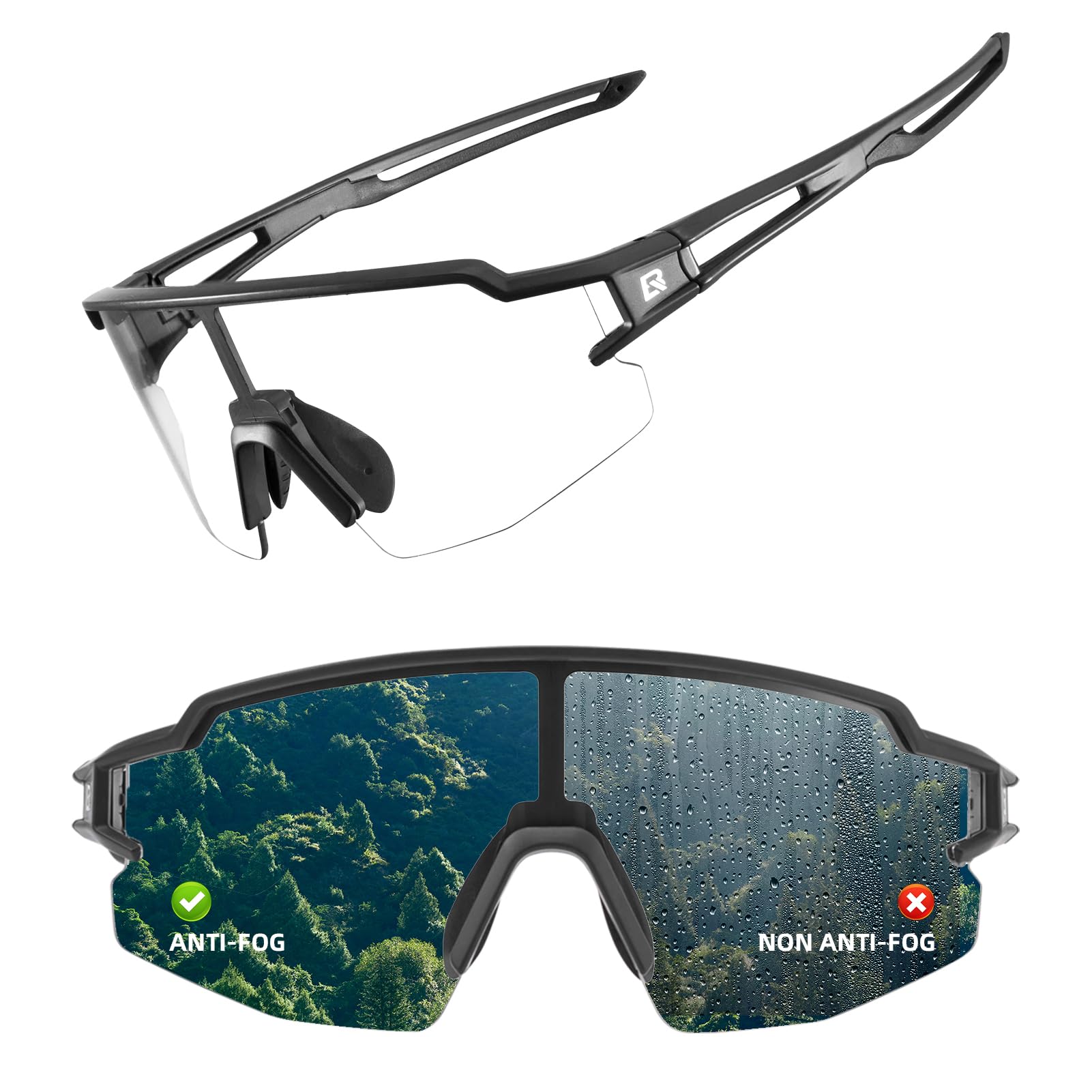
ROCKBROS Photochromic Sunglasses

ROCKBROS Photochromic Sunglasses

Prescription inserts

Our Score 8.6/10
Check Price

Worth Noting

  • Lens stops short of full sun-lens darkness
  • Runs tight on wider faces
Lens Type
Photochromic
Field Of View
180°
Transmittance
16%–83%
Prescription Insert
Myopia frame included
Read the full review

The reason to pick this ROCKBROS pair over the other photochromic option is the insert: a small frame sits behind the lens and takes prescription lenses, so you ride in cycling glasses rather than contacts or a pair of over-glasses that never quite sit right.

Photochromic is the right answer for a route that runs from a shaded towpath into open fields and back. This lens shifts between 16% and 83% light transmission, darkening as the sun climbs and clearing as you drop into trees, and the 180-degree wrap gives more peripheral view than the framed pairs here. Once the insert is filled, the whole arrangement is light enough to forget.

The kit is complete — hard case, pouch, cloth and the insert frame — and it costs about what a single pair of ordinary sunglasses does. Budget for the glazing as well as the glasses, since the insert has to be made up by an optician before it does anything.

Bottom line: The only prescription-friendly pick here: a photochromic wrap with an insert frame, so you ride in cycling glasses instead of over-glasses.

How We Tested 12 Pairs of Cycling Sunglasses

To build the shortlist, I started with the styles riders actually mention to me—road, gravel, and commuter pairs—then filtered by lens options, frame size, replacement-lens availability, and what you get for the money. From that pool, we tested 12 pairs over six months. Each pair went on at least a handful of rides: fast lunch loops, long weekend gravel sessions, rainy commutes, and a few all-day efforts where I forgot I was wearing them until sweat started pooling at the brow.

Fit and comfort got checked before I even clipped in. I adjusted every nosepiece and temple tip, wore each pair under a helmet with straps tight, and noted whether the frames pinched behind the ears or left pressure points after two hours. On the bike, I watched for slipping on rough pavement, bounce on descents, and how much wind came around the lenses. For darkness and function, I rode the same routes at noon, dawn, and under heavy tree cover to see whether the tint was too dark in shade or too weak in direct sun.

Durability and quality came from handling them badly: tossing them in a jersey pocket with keys, cleaning them with a microfiber cloth, and checking hinges, frame flex, and lens coatings after repeated use. Appearance is personal, but I still wore each pair off the bike—coffee stop, errand, school pickup—to see if they looked like a piece of gear or something I'd reach for again. Value was the last filter: I compared what each pair delivered against the rest of the field, not just the price tag.

How to Choose Cycling Sunglasses

Match the lens to your riding light

The real choice is between a fixed tint, an interchangeable kit and a photochromic lens. A kit is the flexible answer, but only if you'll swap: a fifth tint you never fit is dead weight in the case. Photochromic lenses handle changing light without stopping, which makes them the better pick for a commute that starts in the dark and finishes in the sun — just don't expect one to go as dark as a dedicated sun lens at noon.

Most kits polarize only one lens, so check which before you decide the set covers everything. If nine rides out of ten are daylight road, one good dark lens is simpler, lighter and cheaper than a five-lens case.

Coverage beats lens shape

A cycling frame earns its place with the wrap, not the styling. A lens that curves around the eye blocks wind, dust and low sun from the side, and at speed that's the difference between clear vision and streaming eyes. Shield designs take the rim out of your sightline entirely; framed wraps are more forgiving on a wider face.

Check the top edge against your helmet before you commit: the frame should sit below the brow line rather than fight it, and the arms should run outside the helmet's retention system instead of under it.

Fit and retention do the real work

Glasses that creep forward on a descent are worse than no glasses. Look for soft rubber nose pads, and go adjustable if your bridge is narrow or every pair you've owned sits high. Temples should press evenly rather than pinch behind the ear, and the frame should hold when you turn your head to check traffic.

Test that in the first week at home, while returning is still easy. Fit is the one thing a product page can't tell you, and it's why we'd rather you spend a little more on a frame that stays put than on a third lens you'll never fit.

Weight, hinges and how long they last

Under about 30 grams, weight stops being something you notice; above it, you feel the frame on the bridge after a couple of hours. The trade is robustness, because very light frames flex more, and hinges and rims are where budget pairs fail first.

Fold them rather than stuffing them loose into a bar bag, keep them in the case, and accept that a hinge is a wear item on any pair at this money. The one thing worth paying up for is a frame that doesn't creak when you open it.

Polarization and prescription lenses

Polarized lenses cut glare off wet asphalt, water and car bodies, and they're worth having for road riding. They can also make a bike computer or phone screen hard to read at certain angles, which is worth knowing before you wear them for navigation.

If you wear prescription glasses, skip over-glasses and look for a frame with a prescription insert that an optician can fill, or a model that can be glazed directly. Budget for the lenses as well as the frame; the insert is only useful once it's been made up.

Frequently Asked Questions

Final Verdict

Most riders should buy the X-TIGER set. Three lenses, a light TR90 frame and enough wrap to keep wind and grit out make it the safest first purchase here, and nothing else in this group covers as much of the riding year for the money.

Riders whose routes run from dark to bright should take the HAAYOT kit instead, and anyone who wants one uninterrupted lens rather than a kit should look at the Tifosi Vogel SL.