Cycling Apparel

Best Cycling Vests for Night Visibility of 2026

The first time I rode home after sunset without a vest, a driver pulled out so close I felt the mirror brush my arm. That was the end of dark clothing for evening rides. A good cycling vest does one job first — it makes you unmistakable in low light — but the best ones also stay put, breathe, and don't feel like a sandwich board. Over the past six months, our team has ridden in 14 vests, from featherweight reflective shells to battery-powered models with multiple lighting modes.

We looked at brightness and battery life the way a rider actually would: on dawn commutes, after-work loops, and rainy weekend rides where headlights smear across wet pavement. Appearance matters too — a vest that looks decent over a jersey is one you'll actually wear, not leave in the drawer. Some are so light you forget them until you need them; others add real weather protection. The picks below are the ones that balanced all of that without turning a simple safety layer into a gadget.

1

noxgear Tracer2

Top Pick
noxgear Tracer2

Night commuting

Our Score 9.6/10
Check Price

Worth Noting

  • Sold in fixed sizes rather than one universal harness
Fit
Adjusts from a jersey to a winter coat
Weight
6.5 oz
Light Modes
8 solid colors plus multicolor modes
Reflective Coverage
Fiber-optic cords plus 3M chest strap
Read the full review

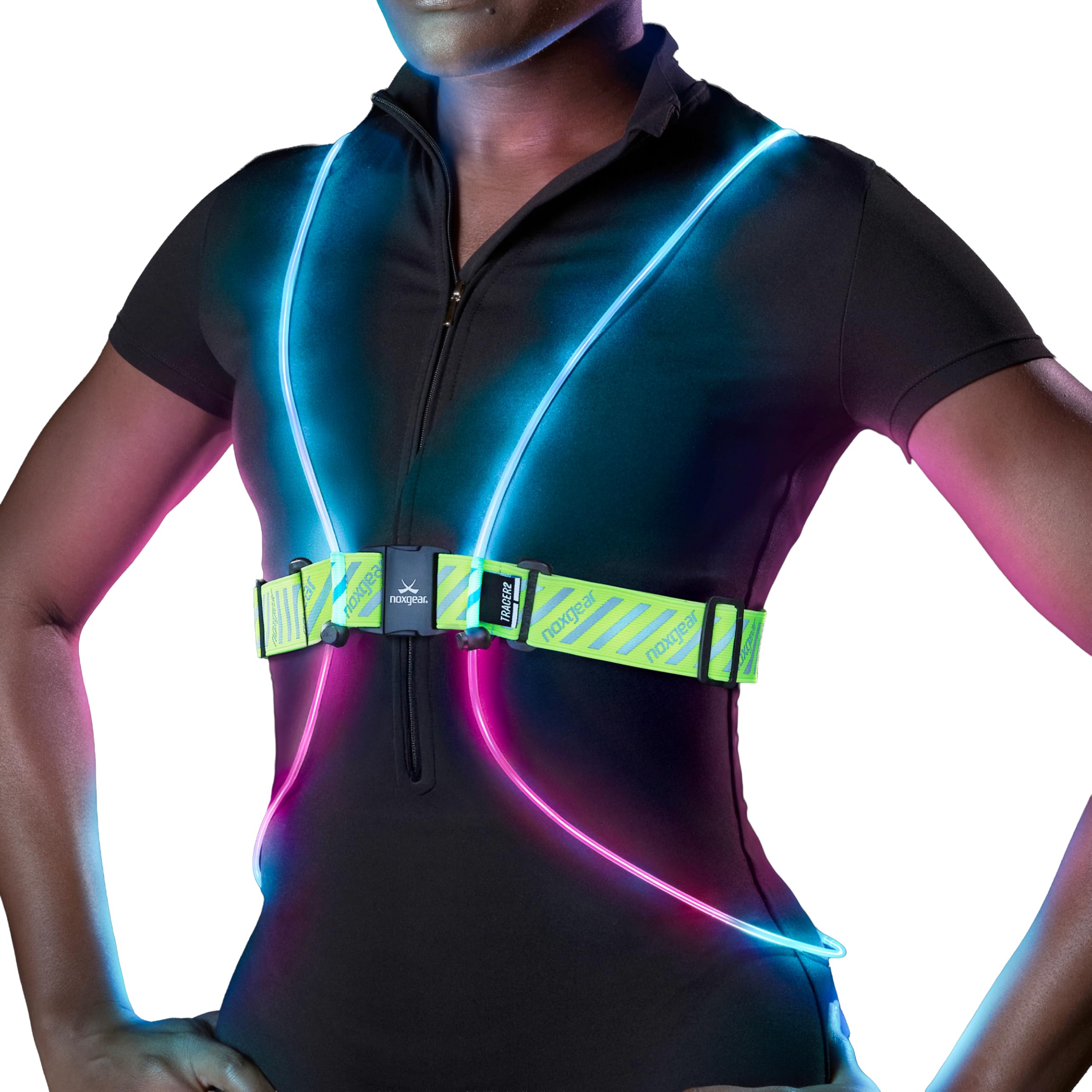
Front and back is the shape most visibility gear takes, and it is the wrong shape for the moment that frightens us most on a bike, which is a car nosing out of a side street. The Tracer2 wraps the light around you instead, with fiber-optic cords running the harness and a reflective chest strap that catches headlights from the side. Of everything here, that is the design we trust most at a junction.

The harness is the other half of the argument. At 6.5 ounces it disappears on your shoulders, and the stretchy mesh opens wide enough to go over a rain shell or a winter coat and cinches back down for a summer jersey; we have worn it both ways without rethreading anything. Eight solid colors and the mixed modes mean a steady yellow for the commute and something louder for a group ride, the front quick-clip buckle works one-handed in gloves, and it recharges, so there are no coin cells to chase.

What it will not do is light the road. This is gear for being seen rather than for seeing, and if your route includes an unlit path you want a beam as well. Nobody in this group does both jobs in a single piece, and on lit streets this one is the better half of that trade.

Bottom line: The one we recommend for commuting: light and reflection that wrap all the way around, 6.5 ounces on your shoulders, and room for a winter coat.

2

Topward LED Vest

Topward LED Vest

Budget commuting

Our Score 9.2/10
Check Price

Worth Noting

  • Charging is the weak point
  • Can ride up when you are bent over the bars
Lights
Front and rear, separate controls
Weight
4.97 oz
Battery
Rechargeable lithium-ion, included
Reflective
Reflective strips across the vest
Read the full review

Two lights, one on the chest and one at the back, each with its own switch. That is the Topward's whole pitch, and it is a good one for commuting, where you want a white light telling drivers you are closing and a red one telling them where you are. The reflective strips work on top of that, and they keep working when the battery does not.

We keep coming back to it because there is nothing to learn. The switches fall under a gloved thumb, the body weighs just under five ounces, and it adjusts over a winter parka without leaving a gap at the shoulders. It costs about what the Zacro does and a fraction of the noxgear, and for a rider who wants lights on a vest rather than a lighting system, that is the sensible place to land.

The independence is the part we appreciate most: front steady and back flashing, or both solid for a group ride, without cycling a single button through four modes to get there. That is why this one stays in the rotation rather than the spares drawer, and why we hand it to friends who are new to riding after dark.

Bottom line: A value pick we keep reaching for: separate front and rear lights and a body that weighs under five ounces.

3

GoxRunx Reflective Vest

GoxRunx Reflective Vest

No charging needed

Our Score 9.0/10
Check Price

Worth Noting

  • Nothing lights up until someone's headlights find it
Design
Lightweight reflective vest
Power Source
Passive, no batteries
Reflective Elements
Vest plus arm bands
Read the full review

Everything else here needs electricity. The GoxRunx does not, and that is the whole case: a reflective vest and a pair of arm bands, with nothing to switch on, nothing to plug in, and nothing that goes dark because you left it in the hallway.

Between them, the vest and the bands cover the two places a driver's eye goes, the torso and the moving arm. The bands go over a sleeve, so they travel with your hand when you signal, and the vest goes over whatever coat the weather has produced. Rain does not bother it, and there is nothing electronic inside to fail.

For city commuting we think that is plenty. The vest goes on over a coat, the bands over sleeves, and the whole thing asks nothing of you before you walk out of the door, with no charger, no switch and no state of charge to check. If you already own a light-up vest, this is the one to keep as the spare.

Bottom line: For the rider who will never remember to charge anything: a reflective vest and arm bands that work every time you put them on.

4

ISEYOU Chest Light Vest

ISEYOU Chest Light Vest

Unlit roads

Our Score 8.8/10
Check Price

Worth Noting

  • Runtime can fall well short of the 16-hour rating
  • Shoulder straps can slip out of place
Runtime
Up to 16 hours
Waist Fit
31–51 inches (80–130 cm)
Front Light
500 lumens, 300 ft beam
Water Resistance
IPX4
Read the full review

Most of the vests here help other people see you. This one also lets you see, which is a different purchase. A 500-lumen lamp sits on the chest harness and throws usable light about 300 feet down the road, and the head tilts through 45 degrees so you can drop the beam onto the surface in front of the wheel instead of into the eyes of an oncoming driver.

We ended up treating it as a headlight with a vest attached, which is the highest compliment we can pay it: on a road with no verge and no streetlight, the difference between reading the surface and hoping is the whole game. Four white modes including a flash, steady and flashing red at the back, and elastic straps that are reflective in their own right cover the rest. IPX4 handles rain and sweat, and at 236 grams it does not drag at the shoulders.

The waist runs from 31 to 51 inches (80 to 130 cm) with adjustable shoulders, so it goes over a jacket without a fight, and the 1,800mAh battery charges over USB-C in three to four hours. It sits in the middle of the price range here and it is the most specialized pick we have: buy it for the beam.

Bottom line: Buy this one if your route leaves the streetlights behind: 500 lumens on the road ahead and reflective straps for everything else.

5

Zacro LED Vest

Zacro LED Vest

Shared family use

Our Score 8.8/10
Check Price

Worth Noting

  • Front light is more marker than headlight
Charging
Dual Type-C, about 50 minutes
Waist Fit
26–49 inches (66–124.4 cm)
Light Colors
5 colors, 3 modes
Shoulder Fit
16–24 inches (40.6–61 cm)
Read the full review

The Zacro is the cheapest chest-light vest in this group, which is how it gets in the door, but the adjustment is what keeps it here. There are white LEDs up front with three brightness levels, five colors and three modes around the back, and both ends charge at once through dual Type-C ports in about 50 minutes, the small convenience that separates a vest that gets worn from one that waits by the socket.

The waist runs from 26 to 49 inches (66 to 124.4 cm) and the shoulders from 16 to 24 inches (40.6 to 61 cm), a broader stated span than anything else we are covering, and the polyester body goes on and off quickly, which counts for something in a cold hallway with gloves on.

We like that range for a household. A teenager, a partner and a rider in a bulky winter coat can share one vest, and nobody has to check which size is on the hook. The catch is the flip side of the same generosity: it is cut to cover the large end of its span, so on a smaller rider it hangs loose rather than sitting close. Buy it for the sharing and for the lit front, not for a spotlight.

Bottom line: One vest, several riders: the waist spans 26 to 49 inches, and both ends charge together in under an hour.

6

SAWNZC LED Vest

SAWNZC LED Vest

Backup or spare

Our Score 8.6/10
Check Price

Worth Noting

  • Lights can stop taking a charge
  • Straps and buckles are the first to fail
Weight
4.8 oz
Waist Fit
25–45 inches
Light Modes
5 colors, 3 modes
Shoulder Fit
14–24 inches
Read the full review

A thousand feet is the distance the SAWNZC packaging promises, and we read a number like that as a best case: dark road, straight line, no streetlights competing. What holds up is that the lights sit on both the chest and the back, they are bright enough to be unmistakable at the distance that matters on a suburban road, and nothing else here lights up for less. That is why it earns a place.

Five colors and three modes, including steady, single-color flash and a five-color RGB flash, cover more than most riders will use, and the elastic harness slides to size across 25 to 45 inches at the waist and 14 to 24 inches at the shoulder. At 4.8 ounces it is the lightest thing on this list, and the dual Type-C cable charges both ends at once in about 50 minutes.

It is the one to buy as a second vest: the one that lives in a pannier for the evening the ride home runs long, or the one you hand to a friend who has just started commuting. Judged against the top pick it is a much simpler piece of kit, and it is priced like one.

Bottom line: The cheapest way onto this list with lights at both ends: five colors, three modes, and elastic that stretches over a jacket.

How We Tested 14 Cycling Vests on Real Rides

We started by pulling together a shortlist of vests sold as cycling-specific — reflective panels, LED options, packable shells, and a few hybrid designs — and filtered out anything with flimsy closures, non-rechargeable lights, or sizing that didn't cover a realistic range. That left 14 vests, which we rode for six months on dawn commutes, after-work loops, and wet weekend rides.

Each vest went over a jersey, a long-sleeve layer, and a rain jacket to check fit and stability. We stood on the pedals, reached for bottles, and loaded rear pockets to see whether hems crept up or reflective panels twisted out of place. For light-up models, we ran every mode on its brightest setting until the battery died, timed the runtime, and repeated the test after a month of charging. We also counted how many lighting options each had and whether we could switch them with winter gloves on.

Visibility was judged at dusk and after dark, with a partner walking toward us in a car's low beams to see how far the reflective strips and lights read. We washed each vest, wore them through rain, and checked seams, zippers, and reflective tape for peeling or curling. We also weighed them, stuffed them into jersey pockets, and wore them over plain and patterned kit to judge appearance — plus pockets and vents that make a vest useful beyond safety.

How to Choose Cycling Vests for Night Visibility

Being seen, or seeing

These vests do one of two jobs. Most of them light you up so drivers notice you. A chest-light harness such as the ISEYOU also puts a beam on the road, which is a different purchase with a different price.

If your riding is on lit streets, coverage and fit matter far more than lumens. If any part of your route is unlit, pay for the beam: a vest that only makes you visible still leaves you guessing where the surface is.

Coverage: the sides count

A front light and a rear light are aimed at traffic ahead and behind. The moment that worries us most happens at a junction, where a driver looks once and pulls out, and from that angle a vest with a lit front panel shows almost nothing. Wrap-around designs and reflective arm bands cover that gap.

Passive reflection follows the same logic with one catch: it works only once someone's headlights find it, which suits lit streets more than dark lanes.

Fit over the layers you really wear

Waist and shoulder ranges are the numbers to check, and check them against your chest measured over your winter jacket rather than over a t-shirt. A harness that seemed generous in October is the one that stops closing in January.

Sized harnesses and adjustable straps solve the same problem differently. The noxgear comes in size ranges and adjusts within them; the strap-based vests cover a wider span with a looser fit. A rider buying for themselves wants the fit, and a household sharing one vest wants the span.

The battery decides whether it works

Across the light-up vests here, the battery and the charge port are where trouble collects, not the LEDs. Match the rated runtime to your longest winter ride and leave margin, since cold and flashing modes both eat into it.

Prefer a standard USB-C port over a proprietary cable, and look for one that charges the front and back together. A passive reflective vest sidesteps the whole question, which is exactly why we keep one on the list.

Frequently Asked Questions

Final Verdict

One vest and no more thinking about it: that is the noxgear Tracer2, and it is the one we point people to first. It is the only design here that puts light and reflection on your sides as well as your front and back, it weighs almost nothing, and it goes over whatever the forecast insists on.

Change one requirement and the answer changes with it. Rides that include unlit road want the ISEYOU and its chest beam. A rider who knows the vest will sit in a bag for weeks should take the GoxRunx, which asks nothing of you before you walk out of the door.